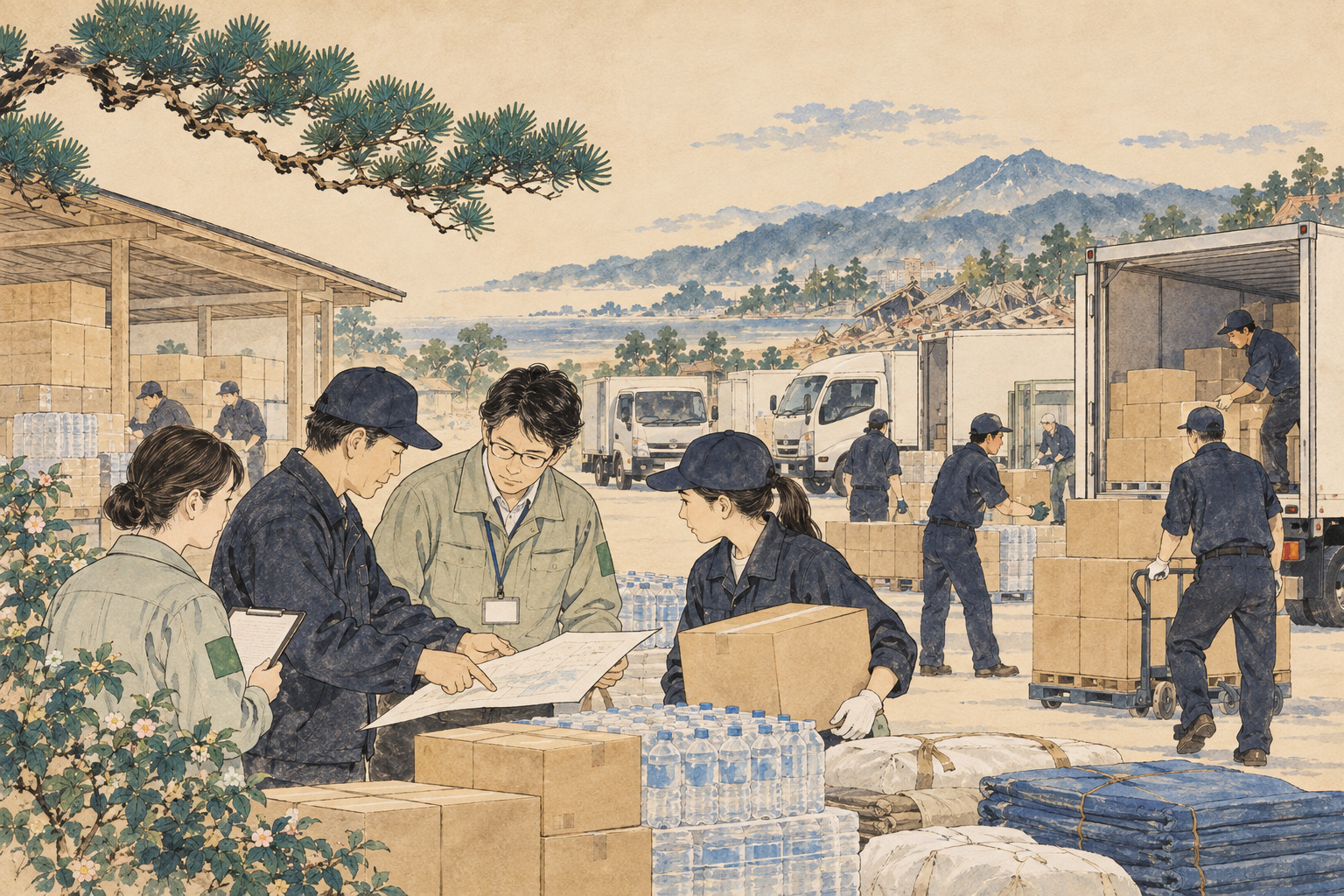
A disaster can create two very different shortages. The first is obvious: there are not enough supplies. The second is more frustrating: food, blankets and hygiene goods exist somewhere in the system, but the system cannot move the right boxes from a logistics hub to the shelter that needs them. Trucks arrive, but nobody has designed the unloading area. Pallets are buried behind other pallets. The road is blocked. A shelter that needed blankets yesterday needs adult diapers today. The last few kilometers determine whether “relief supplies” become actual relief.
On September 18, Kawasaki City signed an agreement with Yamato Transport's Kawasaki branch covering the receipt, handling and delivery of emergency supplies during a major disaster. The arrangement allows the city to request far more than trucks: Yamato may help operate supply hubs, design delivery plans, load and sort goods, provide workers and equipment, dispatch logistics advisers and deliver supplies from concentration warehouses and transfer points to shelters. [1][2]
The agreement was signed by Kawasaki Mayor Norihiko Fukuda and Shinichi Akatsuka, head of Yamato Transport's Kawasaki branch. Despite its name, the branch is located just outside Kawasaki in Anzencho, Tsurumi Ward, Yokohama. [2]
This is not simply an agreement to dispatch trucks
The full agreement lists a broad operating role. Kawasaki may ask Yamato to: manage and operate material collection and transport bases; create delivery plans and execute delivery; collect evacuee supply needs and observe their day-to-day condition during deliveries; carry out loading and sorting at logistics hubs; provide personnel and material-handling equipment; dispatch logistics advisers; and perform other mutually agreed tasks. [2]
| Agreement function | Operational meaning |
|---|---|
| Manage supply hubs | Receive, unload, sort, register, allocate and reload incoming relief goods. |
| Plan and execute delivery | Decide what goes from concentration warehouses or transfer hubs to each shelter and in what sequence. |
| Collect needs and observe conditions | Use repeat deliveries to learn what shelters are missing and report changes from the field. |
| Loading, labor and equipment | Provide skills and resources that municipal staff may not have at scale. |
| Logistics advice | Bring commercial expertise in layout, inventory flow, staging and routes. |
One of the most distinctive clauses goes beyond logistics in the narrow sense: during deliveries, Yamato can be asked to collect evacuees' material needs and confirm their ordinary day-to-day condition. A delivery driver who repeatedly visits the same shelter can become part of a feedback loop—water is sufficient, but infant supplies are running low; blankets are no longer the priority, but hygiene goods are. [2]
That wording should not be inflated into a medical or professional welfare-monitoring service. The agreement concerns observations and supply needs encountered through delivery. It does not assign Yamato personnel responsibility for diagnosis, health assessment or specialist care.
Kawasaki had already written the “last-mile failure” into a 2023 manual
The new agreement has a policy foundation. In March 2023, Kawasaki issued a detailed framework and manual for receiving disaster-relief supplies. It begins with a lesson from previous Japanese disasters: relief goods from governments, businesses and other donors accumulated at public logistics bases, while municipal staff struggled with receipt, inventory, management and transport, making smooth movement from the hub to shelters difficult. [3]
Kawasaki's manual explicitly says the city cannot realize smooth emergency logistics on its own and should build cooperation with the national government, Kanagawa Prefecture, related organizations and private companies. It also calls for effective use of private-sector logistics processes. The Yamato agreement turns that general policy into a standing relationship with a specific logistics operator. [3]
The city plans around supplies for 240,000 people
Kawasaki had an estimated population of 1,567,496 on July 1, 2026, living across seven wards in 144.35 square kilometers. Its logistics manual does not assume the entire population will enter shelters. For national push-type support in a major Tokyo-area earthquake, however, it plans around relief quantities for a combined 240,000 shelter and non-shelter evacuees. [3][5][6]
Moving supplies at that scale is warehouse work as much as emergency management. Kawasaki's manual goes into details familiar to commercial logistics: separate inbound and outbound areas, sort pallets by destination shelter, keep frequently shipped goods accessible, leave forklift and roll-cage routes open, label storage zones clearly and avoid stacking pallets more than two high. [3]
The categories include food, water, infant and elderly care products, sanitary supplies, portable toilets, clothing, cold-weather items and other daily necessities. The operational problem is not only volume but variety.
The logistics model changes after day three and again after day seven
Kawasaki divides disaster supply operations into three broad phases. The days are guideposts, not hard deadlines. [3]
Phase I | Disaster to roughly day 3 — Use household stocks, municipal distributed and concentrated reserves, and commercial inventory available under agreements; prepare hubs and transport for incoming national push support.
Phase II | Roughly days 3–7 — Receive push-type supplies sent through prefectural channels and move them from local transport hubs to shelters; begin building a more specific picture of demand.
Phase III | Roughly day 7 onward — Shift toward pull-type support based on what shelters actually need; procure and request specific goods and allow either hub-based or direct business-to-shelter delivery.
This is where Yamato's field feedback becomes important. Early in a major disaster, authorities may have to send food, blankets and toilets before local needs are fully known. A week later, continuing to send the same standard mix can fill warehouses with low-priority goods while specific shortages persist. Delivery data can help the system move from “send what is probably necessary” to “send what this shelter now says it needs.” [2][3]
Kumamoto showed what happens when relief goods concentrate at the wrong level
Yamato has a long disaster-logistics history. Its corporate centennial history recounts that after the 2016 Kumamoto earthquakes, relief goods concentrated at the prefectural government office, creating operational confusion. Yamato proposed transport support and drew on a process used after the Great East Japan Earthquake that matched lists of what had been sent with lists of what the disaster area needed. [11]
Following the 2011 earthquake and tsunami, Yamato's own annual reporting says it created dedicated operations in Iwate, Miyagi and Fukushima to move supplies from disaster-area logistics bases to shelters, with a maximum operating structure of about 200 trucks and 500 people. [12]
The lesson is more sophisticated than “parcel companies own vehicles.” Large relief trucks can reach a prefectural depot, but goods then have to be broken into smaller shelter-specific loads, routed around damage and delivered on vehicles suited to the final road network. Those tasks resemble commercial parcel logistics running under extreme conditions.
In 2015, Yamato and Amazon built a “what people actually need” model in Tokushima
Yamato's 2015 agreement with Tokushima Prefecture and Amazon offers an earlier version of demand-driven disaster supply. Shelter needs could be placed on Amazon wish lists; purchased goods would leave Amazon's fulfillment centers, and Yamato would deliver them to prefectural supply hubs or shelters. [15]
The plan also considered network resilience. Yamato proposed using facilities in Tokushima and neighboring Kagawa that were less exposed to tsunami damage as substitute terminals and routing nationwide goods through Kansai and Chugoku terminals before entering Shikoku. [15]
The core idea is the same as the new Kawasaki agreement: relief is not only procurement. Needs, inventory, staging, route choice and destination have to be designed as one logistics system.
Noto again exposed the importance of the municipal “last mile”
After the 2024 Noto Peninsula earthquake, the national government used push-type support to send food, water, sanitation goods and other necessities without waiting for detailed requests from affected municipalities. MLIT describes a chain of first-stage transport to the prefectural hub, second-stage transport to municipal hubs, and coordination for reliable “third-stage,” or last-mile, delivery from municipal hubs to individual shelters. [8]
The distinction matters. A shipment recorded as delivered to a prefecture has not yet helped a person in an isolated shelter. If the municipal hub cannot unload, sort or dispatch it, relief accumulates. The Ministry of Land, Infrastructure, Transport and Tourism developed its municipal last-mile logistics and hub-operation handbook after problems highlighted by the 2016 Kumamoto earthquakes and has continued updating it. [7][8]
Yamato can also be a disaster victim
There is an important realism built into the Kawasaki agreement. Yamato is required to cooperate “to the extent possible,” but the agreement explicitly exempts situations in which Yamato itself judges support difficult because it has been affected by the disaster. [2]
That is not a weakness; it is an acknowledgment of physical reality. Roads can fail, fuel can become scarce, terminals can be damaged and drivers can be evacuees themselves. After the 2024 Noto earthquake, multiple Yamato depots were affected. When Japan Post's Anamizu Post Office suffered major damage, Japan Post and Yamato jointly used Yamato's Noto sales office and began shared parcel transport as services were restored. [14]
In August 2026, following the Kumamoto earthquake, Yamato again said it was working with MLIT and Kumamoto Prefecture on public relief-goods transport and operation of relief-supply collection sites. Kawasaki signed its agreement only weeks later. [13]
Why an everyday parcel network is useful during a disaster
A parcel operator already solves a difficult problem every day: thousands of items with different sizes, times and destinations arrive at hubs, are sorted, assigned to routes and delivered to individual addresses. That is close to the challenge of moving mixed relief goods from a hub to many shelters—except roads, power and communications may be degraded.
Yamato Holdings says its disaster-preparedness activities with municipalities include supply transport and hub operation, and in some areas also involve routine management of emergency stockpiles, expiration dates and equipment checks before a disaster occurs. [10]
The capability therefore lies not only in fleet size. It includes inventory visibility, sorting discipline, facility layout, route design, terminal networks and on-the-ground operational judgment.
Kawasaki does not rely on one permanently designated mega-hub
Kawasaki's regional disaster plan says local supply transport bases are not permanently fixed to one facility. Because usable conditions will differ by disaster, the city selects from candidate facilities based on road conditions, building damage and operating constraints. The same flexible approach applies to temporary storage sites for surplus goods. [4]
That flexibility can be valuable, but it means every activated facility may need to be converted rapidly into a working logistics site: where trucks enter, where forklifts move, where shelter-specific pallets are staged, and where outbound loading occurs. A commercial logistics operator's hub-management knowledge becomes particularly relevant in that scenario.
This is not an agreement for unlimited free corporate charity
The contract has a financial mechanism. Kawasaki bears the costs of work Yamato performs at the city's request under the agreement. Unless another law or rule sets the amount, the parties determine the expense through consultation, and the city pays after receiving a valid invoice. [2]
That provision is operationally important. Sustained deployment of trucks, fuel, people, forklifts and hub personnel costs money. Defining cost responsibility before the disaster can reduce the need to negotiate basic commercial terms during the emergency itself.
Japan is also trying to digitize the relief-supply chain
The Cabinet Office has operated a national system for sharing procurement and transport information between national and local governments. The 2026 disaster white paper says the government has been designing and developing a new system, B-PLo, that retains existing functions while improving visibility and usability for officials who are not specialists in relief logistics. [9]
But digital and physical logistics are inseparable. A screen can say “send 30 boxes of adult diapers to Shelter A.” If nobody can locate the boxes, load a truck or drive the route, the data is meaningless. The opposite is also true: trucks can move efficiently but still waste trips if inventory and shelter needs are not shared.
Field observation could turn the last mile into an information network
Perhaps the most forward-looking part of the Kawasaki agreement is the idea that delivery vehicles can carry information back as well as supplies outward. A driver visiting shelters repeatedly may notice changing demand, unusual shortages or signs that the daily situation is deteriorating.
The public agreement does not, however, define a detailed protocol for what “confirming the daily condition of evacuees” means, what information should be reported, how personally sensitive information should be handled, or which standardized form should be used. The contract includes confidentiality obligations, but public materials do not provide a complete privacy or field-reporting procedure for this function. [2]
That makes training important. Collect too much and drivers become overloaded while privacy risk rises. Collect too little and the feedback cannot help the city move toward demand-driven support.
The agreement lasts one year—but renews automatically
The contract took effect on September 18, 2026 for one year. Unless either side gives written notice of termination before expiry, it renews for another year, and continues on the same basis thereafter. The parties are also required to designate responsible departments and contact persons and to notify each other when those contacts change. Confidentiality continues even after the work or agreement ends. [2]
A signed document alone does not create readiness. The practical questions have to be exercised: Who makes the request at 2 a.m.? Can Yamato's trucks actually enter each candidate hub? How quickly can material-handling equipment arrive? What happens if mobile networks fail? Agreement maintenance and joint drills will determine whether the paper works under stress.
What remains undisclosed
The public materials do not specify how many trucks or drivers Yamato would reserve for Kawasaki, how many forklifts or roll cages could be supplied, hub-by-hub staffing plans, target mobilization time after a city request, maximum daily delivery capacity, unit pricing, substitute depots, fuel-contingency arrangements, joint-drill frequency or performance indicators.
The agreement also does not make Yamato the exclusive or guaranteed distributor for every Kawasaki shelter. The city still needs a layered response involving government agencies, other carriers, trucking organizations, the Self-Defense Forces and community actors as conditions require. Yamato's ability to support the city will depend on the condition of its own network. [2][3]
Calling the logistics company after the earthquake is too late
Kawasaki is a city of more than 1.5 million people whose planning model assumes national push supplies for 240,000 evacuees. If officials wait until after a major earthquake to ask a logistics company how to sort thousands of boxes or route dozens of shelters, the delay is already built into the response.
The importance of the September agreement is not that it privatizes municipal disaster response. It connects two systems in advance: the city has emergency authority, shelter information and public stockpiles; Yamato has hub operations, material handling, delivery planning, vehicles and street-level logistics knowledge.
In the first days of a disaster, the job is to deliver what is available. Soon afterward, the job becomes delivering what is actually needed. A strong last mile does both—and brings information back on the return trip. That feedback loop, more than the number of trucks deployed, will determine whether Kawasaki's new partnership works when the city needs it most.
Sources & documents
- Kawasaki City: Agreement with Yamato Transport on receipt and delivery of disaster-relief supplies (Sept. 18, 2026)
- Kawasaki City: Full disaster-relief logistics agreement and press materials (PDF, Japanese)
- Kawasaki City: Disaster-relief supply reception framework and logistics manual (March 2023, Japanese)
- Kawasaki City: Regional Disaster Prevention Plan, earthquake measures
- Kawasaki City: Population and households as of July 1, 2026
- Kawasaki City: Area and seven wards
- Ministry of Land, Infrastructure, Transport and Tourism: Last-mile disaster-relief logistics handbook
- MLIT: Logistics and supply support following the 2024 Noto Peninsula earthquake
- Cabinet Office: 2026 White Paper—disaster supply procurement and transport systems, including B-PLo
- Yamato Holdings: Disaster-prevention and emergency-support activities
- Yamato Group 100th anniversary history: Relief-goods transport after the 2016 Kumamoto earthquakes
- Yamato Holdings: 2011 integrated report, Great East Japan Earthquake relief logistics
- Yamato Transport: Support following the 2026 Kumamoto earthquake (Aug. 25, 2026)
- Yamato/Japan Post: Joint use of facilities and parcel transport after the Noto Peninsula earthquake (Jan. 18, 2024)
- Yamato Holdings: Tokushima-Amazon-Yamato disaster-supply transport agreement (2015)