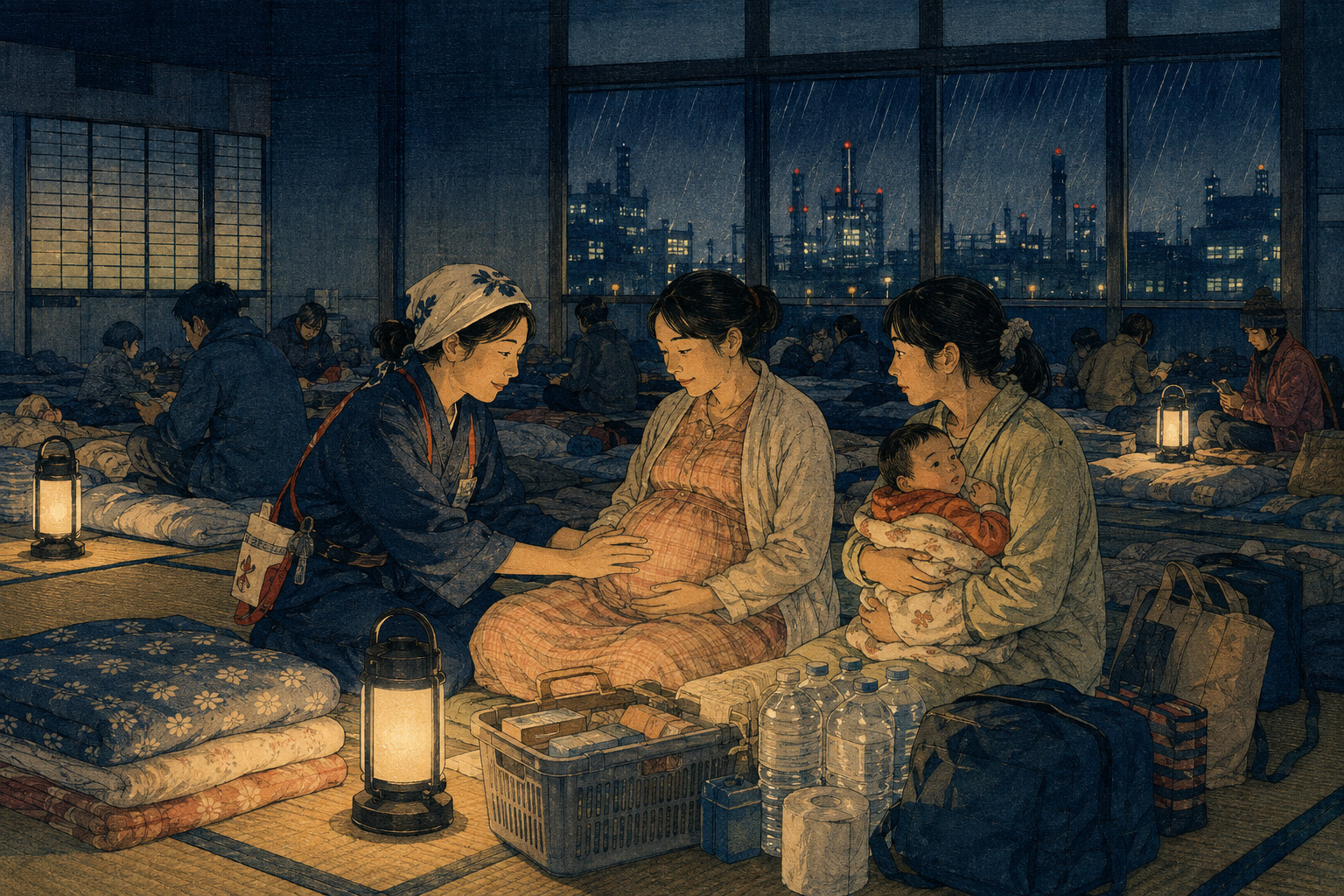
A family reaches a school gymnasium, receives blankets and finds drinking water. On an evacuation ledger, the job may appear complete. But the questions that determine safety have barely begun. How far along is the pregnancy? Is the planned maternity hospital operating? Is a new mother bleeding or in pain? Is an infant feeding normally? Is there clean water to prepare formula?
Kawasaki City and the Kawasaki City Midwives Association, a general incorporated association, signed an agreement on August 27 to support pregnant and postpartum women and infants during major disasters. When the city decides that support is necessary, it is to request the association’s cooperation and coordinate the response. The association is then to dispatch midwives for health consultations and physical and psychological care.
The official announcement identifies three services: a disaster telephone consultation desk, health consultations by dispatched midwives, and overnight disaster care for postpartum women. The signing was attended by Jun Inoue, director-general of Kawasaki’s Children and Future Bureau, and association president Tomiko Okamoto. The city lists 55 association members.
Three doors into three different problems
The telephone service could reach people who never enter a shelter. A national manual hosted by the Ministry of Health, Labour and Welfare warns shelter managers that pregnant women and families with infants may avoid shelters and remain at home or in cars. A building can survive while power, water, roads, clinics and ordinary support networks fail around it. Early telephone reports can guide an individual caller and reveal where needs are accumulating.
A deployed midwife changes the question from a generic “Are you all right?” to an assessment grounded in gestational age, days since delivery, the maternal and child health handbook, symptoms, infant feeding and available maternity care. The national manual tells shelter managers to record pregnancy information and assess food, water, electricity, toilets, sleep, family accompaniment, and the presence of obstetricians or midwives. It says pregnant women and mothers can find it difficult to speak up and recommends individual checks for needs they may be enduring silently.
Overnight care closes a different gap. The Kawasaki document specifically says it is for sanpu—women who have given birth—not a general lodging program for all pregnant women. A patient may be medically ready to leave hospital but have only a crowded shelter, a waterless home or an unheated room to return to. After the 2024 Noto Peninsula earthquake, the Children and Families Agency instructed local governments to consider postpartum-care stays and, when necessary, extend them so affected mothers had a stable environment for roughly the first month after birth.
| Service | What is confirmed | What it can do | What remains unpublished |
|---|---|---|---|
| Telephone desk | To open during disasters | Offer an entry point for triage, referrals and needs mapping, including outside shelters | Number, hours, languages, capacity, publicity and backup communications |
| Midwife dispatch | On city request, for health consultation and physical and psychological care | Assess maternal and infant needs and connect people to appropriate support | Staffing, locations, shifts, transport, equipment and responder safety |
| Overnight disaster care | Named specifically for postpartum women | Provide a stable place after discharge when ordinary living conditions have failed | Facilities, beds, infant accompaniment, duration, fees, infection control and medical links |
| Activation | The city determines need, requests cooperation and coordinates | Places voluntary professional help inside an official response channel | Trigger, decision authority, response-time target and ending criteria |
Different support is not preferential treatment
Labeling every pregnant woman and infant “vulnerable” does not produce a workable plan. They are not all ill, and they do not all need evacuation to a hospital. But pregnancy and postpartum changes may not be visible, infants cannot report symptoms, and disruption can remove access to checkups, feeding supplies, medication and family support at once. A useful system must distinguish who can remain safely in a general shelter, who needs a more suitable place and who requires urgent medical care.
The environment is part of that assessment. Privacy for breastfeeding, clean water, a place to prepare formula or complementary food, diaper changing, handwashing, temperature control, sleep and infection prevention are not decorative amenities. The health ministry advises that powdered formula be prepared with hygienic water and offers alternatives when bottles cannot be sterilized. It also directs families to seek public-health help when pregnancy or infant health checks and other maternal services are disrupted.
The Cabinet Office’s disaster-response guidance has pressed municipalities to plan for lactation rooms, privacy, simple cooking facilities for formula and infant food, and accessible consultation channels. Equal safety does not always come from handing every evacuee the same blanket and the same square of floor. It can require a different space, information route or professional assessment.
Japan’s disaster system learned coordination one failure at a time
Kawasaki’s agreement belongs to a longer institutional history. Each major disaster exposed a different break in the chain between information, medical capacity and the people who needed it.
1995 — After the Great Hanshin-Awaji Earthquake, Japan developed disaster base hospitals, Disaster Medical Assistance Teams and the Emergency Medical Information System.
2006 — The Japanese Midwives Association published a manual for disaster support by midwives.
2011 — Following the Great East Japan Earthquake, the association coordinated supplies, volunteers and care through birth centers. A public-health nurse from Onagawa later wrote that teams had to revisit shelters repeatedly to identify pregnant evacuees.
2014–16 — The national government began training disaster medical coordinators, then pediatric and perinatal disaster liaisons to connect those specialties with the wider disaster-medical command.
2020–21 — Work by Kanagawa Prefecture, Showa University and the Kanagawa Midwives Association produced a system of cooperating disaster midwives and a prefectural dispatch agreement.
2023–26 — Municipal agreements followed in Zushi and Kamakura; Kawasaki signed its agreement in August 2026.
The prefectural pediatric and perinatal liaison works at the medical-coordination level: gathering information, advising the health emergency headquarters and helping align teams and transport. Kawasaki’s midwife agreement operates closer to the household: receiving concerns, placing a professional at a shelter or other site, and supporting daily maternal and infant health. Neither replaces the other. The local layer works only if it can hand urgent cases and reliable information to public-health, obstetric, pediatric, ambulance and prefectural systems.
Noto’s lesson entered Kawasaki’s own disaster plan
In its 2026 revision to the municipal disaster plan, Kawasaki cited problems exposed by the Noto Peninsula earthquake. It strengthened its approach to safe, sanitary toilets and added a commitment to incorporate the perspectives of people requiring particular consideration, including older residents, disabled people, foreign residents, infants, pregnant women and sexual minorities.
Maternal and infant support is not marginal in a city of Kawasaki’s scale. Its estimated population was 1,567,324 on August 1, 2026. The city counted 10,395 births in 2025. Births have declined from 15,015 in 2015, but roughly 10,000 infants and postpartum families still enter the local support system each year.
In ordinary times, Kawasaki commissions postpartum care from hospitals, midwifery practices and home-visiting providers, while the city midwives association coordinates bookings among cooperating practices. That existing relationship may provide familiarity, contacts and experience on which to build an emergency service. It does not prove disaster capacity. The city has not said that the usual facilities or their vacant beds automatically become the overnight disaster program.
Seven questions between a signed agreement and a functioning service
A formal agreement matters. It identifies parties and prevents responders from inventing a chain of command after roads and communications have failed. Its value in the first 72 hours, however, will be determined by operational work done beforehand.
- Which hazards and impacts activate the services, and who makes the decision?
- How will the telephone service continue through outages and network congestion?
- How many of 55 members can respond, after securing their own families and workplaces, and where can they travel?
- How will the city find mothers and infants staying in homes, cars, hotels or relatives’ houses?
- After a risk is identified, which maternity or pediatric service and transport route receives the case?
- Where are overnight beds, with what supplies, fees, infant-accompaniment rules and infection controls?
- How will consultation, dispatch and lodging records reach the disaster headquarters without compromising privacy?
Staffing is the first trap. Midwives are also residents and employees; they may be injured, caring for relatives or needed at their primary workplace. The Kanagawa association’s cooperating-midwife system explicitly says participation in support activity is voluntary. A plan cannot convert a membership roster into an emergency workforce. It needs rapid welfare checks, availability reporting, safe transport, shifts, rest, replacement and compensation.
A telephone desk also requires more than a working number. Operators need a structured assessment, clear thresholds for escalation, language and hearing access, backup communications, and a path for aggregated information to influence shelter operations. Dispatching a midwife is not the endpoint. The purpose is to connect an informed judgment to the next service.
What families can prepare—and what government must not transfer to them
Kawasaki advises pregnant women and families with infants to review the disaster pages in the maternal and child health handbook and use the Kanagawa Midwives Association’s Disaster Preparedness Compass for Parents and Children. The city’s disaster app shows flood, landslide, tsunami and inland-flood hazards as well as shelter openings. Families can keep the handbook, medicines, contact details, feeding supplies appropriate to their infant, diapers, hygiene items, clothing and seasonal temperature protection ready to carry.
Individual preparation cannot supply the missing service design. The city must make the activation route known before a disaster, exercise it with shelter managers, midwives, public-health nurses, doctors and emergency services, and publish what the exercise found. Pregnant and postpartum residents should participate as evaluators, not as props in a drill.
The August 27 agreement is important because Kawasaki has formally acknowledged that the standard shelter response can miss maternal and infant needs. The next step is to show who will deliver each service, when, where and at what capacity. In a disaster, silence does not make a symptom smaller. The system has to go looking for the person who cannot raise her voice.
- Kawasaki City — Disaster-support agreement with the Kawasaki City Midwives Association, August 27, 2026
- Kawasaki City — Official agreement summary, roles and signing details
- Kawasaki City — Disaster preparation for households with pregnant women and infants
- Kawasaki City — Summary of 2026 disaster-plan revisions
- Kawasaki City — Population and households on August 1, 2026
- Kawasaki City — 2025 population dynamics and births
- Ministry of Health, Labour and Welfare — Information-sharing manual for pregnant women in shelters
- Ministry of Health, Labour and Welfare — Protecting health in disaster areas
- Ministry of Health, Labour and Welfare — Pediatric and perinatal disaster liaison guidelines
- Children and Families Agency — Stable accommodation and perinatal support after the Noto earthquake
- Cabinet Office Gender Equality Bureau — Women’s perspectives for stronger disaster response
- Kanagawa Midwives Association — Disaster policy and cooperating-midwife system
- Japanese Midwives Association — Organizational history and disaster activity