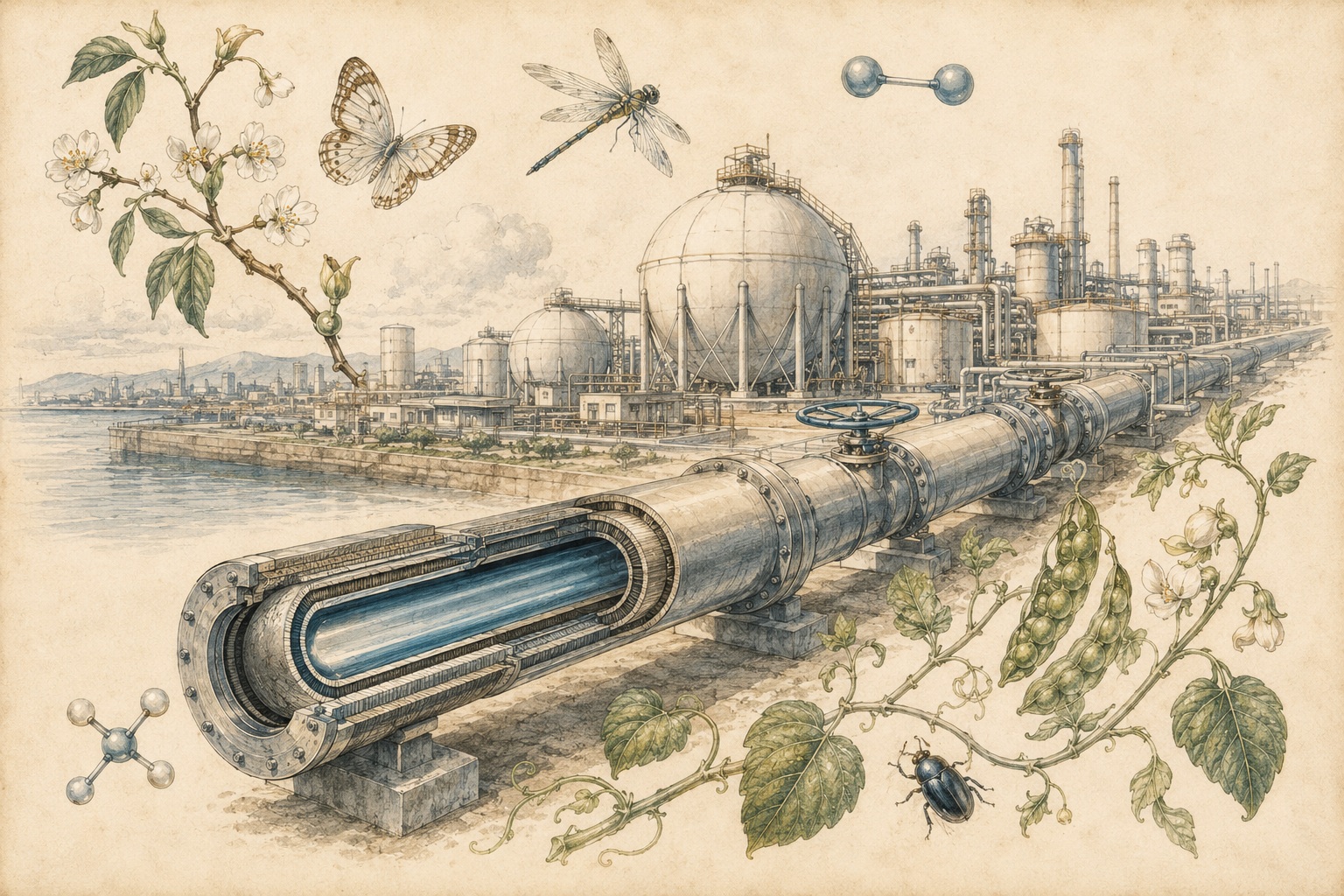
A four-kilometer steel pipe beneath or across Kawasaki’s waterfront will never photograph as dramatically as a giant hydrogen carrier. It will not loom over the skyline like a 50,000-cubic-meter cryogenic storage tank. Yet if Japan is serious about turning hydrogen from a demonstration fuel into an energy industry, the pipe may be one of the most consequential pieces of equipment in the entire system. Ships can bring hydrogen to Japan. Tanks can hold it. Pipelines are what allow an industrial district to treat it as something that simply arrives.
On July 13, 2026, Japan Suiso Energy and JFE Engineering announced the EPC contract for an approximately four-kilometer high-pressure hydrogen pipeline in the Kawasaki coastal area. JFE Engineering will handle engineering, procurement of materials and equipment, and construction as an integrated package. Four kilometers sounds modest. But the line has been designed around two very different operating eras.
During the demonstration, domestically produced hydrogen will flow toward JSE’s Kawasaki LH₂ Terminal on Ogishima. There it will be cooled to minus 253 degrees Celsius and liquefied. After the demonstration, the intended commercial logic reverses: liquid hydrogen arriving from overseas will be received and stored at the terminal, vaporized back into gas and sent outward through the pipeline to consumers in the coastal industrial district.
That makes the line more than plumbing for a terminal. Its changing role captures Japan’s transition from asking whether hydrogen can be produced, liquefied and moved, to asking whether industrial customers can receive dependable volumes every day. In that sense, Kawasaki’s four kilometers mark the point where hydrogen policy begins to resemble ordinary infrastructure policy.
What “Japan’s first” means—and what it does not
There is an important distinction in the phrase “Japan’s first.” It would be inaccurate to call this Japan’s first hydrogen pipeline of any kind. Kawasaki City itself notes that industrial infrastructure already exists in the coastal area for moving hydrogen efficiently between companies. Japan also tested hydrogen-pipeline distribution in projects such as the Kitakyushu Hydrogen Town more than a decade ago.
JSE and JFE Engineering make a narrower and more significant claim: this is the first high-pressure hydrogen pipeline in Japan intended for bulk hydrogen transport. Its purpose is different from a plant pipe, a short industrial interconnection or a neighborhood demonstration. It is being designed as a trunk link for a future system in which large volumes of hydrogen could be distributed among multiple industrial consumers.
The difference is similar to the difference between plumbing inside a building and a transmission main connecting a reservoir to a city. A hydrogen economy does not become an economy because one machine can burn or consume hydrogen. It begins to become an economy when users can assume the fuel will be available without arranging a special delivery every time.
Into the terminal first, out of the terminal later
The most unusual part of the Kawasaki plan is the way the pipeline’s job changes between demonstration and commercialization. JSE originally expected the large-scale demonstration to source hydrogen from overseas. That plan changed in FY2024. For the demonstration through FY2030, JSE now plans to procure gaseous hydrogen produced in Japan.
That domestic gas will be delivered through the new pipeline to the Kawasaki LH₂ Terminal. The terminal will cool the hydrogen to minus 253°C. JSE says liquefaction reduces its volume to roughly one eight-hundredth of the gas, making large-scale storage and maritime transport possible. The liquid hydrogen can then be stored in a 50,000 m³ tank and loaded onto a 40,000 m³-class carrier for ship-to-shore handling tests and ocean-going demonstrations under conditions intended to simulate international transport.
Commercial operation after 2030 is intended to turn the chain around. Hydrogen produced overseas would be liquefied, shipped to Ogishima, unloaded into the Kawasaki terminal and stored. It would then be vaporized and distributed by pipeline to industrial customers in the Kawasaki coastal area, where the hydrogen could be converted into electricity, steam or process heat or used in other industrial applications.
| Stage | Hydrogen flow | Pipeline function |
|---|---|---|
| Commercialization demonstration through FY2030 | Domestic hydrogen → Kawasaki LH₂ Terminal → liquefaction → ship | An inlet feeding hydrogen into the terminal |
| Post-demonstration commercialization | Imported liquid hydrogen → terminal → vaporization → industrial users | An outlet distributing hydrogen from the terminal |
Ogishima: from blast-furnace island to hydrogen gateway
The location gives the project historical weight. The Kawasaki LH₂ Terminal is being built on Ogishima, where a large-scale transition is under way following the suspension of major blast-furnace operations at JFE Steel’s Keihin district. Kawasaki City and the JFE group have been planning the redevelopment of the enormous industrial landholding, with the leading redevelopment area explicitly including a carbon-neutral energy zone.
The wider Kawasaki waterfront was created roughly a century ago through reclamation and industrial development associated with entrepreneurs including Soichiro Asano. After the Second World War it became a core of the Keihin Industrial Zone, concentrating oil refining, steel, power generation, chemicals and logistics. The value of a petrochemical and steel complex was never merely that many factories occupied adjacent lots. Pipes, steam, gases, electricity, raw materials and by-products could be exchanged across company boundaries.
That industrial metabolism is unusually well suited to hydrogen. Large-scale hydrogen is easier to justify where major power stations, refineries, chemical plants and logistics facilities sit close together. Kawasaki created a hydrogen-network council in 2013 and adopted a city hydrogen strategy in 2015 because it already had industrial hydrogen production, consumption, handling expertise and inter-company infrastructure.
For decades, Ogishima received coal and iron ore by ship and fed them into a steelmaking system that supplied material to Japan. If the new system succeeds, the island could receive liquid hydrogen by ship and feed it into an energy network that supplies electricity, steam and industrial heat. The cargo changes; the strategic geography remains.
A 50,000 m³ tank, a 40,000 m³ ship and a four-kilometer line must work as one machine
Hydrogen supply chains are unforgiving because no single impressive asset creates a functioning market. JSE’s Kawasaki LH₂ Terminal is planned with a 50,000 m³ liquid-hydrogen storage tank, marine loading and unloading facilities, hydrogen liquefaction equipment, gaseous-hydrogen send-out systems and liquid-hydrogen tanker-truck loading facilities. Construction began in 2025, with the project intended to verify the requirements of commercial-scale operation through FY2030.
At sea, JSE and Kawasaki Heavy Industries signed a shipbuilding contract in January 2026 for a 40,000 m³ liquefied-hydrogen carrier. Kawasaki Heavy’s earlier demonstration vessel, Suiso Frontier, carried a 1,250 m³ tank. The new ship therefore represents a 32-fold increase in cargo-tank volume. It is about 250 meters long and 35 meters wide, using high-performance insulation, vacuum-jacketed transfer piping and systems that can use hydrogen boil-off gas as fuel.
Now the land side gains the high-pressure pipeline. Ship, tank, liquefier, vaporizer, pipeline and end-use equipment all have to operate at compatible rates. A failure or bottleneck in any one of them can stop the chain. Hydrogen commercialization is therefore less about discovering a new molecule than about coordinating a collection of enormous machines.
- Kawasaki LH₂ Terminal: Under construction on Ogishima with a 50,000 m³ storage tank plus liquefaction, send-out, marine handling and truck-loading functions.
- 40,000 m³ carrier: Being built by Kawasaki Heavy Industries for JSE, with demonstration work planned through FY2030.
- Approximately four-kilometer high-pressure pipeline: EPC by JFE Engineering; feeds the terminal during the demonstration and is intended to distribute hydrogen from it in commercialization.
- Industrial demand: Power, steam, heat and other industrial uses in the Kawasaki coastal cluster.
Why not just keep delivering hydrogen by truck?
Compressed-gas tube trailers and liquid-hydrogen tankers are indispensable in early hydrogen markets. They are flexible when demand is small and dispersed. But once the same industrial cluster needs tens or eventually hundreds of tonnes every day, road logistics become a constraint: more vehicles, more drivers, more transfer operations, more compression capacity and more exposure to traffic and delivery interruptions.
The United States already operates roughly 1,600 miles, or about 2,575 kilometers, of dedicated hydrogen pipelines, primarily serving refineries and chemical facilities. The International Energy Agency notes that pipelines can be the least-cost transport option for pure hydrogen where volumes are high and utilization is strong. Globally, moving hydrogen through pipes is not experimental technology.
Japan’s problem has been scale and demand concentration. A company will hesitate to build an expensive trunk pipeline without customers committed to using it; customers hesitate to invest in hydrogen equipment without confidence that cheap hydrogen will arrive. Government support for terminals, pipelines and large hydrogen users is intended to break that classic chicken-and-egg problem.
The molecule is small; the engineering problem is not
Natural-gas pipeline engineering cannot simply be copied line for line. Hydrogen molecules are small, making leak control around joints, seals, valves and instruments particularly important. Under certain conditions hydrogen can also enter metals and reduce ductility or fracture toughness, a family of effects usually discussed under hydrogen embrittlement.
Higher pressures make material selection, weld integrity, fatigue and crack-growth behavior still more consequential. Japan adds another design requirement that countries with different geology may treat less severely: earthquakes. A hydrogen transmission line must maintain integrity not only under pressure cycles but under ground movement and seismic loading.
That is why the standards are evolving alongside the infrastructure. NEDO launched a FY2025–FY2027 research program specifically aimed at domestic standardization for buried high-pressure hydrogen pipelines, gathering hydrogen-environment data for pipe materials and welds, studying fracture mechanisms and incorporating seismic design. METI has also been studying technical issues around high-pressure hydrogen distribution as part of the broader hydrogen-safety framework.
Kawasaki is therefore not merely a construction project built under a finished rulebook. It is part of the process by which Japan is creating the material, design, seismic and safety evidence that could govern later networks.
“Capable of one million tonnes” is a design statement, not a demand contract
The July release contains an arresting figure: the pipeline is designed with future expansion in mind and can accommodate hydrogen demand on a scale of up to one million tonnes per year. That should not be read as evidence that Kawasaki already has contracts for one million tonnes of annual consumption.
It is a statement about future capacity. The scale is nevertheless strategically important. NEDO’s Green Innovation Fund project uses an assumption of one million tonnes of hydrogen supplied through international supply chains in 2030 when estimating potential market impacts, while Japan’s national strategy has contemplated hydrogen and derivative-fuel supply on a several-million-tonne scale by that date.
The message is that JSE and JFE Engineering do not want the four-kilometer line to become an undersized demonstration pipe that must be replaced just as demand begins to grow. Whether the capacity is ever filled will depend on power generators, chemical producers, steelmakers, logistics operators and other users committing to hydrogen—and on the price they are asked to pay.
The 30-yen barrier: a pipeline only matters if affordable hydrogen flows through it
NEDO’s large-scale hydrogen-supply-chain program targets a hydrogen supply cost of 30 yen per normal cubic meter in 2030 and 20 yen or less in 2050. JSE says its commercialization demonstration is intended in part to test the feasibility of reaching the 2030 target at shipboard delivery.
But a shipboard price is not the customer’s delivered price. Liquefaction, storage, terminal capital, vaporization, compression, pipeline construction, inspection, safety systems, labor and financing all add cost. Even cheap hydrogen at the berth can become expensive hydrogen at the burner if downstream infrastructure is poorly utilized.
This makes a pipeline a utilization business. When large volumes flow every day, fixed costs can be spread over more kilograms. When an expensive line is nearly empty, it becomes an extraordinarily costly transport asset. Kawasaki’s success will ultimately be measured not by kilometers installed but by throughput.
Measure carbon, not the color label
Hydrogen produces no carbon dioxide at the point where it is consumed, but its upstream emissions depend on how it was produced. Electrolysis using renewable electricity, fossil-fuel reforming with carbon capture, biomass and other routes can carry very different lifecycle emissions.
JSE’s project changed from its original plan to use hydrogen sourced from Australian brown coal during the demonstration. Through FY2030 it plans to use hydrogen produced in Japan. After commercialization it intends to receive liquid hydrogen from overseas, but the climate value of that imported fuel will depend on production method, electricity source, capture rates where applicable, liquefaction energy and shipping emissions.
A steel pipeline has no way to distinguish one hydrogen molecule from another. That means certification and carbon accounting become infrastructure too. “Hydrogen is flowing” and “emissions are falling” cannot be treated as interchangeable statements.
The world is moving toward hydrogen networks; Japan is starting with port clusters
Globally, hydrogen pipeline announcements are accelerating. The IEA’s 2026 assessment says announced new and repurposed hydrogen pipeline projects exceed 40,000 kilometers by 2035, although only a small share is already operating or backed by committed investment. Europe is developing regional backbones using both new pipes and repurposed gas infrastructure, while China has begun major long-distance projects.
Japan is unlikely to begin with a single national trunk line. A port-industrial cluster such as Kawasaki offers a more practical starting point: an import terminal, concentrated demand, existing pipeline culture, heavy-industry expertise, available redevelopment land and nearby power and industrial users. A four-kilometer line can therefore be a compact laboratory for the commercial, safety and regulatory problems that would become much larger on a national network.
Kawasaki has rebuilt its energy gateway before
Viewed through the history of the waterfront, the hydrogen pipeline is less alien than it first appears. For a century Kawasaki has built systems to receive energy and raw materials from elsewhere, transform them and distribute the result. Reclaimed land became oil terminals, steelworks, chemical complexes, power plants and logistics hubs. Pipes and cables connected facilities that looked independent from the outside.
That network is now being redesigned around hydrogen, carbon circulation and optimized regional energy use. Kawasaki City has made those three themes central to its carbon-neutral industrial-complex strategy. The redevelopment of Ogishima is therefore not simply the demolition of an old industrial era. It is an attempt to reuse port access, grid connections, industrial land, engineering skills and pipeline culture for a different feedstock.
If the plan works, a large liquid-hydrogen carrier could berth at Kawasaki in the 2030s. Hydrogen at minus 253°C would move into a storage tank, pass through a vaporizer and enter a high-pressure line. Nothing dramatic would be visible at street level. Farther inland or along the coast, turbines would turn, steam would be raised and industrial processes would consume the gas.
Successful infrastructure eventually becomes boring. People stop asking whether water will come from the tap or electricity will reach the socket. The ultimate test for Kawasaki’s hydrogen project is whether an industrial operator can someday stop wondering whether hydrogen will arrive. When that happens, the four-kilometer demonstration line will have become something much more important: ordinary infrastructure.
Early 20th century Reclamation and industrial development associated with Soichiro Asano and others begin shaping the Kawasaki waterfront.
Postwar decades Oil, steel, chemicals, power and logistics concentrate in the Keihin Industrial Zone, developing extensive inter-company energy and material networks.
2013 Kawasaki City establishes the Kawasaki Coastal Area Hydrogen Network Council.
2015 Kawasaki adopts its strategy for realizing a hydrogen society.
2021 Japan Suiso Energy is established; the NEDO Green Innovation Fund large-scale hydrogen-supply-chain project begins.
February 2022 Suiso Frontier completes the Japan-Australia pilot demonstration of liquid-hydrogen marine transport and handling.
July 2024 JSE and JFE Steel agree on land leasing at Ogishima.
May 2025 Construction begins on the Kawasaki LH₂ Terminal, including its 50,000 m³ storage tank.
June 2025 NEDO selects research on materials and seismic design for domestic high-pressure hydrogen-pipeline standards.
September 2025 JSE and JFE Engineering sign the FEED contract for the approximately four-kilometer pipeline.
January 2026 JSE and Kawasaki Heavy sign the contract for a 40,000 m³ liquefied-hydrogen carrier.
July 13, 2026 EPC contract announced for Japan’s first high-pressure hydrogen pipeline intended for bulk transport.
Through FY2030 Demonstration planned using domestically produced hydrogen, the terminal, ship handling and ocean-going tests.
After 2030 JSE aims to receive overseas liquid hydrogen at Kawasaki and supply industrial consumers through a commercial chain.
Reporting notes and principal sources
This article uses public information checked through August 9, 2026, 12:50 a.m. JST. The pipeline’s operating pressure, diameter, detailed route, completion date and contract value have not been publicly disclosed by JSE or JFE Engineering and are not inferred here. The phrase “Japan’s first” is used only in the companies’ narrower formulation: a high-pressure hydrogen pipeline intended for bulk hydrogen transport. Existing industrial hydrogen pipelines already operate in Kawasaki.
- JFE Engineering / Japan Suiso Energy: EPC contract for high-pressure hydrogen pipeline, July 13, 2026
- JFE Engineering / Japan Suiso Energy: FEED contract for Kawasaki hydrogen pipeline, September 2, 2025
- Japan Suiso Energy: Liquefied Hydrogen Supply Chain Commercialization Demonstration overview
- Japan Suiso Energy: Kawasaki LH₂ Terminal and 40,000 m³ carrier releases
- NEDO Green Innovation Fund: Large-scale Hydrogen Supply Chain Establishment
- NEDO: materials compatibility and seismic-design research for high-pressure hydrogen-pipeline standards
- Kawasaki City: Carbon-Neutral Industrial Complex Hydrogen Strategy
- Kawasaki City: Overview of the Kawasaki Coastal Area
- U.S. Department of Energy: Hydrogen Pipelines
- IEA: Global Hydrogen Review 2026 — Trade and infrastructure