Start with her name, not her father’s
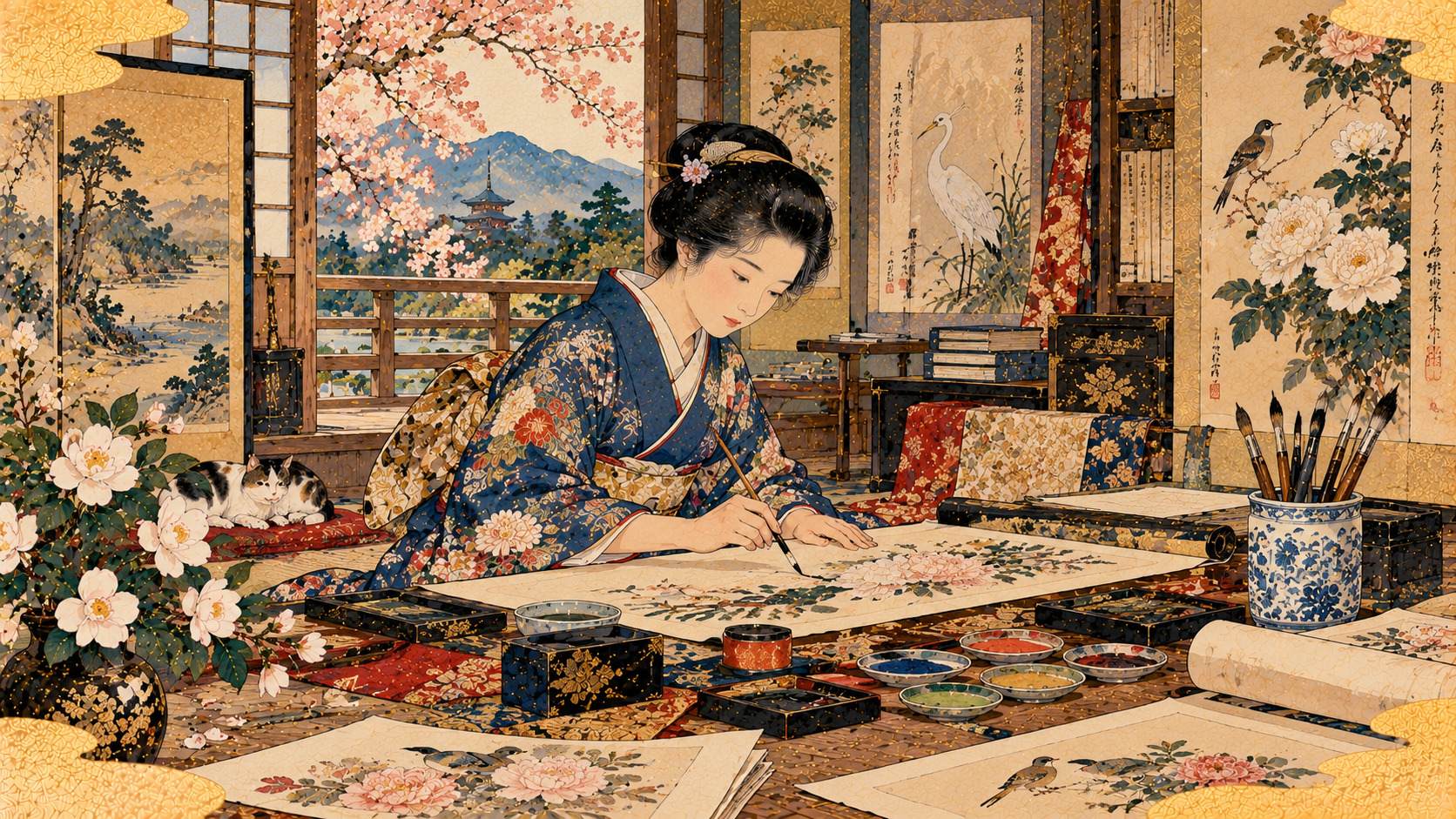
The familiar story introduces Kawanabe Kyōsui (1868–1935) as the daughter of Kawanabe Kyōsai, one of nineteenth-century Japan’s most versatile artists. That relationship matters, but it can obscure the more interesting question: what did she accomplish in her own working life? Kyōsui exhibited paintings, produced prints and illustrated books, pursued techniques beyond the family studio, and taught women at a pioneering art school. Her career makes a compelling case that Japan’s art history is richer when its teachers and working women artists are examined alongside its celebrated masters.
A childhood in a remarkable studio
Accounts preserved by Joshibi University’s art museum say that Kyōsui’s father gave her an instructional picture of a persimmon and a bird when she was young. University materials describe it as a dove; a later exhibition handout uses the more general term bird. That modest difference shows why the details of historical biography deserve careful sourcing. Her father, who trained in the Kanō tradition and worked across paintings, prints and comic or satirical subjects, offered access to a rare artistic education. In the same room, however, she inherited a name that future writers would find difficult to look beyond.
Learning beyond the family
The 2022 exhibition catalog materials from Ichinomiya explain that Kyōsui also studied with Yamana Tsurayoshi (1836–1902), absorbing visual traditions associated with the Tosa and Sumiyoshi schools. Her work cannot be summarized as a simple copy of Kyōsai’s bravura painting. Figure subjects, restrained elegance, decorative surfaces, and narrative themes all suggest an artist navigating different conventions and audiences. Her education illustrates how Japanese painting at the turn of the twentieth century drew from multiple schools rather than a single unbroken style.
Entering public exhibition culture
The Kitakyushu Municipal Museum of Art records two figure paintings submitted to a painting exhibition in 1883 and notes that her coloring subsequently drew praise. A Joshibi exhibition account describes a youthful appearance at the second National Painting Competitive Exhibition with a different age chronology, so it is safer to say that she was active in exhibitions by the 1880s than to assign one precise age to the debut. Public exhibitions represented more than applause: they helped transform artistic talent cultivated in a studio into a professionally recognized identity.
The evidence of a print dated 1894
One particularly tangible clue survives under the title Five Seasonal Festivals: July (Gosekku no uchi, Fumizuki). The Edo-Tokyo Museum catalog identifies a three-sheet color woodblock print dated 1894, designed by Kyōsui and published by Sawamuraya Seikichi. The Kitakyushu Municipal Museum of Art also lists a print of that title. Those records should not be collapsed into an assertion that two catalog entries describe the same physical impression. What matters is that they locate Kyōsui in an active publishing world, where designs depended on publishers, printers, sellers and audiences. Reproducing museum images requires separate attention to each institution’s image-use terms.
Women, theater and the changing visual culture of Meiji Japan
The Kitakyushu museum highlights her bijin-ga, paintings of women, and noh-ga, works concerned with Noh performance and its imagery. It also records illustrated books and multicolored prints extending into the late Meiji period. Other exhibition records include birds, blossoms and historical figures. The diversity matters: these were subjects circulating through both inherited pictorial traditions and a modern market for images. One cannot fully reconstruct her aesthetics from a small group of accessible reproductions, but it is difficult to sustain the notion that she was only an apprentice in her father’s shadow.
After Kyōsai’s death
Kyōsai died in 1889. Joshibi’s museum recounts that his daughter completed some of his unfinished print series and artworks. Such work undoubtedly connected her to the family reputation; it also required mastery, judgment and professional continuity. The historical question is not whether she was influenced by her father—she plainly was—but why an artist who both maintained a workshop legacy and produced independent work should be remembered almost entirely in relation to another person.
The teacher called “Kyōsui-sensei”
Kyōsui’s contribution to professional art education is essential to her story. According to Joshibi University’s 2021 exhibition, she taught Japanese painting from 1902 for approximately three years at the recently established private women’s art school, a predecessor of Joshibi University of Art and Design. The 2022 Ichinomiya exhibition materials describe her as its first woman professor of Japanese painting. A shorter museum biography places the beginning of her teaching in the late 1890s, a chronological inconsistency worth acknowledging rather than smoothing away. The university’s detailed account provides the stronger basis for using 1902. Her students’ affectionate title, “Kyōsui-sensei,” survives as a reminder that influence is not measured solely by surviving canvases.
A career extending well beyond Meiji
Materials for the 2022 retrospective report that Kyōsui won a first-prize gold medal at a 1928 art exhibition associated with the enthronement celebrations of Emperor Shōwa. The exact work and judging record merit further archival investigation, and the award cannot be equated with a present-day international prize. Nonetheless, it rebuts the assumption that her career stopped when the most famous person in her artistic circle died. Her professional trajectory ran from the early Meiji exhibition world into the Shōwa era.
Why so few works are visible
The Kitakyushu museum notes that relatively few of her works survive. It does not establish a total output, an exact loss figure or the cause of every absence. Historical collecting patterns, attribution practices and the dispersal of works among private owners and institutions all create research questions rather than instant answers. A 2020 exhibition list at Jissen Women’s University, for example, records a silk painting titled Hanami-zu in private ownership, dated broadly to late Meiji or Taishō times. The archive of one artist is rarely confined to one museum.
A rediscovery with a history of its own
Kyōsui has not been wholly forgotten by Japanese scholars or museums. Recent reassessments include a 2018 Tokyo Fuji Art Museum exhibition devoted to Kyōsai and Kyōsui, a 2020 show in Takasaki, a 2021 Joshibi special display, and the 2022 exhibition at the Ichinomiya City Memorial Art Museum of Setsuko Migishi. The Kyōsai Memorial Museum characterized the 2022 show as the first exhibition dedicated to Kyōsui. These projects mean a serious rediscovery article must credit existing research rather than claim to have unearthed an artist nobody had investigated.
The novelist’s Kyōsui and the historical one
The 2021 Naoki Prize-winning historical novel Hoshi Ochite, Nao, by Tōko Sawada, uses Kyōsui as its central character. Fiction can draw new readers toward a historical figure, but its conversations and imagined private feelings cannot be cited as documentary fact. Museum lists, contemporary exhibition records and school archives offer a different kind of evidence, one that allows us to see decisions and achievements without pretending to know what she thought in every moment.
What it means to restore an artist’s place
The question is not whether Kyōsui should replace her father in the story of Japanese art. It is whether an art history organized around exceptional men has room to see the working lives of women who exhibited, taught, designed and helped carry traditions forward. Look at her carefully: a painter of figures and performances, a designer of prints, a teacher who helped build professional opportunities for younger women. The simplest act of rediscovery is also the most demanding—look at the work, read the records and begin with her own name.
Sources and further reading
Institutional biographies, museum catalogs and university exhibition materials were prioritized. Reproduction rights for collection images must be cleared separately. No firsthand examination of originals is claimed.
- Joshibi University Art Museum — Kyōsui and the women’s art school
- Kitakyushu Municipal Museum of Art — artist biography
- Art Platform Japan — artist authority record
- Ichinomiya Museum — 2022 exhibition handout
- National Art Center — 2022 exhibition record
- Edo-Tokyo Museum — 1894 color print
- Kitakyushu Museum — Five Seasonal Festivals: July
- Jissen Women’s University — Women, Education and Art catalog
- Kyōsai Memorial Museum — exhibitions and literature