The Demon of Painting: Kawanabe Kyosai, Japan’s Wildest Artist of Monsters, Madness and Mischief
Drunken skeletons, dancing demons, grotesque humor and explosive technique: a long-form look at the nineteenth-century artist whose imagination still feels built for Halloween.
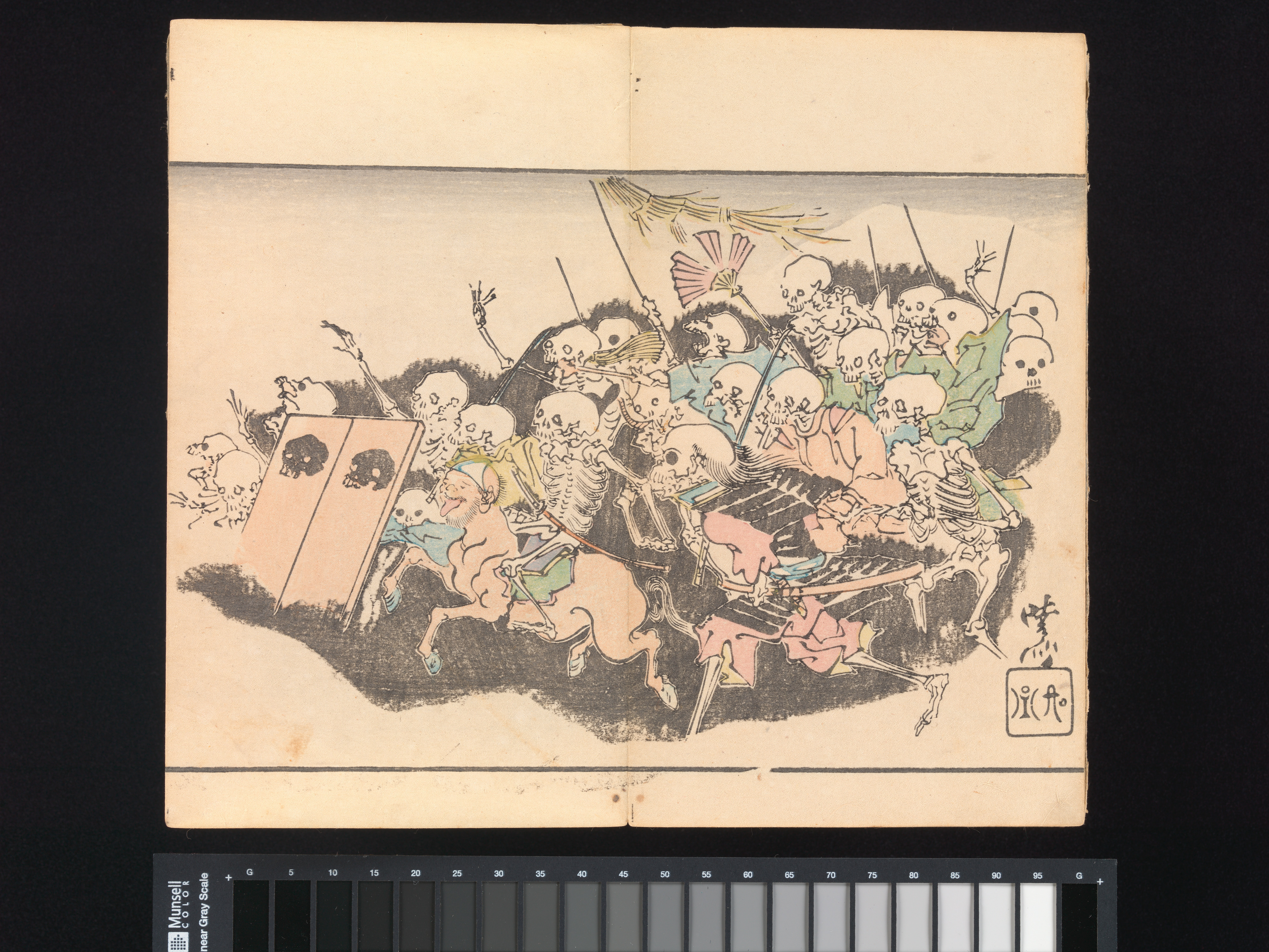
If Halloween needs a patron saint for Japan.co.jp’s October 31 edition, Kawanabe Kyosai is the obvious candidate. He painted demons, skeletons, monsters, frogs, ghosts, courtesans, pranksters and satire with such reckless brilliance that one image often feels like three at once: funny, unsettling and technically dazzling. His world is crowded, theatrical and unruly. It is also deeply rooted in the traditions of Japanese painting.
That tension is the key to Kyosai’s enduring power. He was not a naive eccentric splashing out grotesque fantasies. He was a rigorously trained artist who studied first with Utagawa Kuniyoshi and then within the Kano school. That formal discipline gave him the freedom to do almost anything. In Kyosai’s hands, a skeleton could become a comedian, a demon could become a character, and a picture of chaos could become an essay on modernity.
Kyosai’s genius was not simply that he drew monsters. It was that he turned monsters into a way of seeing society.
A life between popular culture and elite training
Official Japanese sources and museum materials place Kyosai’s birth in 1831, in Koga in what is now Ibaraki Prefecture, before the family moved to Edo. He trained as a child under Kuniyoshi, then entered the Surugadai branch of the Kano school, where he received the artist name Tōiku Noriyuki. This matters because Kyosai is sometimes flattened into a single stereotype: the wild demon painter. But his unruliness came after mastery, not instead of it.
The 2026 exhibition at the Suntory Museum of Art underscored precisely this point. Kyosai’s work sits at a crossroads: ukiyo-e wit on one side, Kano-school technique on the other. The result is a body of work capable of moving from lofty mythological subjects to raucous caricature without losing control of line, structure or rhythm.
The scandal that changed his name
Kyosai’s reputation for mischief is not entirely a modern invention. Local-government biographies and museum references recount the 1870 incident at a calligraphy-and-painting gathering near Shinobazu Pond, where satirical images he produced while drinking led to his arrest and imprisonment. After that episode, the artist who had called himself “Kyōsai” with the character for “madness” is widely said to have shifted to the better-known “Kyōsai” written with the character for “dawn.”
The episode matters not because it makes a good legend, but because it clarifies what was at stake in his art. Kyosai’s humor was not harmless decoration. It could irritate authority. His comic language had teeth.
Why Kyosai belongs to Halloween
Modern Japanese Halloween is often described in terms of tourism, nightlife, cosplay, crowd control and commercial spectacle. Kyosai reminds us that Japan already possessed a rich visual culture of pleasurable unease. Ghosts, yokai, anthropomorphic objects and grotesque humor were long part of the country’s artistic vocabulary. What Halloween adds is a new seasonal frame. Kyosai supplies the older visual intelligence behind it.
His skeletons are the perfect example. They are not simply emblems of death. They dance, quarrel, smoke, play music, feast and perform. The viewer laughs, then remembers that all of this animation belongs to bones. That emotional oscillation—delight tipping into discomfort and back again—is almost the ideal Halloween feeling.
Three works that explain the obsession
1. Kyōsai’s Pictures of One Hundred Demons (1890)
This accordion-format printed book, preserved by the Metropolitan Museum of Art, is one of the clearest demonstrations of Kyosai’s supernatural imagination. The Met describes it as one of the artist’s most popular books and labels the object Public Domain. The procession of monsters feels part encyclopedia, part performance.
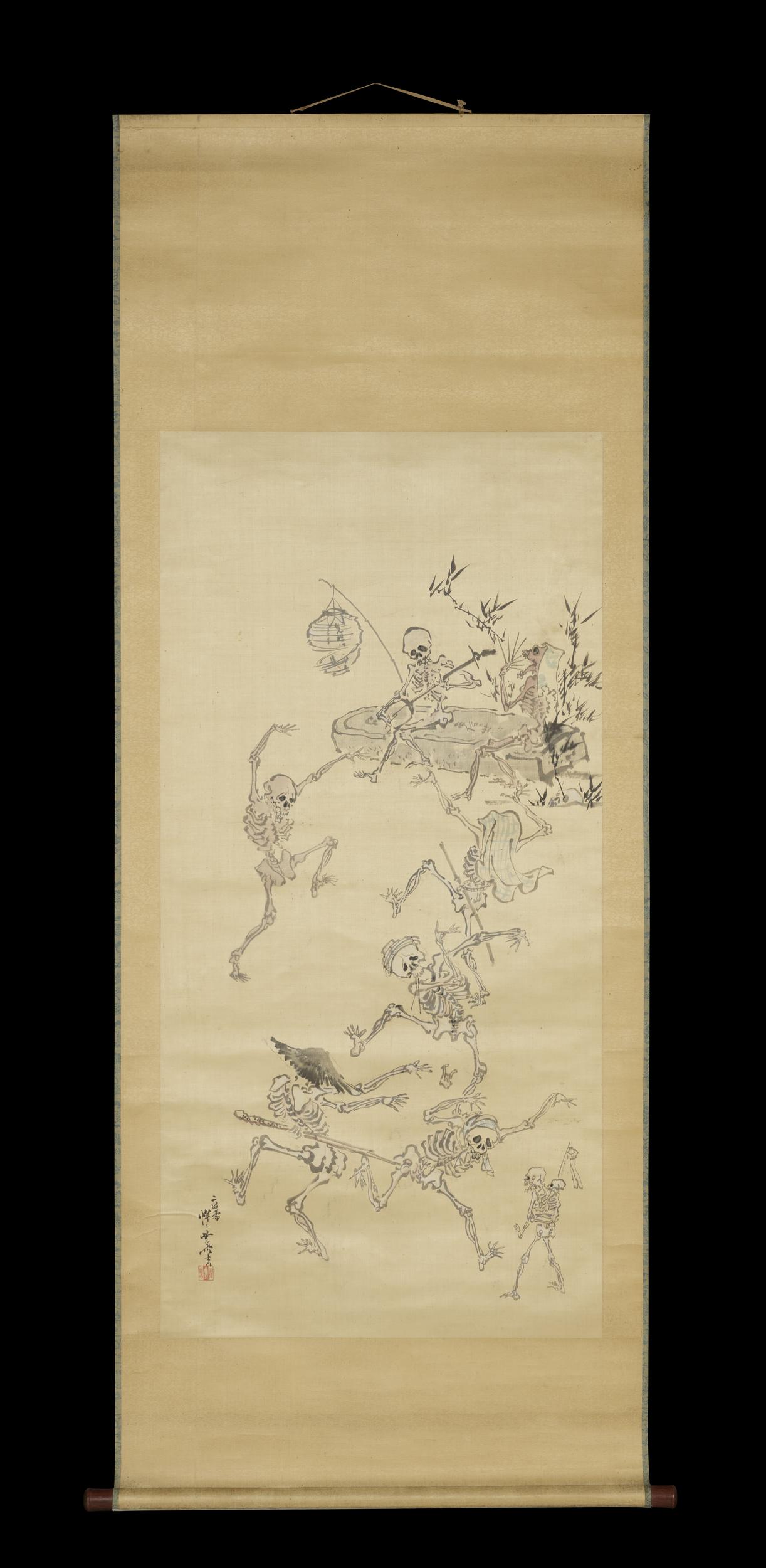
2. Dancing Skeletons
Few artists made skeletons feel so alive. The Ota Memorial Museum’s commentary on Kyosai’s picture books stresses how vivid and humorous these bony figures are: wrestling, fighting, drinking, preaching and performing. The macabre never loses its comic timing.
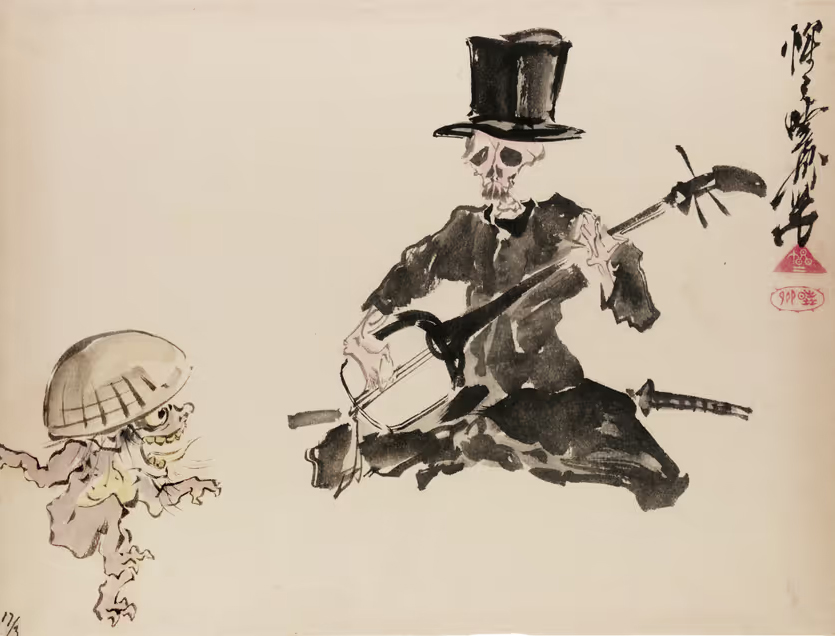
3. Skeleton Shamisen Player in Top Hat With Dancing Monster
A skeleton in Western dress and top hat plays a shamisen while a strange companion dances nearby. The title appears in the 2026 Suntory Museum of Art exhibition list for works from the Israel Goldman Collection. The image captures exactly what makes Kyosai feel modern: collision, parody and style.
How fear becomes entertainment
The Ota Memorial Museum’s online exhibition on Kyosai’s picture books offers a useful clue to his appeal. Skeletons in his illustrations do not merely stand in for death; they imitate kabuki actors, walk tightropes, hold banquets and play instruments that should not logically make a sound. Even their props are skeletal. Bone fans, bone umbrellas, bone shamisen. The joke is visual, but it is also philosophical. The world of appearances has thinned out, yet the performance continues.
Kyosai’s monsters work similarly. Yokai are frightening, but they are also legible, memorable and exuberantly designed. He understood something modern entertainment industries know very well: fear travels farther when it has personality.
Why Kyosai still matters in 2026
Kyosai is not merely a historical curiosity enjoying a brief seasonal revival. He remains an active presence in museums and public collections. In 2026, the Suntory Museum of Art mounted The Israel Goldman Collection: This is Kyosai!, later traveling to Kobe and Shizuoka. The Kawanabe Kyosai Memorial Museum in Warabi continues to rotate focused exhibitions from its holdings. This steady institutional attention reflects a broader shift in art history: Kyosai is increasingly understood not as a sideshow oddity, but as a major artist who bridged popular culture and high painting in late nineteenth-century Japan.
That bridge also explains his appeal to contemporary audiences. Manga scholars, tattoo artists, horror fans and designers have all found something useful in Kyosai’s imagery. He offers not just motifs, but a method: compress energy, exaggerate gesture, honor tradition, disrespect pomposity, and keep the image alive with narrative detail.
Copyright and editorial suitability
Kyosai died in 1889, so the underlying artworks are well outside Japan’s ordinary copyright term. For this article, that matters especially because the Halloween edition benefits from historically grounded imagery. The Metropolitan Museum’s page for Kyōsai’s Pictures of One Hundred Demons explicitly marks that object as Public Domain. Even so, digital reproductions from different institutions can carry their own usage conditions, which should always be checked separately.
The art choice verdict
Kyosai is not just a good Halloween artist. He may be the best Japanese artist for Halloween because he refuses to separate the grotesque from the comic, the scholarly from the popular, or the frightening from the festive. A crowd scene in Shibuya, a nightlife guide for Tokyo, a yokai feature, even a sports illustration with mischievous skeletons—suddenly the entire editorial package makes visual sense once Kyosai is in the room.
That is why Japan.co.jp is treating him not as a footnote, but as the visual intelligence behind the whole edition. He makes AIYASHI — Strange, but delightful feel less like a slogan than a fully formed editorial philosophy.
Editorial note
This feature separates well-documented biography from later anecdote. Some colorful stories about Kyosai’s childhood and drinking culture circulate widely, but only claims grounded in museum or public institutional sources are treated as established here.
Sources
- Taito City: Grave of Kawanabe Kyosai
- Koga City official Kyosai page
- Suntory Museum of Art: The Israel Goldman Collection — This is Kyosai!
- Kawanabe Kyosai Memorial Museum (Japanese Museums Association)
- The Metropolitan Museum of Art: Kyōsai’s Pictures of One Hundred Demons
- Ota Memorial Museum online exhibition: Kawanabe Kyosai
- Ota Memorial Museum essay on Kyosai’s skeletons
- Suntory Museum exhibition list (PDF) with the Skeleton Shamisen title
- Royal Academy article on Kyosai