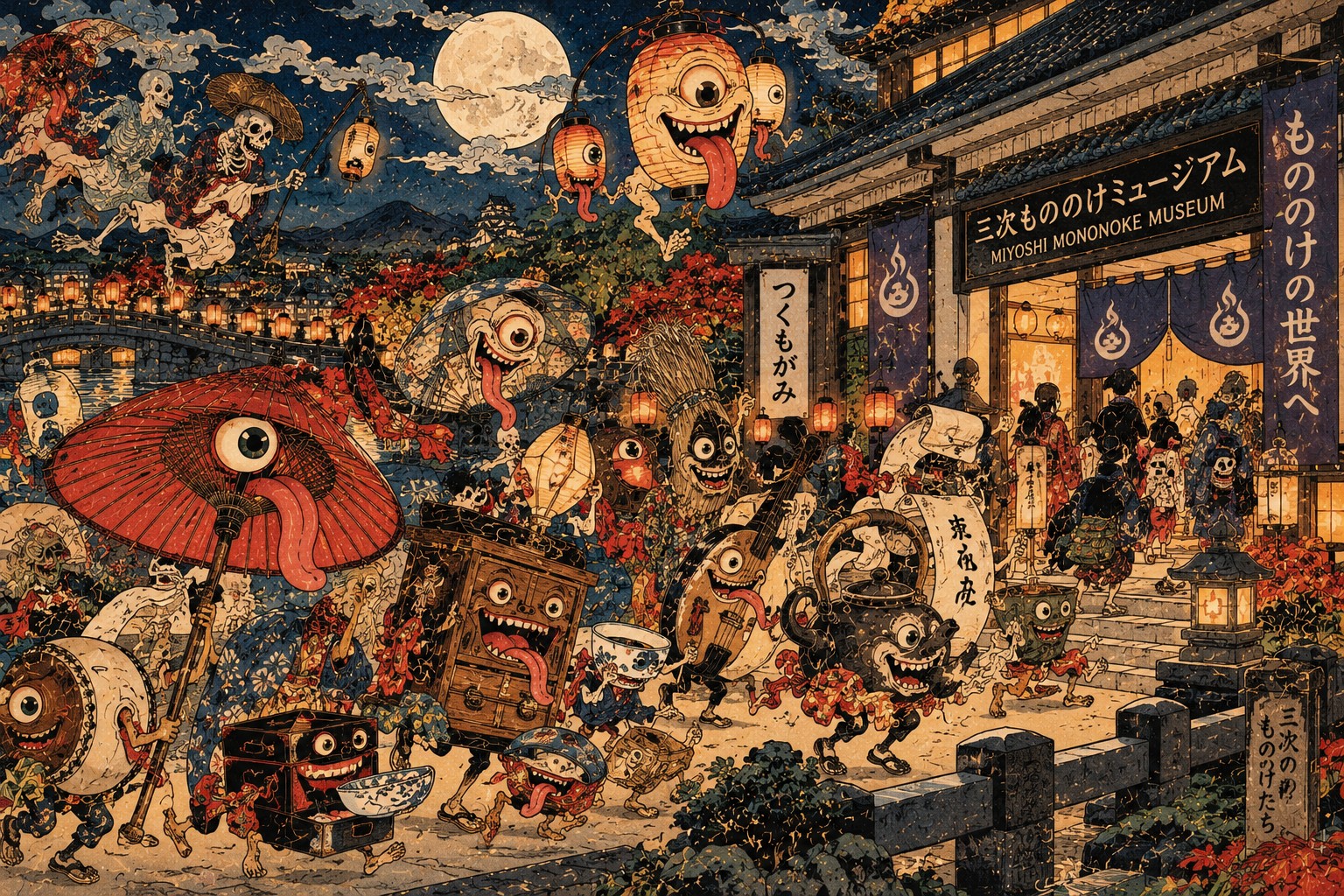
The unsettling part is not that the objects have faces. It is that the things we discard might look back at us.
The haunted things we leave behind
Imagine opening a cupboard and discovering that the umbrella you abandoned years ago has grown an eye and a leg. A paper lantern grimaces; an old instrument decides it can walk. Japan has a name for these uncanny objects: tsukumogami, belongings that acquire supernatural lives. At the Yumoto Koichi Memorial Japan Yokai Museum in Miyoshi, Hiroshima Prefecture, a 2026 exhibition uses that tradition to ask a disarmingly modern question: what does it mean to treat a possession as disposable?
An exhibition still open after a canceled celebration
The museum’s official title is Tsukumogami: Tools Have Turned into Yokai! Its run began June 26 and continues through November 10, with a change of exhibited works in early September. There is an important Halloween correction. The outdoor Miyoshi Mononoke Autumn Festival planned for October 25 was canceled following a forecast of severe weather associated with Typhoon No. 30, although the museum said its regular Mononoke Day activities would continue. The exhibition itself remains the reason to visit. An October 31 outdoor Halloween party at the museum has not been confirmed by the organizer.
A monster born from spring cleaning
In one famous illustrated narrative, household implements that have served for many decades are thrown away during year-end cleaning. Their resentment becomes the force behind an uprising. The abandoned objects acquire frightening bodies and march through a city. The National Diet Library’s explanation of the Tsukumogami Emaki describes a story that ultimately involves religious intervention and repentance. It is much stranger, and more morally complicated, than the modern picture of a friendly umbrella mascot: the monsters confront their human owners with the consequences of neglect.
Why the old picture scrolls matter
There is no single definitive, unchanged image of a tsukumogami. Versions of the narrative and supernatural procession survive in different lineages of illustrated scrolls, including medieval prototypes and later Edo-period copies. The National Diet Library cautions that the original creator and date are uncertain. What is recognizable across the tradition is the transformation of everyday material culture into lively figures. The instruments, vessels, and household goods that once signaled familiarity become a visual language of surprise, fear, and laughter.
A scroll from 1728, on display now
A highlight of the museum’s autumn rotation is a portion of the lower volume of the Tsukumogami Emaki attributed to Ki Munenao (紀宗直) and dated 1728, the thirteenth year of the Kyōhō era. The upper-volume portion was shown earlier in the exhibition run; the lower-volume portion is scheduled from September 3 to November 10. The dates matter for visitors seeking particular historical objects rather than a generic display of monsters. The images are evidence of how artists imagined them, not evidence that such creatures literally existed.
From frightening beings to familiar characters
Over time, artists developed an exuberant inventory of supernatural household goods. The National Diet Library discusses Toriyama Sekien’s Hyakki Tsurezure Bukuro, in which transformed objects include musical instruments and cooking vessels. A museum exhibit of an umbrella-monster netsuke shows how supernatural imagery also moved into small crafted objects. The now-familiar one-eyed umbrella and long-tongued lantern were shaped by multiple artistic traditions; it would be anachronistic to assume every detail of modern character design was fixed in the medieval period.
Why this museum belongs in Miyoshi
Miyoshi has a supernatural literary inheritance of its own. The Edo-period tale Inō Mononokeroku is set in the area and has circulated in books, picture scrolls, and later adaptations. The museum treats this place-based storytelling as a point of entry into Japan’s wider folklore. There is a distinction worth preserving: a community can have a real history of telling ghost stories without the supernatural events in those stories being verifiable history. That layered relationship between place and imagination helps make Miyoshi more than a stop on a Halloween itinerary.
Five thousand objects, one public museum
The institution opened on April 26, 2019. Its formal Japanese name is 湯本豪一記念日本妖怪博物館, and it was established by Miyoshi City around a donation of approximately 5,000 yokai-related materials from collector and researcher Yumoto Koichi. The collection includes prints, illustrated manuscripts, and crafted objects. The figure describes the donated collection, not the number of items on simultaneous display. Rotating exhibitions let curators study how the meaning and appearance of monsters changed across periods and media.
A sustainability lesson—or a historical analogy?
The museum itself invites visitors to think about a sustainable society through the warning embedded in these tales: care for the things you own. There is force in that interpretation, particularly in an age of high-turnover consumer goods. But the stories are not medieval life-cycle assessments, and repairing every worn product is not automatically the least environmentally damaging option. Material durability, transport, waste treatment, energy use, and health all matter. The exhibition offers an ethical and imaginative point of entry, not a measured demonstration of environmental benefits.
The museum as a place of translation
Yokai exhibitions translate historical texts into something that can be understood through faces, gestures, and material objects. A young visitor may recognize a cartoon-like creature before learning it emerged from a centuries-old scroll. A specialist may begin with brushwork, copying traditions, and provenance. The museum’s permanent presentation of Japanese yokai and the Miyoshi tale provides context. No published visitor survey establishes that the exhibition has changed people’s disposal habits; it is more responsible to say the curators are inviting the question.
What visitors need to know
The museum stands at 1691-4 Miyoshimachi, Miyoshi City, Hiroshima Prefecture. The published hours are 9:30 a.m. to 5 p.m., with last entry at 4:30 p.m. It is generally closed on Wednesdays. Admission is ¥1,000 for adults, ¥600 for high school and university students, and ¥300 for elementary and junior high school students, with a combined ticket covering the temporary and permanent exhibitions. Check the museum site before traveling for possible schedule changes or sold-out activities.
The monsters do not disappear at midnight
The best thing about Miyoshi’s Halloween-season exhibition may be that it survives the holiday. The objects remain on view until November 10, inviting a slower kind of encounter than the costume-party rush. In their unsettling faces lies a little piece of everyday history: tools were made, used, treasured, discarded, and then given voices by storytellers. The resulting monsters are both strange and funny. They are also an invitation to reconsider the history of our own possessions.
Sources and verification
Reporting based on museum announcements, National Diet Library scholarship and museum registries. No independent curator interviews or visitor-outcome surveys were conducted.
- Museum exhibition announcement
- Museum current exhibition and object list
- Museum canceled autumn festival notice
- Official museum history
- National Diet Library: Tsukumogami Emaki
- National Diet Library: Toriyama Sekien and tsukumogami
- National Diet Library: Night Parade scrolls
- Japan Museum Association directory
- Official Hiroshima tourism exhibition guide