The evidence does not show that monsters walked the streets. It shows how powerfully generations of people imagined that they did.
Imagine the street belongs to the monsters
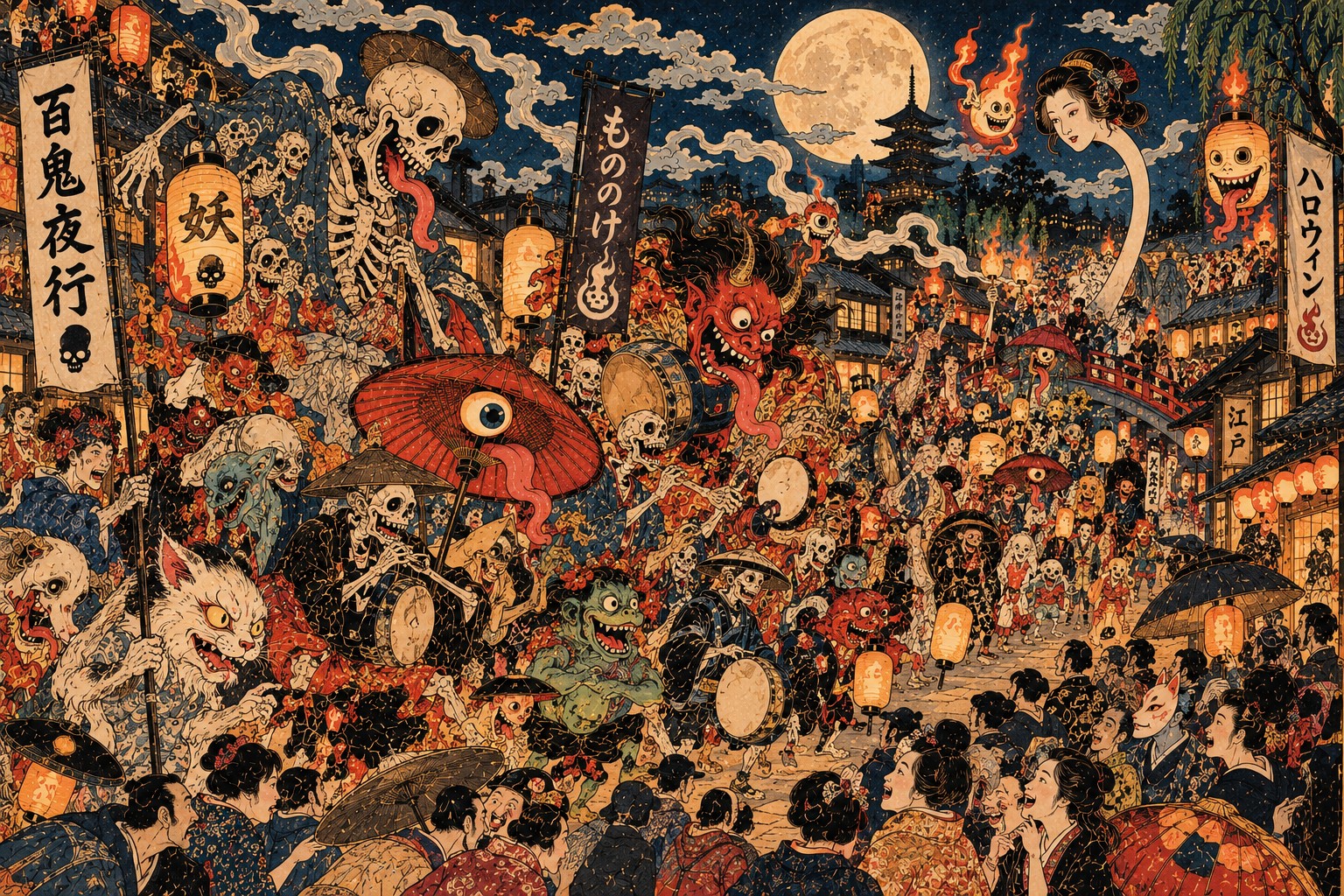
Under a full moon, a one-eyed umbrella bounds past a grinning cooking pot. A skeletal musician follows a fox-like stranger; a procession of creatures stretches beyond sight. It looks as though Halloween has swallowed an old Japanese city. But the Night Parade of One Hundred Demons—hyakki yagyō—belongs to a history far older and stranger than Japan’s modern costume celebrations. To understand its power, separate three different things: encounters imagined by medieval storytellers, processions invented and reinvented by painters, and the contemporary pop-cultural creatures that those images help us recognize.
Before the illustrations, a fear of traveling at night
Japan’s courtly literature includes frightening tales of beings encountered after dark. A narrative involving Fujiwara no Tsuneyuki in the Konjaku Monogatarishū depicts an aristocrat meeting a mass of demons and escaping because of a protective Buddhist dhāraṇī associated with his clothing. Other medieval accounts describe similar anxieties. These are sources for the history of belief, ritual, and storytelling; they are not eyewitness records establishing that supernatural processions literally appeared in Kyoto.
The dark was governed by rules
The haunted road was not simply an empty stage on which monsters could be placed. Night travel carried ordinary hazards, and elite society employed court ceremony, divination, and religious practice to interpret danger. The hundred in the name need not be read as an audited head count of exactly one hundred creatures; it also evokes an overwhelming multitude. Hyakki yagyō was a potent way to imagine human order meeting something beyond its control. The original terror is therefore as much about boundaries as about anatomy.
How the invisible terror became an irresistible picture scroll
The visual tradition eventually transformed supernatural danger into a rolling carnival. The National Museum of Japanese History owns an Edo-period Night Parade scroll filled with transformed household objects, clothing, pots, and other strange figures. A famous lineage is associated with Shinjuan, a subtemple of Daitokuji in Kyoto. Some attributions to the painter Tosa Mitsunobu are traditional rather than conclusive; artists, copyists, and collectors repeatedly reshaped these compositions. A scroll makes the viewer move through the parade, discovering each fresh joke or threat in sequence.
When an old tool becomes dangerous
Tsukumogami, animated household objects, provide one of the most delightful and troubling strands of this imagery. In a related narrative tradition, things discarded after long service become resentful and rise against their former owners. A piece of domestic equipment suddenly acquires feet, eyes, and a will of its own. The reversal is comic but unsettling: what had been useful and obedient now looks back. Yet not every Night Parade painting illustrates one identical tsukumogami story, and the iconic umbrella monster was not fixed in one unchanging form at the tradition’s beginning.
1776: an illustrated book changes the way monsters are seen
Toriyama Sekien’s Gazu Hyakki Yagyō appeared in Edo in 1776. Tokyo University of the Arts and the National Diet Library confirm the publication and its authorship. Instead of simply unfolding one endless parade, its illustrated-book format presents identifiable beings such as tengu, kodama, and yamawaro. It became easier to contemplate a creature individually, attach a name to its form, and remember it. Sekien drew upon older visual and literary materials while exercising his own ingenuity; the images are not a neutral inventory of independently verified folklore.
Kyōsai: the painting demon unleashes the crowd
Kawanabe Kyōsai (1831–1889), whose turbulent invention informs the artwork for this edition of Japan.co.jp, made such supernatural disorder seem almost alive. The Metropolitan Museum of Art holds editions of Kyōsai Hyakki Gadan, a folding woodblock-printed book. Its first edition appeared posthumously in 1889; a Met example is dated 1890. The museum labels it public domain and describes a procession of demons moving through the night. Kyōsai found room for social comedy, theatrical exaggeration, and genuine unease in the same small pages.
From a moving procession to a cast of characters
A picture scroll and a monster picture book ask the audience to look differently. In the scroll, the pleasure is anticipation: the parade carries us toward the next strange body. In a printed collection, a single being can become memorable on its own. Such formats helped make supernatural imagery portable and repeatable. There is an affinity with modern character franchises, but it would be misleading to claim that every contemporary monster directly descends from a single print. Influence must be established from specific works, creators, and records.
Modern manga did not invent Japan’s yokai—nor merely copy them
After the war, artists including Shigeru Mizuki brought yokai into mass popular culture. GeGeGe no Kitarō made an extraordinary cast familiar to readers and television audiences, while writers such as Natsuhiko Kyōgoku continued to explore the power of naming and interpreting the uncanny. Their work participates in a living tradition rather than preserving an unchanged medieval catalogue. A manga panel may echo a historical monster image, radically reinterpret it, or invent something new. All three possibilities belong to the story.
The problem with translating yokai as ghosts
International audiences often receive yokai as ghosts, monsters, or spirits. All are useful approximations, but none fully covers the range. An animated umbrella is not a deceased human; a tengu is not simply a Western demon. Many creatures are frightening, some ridiculous, others morally uncertain. The International Research Center for Japanese Studies launched its Database of Images of Strange Phenomena and Yokai in 2010 and explains that its image descriptions are limited to what a particular work actually depicts. That restraint matters: an image alone cannot prove the age, distribution, or exact meaning of an oral tradition.
Why Halloween is a comparison, not an origin story
Japan’s contemporary Halloween celebrations make the contrast wonderfully visible. Crowds in elaborate costumes and illuminated city streets look superficially like the supernatural parade on a scroll. But Halloween’s traditions emerged from different histories, and Japanese urban cosplay festivals are modern events with their own commercial, civic, and fandom structures. Calling Ikebukuro’s 2026 gathering a literal continuation of a thousand-year-old Night Parade would flatten both histories. The connection works best as an imaginative conversation between them.
A note about historical images and this edition’s art
Original works by Sekien and Kyōsai are beyond Japan’s ordinary copyright term. That does not mean every digital image, modern annotated edition, or contemporary derivative work has identical conditions of reuse. The Met explicitly marks its Kyōsai Hyakki Gadan holdings public domain, an especially practical reference. Japan.co.jp’s accompanying image is an original AI-generated editorial illustration inspired by Kyōsai, not an image of an ancient scroll or a depiction of a real Halloween parade. Crediting that distinction preserves the history while permitting imaginative storytelling.
The real marvel is what survives
The Night Parade does not supply a permanent roster of exactly one hundred monsters. It gathers centuries of changing worries and pleasures: noble families afraid of the dark, artists laughing at the objects in their houses, publishers selling arresting pictures, and modern audiences finding new lives for the strange. Halloween is an excellent night to meet them. The most extraordinary claim we can make is also the one the evidence supports: not that these creatures truly roam the streets, but that they have inhabited Japanese imagination for a very long time—and continue to find new companions.
Sources and verification
Based on museum collection records, Japanese library catalogs and institutional databases. Folklore is analyzed as history and art, not as evidence of supernatural events.
- National Museum of Japanese History: 百鬼夜行絵巻
- International Research Center for Japanese Studies: Yokai image database FAQ
- Tokyo University of the Arts Library: 畫図百鬼夜行
- National Diet Library: 1776 Gazu Hyakki Yagyo
- Metropolitan Museum: Kyōsai Hyakki Gadan (2013.767)
- Metropolitan Museum: Kyōsai’s Pictures of One Hundred Demons (2016.751.1)
- Metropolitan Museum Library: illustrated edition publication history
- Library of Congress: illustrated ghost-story and yokai traditions