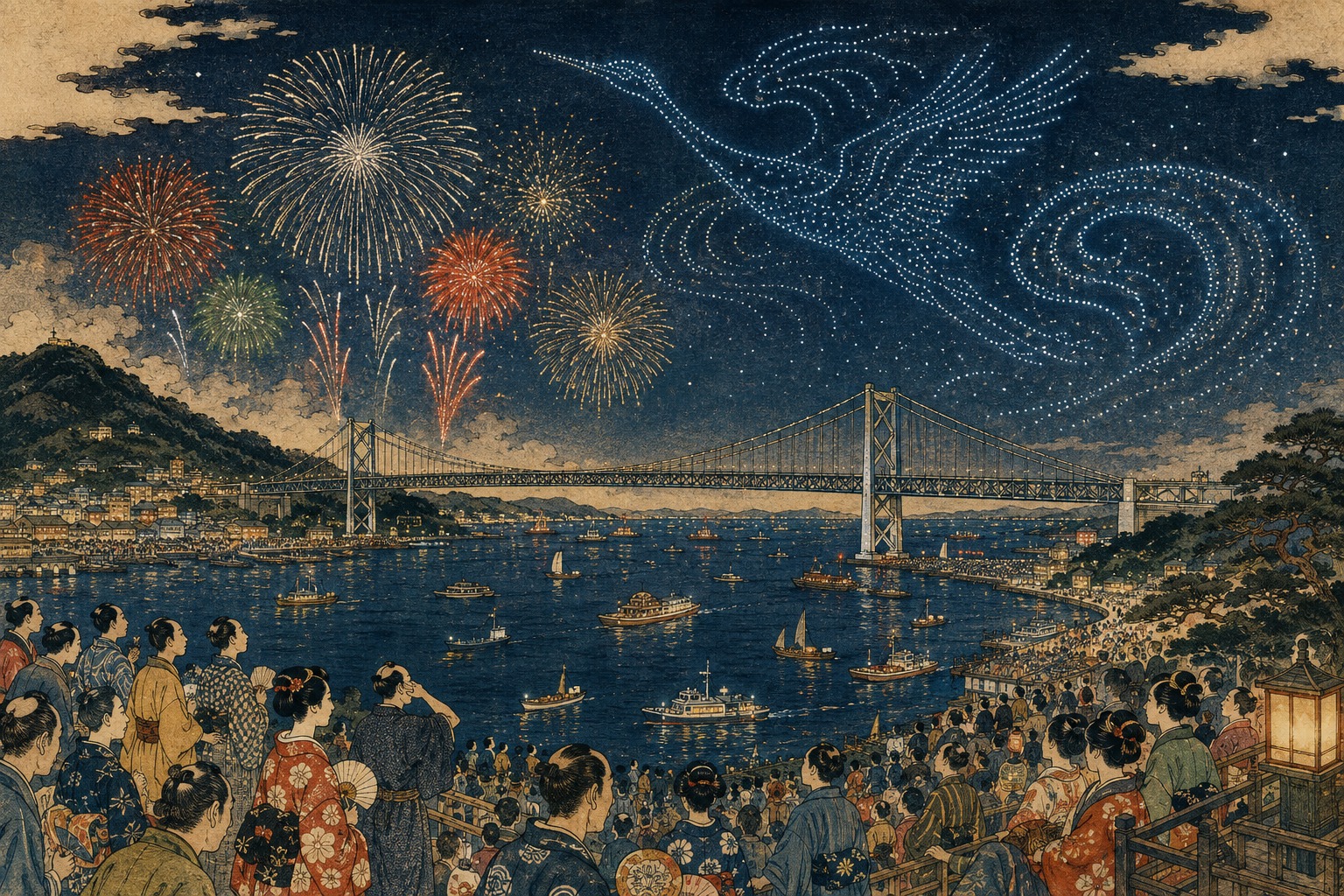
At 7:45 p.m., the Kanmon night should not yet have the concussion of fireworks. The first things to rise will be the lower mechanical hum of rotors and points of LED light. Points become rows, rows become surfaces, and surfaces become a form the eye can read—an animal, perhaps, or words. The 2026 scenario, directed by Shinichi Kudo, imagines life swimming through the night above the strait. A greeting celebrating fifty years of sister-city ties between Shimonoseki and Busan is also planned for the sky.
At 8 p.m., the roles reverse. The drones return to the ground and fireworks begin from Shimonoseki in Yamaguchi Prefecture and Moji in Kitakyushu, Fukuoka Prefecture. The announced total is about 18,000 shells. Light that can be programmed, held and reused yields to light created by powder burning once and disappearing. The drone show is not merely an appetizer. It is a hinge between two technologies of public spectacle.
Drone School Shimonoseki, based in the city’s Yoshimi district, is the organizer. Its year-round work includes training, aerial photography, inspection and agricultural spraying. Tokyo-based large-show specialist Red Cliff is the co-operator. The arrangement joins locally accumulated knowledge of place and production with a national-scale swarm-show system. It does not mean that the hardware was developed or manufactured in Shimonoseki. “Local capability” here means the ability to conceive, coordinate, film and return the record of an event to its community.
500, 800, 840, 900: four summers of growth
The Kanmon drone display is not an old tradition. It began in 2023 as a lightly advertised “secret” show using 500 aircraft, which the operator described as Yamaguchi Prefecture’s first. In 2024 the fleet grew to 800 and the producers tried a two-part format, before the opening ceremony and again during the fireworks. Pufferfish, dolphins and other marine motifs were combined with sponsor imagery.
In 2025, 840 aircraft were concentrated into a fifteen-minute slot beginning at 7:45. The theme was “Time Warp.” Whales, pufferfish and the duel between Miyamoto Musashi and Sasaki Kojiro on Ganryujima helped narrate Shimonoseki’s past, present and future. The number 840 also marked 840 years since the 1185 Battle of Dan-no-ura. In 2026 the count rises to 900, while the story moves from historical pageant to “life of light” and adds the Busan anniversary.
| Year | Scale and format | Creative focus |
|---|---|---|
| 2023 | 500 · first show | A “secret” display; described by the operator as Yamaguchi’s first |
| 2024 | 800 · two parts | Sea life, local identity and sponsor images; a segment during fireworks |
| 2025 | 840 · 15 minutes | “Time Warp”: Dan-no-ura, Ganryujima, whales, pufferfish and the future |
| 2026 | 900 · 15 minutes planned | “Life of light” and fifty years of Shimonoseki–Busan friendship |
More aircraft can increase point density in a fixed-size image or add information to a larger one. Curves in lettering, expressions in animals and depth in three-dimensional forms can gain resolution. But quantity does not automatically create good art. Viewing angle, background light, spacing, color, transformation speed, music, wind and the response to an individual failure all determine whether the fleet becomes one convincing image.
It does not take 900 pilots
A light show is easily misunderstood as 900 radio-controlled aircraft, each flown live by a different person. Ordinarily it is not. Designers define points in the sky at successive times. Software assigns an aircraft to every point and calculates paths between formations that do not collide. Shared timing and positioning coordinate movement and LED color. Each drone is a pixel, but also an aircraft with its own battery, motors, communications and navigation.
The engineering problem has two linked parts. Which aircraft should move to which point in the next formation so that total motion is efficient? And how can all those moves remain collision-free and within speed and acceleration limits? Research published in 2026 demonstrated rapid assignment and time-parameterized trajectory generation at roughly the thousand-aircraft scale. It does not describe the proprietary Kanmon system, but it reveals the computational problem that must be solved before a swarm can “draw.”
The field operation adds another layer. Crews place aircraft on a launch grid and check batteries, propellers, LEDs, communications, positioning and safe recovery behavior. The show must manage a disabled aircraft conservatively. At the end, 900 units must be recovered while the event makes a clean transition to the 8 p.m. fireworks program. The visible fifteen minutes rest on many more hours of ground work.
Japanese law treats “night” and “festival” as distinct risks
Japan requires unmanned aircraft weighing 100 grams or more to be registered, display a registration ID and, in principle, carry remote identification. The Civil Aeronautics Act regulates airspace such as densely inhabited districts and areas near airports, as well as flight methods including nighttime operation, beyond visual line of sight, flight within 30 meters of people or property, and operation over an event. Specified flights conducted under permission or approval also require advance reporting of the flight plan and maintenance of flight logs.
The transport ministry says that flight over an event requires an application identifying both the place and time. Even an operator holding broader approvals cannot use them alone to cover a festival flight. Night, beyond-visual-line-of-sight operation and densely inhabited airspace can alter the procedure further. Whether a fleet passes over spectators or flies inside a controlled exclusion zone is a crucial legal and operational distinction.
The August 12 organizer release does not publish permit numbers or a flight map. It would therefore be wrong to conclude that the fleet will cross the channel, pass over ships or fly directly above the audience. What is confirmed is the list of Shimonoseki venues—Misakinocho Wharf, Arcaport, Kamon Wharf and the front of Karato Market—and the organizers’ promise to prioritize safety, with cancellation and next-day postponement possible.
- The fireworks decision: Moji’s official information says rain alone does not stop the event, but strong wind may; it describes an initial decision by noon and a final one at 2 p.m.
- The drone decision: The drone organizer separately warns that weather may cancel the show and shift it to the following day. The two programs need not make the same call.
- On-site safety instructions: Do not infer the flight boundary. Follow staff, fencing and the official event site. A professional show does not authorize private drones near the venue.
Beneath the lights is one of Japan’s most difficult waterways
The Kanmon Strait lies between the western end of Honshu and the northern end of Kyushu, connecting the Sea of Japan and Hibiki-nada with Suo-nada and the Seto Inland Sea. According to the transport ministry’s regional channel office, differences in tide level between the two sides generate currents of about ten knots in the narrow Hayatomo Seto. The current reverses roughly every six hours, four times a day. Dense fog can cause authorities to recommend suspending entry. The scenic backdrop remains working transport infrastructure.
The geography gives the show a rare visual compression. Spectators can watch the same night sky from another prefecture across the water. Separate organizing bodies on the Shimonoseki and Moji sides coordinate simultaneous fireworks at 8 p.m., so the gaze is not fixed on one conventional stage. A 2024 drone notice said that the show would be clearly visible from Kitakyushu. Visibility, however, does not guarantee an identical image from every angle. Text and flat figures have a front; viewed from the side, they compress.
The 2026 public material does not describe the navigable channel as the flight box. That is why the enticing phrase “900 drones over passing ships” should not be invented. Yet the real challenge remains: ports, railways, roads, crowds, pyrotechnics and aviation activity all concentrate in a narrow landscape. Producing a show here tests the ability to coordinate public space, not merely to animate an empty sky.
In this strait, movement has always been history
In 1185, the final battle of the Genpei War took place at Dan-no-ura. The child Emperor Antoku is said to have entered the sea as the Taira were defeated. In 1612, Musashi and Kojiro fought on Ganryujima. In the 1860s, the Choshu domain fired on foreign shipping, making the waterway a point of collision between domestic politics and international power. Kanmon has repeatedly been both boundary and stage for people trying to cross or control one.
Modernity turned crossing into infrastructure. The Sanyo Railway reached Shimonoseki in 1901 and connected with ferries. In 1911, entire freight wagons began moving across by ship. The undersea rail tunnel opened in 1942, the road and pedestrian tunnel in 1958, and the 1,068-meter Kanmon Bridge in 1973. People crossed on the surface, walked below the seabed, drove over a suspension bridge—and now place temporary images of light above the same gap.
1185 Battle of Dan-no-ura; Emperor Antoku is said to have died in the strait
1612 Musashi and Kojiro duel on Ganryujima
1911 Japan’s first rail-wagon ferry begins between Shimonoseki and Komorie
1942 Kanmon railway tunnel opens
1958 Kanmon road and pedestrian tunnel is completed
1973 Kanmon Bridge is completed
1976 Shimonoseki and Busan sign their sister-city pact
1985 / 1988 Shimonoseki fireworks begin / Moji joins to create the two-shore festival
2023 / 2026 The first 500-drone show / the planned 900-aircraft display
In 1988, two prefectures made one festival
The fireworks should not be mistaken for an unbroken medieval rite. The Shimonoseki event began in 1985. Moji joined in 1988 through the “Asia Port Festival in KANMON88,” connected to a port-and-rail centennial. Shimonoseki’s third edition was Moji’s first. Distinct civic organizations on opposite sides of a prefectural boundary began making one sky together.
The Moji committee describes the August 13 fireworks as a mukaebi: a welcoming fire for ancestors and people returning home during Obon. That is the modern festival’s chosen meaning, not a claim that the exact event has continued for centuries. Still, the idea of raising fire to welcome the absent gives a civic spectacle a purpose beyond tourism. In 2026, Moji’s organizers also say the fireworks will carry condolences, gratitude, sympathy and hopes for recovery after the Kumamoto-centered earthquake.
The festival has learned how fragile a mass gathering can be. In 2020, the pandemic ended the large event and only brief, unannounced fireworks were launched. The same happened in 2021 amid the pandemic and heavy rain. In 2022, the festival returned with attendance controls and paid sponsorship viewing areas. In 2026 the Moji waterfront near the launch area again has no free viewing zone and depends on sponsorship, corporate contributions and volunteer labor. Security, cleaning, temporary toilets, extra trains and traffic control are part of the spectacle’s real cost.
A message toward Busan: fifty years of port-city diplomacy
The Busan message planned for the drone sky has a history longer than the display. After Japan and South Korea normalized relations in 1965, a Korean consulate opened in Shimonoseki in 1966. A regular Shimonoseki–Busan ferry began in 1970. Growing movement of people and goods helped lead to a sister-city pact in 1976.
Relations expanded through staff exchanges, sports, cultural performances, the Little Busan Festival and reenactments of Korean diplomatic processions. Shimonoseki’s August 2026 city bulletin emphasizes that the two places share the culture of maritime port cities and announces an anniversary program for the August 13 festival. Music associated with Busan is planned for the fireworks, while drones will write a celebratory message above Shimonoseki.
The Kanmon Strait is not Japan’s border with Korea. But Shimonoseki faces two scales of connection at once: an internal strait joining Honshu and Kyushu, and an international ferry route opening toward Busan. Nine hundred lights cannot carry a passenger like a tunnel or ship. They can, however, place a shared symbol temporarily over a port city’s public horizon.
Will drones replace fireworks?
The technologies can compete, but at Kanmon they are sequenced. Drones do not combust. They can hold shapes and words, change color and be used for other performances. They create no pyrotechnic blast or combustion smoke at the point of display. But charging and transporting them, and manufacturing and discarding batteries and aircraft, consume energy and materials. Night lighting can affect birds and insects. “No smoke” is not the same as no environmental cost.
Fireworks cannot be reused or hold an image for several seconds. Yet their pressure, delayed sound, smoke and falling sparks are bodily sensations. Their irreversibility—a shell cannot be unburned—can resonate with memorial time. The drone line is repeatable; the firework line is not.
| Dimension | Drone show | Fireworks |
|---|---|---|
| Image | Words and contours can be held, animated and reproduced | Combustion produces an unrepeatable, short-lived trajectory |
| Sound and smoke | Rotor noise and light; no explosive blast or combustion smoke on site | Concussion, flash and smoke create a physical experience |
| Vulnerability | Rain, wind, lightning, positioning, links, batteries and viewing angle | Wind, rain, fire, falling material and explosive safety |
| Environmental claim | Reusable, but electricity, batteries, transport and light effects remain | Creates combustion products, while supplying a culturally specific ritual |
Kanmon’s order is therefore revealing. Drones do not dismiss fireworks as obsolete. First they place readable story and commemoration in the sky. Then they hand the space to fire and sound that cannot be reduced to words. Digital image and welcoming fire supply what the other lacks.
What local technology leaves behind
A-commerce opened a multidisciplinary facility in Yoshimi in 2022 with the stated goal of cultivating services and people in Shimonoseki who could connect to the wider world. Drone School Shimonoseki operates there, offering national-license training alongside photography, inspection and agricultural work. Its plan to film the fireworks and drone display and donate edited footage to the city and tourism organization extends that local role.
The 900-aircraft operation is shared with Red Cliff; this is not a story of a city independently building every layer of a swarm system. But neither is it simply an outside contractor dropping in. A local interface understands weather, crowd flow, government, tourism, broadcasting and the fireworks operation, while experience accumulates year by year. The rise from 500 to 900 measures not only aircraft but repetitions of coordination.
The best test of that accumulation is not a promotional crowd estimate. Did the event end without injury? Could organizers postpone or cancel when necessary? Did skills spread into year-round inspection, photography and other work? Were footage and operational lessons preserved? Turning fifteen festival minutes into regional capability requires storing the decisions that remained invisible, not only the successful image.
At 8 p.m., disappearance completes the work
If all goes to plan, spectators will see great creatures and words. The material reality underneath them will be 900 registered aircraft, batteries, trajectories, access controls, weather decisions, ground crews, two prefectural festivals and a moving waterway. The aerial picture exists only because those things align temporarily.
When the drones disappear at 8 p.m., they have not failed. Their descent gives the sky to fireworks and moves the audience from programmed life to irreversible fire. Organizers call that fire a welcome for the absent. Neither the Busan message nor the history reaching back to Dan-no-ura will remain physically overhead. What remains is a shared memory of looking up from two shores at the same time.
Kanmon is water that divides, repeatedly reconnected by ships, railways, tunnels, bridges and ferries. On August 13, 2026, a fifteen-minute bridge of light is meant to join that history. The 900 points will not own the sky. They will appear safely, make meaning and yield to the next light. Their brevity is what allows spectacle to become memory.
- A-commerce / Drone School Shimonoseki, “900-Drone Show at the 42nd Kanmon Strait Fireworks Festival” (August 12, 2026: time, scale, theme, venues, operators, Busan program and weather contingency)
- Shimonoseki City Bulletin, August 2026 (official schedule, 18,000 fireworks, venues and fifty-year Busan history)
- Kanmon Strait Fireworks Festival Moji official site (transport, viewing, safety, heat and operations)
- Moji committee, “Origins and History” (1988, Obon welcoming fire and 2020–22 changes)
- Drone School Shimonoseki, 2023 secret show (500 aircraft and the first edition)
- Drone School Shimonoseki, 2024 show (800 aircraft, two-part format and cross-strait visibility)
- Drone School Shimonoseki, 2025 show (840 aircraft and historical motifs)
- Red Cliff, “840 Drones, 840 Years Since Dan-no-ura” (2025 relationship between fleet size and anniversary)
- Ministry of Land, Infrastructure, Transport and Tourism, unmanned-aircraft flight rules (registration, permission, flight plans and logs)
- MLIT permission and approval procedures (event, night and location-and-time-specific applications)
- MLIT Kyushu Regional Development Bureau, Kanmon Strait (currents, geography, Dan-no-ura, Ganryujima, tunnel and bridge)
- JR West, railway heritage (rail arrival, wagon ferry and 1942 tunnel)
- Yang et al., “On Unmanned Aerial Vehicles Light Show Systems” (2021: RTK, formation transformation and collision-free trajectory background)
- Yunes Alqudsi, “Enhancing Drone Light Shows Performances” (2026 large-swarm assignment and trajectory research)
Editor’s note: This report compared the organizer’s release with city, transport-ministry, two-shore festival, past-event and research sources. Japan.co.jp did not independently interview the organizers, aviation or maritime authorities, or pyrotechnicians. It did not guess the unpublished flight volume, permit numbers, aircraft, wind limit, maritime coordination or attendance. Promotional market-rank and crowd claims were not treated as verified results. Because published pages differ on the fireworks’ end time, this article states only the confirmed 8 p.m. start and approximately 18,000 planned launches.