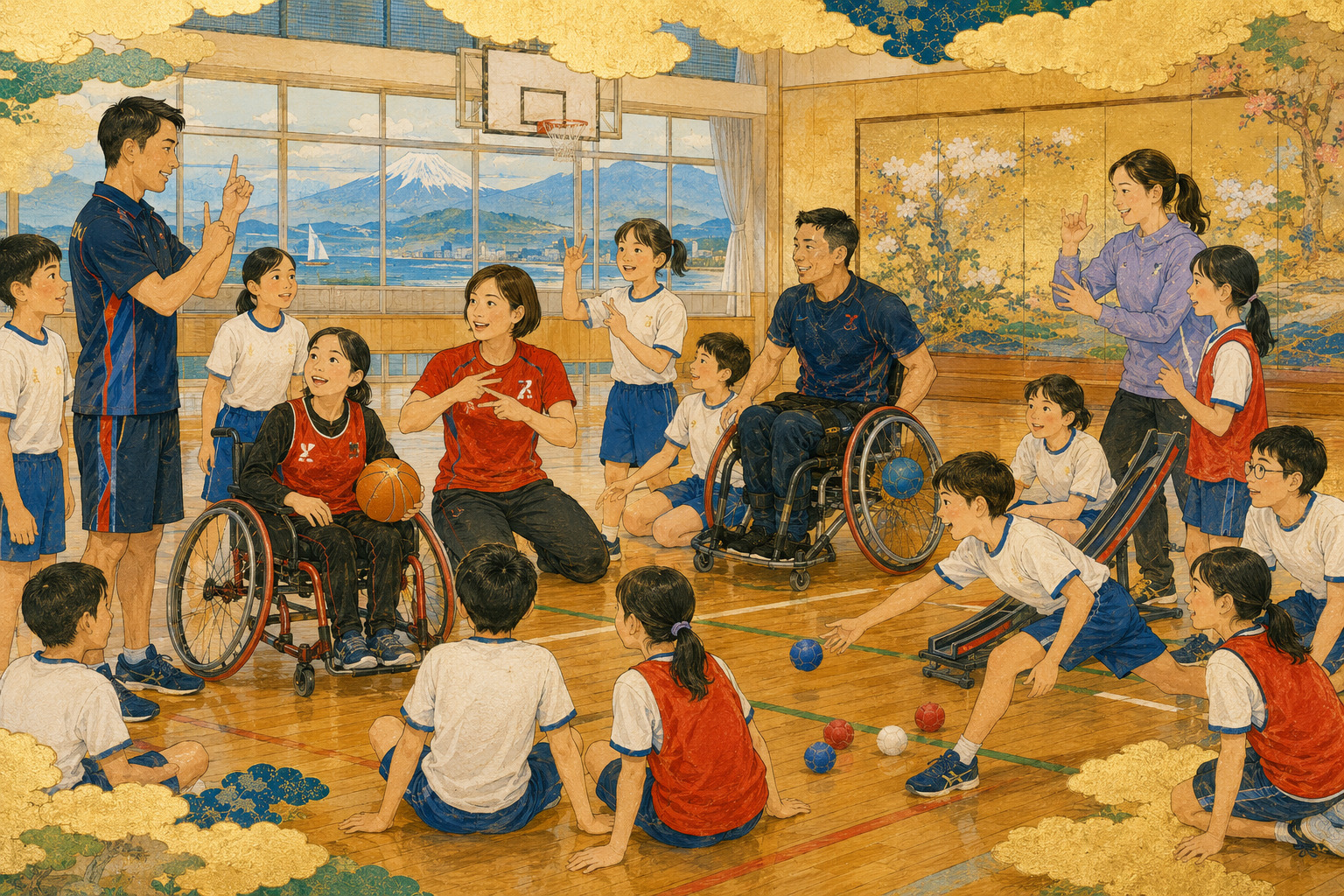
The lesson can begin with a deceptively simple question: Who receives the signal? In a gym built around spoken instructions and whistles, a Deaf player may have to turn away from the action to find information. In a goalball match, by contrast, silence from spectators is part of access because athletes track a bell inside the ball. In wheelchair basketball, the chair is not a hospital device but precision sporting equipment, accelerated, braked and rotated as deliberately as any racquet or bicycle.
Kanagawa Prefecture will bring those different systems into public-school classrooms from September 2026 through March 2027. Under a program whose Japanese title means “Future Lessons Connected Through Sport,” Deaf-sport and para-sport athletes will visit elementary, junior-high, senior-high and special-needs schools. The prefecture says each class will combine a lecture, hands-on sport, an athlete demonstration and questions from students.
Twenty schools are planned. An annex released on September 4 identifies dates, disciplines and instructors for 17 of them; the remaining schedule was still being arranged. The first published class is September 11 at Hadano Sogo High School, where wheelchair basketball player Moeko Suzuki will teach. Kanagawa's own earlier profile verifies her Japanese name, 鈴木百萌子, and reading, すずき・ももこ, and describes her work with the women's wheelchair basketball team WING.
The prefecture presents the classes as a legacy of the Tokyo 2025 Deaflympics, held the previous November. That label creates an obligation. A legacy is not sustained by attaching a finished event's name to a new ceremony. It survives when a child begins to notice which classmates are missing information, when a teacher changes how instructions are delivered, and when a school makes participation possible without waiting for an exceptional athlete to visit.
From watching a sport to testing its design
The announced program is geographically and competitively broad. Published visits reach Yokohama, Hiratsuka, Odawara, Atsugi, Yokosuka, Manazuru and Kiyokawa as well as prefectural schools. The disciplines include wheelchair basketball, para cycling, goalball and blind football; Deaf futsal, athletics, handball, football, basketball, cycling and tennis are also represented.
That range protects against one of the easiest mistakes in disability education: treating “disability sport” as though it were a single game with one set of accommodations. Some athletes need more visual information. Others depend on sound. Some use highly specialized chairs or tandem bicycles. The relevant design changes with the discipline, the setting and the person.
The schedule itself offers useful contrasts. A September 29 para-cycling class at Ohara Elementary School in Hiratsuka is assigned to Masashi Ishii, a Beijing 2008 Paralympic gold medallist. Takehide Shitara is scheduled to introduce Deaf futsal at Kamiogino Elementary School in Atsugi on October 14. Deaf track-and-field athlete Honami Kawaguchi is listed for Sagamihara Chuo Special Needs School on October 28. November and winter sessions extend into Deaf handball and basketball, goalball, blind football and Deaf tennis.
The official annex should be treated as a working schedule. Kanagawa says coordination is continuing, and school lessons are not open to the public. Journalists must contact the prefecture at least one week in advance; schools may decline coverage. The restriction is not a minor logistical detail. The participants are pupils, and educational purpose and privacy take precedence over turning the class into a public show.
Deaf sport and para sport are not synonyms
The title of the initiative names two sporting traditions, and the distinction matters. The Deaflympics are governed by the International Committee of Sports for the Deaf, or ICSD. They are separate from the Paralympic Games. The first Summer Deaflympics took place in Paris in 1924 with 148 athletes from nine countries. Tokyo 2025 was the 25th Summer Deaflympics, the centennial edition and the first held in Japan.
Many Deaflympics rules closely resemble those used in mainstream competition. The essential difference is access to information. A flash lamp can replace an audible starting signal in athletics or swimming. A referee can raise a flag or arm along with blowing a whistle. The Japanese Federation of the Deaf describes these measures as shikaku hosho—visual assurance or visual access. They do not make the contest easier. They make the same competitive information available to every athlete.
Para sport encompasses a wider range of impairments and classification systems. Rules, equipment and assistance are specific to each discipline. A sighted guide, a tactile marking, a sport chair or an audible ball serves a different competitive purpose. Even the sensory environment can reverse: the additional visual signal needed in Deaf sport is matched by the controlled quiet needed for goalball. “Accommodation” is therefore not one standardized favor. It is a method of identifying the information and movement a sport requires, then designing a fair way to access them.
A centennial event meets a new sign-language law
The Tokyo Deaflympics arrived during a significant change in Japanese law. The Act on the Promotion of Policies Concerning Sign Language—Act No. 78 of 2025—passed both houses unanimously, then was promulgated and took effect on June 25, 2025. It recognizes sign language as a language and other important means of communication for those who use it. It assigns national and local governments responsibilities for its acquisition and use, preservation and development of sign-language culture, and greater public understanding.
That history changes what a classroom encounter ought to accomplish. Teaching a few signs as novelty can be a friendly beginning, but it is not the end. Students can examine where a speaker stands, whether faces are visible, whether a video has captions, whether an announcement exists in a visual form, and whether turn-taking lets everyone follow a group discussion. Sport becomes a working laboratory for access rather than an abstract moral lesson.
Kanagawa's policy line is older than the Tokyo 2025 event. It has promoted “Kanagawa Para-Sports” as a concept under which people make use of their own physical functions to do, watch and support sport. The prefecture operates equipment loans, classes, instructor development and a separate lecturer-dispatch program. Its second Sports Promotion Plan, adopted in March 2026, places “realizing an inclusive society through sport” among four strategic perspectives.
The same plan establishes a measurable gap. Kanagawa's fiscal 2024 survey put the proportion of disabled residents playing sport at least once a week at 34.5 percent. The fiscal 2030 target is 40 percent. A visiting-athlete class is not, by itself, a participation-rate intervention. But it can open a pathway: a disabled child discovers a viable discipline; classmates learn how to share a game; a teacher sees equipment as an enabler rather than an obstacle; a family receives a link to a local club.
1924 — The first Summer Deaflympics is held in Paris with nine countries and 148 athletes.
2015 — Kanagawa advances its prefecture-wide “Kanagawa Para-Sports” approach.
2021 — The delayed Tokyo 2020 Paralympics takes place as Olympic and Paralympic education expands in schools.
June 2025 — Japan's sign-language policy act is passed, promulgated and put into force.
November 2025 — Tokyo hosts Japan's first Deaflympics, a centennial edition of the Summer Games.
September 2026 — Kanagawa begins its new 20-school athlete program.
What a visiting athlete can—and cannot—teach
An athlete visit has an immediacy that a worksheet cannot reproduce. Students can see acceleration, balance, timing and tactical communication. They can ask a person about a lived experience instead of hearing a nondisabled adult speak on the person's behalf. A sport demonstration also displaces the assumption that adapted competition is a diluted version of something else: the skill is visible before any lecture explains it.
Research on Japan's Olympic and Paralympic education, however, argues for modest claims. A 2020 study analyzed open-ended responses from 124 elementary, junior-high, senior-high and special-needs teachers involved in the Sports Agency's national program. Teachers associated athlete talks and practical instruction with stronger interest, understanding of disability and learning about values. They also reported difficulty with preparation, scheduling, equipment and facilities, cooperation among teachers and continuity.
The evidence has limits. It was a qualitative analysis of teachers' accounts, not a controlled measurement of pupils' behavior years later. A separate analysis of school reports from 2016 and 2017 likewise documented a wide range of activities and reported outcomes, but could not consistently match every activity with every claimed effect. Such studies support careful lesson design; they do not prove that a single exciting afternoon permanently changes attitudes.
The practical lesson is to build before and after the athlete's visit. Beforehand, students can study the discipline and predict where information or movement may be blocked. During the class, they can test visual signals, adapted equipment and team communication. Afterwards, they can audit their own gym, assemblies, announcements, emergency drills and club activities. The visit then becomes the middle of an inquiry rather than its ceremonial conclusion.
Five tests for a class that lasts beyond one day
- Preparation: Students learn the rules and identify possible barriers before the athlete arrives.
- Experience: The class tests signals, equipment and communication instead of relying on a speech alone.
- Reflection: Pupils apply the lesson to information and participation inside their own school.
- Agency: Athletes define their own experience; adults do not compress it into a predetermined moral.
- Evaluation: Schools measure knowledge, attitudes and actions after time has passed, not only same-day satisfaction.
Do not turn expertise into inspiration alone
There is a recurring danger when elite disabled athletes enter schools: presenting them only as inspirational people who “overcame” disability. Their training and results can rightly command admiration. But if the lesson locates every achievement in individual willpower, it removes the inaccessible building, the audio-only announcement, the unavailable interpreter and the absence of a nearby club from view.
An athlete is not a welfare exhibit. The visitor is an expert in competition. Questions about chair handling, drafting, court vision, an opponent's tactics, team signals, training and defeat make room for sporting knowledge. They also let students move beyond two limiting reactions—pity and amazement—and see a player whose craft can be analyzed.
The program's own delivery must model the inclusion it teaches. Sign-language interpretation, captions, positioning, readable materials, tactile access, breaks and personal assistance may be relevant, but requirements differ by instructor and class. Kanagawa's public announcement does not specify the arrangements school by school. Publishing an anonymized account of what worked and what changed would turn 20 local experiences into practical guidance for teachers across the prefecture.
The route from a school gym to everyday participation
Kanagawa already has programs that could receive students after the class: para-sport lessons, equipment loans, trained support personnel and instructor dispatch. A school visit becomes more consequential when it ends with a concrete next place to play, volunteer, watch or learn. Without that bridge, curiosity can expire at the gym door.
The prefecture should also define success publicly. Why were these 20 schools chosen? How many disabled and nondisabled pupils participated? What did they understand before the lesson and several months later? Did teachers change an exercise, a communication practice or a school event? Did any pupil enter a local sport program? The September 4 announcement provides no evaluation framework, and the absence should not be filled with invented results.
When the first ball strikes the floor on September 11, the most important sight will not be a spectacular shot. It will be the moment a class asks who received the signal, who did not, and what can be redesigned. A mega-event leaves banners and records. A social legacy is quieter: a repeated habit of noticing barriers, asking the people affected and changing the conditions of participation.
Primary documents and research
- Kanagawa Prefecture, “Fiscal 2026 ‘Future Lessons Connected Through Sport’ taught by Deaf and para athletes” — September 4, 2026; purpose, dates, planned 20 schools, class components and access conditions.
- Kanagawa Prefecture, “List of dates, schools, disciplines and instructors” — the 17 publicly scheduled classes as of September 4; Japanese names and spellings.
- Japanese Federation of the Deaf, introduction to the Deaflympics — competition history, eligibility and visual access through start lamps, flags and gestures.
- Japan Goalball Association, “What is goalball?” — the ball's bells, eyeshades and the sport's use of sound.
- Cabinet Office, “Promoting policies concerning sign language” — enactment in 2025, the law's status and core principles.
- Kanagawa Prefecture, Second Sports Promotion Plan — March 2026; inclusive-society policy, Tokyo 2025, participation baseline and 2030 target.
- Kanagawa Prefecture, para-sports programs — prefectural concept, classes, equipment lending, personnel development and instructor dispatch.
- Kanagawa Prefecture, women's wheelchair basketball team WING — official spelling and reading of Moeko Suzuki's name and her team background.
- Japanese Para-Sports Association, Beijing 2008 Japanese medallists — Masashi Ishii's gold, silver and bronze medals in cycling.
- Fujisawa Mirai Foundation, athlete profile of Masashi Ishii — official reading and competitive record.
- Gunma Prefecture Para-Sports One-Stop Center, athlete profile of Takehide Shitara — official reading and Deaf futsal discipline.
- Japanese Federation of the Deaf, Tokyo 2025 athletics team — official reading and discipline for Honami Kawaguchi.
- Japan Sports Agency, nationwide Olympic and Paralympic movement education project — national program, practice reports and overall evaluation.
- Yusuke Okada and co-authors, “Methods for promoting Olympic and Paralympic education from teachers' perspectives”, Japanese Journal of Sport Education Studies, Vol. 40, No. 2 (2020) — qualitative analysis of 124 teachers.
- Akiyo Miyazaki, “Development and evaluation of Olympic and Paralympic education at school”, Japan Journal of Physical Education, Health and Sport Sciences (advance publication, 2019) — analysis of participating schools' reports from 2016 and 2017.
Reporting note: This report uses public information available through 8:00 a.m. JST on September 5, 2026. Japanese primary sources from Kanagawa and Gunma prefectures, the Cabinet Office, the Sports Agency, the Japanese Para-Sports Association and the Japanese Federation of the Deaf were used to verify the program title, institutional names, school and instructor names, dates, disciplines, statute, statistics and specialist terminology. The readings used for Moeko Suzuki, Masashi Ishii, Takehide Shitara and Honami Kawaguchi were checked against official Japanese profiles or records; no unverified readings were inferred. Public records reviewed did not identify the remaining three schools, grades and participant counts, lesson length and materials, site-specific accessibility arrangements, school-selection criteria, athlete compensation, total budget, outcome measures or continuation after March 2027. The Japanese and English reports were structured and written independently.
Image rights: © 2026 Japan.co.jp. This AI-assisted editorial illustration may not be reproduced or reused without permission. For licensing, visit the contact page.