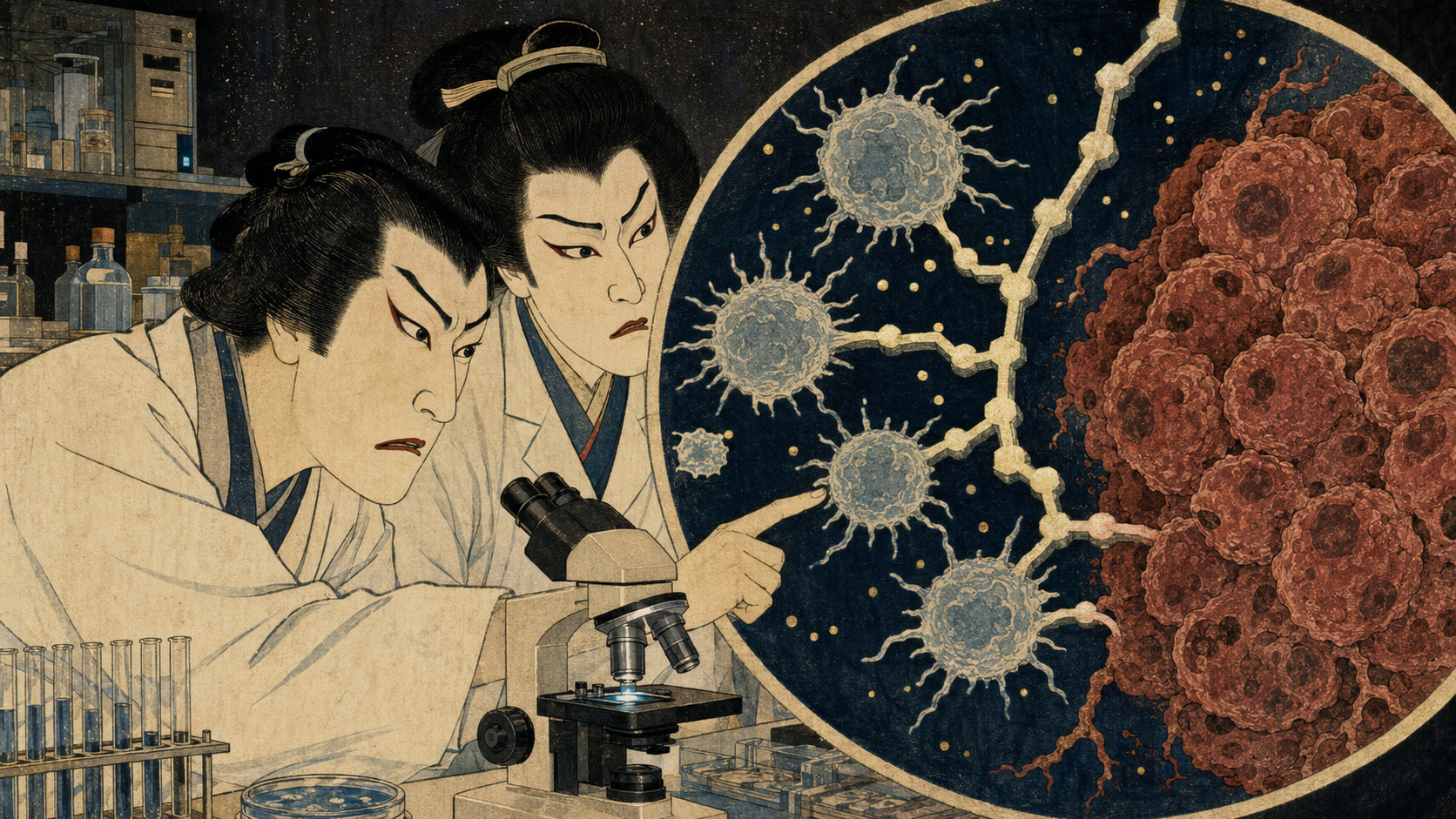
If cancer immunotherapy were a car, a checkpoint inhibitor would release the brake. Antibodies block suppressive molecules such as PD-1 or CTLA-4 and tell an exhausted T cell to move again. Inside some colorectal tumors, however, the road beyond the brake is barricaded. A research team at Juntendo University has mapped one circuit that can build that barricade.
Takumi Itoh, Ryo Hatano, Yuta Hasegawa, Chikao Morimoto and colleagues found selective accumulation of IL-26-producing type-17 T cells in colorectal tumors resistant to immune-checkpoint blockade. IL-26 did not behave merely as an ordinary cytokine carrying an instruction to a receptor on the cell surface. It entered colorectal-cancer cells, moved into their nuclei and altered how genes were read. The remodeled tumor then called in neutrophils and other myeloid cells that suppressed cancer-killing CD8 T cells.
The work appeared online in Nature Communications on July 17 and was announced by Juntendo on July 23. Its conceptual advance is to connect inflammation, epigenetics and immune escape through one molecule. Researchers have long known that inflammation surrounding a tumor can worsen malignancy. This study proposes a chemical itinerary: a signal made by an immune cell enters a cancer-cell nucleus, changes chromatin and turns the tumor into a dispatcher for immune suppression.
Reading the circuit one step at a time
The first actor is a type-17 T cell. The intestine constantly encounters food, commensal organisms and pathogens; type-17 immunity helps defend that border. When chronically activated, however, it can also damage tissue and contribute to autoimmunity or tumor-promoting inflammation. The Juntendo team identified a prominent IL-26-positive population among tumor-reactive type-17 T cells in checkpoint-resistant colorectal cancer. IL-26 expression was also higher across colorectal-cancer samples than in healthy controls, with similar trends reported in gastric and esophageal cancer.
IL-26 then entered the cancer-cell nucleus. According to the paper, it bound directly to the transcription factor STAT1 and assembled complexes with NF-κB and AP-1—major switches for inflammatory and stress-responsive genes. The active-chromatin mark H3K27ac and the BET-family “reader” BRD4 accumulated at regulatory regions. The DNA sequence itself did not change; access to the sequence did. That is epigenetic remodeling.
Among the genes opened most dramatically were chemokines including CXCL1, CXCL2 and CXCL3. Chemokines are molecular addresses telling immune cells where to travel. Juntendo says expression rose by more than 5,000-fold under the reported experimental conditions. Neutrophils and other myeloid-derived cells followed the signal into the tumor, where they suppressed CD8 T-cell killing. A molecule made by one immune subset reprogrammed a cancer cell; the cancer cell summoned another immune population; those arrivals restrained the very T cells checkpoint therapy had tried to liberate.
| Stage | What happens | Possible therapeutic meaning |
|---|---|---|
| 1. Signal source | Tumor-specific type-17 T cells release IL-26 | Candidate tissue or blood biomarker of resistance |
| 2. Nuclear entry | IL-26 enters the cancer-cell nucleus, binds STAT1 and joins NF-κB/AP-1 complexes | A blocking point beyond conventional cell-surface cytokine signaling |
| 3. Chromatin remodeling | BRD4 and H3K27ac increase, making CXCL genes easier to transcribe | Potential intervention at IL-26 or BET/BRD4 |
| 4. Cellular recruitment | CXCL1, CXCL2 and CXCL3 draw neutrophils and other myeloid cells | The downstream CXCL/CXCR2 axis may also be targetable |
| 5. Immune escape | Recruited cells suppress CD8 T cells and promote tumor growth and checkpoint resistance | Reveals a wall that PD-1 blockade alone may not remove |
Why colorectal immunotherapy divides into two worlds
The discovery makes sense only against both the success and the limits of colorectal immunotherapy. When a cell copies DNA, mismatch-repair machinery corrects typographical errors. Tumors that lose proteins such as MLH1, MSH2, MSH6 or PMS2 are mismatch-repair deficient, or dMMR. Errors accumulate in repetitive sequences, producing high microsatellite instability, or MSI-high. More mutations can produce more neoantigens that look foreign to the immune system. These tumors often contain T cells, then protect themselves through pathways such as PD-1/PD-L1—making brake release unusually effective.
A small 2015 phase II study led by Johns Hopkins researchers became a turning point. Pembrolizumab produced responses in four of ten patients with dMMR colorectal cancer and none of 18 with mismatch-repair-proficient disease. The dMMR tumors averaged 1,782 somatic mutations, compared with 73 in the proficient tumors. That contrast helped establish a new principle: the DNA-repair state, not merely the organ of origin, could predict checkpoint benefit.
In the 307-patient KEYNOTE-177 trial, first-line pembrolizumab extended median progression-free survival in metastatic MSI-high/dMMR colorectal cancer to 16.5 months, versus 8.2 months with chemotherapy. Japan’s Society for Cancer of the Colon and Rectum recommended first-line pembrolizumab in its 2024 guideline. Following CheckMate 8HW, nivolumab plus ipilimumab also became available in Japan in 2025 as first-line therapy for unresectable advanced or recurrent MSI-high disease.
But the U.S. National Cancer Institute estimates that only about 4% of stage IV colorectal cancers are dMMR/MSI-high. Most are microsatellite-stable and mismatch-repair proficient. They may have fewer visible neoantigens, poor T-cell entry, suppressive fibroblasts and blood vessels, TGF-β signaling or multiple myeloid barriers. Even MSI-high disease does not respond universally. Some tumors never respond—primary resistance—while others escape after an initial benefit. IL-26 adds a new roadblock to that already complicated map.
From bacterial toxins in the 1890s to Japan’s discovery of PD-1
The hope of directing immunity against cancer is old. In the 1890s, American surgeon William Coley, influenced by tumors that regressed after infection, injected bacterial products into patients. The results were inconsistent and dangerous, but suggested that an immune disturbance could sometimes turn against cancer. In the 1950s, Frank Macfarlane Burnet and Lewis Thomas articulated immune surveillance: the idea that immunity continuously removes abnormal cells.
The decisive shift was not simply to press the immune system harder, but to remove mechanisms that stop it. In 1996, James Allison and colleagues showed that an antibody blocking CTLA-4 could cure tumor-bearing mice and leave durable immune memory. One of the models used a colon-carcinoma cell line.
The second path began in Kyoto. Tasuku Honjo’s laboratory identified an unfamiliar gene in 1992 and named it programmed cell death-1, or PD-1, because of the context in which it appeared. Years of work revealed that PD-1 was a brake guarding against excessive immune reactions, and that tumors could engage it through PD-L1. Allison and Honjo received the 2018 Nobel Prize in Physiology or Medicine for cancer therapy through inhibition of negative immune regulation.
Checkpoint antibodies do not poison a cancer cell directly in the manner of classic chemotherapy. They alter the relationship between tumor and host immunity. That can generate long-lasting remission, but it can also cause autoimmune-like colitis, pneumonitis, hepatitis and endocrine injury. Immune brakes protect healthy tissue for a reason. An IL-26 therapy would face the same fundamental challenge: stop the tumor’s misuse of inflammation without destroying antimicrobial defense and mucosal balance.
IL-26: an unconventional cytokine found through a virus
The IL-26 story began in 2000. Researchers studying human T cells transformed by a monkey herpesvirus isolated an unknown gene related to IL-10 and called it AK155. It encoded a secreted protein of 171 amino acids, later renamed IL-26. In 2004, investigators identified its conventional receptor as the combination of IL-20R1 and IL-10R2, which activates STAT1 and STAT3. Colon epithelial and carcinoma cells were among the early recognized targets.
IL-26 proved stranger than an ordinary messenger. It is positively charged and amphipathic. In 2015, researchers showed that human TH17-derived IL-26 could act as a natural antimicrobial: it punched pores in bacterial membranes, bound bacterial or host DNA and carried that DNA into innate immune sensing pathways. Its biology was not confined to docking at a receptor. The Juntendo study adds a more unusual identity—an immune molecule that enters a cancer-cell nucleus and participates in a transcriptional complex that changes chromatin.
IL-26 research carries a persistent technical blind spot: mice and rats lack the IL26 gene. The most common animals in cancer immunology do not naturally make the molecule. Juntendo’s investigators used mice engineered to express human IL-26. When colorectal-cancer cells were implanted, checkpoint treatment lost effectiveness, inflammatory colorectal tumors grew larger and myeloid cells accumulated. Inhibiting IL-26 or BRD4 reduced malignant behavior and resistance in the models.
That engineered system is both a strength and a limitation. A mouse supplied with one human cytokine does not reproduce decades of human diet, microbiota, aging, medication and treatment history. A greater-than-5,000-fold transcriptional change in a controlled model is not a clinical response rate. The paper aligns observations in human tumors with cell, chromatin and intervention experiments, but it does not show that blocking IL-26 benefits a person with colorectal cancer.
Epigenetics changes the performance without rewriting the score
Developmental biologist Conrad Waddington used the word “epigenetics” in 1942 to think about how genotype produces phenotype. The modern term includes DNA methylation, histone modification and chromatin organization—ways of changing gene availability without changing the sequence of DNA letters. If DNA is a musical score, epigenetics decides which page lies open, how loudly it is played and which passage comes next.
DNA wraps around histone proteins. Adding acetyl groups at particular histone positions generally loosens the arrangement and makes transcription easier. H3K27ac—acetylation of lysine 27 on histone H3—is a familiar mark of active enhancers and promoters. BRD4 recognizes acetylated lysines with its bromodomains and recruits machinery that advances transcription. It is an epigenetic reader: neither the writer nor eraser of the mark, but the protein that interprets it.
In 2010, researchers reported in Nature that the small molecule JQ1 could competitively occupy BET bromodomains and displace BRD4 from chromatin. The work established that an epigenetic reader could be drugged and made BRD4 a major target in cancer and inflammation. Translation has been difficult. BRD4 supports normal transcription in many tissues, and BET inhibitors have faced problems with thrombocytopenia, gastrointestinal toxicity, selectivity and durable efficacy.
Thus, weakening resistance with a BRD4 inhibitor in the new mouse model does not mean an existing BET drug is ready for colorectal patients. Blocking the upstream IL-26 signal might be more selective. Blocking downstream CXCL chemokines or their receptors might be safer. Each option interrupts a different part of the circuit and risks a different kind of collateral damage.
Inflammation can be the fire brigade and the arsonist
Nineteenth-century pathologist Rudolf Virchow noticed tumors arising in sites of chronic inflammation. Modern colorectal medicine recognizes that longstanding ulcerative colitis and Crohn’s colitis increase cancer risk. Inflammation repairs wounds and removes infection; when sustained, it can also drive proliferation, DNA damage, blood-vessel growth and immune suppression. Tumors have often been compared to wounds that do not heal.
The IL-26 circuit brings that duality into sharp focus. Type-17 cells normally participate in microbial defense at mucosal surfaces. Neutrophils are rapid killers of bacteria. NF-κB and AP-1 coordinate survival after infection and injury. A tumor can rearrange these legitimate defenses into a barrier against CD8 T cells. The fire brigade answers a smoke alarm, but ends up forming a perimeter that keeps law enforcement away from the arsonist.
That is why “remove the neutrophils” or “block every IL-26 molecule” is not an adequate treatment plan. Weakening antimicrobial defense could cause infections. Damaging the intestinal barrier might produce still more inflammation. Tumor-localized antibodies, limited treatment windows, selection of IL-26-high patients or intervention at the downstream CXCR2 migration pathway are plausible strategies—not established therapies.
The road to a drug is longer than the road to a target
The team reports that inhibiting IL-26 or BRD4 weakened malignancy and checkpoint resistance in experimental models. The paper also discloses that Itoh, Hatano, Yutaro Kaneko, Kei Ohnuma and Morimoto are inventors and patent holders on a humanized anti-IL-26 monoclonal antibody. Kaneko is chief executive of Y’s AC, while Nam H. Dang, Ohnuma and Morimoto are shareholders. These interests do not negate the experiments. They make independent replication and transparent clinical development especially important.
The next evidence should follow patients prospectively from before checkpoint therapy. Investigators need to connect tumor IL-26-positive T cells, blood IL-26, CXCL chemokines and neutrophil measures with response, progression-free survival and acquired resistance. MSI-high and microsatellite-stable tumors must be separated, as must colon and rectal primaries, liver metastases, anti-PD-1 monotherapy and PD-1/CTLA-4 combinations. Only intervention in people can ultimately establish whether IL-26 is a driver of resistance or a marker that rises alongside an aggressive inflammatory tumor.
- Who has the circuit? Is it strongest in MSI-high or MSS disease, primary tumors or particular metastases?
- Can it predict? Does pretreatment IL-26 forecast primary resistance, and does a rise during therapy anticipate acquired resistance?
- How should it be measured? Which is reproducible and practical: tumor staining, tissue RNA or blood protein?
- Is it causal? Do independent patient-derived organoids and humanized immune models reproduce the chain?
- Where should treatment intervene? IL-26, BRD4, CXCL, CXCR2 or the suppressive function of recruited cells?
- When should it be combined? Before anti-PD-1, concurrently or only after resistance emerges?
- What happens to infection defense? Can gut microbiota, mucosal repair and systemic protection remain intact?
- How does immune toxicity change? Would blockade reduce checkpoint colitis or complicate it?
- Will independent centers reproduce it? Replication should be separate from patent and company interests.
- Does it help patients? A trial must improve durable response, quality of life or survival—not only a laboratory biomarker.
Why the finding matters especially in Japan
Colorectal cancer is Japan’s most frequently diagnosed cancer. The National Cancer Center summarizes more than 150,000 diagnoses and 53,000 deaths each year. Fecal immunochemical testing, colonoscopy after a positive result and removal of precancerous polyps can reduce mortality, but screening and diagnostic-completion rates remain inadequate. Sophisticated molecular treatment and ordinary screening are not competitors. Preventing or finding cancer early remains the most powerful strategy against treatment resistance.
For people with advanced or recurrent disease after standard options fail, however, maps of resistance are urgently needed. Japan gave the world PD-1. This new work describes a layer that cannot be solved by releasing the brake alone. The field is moving from indiscriminately strengthening immunity toward measuring which cells a tumor recruits, which chromatin regions it opens and which attackers it excludes in each patient.
Finding a wall is not the same as safely demolishing it
The most compelling element of Juntendo’s finding is continuity. One immune-cell molecule does not stop at an extracellular message; it enters a cancer-cell nucleus, becomes part of a transcriptional apparatus and changes the personnel around the tumor. IL-26, STAT1, NF-κB/AP-1, BRD4/H3K27ac, CXCL chemokines, neutrophils and CD8 T cells form a sequence. Each actor was familiar, but connecting them exposes possible places to intervene.
A blueprint is not a building. The paper combines resistant human tumors, molecular experiments and human-IL-26 mouse models into a persuasive mechanism. It is not a trial of an anti-IL-26 antibody in patients. The field still must identify the right people, preserve infection defense, protect BRD4’s normal functions and find the correct combination with checkpoint therapy. Nature also notes that the online manuscript is an early unedited version and will undergo further editorial processing.
Immunotherapy’s history shows that strange basic discoveries can transform treatment decades later. PD-1 was initially named in the context of cell death. IL-26 was discovered in virus-transformed T cells, then understood as a receptor ligand, an antimicrobial and a DNA carrier. It has now appeared as a remodeler inside the cancer-cell nucleus. Whether the next chapter is an anti-IL-26 medicine remains unknown. For now, a dark area of checkpoint resistance has gained a circuit diagram—and a wire that might one day be safe to cut.
Sources and references
This report checked Juntendo’s announcement and the original paper against the National Cancer Center Japan, the Japanese Society for Cancer of the Colon and Rectum, the U.S. National Cancer Institute and FDA, the Nobel Foundation, and foundational IL-26 and BRD4 studies. Human observations are distinguished from cell and engineered-mouse results; the experimental “5,000-fold” expression finding is not presented as a clinical effect. Treatment requires tumor MSI/MMR testing and decisions with an oncology team.
- Juntendo University: new mechanism of colorectal-cancer progression and immunotherapy resistance (July 23, 2026)
- Itoh et al.: “IL-26-driven epigenetic remodeling promotes immune evasion in colorectal cancer” (Nature Communications, 2026)
- National Cancer Center Japan: colorectal-cancer fact sheet (2025)
- National Cancer Center Japan: 2024 evidence-based colorectal-screening guideline
- Japanese Society for Cancer of the Colon and Rectum: first-line nivolumab plus ipilimumab for MSI-high advanced disease
- U.S. National Cancer Institute: Colon Cancer Treatment PDQ and MSI-high/dMMR immunotherapy
- Le et al.: “PD-1 Blockade in Tumors with Mismatch-Repair Deficiency” (NEJM, 2015)
- FDA: first-line pembrolizumab and KEYNOTE-177 results (2020)
- FDA: nivolumab plus ipilimumab and CheckMate 8HW (2025)
- Nobel Foundation: the history of CTLA-4, PD-1 and cancer therapy by inhibiting negative immune regulation (2018)
- Knappe et al.: discovery of AK155/IL-26 (Journal of Virology, 2000)
- Sheikh et al.: the IL-20R1/IL-10R2 receptor and STAT signaling (Journal of Immunology, 2004)
- Hör et al.: IL-26 targets epithelial and colon-carcinoma cells (JBC, 2004)
- Meller et al.: antimicrobial and DNA-sensing functions of TH17-derived IL-26 (Nature Immunology, 2015)
- Filippakopoulos et al.: selective BET bromodomain inhibition and JQ1 (Nature, 2010)