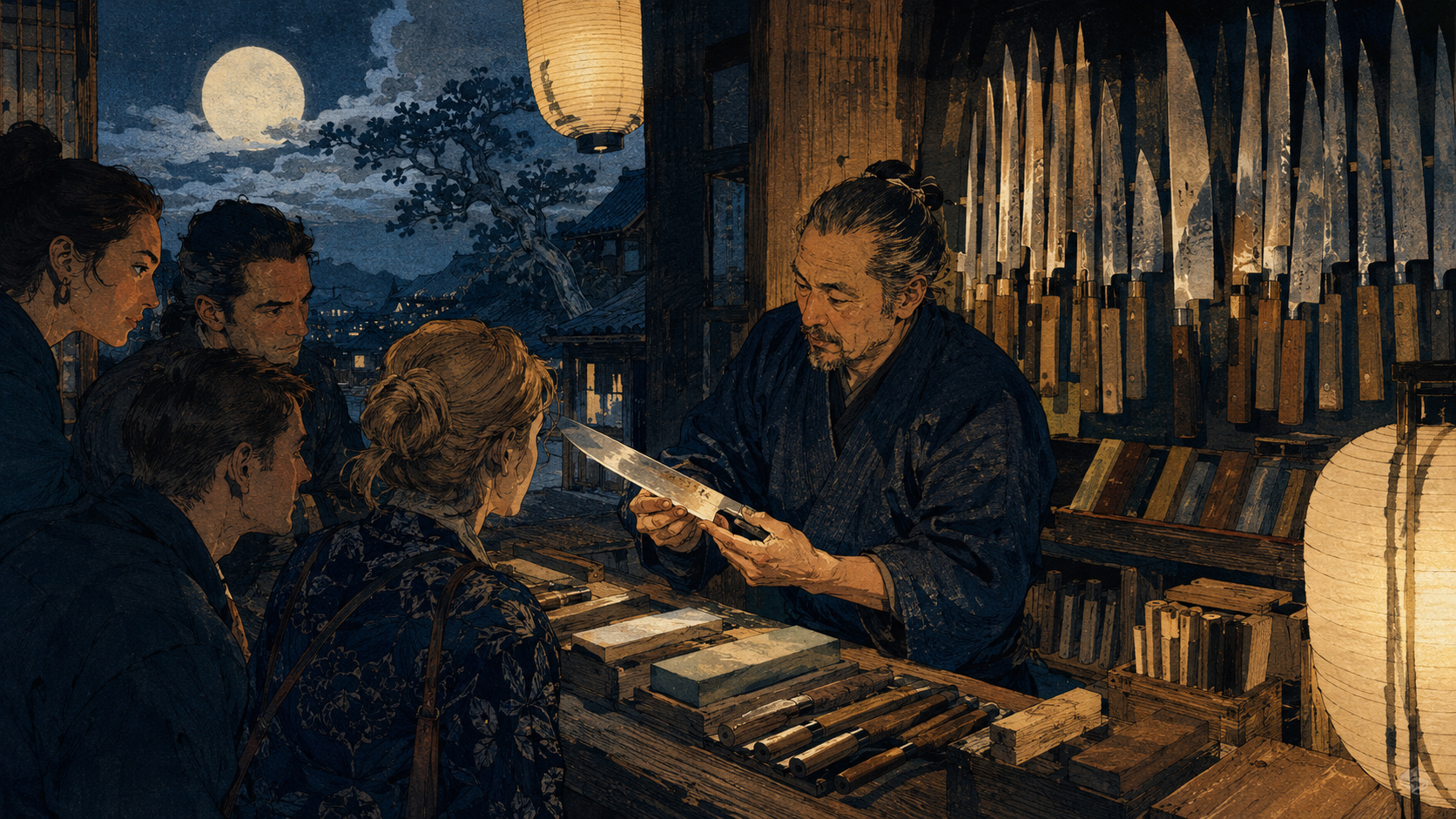
The sale often begins with a tomato, a sheet of paper or a carrot. A visitor lifts a knife from a Tokyo display, feels the balance, and watches the edge pass through the test material with almost no visible pressure. Then comes the longer conversation: right- or left-handed, carbon or stainless, single- or double-bevel, meat or fish, home cook or professional, whetstone or paid sharpening. In the best shops, the object is not sold as a generic piece of “Japanese steel.” It is fitted to a person and a kitchen.
That encounter is multiplying. A July 16 report described Japanese kitchen knives selling briskly to foreign visitors at specialty stores near Omotesando, in Shibuya Center-gai and by Tokyo Skytree. Tokyo’s Kappabashi kitchenware district—about 900 meters and nearly 170 specialist shops—now draws growing tourist crowds alongside its traditional restaurant-industry customers. In Sakai, Osaka Prefecture, the city’s traditional-crafts museum passed ¥100 million in annual knife sales in fiscal 2023, with overseas visitors accounting for roughly half, according to a Kyodo report.
The phenomenon is larger than a fashionable shopping street. The product connects Japan’s global restaurant culture, the weak yen, record visitor spending, social media, home cooking and a centuries-old network of small manufacturers. It also forces a more difficult question: what exactly is a “Japanese knife”? The answer may refer to a blade shape, a sharpening geometry, a production region, a brand, a style inspired by Japan—or verifiable manufacture in Japan. Those are not interchangeable.
The boom in four numbers—and one warning
Tokyo Shoko Research extracted 38 kitchen-knife manufacturers from its company database for which five consecutive periods of sales and profit could be compared. Their latest financial years, ending between September 2024 and August 2025, produced aggregate sales of ¥16.733 billion, up 2.5 percent, and profit of ¥623 million, up 44.5 percent. Sales had risen by roughly ¥2 billion over five years. Both totals were the highest in the comparison.
Demand came from several directions: durable household use, the pandemic-era home-cooking lift, hometown-tax gifts, exports, overseas restaurants and purchases by travelers who could handle or test an item before buying. The weaker yen improved export competitiveness and made high-quality knives look less expensive to visitors; price increases helped offset materials costs. At the same time, some companies reported that post-pandemic demand had cooled or that raw-material inflation was squeezing margins.
The warning is methodological. The ¥16.733 billion is not the value of Japan’s entire kitchen-knife industry. It is a matched panel of 38 companies chosen from two industry classifications, adjusted in the case of large diversified firms to count the identifiable kitchen-knife portion. Tokyo’s 41.9 percent share in the panel is pushed up by a single large company. Gifu, home to Seki, represented 31.8 percent; Niigata, including Tsubame-Sanjo, 16.7 percent; Kochi, home to Tosa blades, 4.4 percent; and Osaka, including Sakai, 3.5 percent. Those are panel shares, not a complete map of regional production.
Why the tourist market matters in 2026
Japan received about 42.68 million foreign visitors in 2025, the first year above 40 million and a record. Their estimated spending reached ¥9.4559 trillion, 16.4 percent higher than in 2024 and almost twice the 2019 level. The average across all trip purposes was ¥229,000 per traveler. A durable, portable and culturally legible tool fits squarely into the shift from cheap souvenirs to higher-value purchases.
The latest quarter is more nuanced. From April through June 2026, inbound spending was ¥2.5096 trillion, only 0.2 percent above a year earlier, while spending per traveler rose 3.3 percent to ¥244,000. The United States ranked first, followed by Taiwan, China, South Korea and Hong Kong. Japan’s inbound economy therefore remains strong in value even as visitor flows are not rising uniformly from every market. A knife retailer cannot assume endless volume growth; product knowledge and trust matter more when the buyer is spending selectively.
Demand also travels in the other direction. The Ministry of Agriculture, Forestry and Fisheries counted about 181,000 Japanese restaurants overseas in 2025, down from the unusually high 2023 estimate of 187,000 but more than double the roughly 89,000 counted in 2015. The figure is a survey estimate of establishments treated locally as Japanese restaurants, not a quality certification. Still, it describes an enormous international workforce of chefs and diners already familiar with sushi, ramen, yakitori and Japanese presentation.
UNESCO’s 2013 inscription of washoku concerned social practice and New Year food culture, not an endorsement of particular knives. Yet global recognition of Japanese cuisine widened interest in the tools behind precise fish slicing, vegetable cuts and presentation. The knife is attractive because it is useful after the trip: every onion becomes a small return to Japan.
Not one origin story: tomb tools, tobacco knives, swords and farms
Retail shorthand often says Japanese kitchen knives descend from samurai swords. The connection is real in certain places and techniques, but it is incomplete. Japan’s blade industry grew through several streams: sword making; tools for agriculture, forestry and carpentry; razors and scissors; tobacco processing; Western cutlery; and, later, mechanized stainless-steel production. The modern market is a family of regional manufacturing systems, not a single sword line converted into chef knives.
Sakai’s official history reaches back to ironworkers who made tools for kofun construction in the fifth century. The decisive commercial turn came in the sixteenth century, after firearms and tobacco arrived through Portuguese contact. Sakai produced guns and the sharp knives used to cut tobacco leaves. The Tokugawa shogunate granted a quality seal and exclusive selling privileges, spreading Sakai’s reputation nationally. Single-edged kitchen knives developed during the Edo period; the deba and a growing family of purpose-specific forms followed.
Seki, in Gifu Prefecture, built its name as a medieval sword-making center. The local story dates its smithing tradition to the Kamakura period and associates the town with blades that would not bend or break and cut well. When the Meiji government prohibited samurai from wearing swords in 1876, the sword market collapsed. Seki’s makers turned their metalworking and finishing skills toward kitchen knives, scissors, razors and other cutlery. Over time the city became as important for factory-scale and branded production as for hand forging.
In Tsubame-Sanjo, Niigata Prefecture, the root was often a nail rather than a sword. Regional sources date Sanjo smithing to 1625, when officials brought nail makers from Edo to help farmers earn income after repeated river flooding. The cluster expanded into sickles, tools and knives. Nearby Tsubame developed metal files, pipes, hammered copperware and, in the twentieth century, Western tableware and stainless housewares. Today the paired name describes a dense ecosystem capable of both traditional blacksmithing and precision industrial processing.
Echizen’s tradition is said to begin in 1337, when the Kyoto swordsmith Chiyozuru Kuniyasu settled in the area and made sickles for farmers. Under Fukui-domain patronage, guilds and traveling lacquer workers carried Echizen blades through the country. In 1979, Echizen forged blades became the first cutlery-producing region designated under Japan’s national Traditional Craft system. A cooperative shared workshop and design program later helped small family businesses survive the decline in hand sickles and the rise of mass production.
Tosa blades grew from the needs of a warm, rainy and heavily forested Kochi. Sword techniques arrived in the medieval period, but forestry axes, hatchets and sickles sustained the trade. Tosa’s “free forging” lets a smith shape many sizes and forms in small batches, historically responding to orders drawn at actual scale. Tosa Uchihamono was nationally designated in 1998. These histories show why the categories overlap: a kitchen knife may inherit a swordsmith’s heat treatment, a farmer’s laminated sickle, a carpenter’s grinding culture and a modern factory’s stainless metallurgy.
Five production regions, five different strengths
| Region | Historical base | Contemporary character |
|---|---|---|
| Sakai, Osaka | Tomb tools, firearms and sixteenth-century tobacco knives; Edo quality seal and kitchen specialization. | Renowned for professional single-bevel knives and a strict division of labor among forging, sharpening, handle fitting and wholesale/finishing. National designation: 1982. |
| Seki, Gifu | More than 700 years of sword making; diversification after the end of samurai sword wearing. | A broad cutlery cluster ranging from artisanal work to high-volume branded knives, scissors and razors; strong in modern stainless production and export. |
| Tsubame-Sanjo, Niigata | Seventeenth-century nail making as flood relief, followed by tools, copperware and Western tableware. | Blacksmith knives, work tools, tableware and precision metal processing coexist in an unusually deep supplier network. |
| Echizen, Fukui | Sickles linked to swordsmith Chiyozuru Kuniyasu from 1337; Edo distribution through lacquer workers. | Fire forging, hand finishing and distinctive double-blade spreading; first cutlery region designated a Traditional Craft, in 1979. |
| Tosa, Kochi | Forestry tools and medieval forging in a timber-producing region. | Flexible “free forging” for small-batch, many-form production, from axes and sickles to kitchen knives. National designation: 1998. |
A region name does not by itself describe every knife made there. Sakai companies also sell double-bevel and stainless knives; Seki contains small workshops as well as factories; Echizen makers use modern powder steels; Tosa firms export contemporary chef knives. Nor does a national Traditional Craft designation cover every product from a place. It applies to defined materials, methods and production areas. The designation is valuable evidence, not a universal halo.
From deba and yanagiba to gyuto and santoku
Premodern and early-modern Japanese kitchens developed specialized forms around fish, vegetables and professional trades. A deba is a thick, weighty knife for breaking down fish, not a cleaver to swing through hard bone. A yanagiba draws a long, clean slice through sashimi. An usuba makes precise vegetable cuts and is demanding to control. Eel knives differ between Kanto and Kansai because preparation traditions differ. The takohiki’s square-tipped form belongs to Kanto sashimi work; despite the name, it is not simply an octopus-only tool.
The Meiji embrace of Western food and meat brought Western-derived chef-knife forms into Japanese production. The gyuto—literally “beef sword”—evolved into Japan’s version of a Western chef knife: usually double-bevel, narrower and often thinner than many European counterparts. The petty became a compact utility knife. Factory steel, rolling, stamping and standardized handles broadened ownership beyond professional kitchens.
The santoku emerged in the postwar home as a multipurpose answer to changing diets and smaller kitchens. Its name is commonly interpreted as “three virtues,” referring to meat, fish and vegetables, although marketing explanations vary. A flatter profile than many Western chef knives suits push cutting; the rounded or lowered tip saves space. For many visitors, a stainless 165–180 millimeter santoku—not a single-bevel yanagiba—is the most practical first Japanese knife.
This is why the phrase “Japanese knives are single-bevel” misleads. Traditional professional wa-bocho such as yanagiba, usuba and many deba are often single-bevel, built for highly controlled cuts and usually made in right- and left-handed versions. Modern Japanese gyuto, santoku, nakiri and petty knives are commonly double-bevel. “Japanese” describes a culture and industry; bevel geometry describes a particular tool.
What creates the cut: geometry before mythology
Sharpness is not one material property. The cutting experience comes from the angle and thickness immediately behind the edge, the blade’s overall grind, surface finish, heat treatment, steel, balance and the task. A very hard, acute edge can hold fine sharpness but may chip under twisting or impact. A tougher, softer edge may roll sooner yet survive rougher work and be easier to restore. There is no best steel independent of user and food.
Traditional laminated construction joins hard, carbon-rich edge steel to softer iron. The hard layer takes the cutting edge; the softer body adds support and makes sharpening more manageable. A single-bevel blade usually has a broad bevel on one face and a slightly hollow back, the ura, which reduces contact and permits precise flat-side maintenance. Double-bevel san-mai construction places a hard core between softer outer layers. Honyaki knives, made from one piece of carbon steel and differentially hardened, demand exceptional heat-treatment and grinding skill and are expensive partly because failure rates and labor are high.
Carbon steels can take very keen edges and are responsive on stones, but they discolor, form patina and can rust quickly if left wet or acidic. Stainless and semi-stainless steels trade some traditional behavior for easier care. Modern high-alloy and powder-metallurgy steels can offer long edge retention, but their hardness may make them slower to sharpen and less forgiving of impact. Steel names are useful only alongside heat treatment and geometry.
“Damascus” usually describes visible layered patterning around a core. It can be beautifully made, but layer count does not automatically determine sharpness, durability or Japanese origin. A 67-layer knife is not inherently better than a plain three-layer blade. The core does the cutting; the cladding pattern is largely aesthetic. Buyers paying for performance should ask what the core steel is, who heat-treated and ground it, and whether the maker can service it.
A practical knife map for visitors
| Knife | Designed for | What a visitor should know |
|---|---|---|
| Santoku | General home use: vegetables, boneless meat and fish. | Usually double-bevel; 165–180 mm is manageable. A strong first purchase for a compact kitchen. |
| Gyuto | General chef work, slicing and chopping. | Usually double-bevel; choose length by board and workspace. 210 mm is common, but not automatically ideal. |
| Nakiri | Vegetables with an up-and-down or push cut. | Thin, double-bevel and approachable; the rectangular profile is not a bone cleaver. |
| Petty | Fruit, trimming and small board work. | A useful second knife, but not for prying or jointing hard bone. |
| Yanagiba / takohiki | Long draw cuts for sashimi. | Often single-bevel and handed; long blades need technique, storage and a suitable board. |
| Deba | Fish butchery, heads and small fish bones. | Thick and often single-bevel. It is not intended for frozen food or heavy mammal bones. |
| Usuba | Professional Japanese vegetable technique. | Single-bevel and precise but unforgiving; a nakiri is easier for most home cooks. |
| Honesuki | Poultry boning and work around joints. | Stiff and pointed; use the geometry for separation, not as a general cleaver. |
The best purchase is often less exotic than the most photogenic one. A home cook with a hard glass board, no whetstone and a dishwasher will not be served by a reactive, thin, highly asymmetric blade. A left-handed buyer should never assume a single-bevel knife can simply be turned over. A professional who sharpens weekly will make a different decision from a tourist who needs mail-in service.
Retail becomes theater, classroom and export channel
Inbound demand is changing the shop itself. Retailers put test-cutting stations beside display cases, explain steel in several languages, engrave names, offer sharpening and place workshops near markets or tourist routes. MUSASHI JAPAN opened a Shibuya flagship in April 2026 and a new Kanazawa Higashi Chaya district store in May; it had also opened its first overseas store in Paris in March. Seisuke Knife’s 2026 festival brought makers and customers together at Asakusa Hanayashiki. These are company announcements, not independent demand measurements, but they show how the industry is investing.
The strongest experience is not spectacle alone. A customer should be allowed to compare handle circumference, weight, balance and blade height; disclose handedness and the board used at home; hear what the warranty does not cover; and leave with maintenance and transport instructions in a language they understand. An engraving may make the sale memorable, but a first sharpening appointment makes the relationship durable.
Production regions can capture more value when a visit includes the forge, grinder, museum, local food and repair desk rather than moving a finished blade through a Tokyo counter. Echizen’s shared Knife Village, Sanjo’s blacksmith training hall, Seki’s swordsmith museum and Sakai’s knife museum translate manufacturing into tourism. Done well, this is not a staged replacement for production. It is a way to finance and explain it.
Trust under pressure: the 2026 Sakai refund
The boom’s central vulnerability is provenance. On February 12, 2026, the Sakai Traditional Crafts Museum announced refunds after an inquiry found that eight knives sold between December 1 and 9, 2025, had been manufactured in China. The listed products included gyuto, santoku, kiritsuke, nakiri and yanagiba models priced from ¥25,900 to ¥97,000. The museum stopped sales, acknowledged inadequate verification and promised stronger inspection.
The episode was limited in quantity, and the institution’s public recall and full-refund offer are important. But the location made it significant. A buyer in a traditional-crafts museum reasonably expects origin to have been vetted. Terms such as VG10, Damascus, wa-gyuto, Japanese-style handle or a Japanese brand name do not prove Japanese manufacture. Nor does the place of sale.
Japan Customs states that imported goods bearing false or misleading country-of-origin indications cannot be cleared, and defines origin generally as the country or region where the goods were actually produced or manufactured. Real-world supply chains complicate the question: steel may be melted in one country, rolled in another, heat-treated and ground in Japan, fitted with an imported handle and sold under a regional brand. The truthful answer may therefore require more detail than a single “made in” line.
A serious retailer should be able to distinguish brand owner, manufacturing country, production region, smith or factory, sharpener, core steel, cladding, heat treatment, handle origin and final assembly. Not every buyer needs every name. Every buyer deserves claims that can be supported.
How to buy one knife without buying a legend
| Ask | Why it matters |
|---|---|
| Where was the blade forged or cut, heat-treated and ground? | “Japanese brand” and “Japanese style” do not establish manufacture. Multi-country production should be explained plainly. |
| What is the core steel and hardness range? | It helps predict corrosion, edge retention, sharpening effort and chipping risk—but does not replace geometry or heat-treatment quality. |
| Is it single- or double-bevel, and is it handed? | A left-handed single-bevel version may be different and more expensive; asymmetric double-bevels also need appropriate sharpening. |
| What food, board and motion is it designed for? | Thin edges dislike glass, frozen food, hard bone, twisting and using the blade as a scraper. |
| Who will sharpen it in my country? | Serviceability matters more than a dramatic factory edge. Ask whether the shop accepts international returns. |
| What does the price include? | Confirm sheath, engraving, tax treatment, initial sharpening, repair and warranty terms. |
| May I handle or test it safely? | Comfort, knuckle clearance and balance cannot be inferred from layer count or photographs. |
Look for an invoice that identifies the model and seller, keep the packaging and photograph markings before travel. A national Traditional Craft label or a regional collective trademark can strengthen a provenance case for products actually within its standards, but do not assume every knife in a regional store qualifies. When the claim is artisanal, ask which artisan performed which stage. “Handmade” can truthfully mean substantial handwork without meaning one person made the entire object.
Sharpness is a maintenance system, not a factory event
A knife begins changing the first time it reaches a board. The apex wears, rolls or microscopically chips; the bevel thickens after repeated sharpening; carbon steel reacts with moisture and acids. Good ownership therefore includes edge maintenance, thinning, rust control and occasional repair. A high price does not suspend physics.
The July report cited a consumer survey in which 45 percent used a handheld pull-through sharpener, 25 percent used a whetstone, 19 percent did no maintenance and 9 percent hired a professional. Pull-through devices can restore bite quickly, but a fixed slot may remove metal unevenly, mismatch an asymmetric blade or progressively damage its geometry. A ceramic honing rod is not a universal solution either: very hard, thin Japanese edges can chip if struck or twisted.
For a double-bevel home knife, a medium whetstone and consistent angle can handle routine sharpening, but learning on an inexpensive blade is prudent. Traditional single-bevel sharpening includes maintaining the wide bevel and carefully performing uraoshi on the flat rim around the hollow back; an untrained user can alter the blade permanently. When in doubt, use a specialist who understands the exact geometry, not merely a high-speed grinder.
Wash by hand, wipe dry promptly, and keep carbon steel especially dry. Do not leave a knife in a sink, run it through a dishwasher, cut on glass or stone, twist through joints, pry, or chop frozen food unless the maker explicitly designed the tool for that task. Move ingredients with a bench scraper or the blade’s spine, not by dragging the cutting edge sideways across the board. Store it in a saya, guard, block or secure magnetic rack where the edge cannot strike other metal.
Getting it home: the purchase is a reason, not permission to carry
All blades are prohibited in an aircraft cabin on ANA international flights, regardless of type; sharp objects must be placed in checked baggage, subject to the operating airline and destination’s rules. JAL gives the same general instruction for domestic travel. A knife should be sheathed or protected, wrapped so baggage handlers cannot be injured, and declared if an airline or customs authority requires it. Travelers should check every carrier and transit country, not only the departure airport.
Inside Japan, carrying a blade longer than six centimeters without work or another justifiable reason is prohibited under the Firearms and Swords Control Act; smaller blades can still create problems under the Minor Offenses Act when carried without justification. Transporting a newly purchased kitchen knife home is very different from carrying one for self-defense, but the buyer should keep it boxed, inaccessible and accompanied by the receipt, travel directly and follow shop or police guidance. Do not open and wear it, put it in a day bag for casual sightseeing, or treat “under six centimeters” as a general permission.
Destination laws vary sharply. Some jurisdictions regulate locking mechanisms, blade length, importation, shipping or public possession. A store’s willingness to sell does not guarantee legal entry elsewhere. If uncertain, ask the airline and the destination customs or police authority in writing before buying.
The workforce behind the polished edge
The 38-company panel is old and small by structure. Twenty-eight firms—73.6 percent—were 50 to under 100 years old; six had operated for at least a century. Thirteen employed fewer than five people, and twelve employed five to under ten. Together, 65.7 percent had fewer than ten employees. A rush of orders can therefore strike a workshop with very little spare capacity.
In a divided production system such as Sakai’s, the shortage of one specialist can constrain the whole chain. A talented smith cannot ship a finished professional knife without a skilled sharpener; a grinder cannot create inventory without forged blanks; neither necessarily has time or language staff for global retail. Long training, aging owners, irregular cash flow and urban land costs make succession a business problem as much as a cultural one.
The boom can help. Higher prices, advance orders, tourism revenue, direct-to-consumer margins and visible artisan names can make apprenticeships more plausible. Shared workshops reduce capital barriers. Design collaboration and modern steel attract new customers. But demand can also worsen long waits, encourage opaque subcontracting, inflate story-driven brands and reward surface patterning over durable skills.
Public policy should measure more than sales. Useful indicators include active smiths and sharpeners by age, apprentices retained after five years, repair turnaround, wages, documented origin, accident rates, production bottlenecks and the share of tourist revenue reaching production regions. A craft survives when people can earn a life performing every necessary stage—not when a regional name sells after the workshop has disappeared.
What the boom should become
First, origin information should become more specific and auditable. A simple product passport—brand owner, country and region of major processes, steel, maker or workshop where disclosed, sharpening geometry and service contact—would protect both consumers and honest firms. It would also make mixed industrial-artisanal production easier to explain without pretending every blade is forged alone by a master.
Second, maintenance must be sold with the knife. Retailers can include a first-service voucher, multilingual care card, video matched to the model and a network of approved sharpeners abroad. Manufacturers can design packaging that safely returns a blade for repair. The commercial relationship should last longer than the tourist’s flight.
Third, tourism should move value toward production. Bookable forge visits, paid demonstrations, sharpening classes, museum interpretation, regional food and shipping services let rural clusters earn directly while controlling safety and workflow. Visitor numbers must be capped where workshops cannot accommodate them; a forge is a workplace, not an unlimited stage.
Finally, the industry should resist the easiest myth. Japanese knives are remarkable not because all are miniature swords, all are handmade, all are single-bevel or all use a secret steel. They are remarkable because generations of cooks and metalworkers created many precise answers to different cutting problems—and because contemporary manufacturers continue to combine those answers with modern metallurgy and production.
Conclusion: buy the relationship, not only the edge
The present boom is supported by evidence: record tourism, high visitor spending, a five-year rise among 38 manufacturers, global Japanese dining and visibly expanding retail. It gives Japan a rare export that is simultaneously industrial product, craft object, culinary instrument and travel memory. It can finance apprentices, museums and workshops that domestic demand alone may not sustain.
But an edge that cuts cleanly can hide a messy supply chain. The 2026 Sakai refund shows why institutional trust needs verification. The survey’s small-company structure shows why sales growth does not automatically secure succession. The maintenance data show why a spectacular first cut can end in a drawer. And the law shows why a portable souvenir must still be transported with care.
A good Japanese knife is not complete at the cash register. Its value unfolds when the origin is truthful, the geometry fits the cook, the owner respects the food and board, and a sharpener can restore it years later. Foreign visitors are driving a new knife boom. The lasting achievement will be turning that demand into an honest, repairable and teachable relationship between Japan’s makers and the world’s kitchens.
Sources and further reading
- News On Japan: Japanese Knives Make The Cut With Foreigners (July 16, 2026) — the immediate story, shop examples, knife forms, handling and consumer maintenance survey.
- Tokyo Shoko Research: 2026 kitchen-knife manufacturing performance — matched 38-company sales, profit, geography, company age, workforce and methodology.
- Japan Tourism Agency: April–June 2026 inbound spending — ¥2.5096 trillion, per-traveler spending and leading markets.
- Japan Tourism Agency: 2025 annual inbound spending — ¥9.4559 trillion and average expenditure.
- Japan Tourism Agency: January 2026 commissioner’s briefing — 42.68 million visitors in 2025 and longer-term context.
- Ministry of Agriculture, Forestry and Fisheries: overseas Japanese restaurant count, 2025 — about 181,000 restaurants and regional change.
- UNESCO: Washoku, traditional dietary cultures of the Japanese — scope of the 2013 intangible-heritage inscription.
- Sakai Tourism and Convention Bureau: Appeal of World Renowned Sakai Knives — kofun ironwork, firearms, tobacco knives and Edo development.
- Association for the Promotion of Traditional Craft Industries: Sakai Uchihamono — history, techniques and 1982 designation.
- Sakai Traditional Crafts Museum: 2026 refund notice — China-made knives, affected period, models, prices and corrective action.
- Japan Customs: country-of-origin labeling Q&A — false or misleading origin indications on imported goods.
- Kyodo / South China Morning Post: Sakai knife tourism — museum sales above ¥100 million and foreign-customer share.
- Nippon.com: Iidaya and Kappabashi (2026) — 900-meter district, nearly 170 shops and growing visitor traffic.
- Japan National Tourism Organization: Seki — sword-making transition into modern cutlery after the Meiji prohibition.
- Association for the Promotion of Traditional Craft Industries: Echizen Uchihamono — 1337 origin tradition, techniques and 1979 designation.
- Tsubame-Sanjo Regional Industries Promotion Center: regional metalworking history — 1625 nail making and later cutlery development.
- Association for the Promotion of Traditional Craft Industries: Tosa Uchihamono — forestry, free forging and 1998 designation.
- MUSASHI JAPAN: Shibuya flagship opening — company evidence of 2026 retail investment.
- ANA: items not permitted in the aircraft cabin — blades and other potential weapons on international flights.
- Japan Airlines: restricted items — sharp objects must not be carried into the cabin.
Editor’s note: Reporting was checked through 10:37 a.m. Japan Standard Time on July 17, 2026. Tokyo Shoko Research’s ¥16.733 billion figure is a five-period matched panel of 38 manufacturers, not a complete national industry total; regional percentages are shares within that panel. Company store announcements are evidence of corporate expansion, not independent measures of market size. Traditional-craft designations apply to specified production areas, materials and methods, not automatically to every knife sold under a regional name. Transport and possession rules are summarized for general information; travelers must confirm the current rules of the operating airline, transit points and destination authorities.