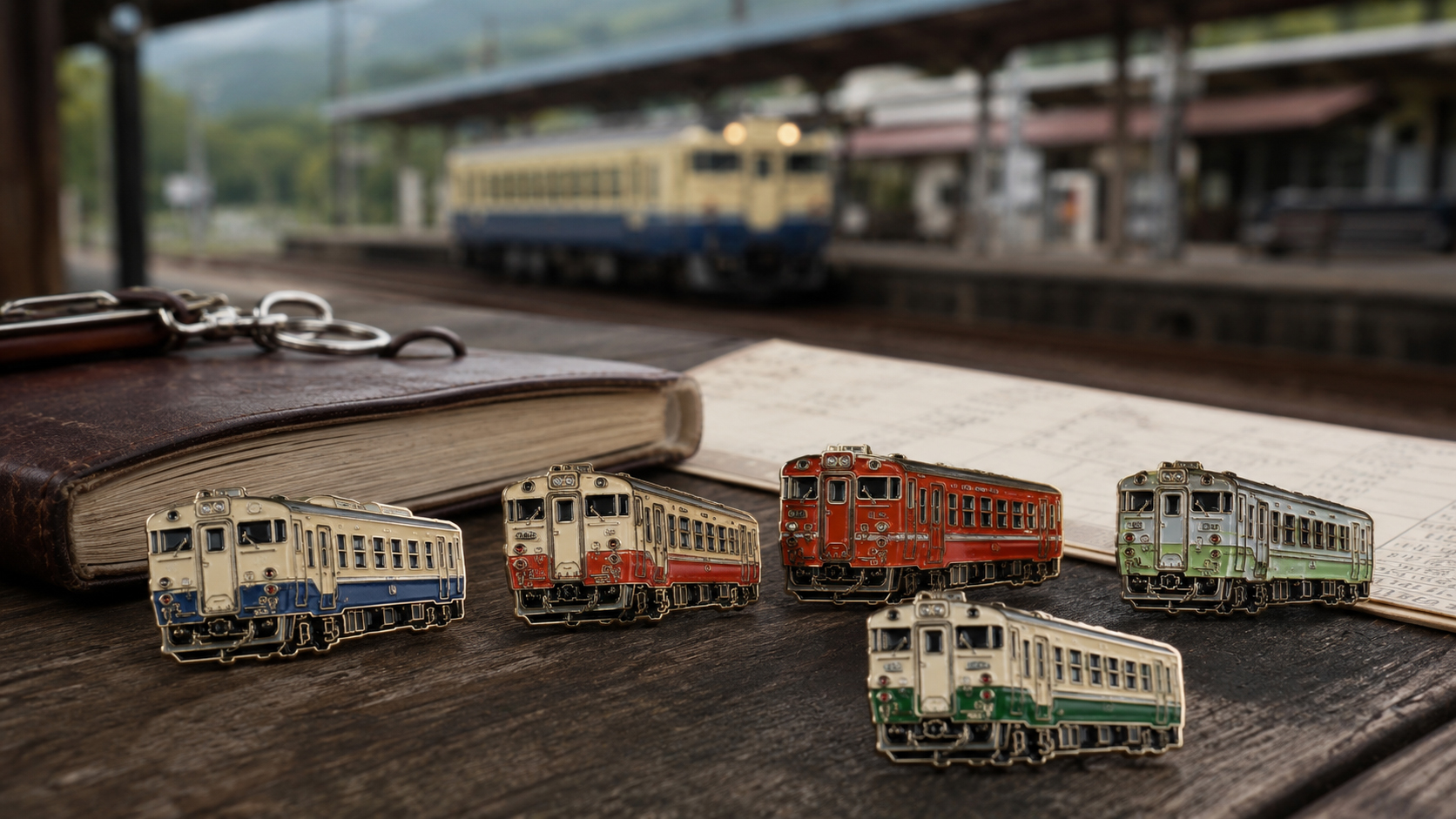
A small pin can contain the sound of a local line
Railway goods have a strange power. Real trains are enormous. They are heavy, long, loud, oily, metallic things that shake platforms and move towns. Yet railway memory often lives in very small objects: tickets, destination-sign keychains, station-name magnets, clear files in old liveries, and pin badges.
The KiHa 40 Series DMU Pin Badge collection from JR West Trading’s TrainBox brand is one of those small memory tools. It launches on June 25, 2026. There are 12 designs. They come as capsule toys or individually wrapped packets. You do not know which car you will get until you open it. There is no complete box planned for the random version. In other words, luck is part of the product. Buy it at a station, open it, and see which color of local-line memory appears. For rail fans, that is already a tiny trip.
The KiHa 40 is not a Shinkansen. It is not a sleek urban commuter train. It is a rural diesel railcar. That is exactly why the memory is so dense. Morning students, evening shoppers, snow-covered unmanned stations, the San’in coastline, cloudy Hokuriku skies, mountain lines in Yamaguchi, quiet fields in Okayama. The KiHa 40 carried ordinary days.
What was the KiHa 40?
The KiHa 40 series was introduced by Japanese National Railways in 1977. It was a diesel multiple unit intended to replace older railcars on non-electrified suburban and rural lines. The family included KiHa 40, KiHa 47, and KiHa 48 variants, with differences in cab arrangement, doors, toilets, climate-region specifications, and later modifications.
Its charm is that it was not born a star. The KiHa 40 was an everyday train. Not a glamorous limited express, but the train people actually used: high school students, older residents, local shoppers, occasional travelers, and rail fans who understood that ordinary trains often hold the deepest memories.
After JNR was privatized and split in 1987, KiHa 40 cars passed to JR Group companies. In JR West territory, they worked across non-electrified routes in Hokuriku, Chugoku, San’in, and other regions. Some received regional colors. Some were renewed. Some became sightseeing trains. As the cars age, many are being retired, but others have found a second life as tourism carriers. Old rolling stock becomes a new vessel for regional storytelling.
Why diesel sound stays in memory
Railway memory is not only visual. It is sound. Anyone who has ridden a KiHa 40 may remember the low engine note, the heavy acceleration, the vibration under the floor, and the slight pause of the transmission. It is not as smooth as an electric train. It feels slower, less polished, and more alive.
Rural diesel trains have a way of slowing time. The Shinkansen brings destinations closer. The KiHa 40 lets you see the middle. It is slow enough for scenery to become legible: rice fields, hillsides, coastal light, bicycles by station buildings, students in uniforms, a single vending machine, a road crossing with no hurry in it.
That is why a KiHa 40 pin badge is not merely a miniature train design. It is also a miniature of sound and time. The metal object has no engine. But for those who remember, something starts up.
Regional liveries are railway dialects
The appeal of the new pin badges lies in their regional colors. A train livery is not just paint. It is a railway dialect. The same KiHa 40 can feel different depending on whether it carries a San’in color, a Hokuriku memory, an Okayama mood, a Hiroshima identity, or a sightseeing-train design.
JNR-era trains were built with national standardization in mind. After privatization, JR companies and regions gave vehicles new colors and new meanings. The KiHa 40 became a perfect canvas for that change. Standard design became local memory.
Collecting the pins is therefore a way of collecting railway dialects. You are not simply trying to get 12 objects. You are gathering West Japan’s local-line colors in miniature.
The KiHa 40 as sightseeing train: when old becomes valuable
One of the most interesting late-life roles of the KiHa 40 is its use as a sightseeing train. In JR West territory, KiHa 40-based sightseeing trains have carried local food, scenery, craft, stories, and regional branding.
New trains are more efficient, accessible, fuel-conscious, and easier to maintain. But tourism does not always want newness. It often wants atmosphere. Older railcars have texture: window shape, seat feel, diesel sound, gentle vibration, and compatibility with rural landscapes. In a sightseeing train, slowness can become value.
The made-to-order framed JR West sightseeing train collection recognizes that. Seven sightseeing-train pin badges are placed in a dedicated frame with a plate. This is not only a souvenir. It is a displayable railway memory. Put it on a wall or desk, and it becomes both remembrance and invitation. If you rode one of the trains, you remember. If you have not, you may want to go.
| Item | Details |
|---|---|
| KiHa 40 Series DMU Pin Badges, JR West Area Vol. 1 | A 12-design random badge collection featuring KiHa 40 railcars active in the JR West area. |
| Release date | June 25, 2026. Sold mainly at JR West-area station shops. |
| Price | 455 yen before tax for a single random badge, sold as capsule toy or individually wrapped package. |
| Collection style | The design is revealed after opening. No complete box is planned for the 12-design random lineup. |
| Framed collection | A made-to-order framed set of seven JR West sightseeing train pin badges, available for order from June 25 to July 13. |
Random goods feel a little like travel
You do not know which badge you will get. That is familiar in modern goods culture: anime, idols, characters, railway collections. Random products stimulate the collecting instinct. You may not get the one you want. That creates the small thrill of opening.
With railway goods, randomness feels a little like travel. A local-line trip has plans, but also accidents of experience. Can you get the window seat? What will the weather do? What will you see at a transfer station? What will you eat with five minutes before the next train? Railway travel is never fully controlled, and that is why it stays in memory.
Buy a badge. Open it. Discover an unfamiliar livery. Look it up. Learn where it ran. Want to visit. A random badge is not only a sales method. It can be a doorway into railway geography.
Why rail fans collect small things
Rail fans love enormous things, then collect tiny ones: models, tickets, destination boards, station signs, builder’s plates, timetables, headmarks, and pins. This is natural. You cannot take home the train. You take home a reduced form of its memory.
Railways are public things. The train belongs to everyone. The track belongs to the operator. The station belongs to the place. A fan cannot possess the whole experience. So the fan preserves fragments: a photo, a ticket, a model, a badge on a bag.
The KiHa 40 is especially suited to this culture. It is not one national superstar with a single meaning. It has local meanings. Someone rode it to school. Someone photographed it by the sea. Someone met it on a rural trip. Someone rode a sightseeing version. The pin becomes a marker for personal railway memory.
Local lines become more vivid as they fade
Japan’s rural local lines face severe pressure: depopulation, aging communities, private car dependence, maintenance costs, disaster recovery, driver shortages, and aging facilities. Railways are both public lifelines and costly infrastructure. That contradiction is hard to solve.
Because of that pressure, local-line memory becomes more vivid. Things that may disappear, shrink, or be replaced become emotionally brighter. The train that once felt ordinary becomes special after a retirement announcement. The color that used to pass every day suddenly looks irreplaceable.
The KiHa 40 is in that emotional zone. Some still run. Some have become sightseeing trains. Others have retired or been replaced. They will not run forever. Aging continues. Replacement continues. A 50th-anniversary lead-up pin collection carries a faint sense of farewell as well as celebration.
Railway goods are small entrances to regional tourism
A pin badge sold in a station can become a tourism entrance. A traveler buys one in Kanazawa, Fukui, Tsuruga, San’in, or Yamaguchi. A design appears. The traveler searches where the train ran. A sightseeing train design comes out, and the next trip begins as an idea.
For JR West, railway goods are not only side revenue. They are regional touchpoints. A train design becomes a symbol of a line, a region, a meal, a coast, a hot spring, or a mountain route. A pin badge makes that symbol portable.
Small goods can move people. Not always immediately, not always dramatically, but often enough. Buy because it is cute. Search because it is unfamiliar. Ride because now it means something. A small piece of metal can open a map.
JNR memory and JR present
The KiHa 40 is a JNR train. It is also a JR-era train. That double identity is part of its appeal. JNR’s standardized design survived into the regional identities of the JR companies. One train family crossed two railway eras.
JNR represented national uniformity. JR brought regional expression. The KiHa 40 carries both: a nationally recognizable form and locally specific colors. That is why it is collectible.
As a pin badge, this double identity becomes clear. The shape is KiHa 40. The color is local. JNR design is re-edited as JR West memory. Railway goods do not merely preserve the past. They translate it into a form today’s fans can collect.
A pin badge becomes railway punctuation
Rail journeys are long memories: departure station, transfer, scenery, bento, announcement, terminal stop. But people cannot always carry long memories in long form. They need short signs: station name, car number, color, headmark, pin badge.
A pin badge is railway punctuation. Put it on a bag. Place it on a shelf. Frame it. See it and remember a line. Even if you never rode that exact train, you may want to. Because it is small, it can enter daily life. Because it enters daily life, memory continues.
That is why railway companies make goods. Trains run many times a day, but fans cannot always ride them. Goods keep the railway nearby during the time between trips. For a vehicle like the KiHa 40, sitting between active service and memory, that small presence fits perfectly.
On the eve of 50 years
In 2027, the KiHa 40 series reaches 50 years since service began. Half a century is a long life for a railcar family. Design philosophy, passengers, regional populations, tourism styles, fuel concerns, and maintenance realities have all changed. Still, the KiHa 40 remains in memory.
A pin badge collection before the anniversary feels just right. Not too grand. But meaningful to those who understand. It is not a new train announcement. It is not a line-closure notice. It is more like a small thank-you note.
Railway history is not preserved only in depots and museums. It survives in station shops, capsule toys, pockets, children’s hands, and the desk of someone who once rode the train to school.
A perfect soft closer
On June 25, 2026, Japan.co.jp’s news lineup includes a prison hotel, a World Cup matchday, AI telecom infrastructure, Osaka summer comedy, digital aquarium fireworks, a Supreme Court decision, Sanrio cafe culture, disaster-tech infrastructure, and summer cafe menus. Ending with a KiHa 40 pin badge feels exactly right.
A daily paper cannot live only on large news. Society needs serious stories. It needs future stories. It needs food stories. It also needs small memory stories. The KiHa 40 pin badge is a gentle closing note from regional Japan.
Trains retire. Liveries change. Lines change. Stations change. But for a while, color can remain in a small piece of metal.
The KiHa 40 was not fast. It was not new. It was not too convenient. But in many places, it was there every day.
That is more than enough reason to become a pin badge.
- The KiHa 40 Series DMU Pin Badges, JR West Area Vol. 1, launch on June 25, 2026.
- The random single badges have 12 designs and cost 455 yen before tax, sold mainly at JR West-area station shops.
- No complete box is planned for the 12-design random collection, preserving the opening-and-collecting fun.
- A made-to-order framed collection of seven JR West sightseeing train badges is also available.
- The KiHa 40 series entered JNR service in 1977 and reaches its 50th anniversary in 2027.
Sources and references
This article was based on public information from JR West Trading / TrainBox, PR TIMES, railf.jp, Dengeki Hobby, RailLab, JR West, and public KiHa 40 series railway history references.
- PR TIMES: KiHa 40 Series DMU Pin Badges, JR West Area Vol. 1
- railf.jp: TrainBox releases KiHa 40 Series DMU Pin Badges, JR West Area Vol. 1
- Dengeki Hobby: 12 KiHa 40 pin badge designs released
- JR West Trading: KiHa 40 pin badge sales locations PDF
- WESTER Mall: Framed KiHa 40 JR West sightseeing train pin badge set
- RailLab: JR West KiHa 40 historic colors reproduced
- JR West official travel information
- The Red List of Trains in Japan: JNR KiHa 40 series