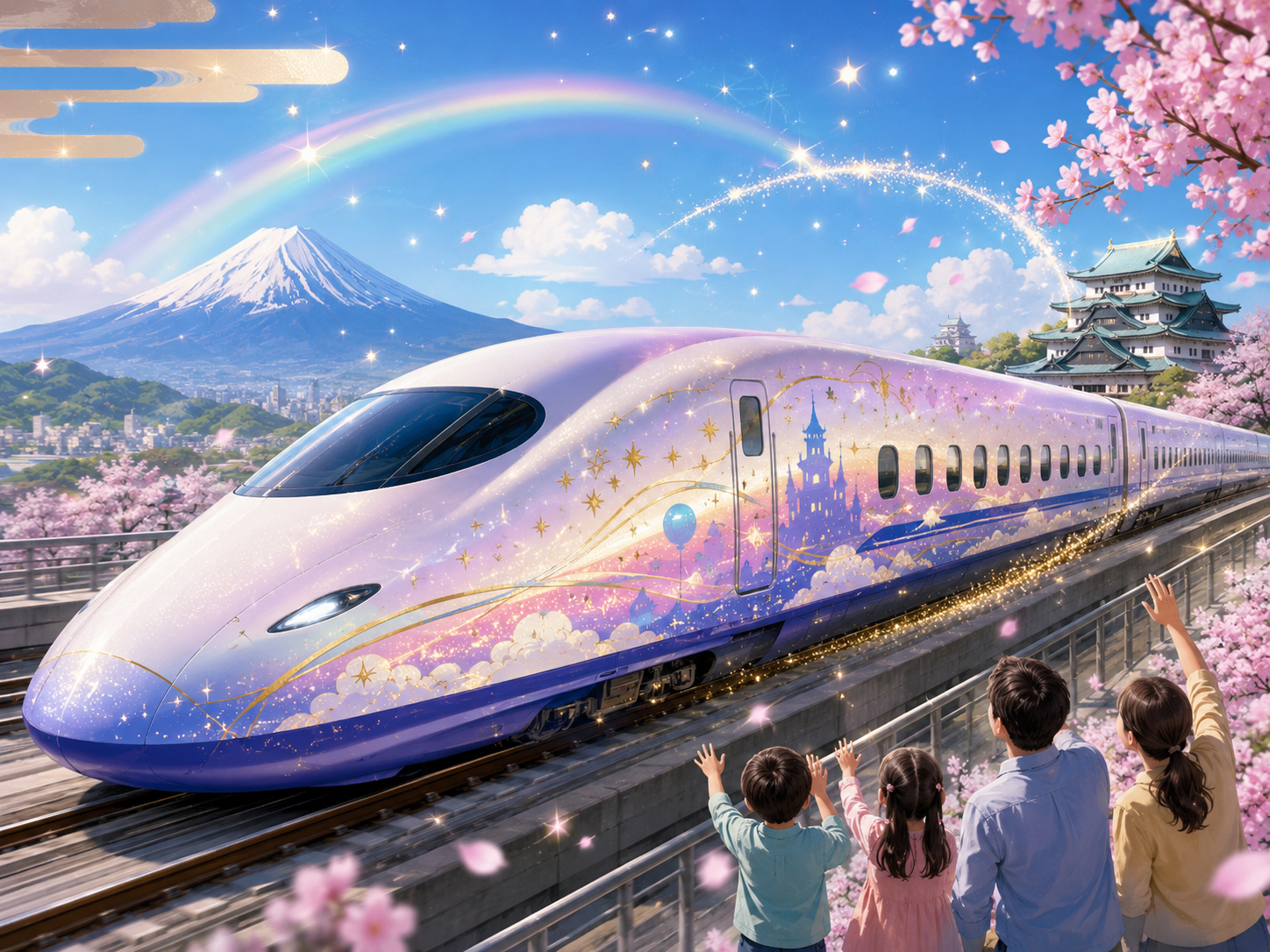
A little magic is about to run on Japan’s most businesslike railway. JR Central and Oriental Land announced that the “Sparkling Dreams Shinkansen,” a specially wrapped Tokaido Shinkansen linked to Tokyo DisneySea’s 25th-anniversary “Sparkling Jubilee,” will begin operating on June 19, 2026. It will run between Tokyo and Shin-Osaka, mainly as Hikari and Kodama services.
That is fun for the obvious reason: people love a themed train. But the deeper reason is better. The Tokaido Shinkansen is not a toy. It is one of Japan’s most serious pieces of infrastructure, the high-speed artery connecting Tokyo, Nagoya, Kyoto and Osaka. It carries business trips, homecomings, school excursions, family vacations, concert weekends, exam travel and national rituals of movement. When a celebration appears on that white-and-blue machine, efficiency briefly becomes enchantment.
The charm of Hikari and Kodama
It matters that the special train is expected to run mainly as Hikari and Kodama. Nozomi is the sprint: the fastest, most businesslike service. Hikari and Kodama have a little more room in the imagination. They stop more often. They let the scenery change slowly enough to notice. They carry more family trips, school memories and ordinary discoveries. A special wrapped train belongs naturally to that rhythm.
JR Central’s campaign page says the train uses “Jubilee Blue,” inspired by the 25th anniversary theme, and features the world of Tokyo DisneySea’s eight themed ports. For passengers, the real point is that the train becomes part of the experience before the destination. A child spots the train on the platform. Parents take a picture. A commuter looks up from email. A trip starts before departure.
1964: the future arrived on rails
The Tokaido Shinkansen opened on October 1, 1964, just before the Tokyo Olympics. Japan was moving from postwar recovery into high-growth confidence. Expressways, hotels, airports, television and the bullet train all became part of a national story about modernization. The round-faced 0 Series train was not only a vehicle; it was proof that Japan could build the future and make it run on time.
At launch, the Hikari service connected Tokyo and Osaka in four hours, while Kodama took around five. That sounds long today, but it was revolutionary. Same-day travel between Japan’s largest urban regions changed business, tourism and the country’s mental map. JR Central still describes the Tokaido Shinkansen as the artery linking Japan’s three largest metropolitan areas: Tokyo, Nagoya and Osaka.
Why the Tokaido corridor matters
The Tokaido Shinkansen is not merely a tourism line. It runs through the densest belt of Japanese population, industry, finance, universities, culture and international travel. From Tokyo to Shinagawa, Shin-Yokohama, Nagoya, Kyoto and Shin-Osaka, the route traces the spine of the Japanese economy. That is why a special train on this line has unusual visibility. It is not tucked away on a local branch line; it passes through the country’s busiest public spaces.
A themed train here becomes more than marketing. It turns stations into small stages. It gives families a reason to arrive early. It creates photos, social posts and conversations. The train is a moving advertisement, a public celebration and a limited-time travel memory.

Japan’s love of character trains
Japan has long understood that trains and characters go beautifully together. Wrapped regional trains, anime pilgrimage services, tourism campaign cars, Pokémon trains, Hello Kitty Shinkansen sets, mascot announcements and limited-edition station goods all belong to the same culture. Japan’s railways are strict about time, cleanliness and safety — yet they make room for play.
This is also a strength of Japanese consumer culture. A special train is never just paint. It becomes merchandise, station stamps, bento tie-ins, hotel packages, fan posts, family photographs and destination marketing. Railway companies, theme parks, travel agencies, hotels, station shops and fan communities all share the same moving story.
How can a bullet train be cute?
The Shinkansen is, technically, a hard machine: speed, seismic engineering, maintenance, timetable control, driver training and safety systems. There is nothing soft about the discipline behind it. Yet precisely because the system is trusted, it can be playful on the surface. Passengers believe the train will be safe and punctual. That confidence lets them enjoy the decoration.
In other words, the dream rides on the timetable. A family can take photos and still expect to arrive. A visitor can chase the special train and still rely on the whole network. That is very Japanese: whimsy layered on top of operational seriousness.
- Check the official operating schedule before planning
- Photograph from behind the safety line on platforms
- Build Hikari or Kodama stops into the trip
- Pair the ride with Tokyo DisneySea’s 25th-anniversary program
- Watch for station and online campaign details
A small ambassador for travel Japan
For international visitors, the Shinkansen is already an attraction. The view of Mount Fuji, ekiben meals, orderly platforms, quiet cars, precise timetables and cleaning teams are all part of the experience. Add a celebration connected to Tokyo DisneySea and the journey becomes even more memorable. Even travelers heading to Kyoto or Osaka, not the theme park, may encounter a train that says something about Japan’s blend of engineering and imagination.
The Sparkling Dreams Shinkansen is not important because it is the largest story in Japan. It is important because it is joyful in a very Japanese way. The same line that carried the future in 1964 can still carry a child’s photograph, a family plan and a blue flash of celebration in 2026. Japan’s railways, somehow, still deliver dreams on time.
Sources and references
This Japan.co.jp report is based on JR Central and Oriental Land announcements, JR Central campaign material, JR Central Shinkansen background and Japanese government material on Shinkansen history.