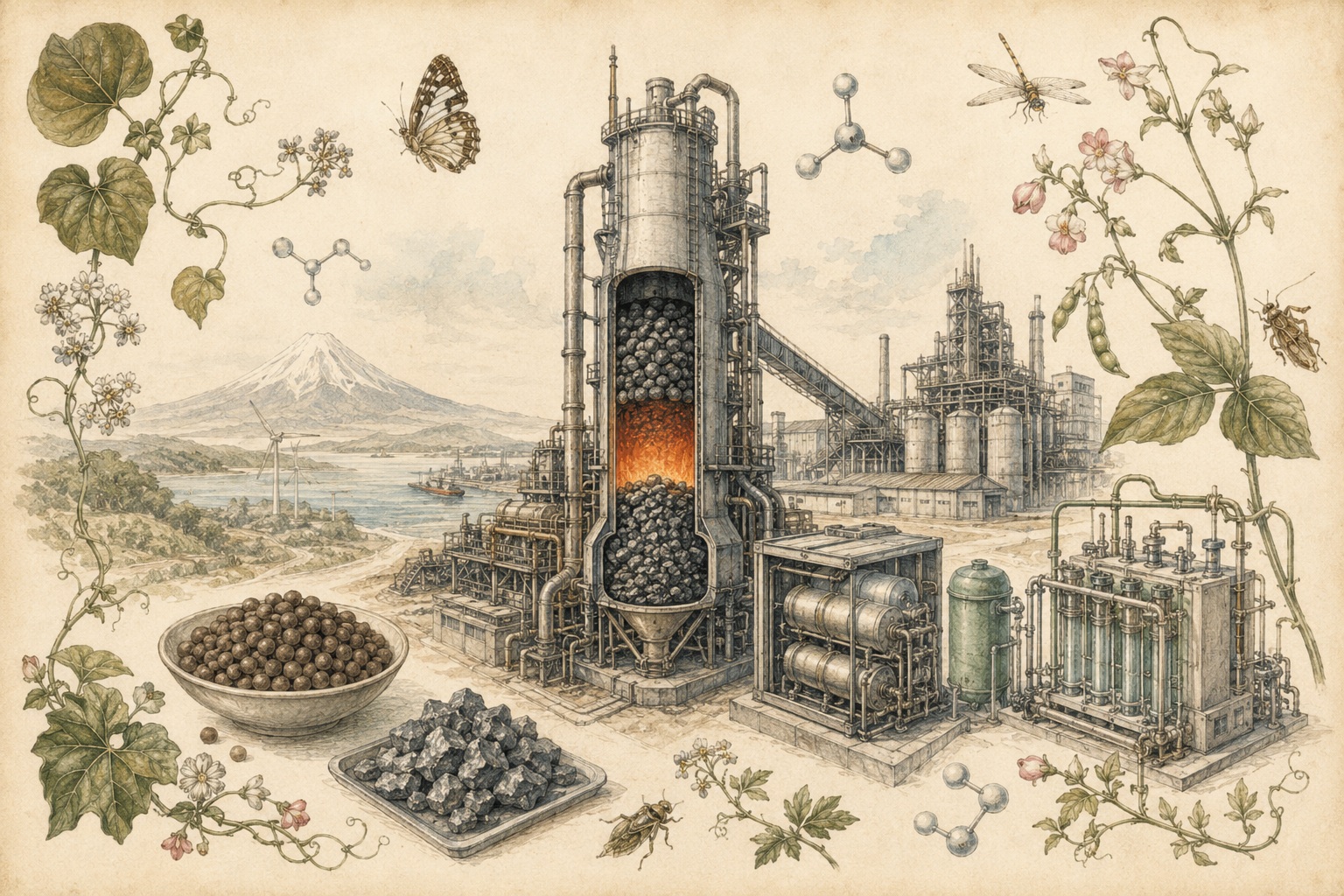
On the waterfront at Chiba, a pile of dull gray, metallic-looking material marked a small reversal in Japanese industrial history. It was not automotive sheet, bridge plate or finished steel. It was iron at an intermediate stage—iron ore from which oxygen had been chemically removed. Yet the roughly one tonne carried an unusually large meaning. Renewable electricity in Yamanashi had split water to make hydrogen. The gas was compressed, loaded onto a trailer, driven to Tokyo Bay, fed into a JFE pilot furnace and allowed to take oxygen away from iron ore. Instead of carbon leaving the furnace as carbon dioxide, hydrogen left the reduction reaction as water.
The location gives the experiment its historical force. JFE’s Chiba district, opened by predecessor Kawasaki Steel in 1951, blew in its first blast furnace in 1953. It became an emblem of postwar Japan’s coastal integrated steelworks: imported ore and coal arriving by large vessel, then moving through blast furnace, converter and rolling mills at one enormous seaside site. Seventy-three years later, the same works hosted an experiment aimed at changing the element that performs ironmaking’s most fundamental task—from carbon to hydrogen.
On July 31, JFE Steel, NEDO, Yamanashi Hydrogen Company, Tomoe Shokai, Kanadevia, the Yamanashi Prefectural Enterprise Bureau and the GREINS hydrogen-steelmaking consortium announced that the trial had produced about one tonne of reduced iron with green hydrogen. In the physical scale of an integrated works, one tonne is tiny. But the experiment connected several systems that are usually discussed separately: renewable power, electrolysis, hydrogen compression and transport, ore reduction, and eventually electric-furnace refining.
Iron ore is iron already bound to oxygen
The essential act of ironmaking occurs before shaping, rolling or alloying. Iron ore is composed largely of iron oxides: iron chemically bound to oxygen through geological time. To recover metallic iron, steelmakers must transfer that oxygen to another substance. The history of ironmaking is, in large part, the history of choosing and controlling that oxygen-carrying substance.
In a blast furnace, coke made from coal is both fuel and chemical agent. Carbon monoxide formed in the furnace takes oxygen from the ore and becomes carbon dioxide. Coke also supports the heavy burden of ore, keeps channels open for gas flow, supplies heat and adds carbon to the molten iron. Coal is therefore not an accessory that can simply be exchanged for another burner fuel. It performs several jobs at once, which is one reason blast-furnace decarbonization is so difficult.
Hydrogen reduction changes the simplified chemistry to “iron oxide plus hydrogen becomes iron plus water.” NEDO’s technical material presents the two basic reactions this way:
- Hydrogen route: Fe2O3 + 3H2 → 2Fe + 3H2O
- Carbon-monoxide route: Fe2O3 + 3CO → 2Fe + 3CO2
Hydrogen changes the immediate reaction product from carbon dioxide to water. It does not by itself make the full steel value chain emissions-free. The electricity used to make and heat the hydrogen, its compression and transport, and the power used to melt and refine the reduced iron must also be low-carbon.
The material emerging from a direct-reduction furnace remains solid. It is porous and is often called sponge iron. It must later be melted and refined—usually in an electric furnace or an electric smelting furnace—before it becomes steel with controlled carbon, alloy content, cleanliness and mechanical properties.
Chiba was built for the age of coal, ships and mass production
The history of the Chiba works makes the pilot more than a laboratory result. Kawasaki Steel was established in 1950 and opened the Chiba works the following year. The first blast furnace was blown in during 1953, and an integrated iron-and-steel system was established by 1958. The site helped define postwar Japan’s coastal steelmaking model—large reclaimed land, deepwater port access, continuous production and the ability to receive raw materials from around the world.
Earlier steelworks had been more tightly constrained by domestic coalfields, mines and established urban locations. Chiba pursued scale through maritime logistics. Ore and coking coal came in by ship; steel flowed out into automobiles, ships, buildings, machinery and household appliances. The works helped make steel abundant enough to become the hidden material of Japan’s rapid-growth era.
That industrial strength was inseparable from carbon. JFE and NEDO note that steelmaking accounts for roughly 14% of Japan’s total carbon-dioxide emissions. Globally, worldsteel estimates that iron and steel production represents about 7%–8% of anthropogenic greenhouse-gas emissions. Efficiency improvements matter, but they cannot by themselves deliver the depth of reductions associated with a 2050 carbon-neutral objective. The connection between ore and fossil carbon has to be redesigned.
The first blast furnace at Chiba answered a Japan that needed much more steel. The 15-kilogram-per-hour test furnace answers a different Japan: one that must continue producing high-grade steel while breaking the link between production growth and carbon emissions. The machines are incomparable in size, but the industrial question is equally fundamental.
Direct reduced iron is not new; the origin of the hydrogen is
Direct reduction has been a commercial steelmaking route for decades. Rather than melting ore while reducing it in a blast furnace, a shaft furnace or other reactor removes oxygen while the feed remains solid, producing direct reduced iron, or DRI. The route developed especially in regions with abundant, inexpensive natural gas. Global DRI production reached a record 140.8 million tonnes in 2024.
Existing gas-based DRI already relies heavily on hydrogen. Reforming natural gas produces a mixture of hydrogen and carbon monoxide, so hydrogen has participated in commercial ore reduction for many years. The novelty is not the observation that hydrogen can reduce iron oxide. It is the attempt to replace fossil-derived reducing gas with hydrogen made from renewable electricity, and ultimately to raise the hydrogen concentration toward 100%.
Japan did not historically adopt gas-based direct reduction on a large scale because it imports natural gas and could not match the economics of gas-rich regions. Japanese producers instead became exceptionally skilled at processing imported ore and coking coal through blast furnaces while delivering large volumes of clean, high-performance steel. Moving away from that system requires more than changing chemistry. It means rebuilding furnaces, power supply, hydrogen logistics, raw-material specifications and downstream refining while continuing to serve customers.
| Steelmaking route | Reducing agent and energy | Strengths | Principal challenges |
|---|---|---|---|
| Blast furnace–basic oxygen furnace | Coke and carbon monoxide | Very high output, established production of high-grade and advanced steels | Large process emissions; coke also performs structural and thermal functions |
| Natural-gas DRI plus EAF | Fossil-derived H₂ and CO, electricity | Large commercial base; potentially lower emissions than the blast-furnace route | Upstream fossil emissions; preference for high-grade pellets |
| Green-hydrogen DRI plus EAF | Renewable H₂ and low-carbon electricity | Potential to remove most direct CO₂ from ore reduction | Hydrogen cost and volume, heat supply, lower-grade ore, impurities and EAF scale |
From Yamanashi to Chiba: two demonstration programs became one chain
The hydrogen used in the June trial was not produced inside the steelworks. It came from the Komekurayama Power Storage Technology Research Site in Kofu, Yamanashi Prefecture. There, renewable electricity powers a 1.5-megawatt proton-exchange-membrane electrolyzer manufactured by Kanadevia, splitting water into hydrogen and oxygen.
The Komekurayama power-to-gas program began in September 2016. After the original NEDO project ended, the site continued producing and supplying compressed hydrogen to users. In a June 2026 account, NEDO said the installation had operated steadily for almost five years without major trouble. For JFE’s trial, Yamanashi Hydrogen Company and Tomoe Shokai arranged the supply, and the compressed gas traveled by trailer to Chiba.
JFE’s small reduction unit had begun hydrogen tests in December 2024. From June 29 through July 1, the Komekurayama hydrogen was fed to the furnace and roughly one tonne of reduced iron was made. At a rated 15 kilograms per hour, a simple full-rate calculation gives about 67 hours for one tonne—roughly the duration of the announced test window. The milestone was therefore not a momentary reaction in a laboratory tube, but a multi-day operating campaign.
The arrangement reveals how industrial decarbonization actually advances. An electrolyzer project without dependable customers does not create a hydrogen economy. A hydrogen-ready furnace without low-carbon gas does not reduce lifecycle emissions. The one tonne was also a physical link between two NEDO-supported development streams: one designed to produce renewable hydrogen and another designed to consume it in one of industry’s hardest-to-abate processes.
Hydrogen reacts quickly, but it takes heat from the furnace
Hydrogen reduction carries a thermodynamic penalty that is easy to miss in simplified diagrams. NEDO explains that hydrogen can reduce iron oxide faster than carbon-based gas, but the reaction absorbs heat. Its project material shows the hydrogen reaction requiring 886 megajoules per tonne of iron, while the carbon-monoxide reaction releases 222 megajoules per tonne under the stated comparison.
Increasing the hydrogen share can therefore lower direct carbon emissions while cooling the reduction zone. Engineers must preheat the gas, deliver sufficient sensible heat to the ore and maintain a uniform temperature and gas flow across the furnace. A condition that can be controlled in a small test reactor may become uneven across the diameter of a much larger shaft packed with hundreds of times more material.
Hydrogen also brings demanding safety and materials requirements. Its molecules are small, leakage control is critical, and it burns across a wide concentration range. Piping, seals, detection, ventilation, isolation and emergency shutdown all become part of the process design. Steelworks operate continuously for years; there is a vast engineering distance between “the reaction worked” and “the plant can run safely around the clock.”
How much hydrogen does one tonne imply?
Stoichiometry provides a useful lower bound. Reducing pure Fe2O3 completely to one tonne of metallic iron requires about 54 kilograms of hydrogen in theory. That is not a prediction of JFE’s actual consumption. Real demand depends on ore grade, metallization, unreacted hydrogen in the exhaust, recycling, heating and process losses.
Scale the chemistry up, however, and the infrastructure problem becomes visible. Producing one million tonnes of metallic iron would require at least about 54,000 tonnes of hydrogen on that theoretical basis, and an operating plant would require more. Generating that hydrogen needs very large quantities of low-carbon electricity, followed by compression or another transport form, storage and continuous delivery to the furnace.
Trailer delivery was sensible for joining two pilot programs. It cannot simply be multiplied into the supply system for a steelworks producing millions of tonnes annually. Commercial hydrogen ironmaking would require some combination of large on-site electrolyzers, pipelines, port storage, imported hydrogen or hydrogen carriers, and grid infrastructure. NEDO itself identifies abundant low-cost hydrogen as a precondition for implementation.
- What is substantial: Renewable hydrogen was transported to an operating pilot and sustained stable reduction over several days.
- What remains small: World DRI output exceeds 140 million tonnes a year, and commercial modules operate at million-tonne scale.
- What remains downstream: Reduced iron is not finished steel. Melting, dephosphorization, denitrogenation, chemistry control, casting and rolling remain.
- What was not disclosed: The release did not publish the exact ore grade, hydrogen consumption, metallization, product chemistry, cost or lifecycle emissions for the trial.
Why Japan chose the harder problem of lower-grade ore
The formal NEDO objective is to develop direct hydrogen reduction of lower-grade iron ore. Today’s commercial shaft furnaces generally prefer high-iron, low-impurity pellets. If every future hydrogen-DRI plant competed for the same limited premium ore, scarcity and price could become a major constraint.
Japanese blast furnaces have learned to process a broader raw-material mix through sintering, coke-supported gas flow, high-temperature melting and slag formation. In direct reduction, oxygen is removed while the material remains solid, so silica, alumina, phosphorus and other gangue remain with the iron more readily. They must be handled later during melting and refining, often at an energy and slag penalty.
Technology that can use lower-grade feed is therefore central to Japan’s raw-material security and cost competitiveness. Importing a process that works only with premium pellets might simplify the reactor while transferring the bottleneck to the ore market. The Japanese program is attempting to solve for the material conditions a full industry would actually face.
But the distinction between project ambition and disclosed trial result matters. The July 31 release names lower-grade ore as the program’s target, yet does not specify the grade used during the June 29–July 1 campaign. It is accurate to say JFE demonstrated stable reduction with green hydrogen. It is premature to state as fact that the announced one tonne itself proved commercial treatment of lower-grade ore.
The next barrier is turning reduced iron into premium steel
Japan’s competitive strengths lie in steels whose impurity levels and microstructures are controlled with extreme precision: automotive outer panels, electrical steel, high-tensile plate and many specialized products. Melting hydrogen-reduced iron in an electric furnace does not automatically reproduce those properties.
NEDO’s program therefore develops the downstream process in parallel. It targets faster DRI melting, phosphorus and nitrogen removal, improved stirring, atmosphere control, preheating and slag optimization. A 10-tonne test electric furnace at JFE’s Chiba district is being used to study reduced-iron preheating and heat delivery. The ultimate objective is an integrated process at roughly 300-tonne scale that controls impurities at blast-furnace-route levels and produces grades suitable even for automobile outer panels.
The distinction between iron and steel is not semantic. Reduced iron is feedstock from which oxygen has been removed. Steel is a designed material whose carbon, alloy elements, residuals, cleanliness and internal structure have been controlled for a particular use. The July milestone is a major upstream step. The bridge to a certified finished product is still being built.
| Stage | What the trial demonstrated | What implementation still requires |
|---|---|---|
| Green hydrogen production | Supply from Komekurayama’s 1.5 MW PEM system | Much lower cost, much larger scale and long-term availability |
| Transport and delivery | Compressed-gas trailer from Yamanashi to Chiba | Commercial pipelines, ports, on-site production or bulk carriers |
| Direct reduction | About one tonne and stable reaction in a 15 kg/h unit | Detailed lower-grade-ore validation, thermal efficiency and medium/full scale |
| Melting and refining | Separate development is under way in 10-tonne test furnaces | Blast-furnace-level impurity control at roughly 300-tonne scale |
| Steel product and market | Outside the scope of this announcement | Quality certification, cost, customer demand and credible emissions accounting |
Japan was not first globally—and that makes its particular challenge clearer
Green-hydrogen direct reduction had been demonstrated outside Japan before the JFE test. Sweden’s HYBRIT initiative announced in 2021 that it had produced around 100 tonnes of sponge iron at pilot scale using hydrogen made with fossil-free electricity. SSAB then used the material to make and deliver a proof-of-concept batch of fossil-free steel.
JFE’s result is therefore “Japan’s first,” as NEDO states, not the world’s first. That distinction does not diminish the achievement. It clarifies the competitive problem Japan must solve rather than allowing national novelty to substitute for industrial analysis.
Sweden benefits from high-grade domestic ore, abundant low-carbon electricity and close geographic links between mines, pellet plants and steelmaking. Japan imports most of its ore and energy, possesses enormous sunk investment in blast-furnace complexes and must maintain large-scale supply of sophisticated grades. It must solve lower-grade feed, imported or domestically produced hydrogen, high-quality electric-furnace steel and the transition of existing assets at the same time.
Japan’s test is not simply whether it can make the first green piece of iron. It is whether a resource-importing industrial economy can preserve quality and scale under much more constrained energy and raw-material conditions.
GREINS is pursuing several paths rather than betting on one furnace
Nippon Steel, JFE Steel, Kobe Steel and the Japan Research and Development Center for Metals formed the GREINS consortium in 2022. NEDO’s Green Innovation Fund program covers not only direct hydrogen reduction but hydrogen use in blast furnaces, carbon-recycling blast furnaces, electric-furnace quality improvement and electric smelting.
This is not indecision. Japan cannot convert all ore-based steelmaking to one new route in a few years. The age of each works, its product mix, local power and hydrogen availability, scrap supply and port infrastructure will produce different answers. During transition, the industry may need blast furnaces with much lower emissions, DRI imported or made domestically, advanced electric furnaces and carbon capture at the same time.
JFE says it aims to establish breakthrough technologies for carbon neutrality around 2035 while pursuing direct hydrogen reduction and carbon-recycling blast furnaces in parallel. The direct-reduction program runs from FY2021 through FY2030 and targets a medium-scale demonstration using lower-grade ore with at least a 50% CO₂ reduction compared with the current blast-furnace route.
Green hydrogen does not automatically make the entire tonne zero-carbon
Komekurayama hydrogen is defined as green because renewable electricity powers water electrolysis without direct CO₂ emissions during hydrogen production. That is not the same as saying the resulting steel has zero lifecycle emissions.
Mining and concentrating ore, pelletizing, ocean transport, hydrogen compression, trailer movement, furnace heating, melting, refining, casting and rolling all require energy. Building the new infrastructure also carries embodied emissions. A product’s claimed carbon intensity changes with the accounting boundary, making comparable methods and independent verification essential.
The JFE announcement did not publish lifecycle emissions or production cost for the one-tonne trial. Calling it “zero-CO₂ iron” would go beyond the evidence. Equally, it would be wrong to dismiss the significance of replacing the reducing agent in the most carbon-intensive upstream step with hydrogen actually produced from renewable power.
Who pays for the new chemistry?
Commercialization will be an economic test as much as a chemical one. Green hydrogen remains expensive relative to coking coal or fossil-derived reducing gas in many settings. Electrolyzers, renewable generation, storage and transport require investment. New reduction and electric furnaces must be built while existing works continue operating safely and supplying customers.
Because steel is only one component of a vehicle, building or machine, the premium for lower-emission steel may be diluted across the finished product. But if steelmakers alone absorb the transformation cost, they risk losing competitiveness. Public support, long-term clean-power contracts, hydrogen price-gap mechanisms, procurement commitments, customer offtake agreements and credible carbon policy all become part of the technology package.
A process can work technically and still fail to attract capital if customers insist on conventional-steel prices. Conversely, if emissions reductions are measured credibly and buyers in automotive, construction and shipping recognize the value, a one-tonne trial can become evidence for a new market.
What one tonne revealed: a steelworks is becoming an energy system
A blast-furnace steelworks is already an integrated energy complex. It receives ore and coal, recovers byproduct gases and uses them for heating and power. A hydrogen steelworks will not be a conventional works with one furnace swapped out. It will integrate renewable generation, electrolysis, storage, port infrastructure, pipelines, electric furnaces, oxygen use and the power grid.
The trailer from Komekurayama is not the final supply architecture. It is a miniature of a possible Japanese chain linking renewable-energy regions, overseas hydrogen production and coastal heavy industry. It allowed the connections to be tested before the permanent infrastructure exists.
Chiba’s innovation in the 1950s was to receive raw materials at scale by sea and concentrate production on one coastal site. The 2026 challenge is to reorganize raw materials and energy again—reducing carbon’s role without surrendering the output, reliability and quality on which downstream Japanese manufacturing depends.
Beside a blast furnace, one tonne of reduced iron is almost nothing. But industrial transitions often appear first not as finished answers, but as experiments that break one old assumption. The assumption broken at Chiba was that fossil carbon must always perform the oxygen-removal step in ore-based ironmaking.
The next questions are harder: Can the reaction run for a year rather than several days, at hundreds of tonnes per hour rather than 15 kilograms? Can lower-grade ore become premium steel? Can low-cost hydrogen arrive in vast quantities? And will customers buy the resulting product? JFE’s one tonne was not the answer. It gave Japan’s steel transition a tangible form—and made the remaining questions impossible to ignore.
1951 Kawasaki Steel opens the Chiba works.
1953 Chiba’s first blast furnace is blown in, helping establish postwar Japan’s coastal integrated-steelworks model.
1958 Chiba completes an integrated iron-and-steel production system.
2016 Yamanashi’s Komekurayama power-to-gas program and Sweden’s HYBRIT initiative begin.
2020 HYBRIT starts operating its hydrogen direct-reduction pilot.
2021 HYBRIT reports about 100 tonnes of hydrogen-reduced sponge iron; Japan launches NEDO’s Hydrogen Utilization in Iron and Steelmaking Processes project.
2022 Nippon Steel, JFE Steel, Kobe Steel and JRCM form GREINS.
December 2024 Hydrogen-reduction testing begins in JFE Chiba’s 15 kg/h pilot.
June 29–July 1, 2026 The pilot uses Komekurayama green hydrogen to produce about one tonne of reduced iron.
July 31, 2026 JFE, NEDO and partners announce the result as Japan’s first.
FY2030 Final year of the NEDO project, which targets medium-scale lower-grade-ore reduction and premium-steel process demonstrations.
Around 2035 JFE’s target period for establishing breakthrough carbon-neutral technologies.
2050 Target for carbon neutrality across JFE and Japan’s steel transition.
Reporting notes and principal sources
This article uses public information checked through August 9, 2026, 12:50 a.m. JST. The JFE–NEDO announcement supports the production of roughly one tonne of reduced iron with green hydrogen and confirmation of stable reduction. It does not disclose the exact grade of ore used in this campaign, hydrogen consumption, metallization, product chemistry, cost or lifecycle emissions. The theoretical figure of about 54 kilograms of hydrogen per tonne of metallic iron is Japan.co.jp’s stoichiometric calculation from the Fe₂O₃ reaction shown in NEDO material; it is a chemical lower bound, not JFE’s reported operating consumption.
- JFE Steel, NEDO and partners: Japan’s first green-hydrogen reduced-iron trial, July 31, 2026
- NEDO: Approximately one tonne of reduced iron, Komekurayama supply and trial conditions
- NEDO Green Innovation Fund: Hydrogen Utilization in Iron and Steelmaking Processes
- NEDO: Progress of the Hydrogen Utilization in Steelmaking project
- NEDO: Innovation in blast furnaces, direct hydrogen reduction and electric furnaces
- NEDO: Komekurayama’s 1.5 MW PEM electrolysis system and operating record
- JFE Steel: History of the Chiba district
- Midrex: World DRI production reached 140.8 million tonnes in 2024
- HYBRIT: Around 100 tonnes of fossil-free hydrogen-reduced sponge iron in 2021
- worldsteel: 2024 steel production and global greenhouse-gas emissions