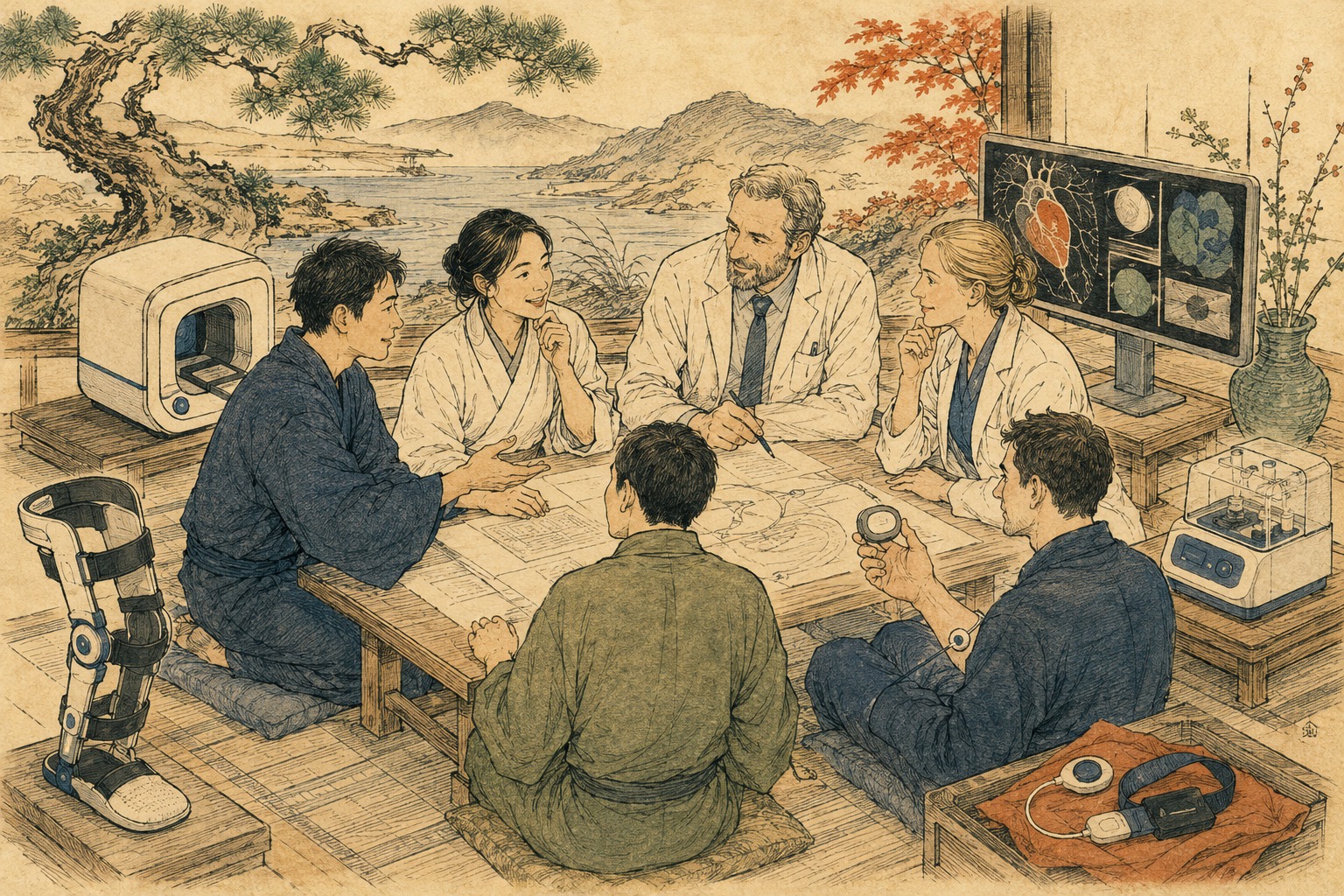
A good medical device can die on the way to the examination room. It works on a laboratory bench. It has been tested in Japan. Its founders care about the patient and clinicians see promise. Then an American hospital asks: Which FDA pathway? Who pays? How many minutes does this add to the workflow? Does it perform in our patients? One weak answer can leave the invention on a shelf.
The distance between laboratory and bedside is often called a valley of death. In healthcare, it is a mountain range: one valley for choosing a meaningful clinical endpoint, another for determining the Food and Drug Administration’s regulatory pathway, another for coding, coverage and payment, and still another for integration into hospital technology and practice.
On August 10, the Japan External Trade Organization, or JETRO, and Mayo Clinic Platform announced 15 companies in the 2026 J-StarX US Healthcare Breakthrough cohort, a program supported by Japan’s Ministry of Economy, Trade and Industry. The technologies extend from clinical AI and an injectable cell scaffold to water-less miniaturized home hemodialysis, stroke rehabilitation and an invasive brain–machine interface. What unites them is an attempt to translate a Japanese innovation into something American healthcare can evaluate, buy and continue to use.
One Cohort, Two Different Promises
Accuracy begins by not treating the 15 as one undifferentiated group. The Foundational course primarily targets seed-to-early-stage companies with a defined product, initial market validation and a clear U.S. ambition. A domestic program runs from late July through September, followed by a planned U.S. visit October 19–23. Its curriculum covers regulation, market-entry strategy, clinical and commercial evidence, mentoring and local connections.
The Business Development course targets companies with traction, regulatory feasibility and a concrete American milestone, at roughly Series A through Series C. Tailored online support runs from late July to mid-October; expert support and individual travel may continue to early March 2027. Each company is to receive a roadmap spanning FDA strategy, reimbursement, business development and investor engagement in pursuit of initial market traction.
| Foundational | Business Development | |
|---|---|---|
| Selected | 10 companies | 5 companies |
| Indicative stage | Mostly seed through Series A | Approximately Series A through C |
| Primary work | Regulatory, market and evidence foundations; strategy and connections | Tailored FDA, reimbursement, customer, investor and commercialization work |
| U.S. component | Planned group visit, October 19–23 | Company-specific expert support and individual travel |
| Not announced | Product authorization, Mayo adoption, investment, guaranteed clinical performance or patient-data access for every company | |
JETRO covers program fees such as mentoring, while participants bear airfare, local transportation, lodging, insurance, food, visas and costs beyond JETRO’s specified services. Public support opens doors; it does not erase the cost or execution risk of U.S. expansion.
The Foundation Ten: Inventions Built Around a Patient’s Day
The foundation group demonstrates that Japanese healthtech is not simply another list of imaging algorithms. Its targets include data exchange, pediatric cognition, central sleep apnea in heart failure, angiogenesis, rehabilitation, dialysis, surgery and direct communication with the brain.
| Company | Announced development focus | The American question |
|---|---|---|
| AIBTRUST | A system intended to advance Japanese medicine through circulation of medical data | Consent, de-identification, HIPAA, data rights and interoperability among health systems |
| Almaprism | A medical device measuring how children think and solve problems during a short video-game session | Age, language and cultural effects; connection to diagnosis; boundary between school and clinic |
| CaTe | Software as a medical device for cardiovascular disease management, pursuing usability, efficacy and safety | Intended population, clinical outcome, alert burden and reimbursement for remote management |
| CellFold | Angiogenic therapy using its Injectable Cell Scaffold | Cell retention, safety, manufacturing quality and the pathway for a potentially complex product |
| HICKY | A novel therapy for central sleep apnea in patients with heart failure | Benefit versus invasiveness, long-term outcomes and comparison with existing treatment |
| KuχAI | Real-time intraoperative AI analysis to optimize and standardize catheter ablation | Real-time accuracy, clinician authority, site variation and a safe response to faulty guidance |
| MY ROBOTS | Surgical intelligence that captures and structures video, audio and related clinical data | Operating-room privacy, ownership, workflow and validity for performance or training use |
| Neubond | A wearable delivering autonomous stroke mobility rehabilitation during daily activities | Home safety, adherence, magnitude of functional recovery and the therapist’s role |
| Physiologas Technologies | A “water-less,” next-generation miniaturized home hemodialysis device | Solute removal, fluid control, consumables, infection, emergencies and home training |
| Ruten | Invasive brain–machine interfaces intended to restore function lost to injury or illness | Neurosurgical risk, signal durability, cybersecurity, consent, reversibility and maintenance |
The third column is Japan.co.jp’s analysis of likely U.S. commercialization questions, not a result of the selection process. “Water-less” dialysis, for example, could change home treatment if it removes the conventional need for large volumes of dialysis water. It still must demonstrate how it safely performs dialysis’s essential jobs of solute clearance and fluid management. An invasive brain interface may pursue dramatic functional restoration, but carries obligations extending beyond software to implantation, surgery and years of follow-up.
The Business-Development Five: From Technology to Purchasable Care
The newly created track is for companies pursuing more concrete U.S. milestones. Here a polished demonstration matters less than knowing who buys, from which budget, what the technology replaces and which metric improves after deployment.
| Company and product | Announced work | Commercialization test |
|---|---|---|
| Cardio Intelligence SmartRobin | An AI medical device that rapidly analyzes long-term ECG recordings | How much review time and workload it saves, whether it limits missed findings and how it fits billing |
| GramEye Mycrium | Robotic automation of Gram staining with AI-assisted image interpretation | Time to antimicrobial decision, laboratory quality, expert comparison and integration in regulated labs |
| MNES LOOKREC | A fully cloud-native, multimodal medical-imaging platform | PACS interoperability, storage economics, latency, security and migration burden |
| Quadlytics | Wearable ECG and proprietary AI intended to detect preictal signs and alert patients and caregivers | False alarms, warning interval, seizure safety, daily adherence and evidence that alerts change care |
| SmarTrial | An AI agent for clinical-trial execution | Hallucinations, audit trails, Good Clinical Practice, privacy, human sign-off and sponsor accountability |
Organizers say each will receive a customized roadmap around regulation, reimbursement, business development and investors. A roadmap is not an authorization. But if it prevents a startup from choosing the wrong patient population, running an unusable trial or finishing a product no payer will cover, it may be more valuable than a generic grant.
“Getting FDA” Is Not One Door
The shorthand hides several routes determined by intended use and risk. Many moderate-risk devices seek 510(k) clearance by demonstrating substantial equivalence in safety and effectiveness to a legally marketed predicate. A novel low- or moderate-risk device without an appropriate predicate may pursue De Novo classification. High-risk devices generally face premarket approval, or PMA. An invasive brain interface, a scaffold used with cells, clinical AI and a laboratory robot will not travel the same road.
FDA increasingly treats AI medical devices through a total-product-lifecycle lens. A model developed at one hospital or in one demographic may lose performance elsewhere. Changes in equipment, clinical codes and patient populations can shift the input. Material software updates may affect regulatory obligations, while post-deployment monitoring matters because a static retrospective test cannot predict every real-world condition.
This is why American external validation is more than translation into English. It asks whether a model retains safety and usefulness amid different demographics, clinical pathways, record systems and standards of care. Even then, marketing authorization does not command a hospital to buy. Safe and effective for a labeled use is not the same claim as better value than existing care, billable service or reduced clinician workload.
After Authorization, the American Test Starts Again
The Centers for Medicare & Medicaid Services separates three concepts in its guidance for medical-technology companies: coding, coverage and payment. A code is the claims vocabulary identifying a product or service. Coverage determines whether it is a benefit for specified patients and circumstances. Payment determines how much is paid and to whom. One does not automatically confer the other two.
A health system then adds purchasing review, cybersecurity, liability, electronic-record integration, training and change management. An ECG algorithm can save analysis time yet add work if its results live in another screen. Structured surgical video can be useful yet stall if consent and retention policies are unresolved. A compact home device still needs supplies, training and someone to answer when it fails at 2 a.m.
- Regulatory: What precise diagnosis or treatment claim will be made, through which pathway, against what comparator and evidence?
- Clinical: Beyond accuracy, does the product improve a patient outcome or a clinician’s decision?
- Economic: After acquisition and labor costs, which hospital, payer or patient receives value?
- Workflow: Can it enter the electronic record, laboratory, operating room or home without unreasonable friction?
- Trust: Can the company sustain privacy, fairness, explanation, failure response and monitoring after updates?
More Valuable Than the Mayo Name: Friction From Clinicians
Mayo Clinic Platform was created in 2019 to extend Mayo’s knowledge and data-driven capabilities beyond patients able to travel to its campuses. Platform_Accelerate, launched in March 2022, offers a 30-week program for early healthtech AI companies, with a structured curriculum, one-to-one expertise and, under appropriate engagements, work inside a de-identified clinical-data environment. Mayo Clinic Berg Innovation Exchange connects clinical needs with founders, researchers and investors; Kicker Ventures contributes early-stage healthcare business experience.
The announcement does not say that every Japanese company enters the standard 30-week Accelerate program or freely receives millions of patient records. Mayo describes controlled access as “data behind glass”: a privacy-preserving environment, not a transfer of identifiable charts to a startup. Data scope, projects and contracting remain separate matters.
The most valuable output may not be a prestigious logo. It may be friction from clinicians: What do I do when this alert appears? Does it work on a night shift? Who is missing from the training data? Those questions can narrow intended use, change an endpoint and force a company to remove a feature. Clinical co-development is not the application of institutional prestige to a product. It is the early discovery of why a real care team might reject it.
From a 1958 Export Agency to a Healthcare Bridge
JETRO was founded in 1958 to promote Japanese exports. In the era of postwar reconstruction, trade fairs, market intelligence and overseas offices helped Japanese manufacturers meet the world. In the twenty-first century its focus expanded toward attracting investment into Japan and helping small and midsize companies and startups grow abroad. Moving health technologies into an American hospital ecosystem differs from moving manufactured goods through a port, but the essential job—translating the market’s language—remains.
Following Japan’s 2022 Startup Development Five-year Plan, the government launched J-StarX in fiscal 2023 to expose entrepreneurs to global ecosystems. JETRO’s collaboration with Mayo Clinic Platform began in 2024. That first year put 16 Japanese companies through an educational first phase, with up to five progressing to Mayo Clinic Platform_Accelerate. In 2025, 12 joined the first phase of an AI Medical course; four later entered its 2026 medical-data phase.
The 2026 edition broadens the name to US Healthcare Breakthrough, encompassing medical devices and digital health beyond AI, and adds Business Development for five more mature companies. That is not cosmetic. It moves the accelerator’s unit of success away from attendance and demo-day applause and toward company-specific regulatory meetings, evidence plans, research contracts, first customers and reimbursement strategy.
1958 JETRO is established with export promotion at its center.
2019 Mayo Clinic Platform is created.
2022 Mayo Clinic Platform_Accelerate launches; Japan adopts its Startup Development Five-year Plan.
2023 J-StarX begins.
2024 JETRO and Mayo Clinic Platform launch their Japan healthtech collaboration; 16 companies enter phase one.
2025 Twelve companies are selected for the AI Medical course.
August 10, 2026 Fifteen US Healthcare Breakthrough companies and two tracks are announced.
Why a Successful Japanese Product Cannot Simply Be Exported
Human biology does not change at customs. Healthcare institutions do. Japan’s nationally organized public insurance and fee schedule differ sharply from America’s layers of Medicare, federal-state Medicaid, commercial insurance and self-pay. The economics of the same device can change with facility, patient population and payer contract.
Clinical data also carry geography. Demographics, disease prevalence, referral patterns, diagnostic equipment and documentation differ. Translating a clinical AI agent from Japanese to English does not resolve abbreviations, responsibility, local standards of care or bias. For home devices, housing, caregivers, emergency services and supply logistics become design variables.
Japanese companies also bring strengths: precision engineering, miniaturization, continuous improvement, and experience with chronic disease, rehabilitation and home care in a rapidly aging society. Physiologas’s home dialysis, Neubond’s rehabilitation embedded in daily life and Cardio Intelligence’s long-duration ECG analysis align with a global shift from hospital-centered care toward the home. American expansion can validate those strengths while exposing assumptions invisible in the domestic market.
How to Measure Success After Selection
An accelerator can create access. It cannot guarantee a clinical trial, determine an FDA decision, compel payer coverage or make a hospital purchase. Even with Mayo expertise, each company remains the sponsor responsible for data quality, manufacturing, financing and compliance.
By spring 2027, useful evidence will be more concrete than a cohort photograph. Did a company clarify its FDA pathway through a pre-submission interaction? Did it contract with an American research institution and select the right population and endpoint? Did customer interviews identify buyer, price and implementation owner? If evidence was negative, did the founders disclose it and redesign? Beyond those milestones lie authorization, coverage, first revenue and real-world safety monitoring.
| Milestone | What it establishes | What it still does not establish |
|---|---|---|
| Program selection | The company passed an application and review process for support | Effectiveness, FDA authorization or Mayo adoption |
| U.S. evidence plan | Population, comparator, endpoint and data source are defined | Trial success or commercial demand |
| FDA clearance or approval | Applicable requirements are met for the labeled use | Coverage, hospital purchase or superiority for every patient |
| Initial deployment | A customer has begun real-world use | Scale, long-term safety or durable profit |
Not Fifteen Futures, but Fifteen Hard Tests
Placed together, the cohort resembles an exhibition of future medicine: measure thought through a game, learn from surgery video, read the heart and brain with AI, dialyze at home and connect directly to the nervous system to restore motion. It is natural to feel excitement.
Care, however, is not built from possibility alone. There is a patient kept awake by false alarms, a family facing a stopped home machine, a physician accountable for an algorithm’s conclusion, a hospital defending its budget and a citizen entrusting intimate data. Innovation and evidentiary caution are not enemies. Caution is what turns invention into medicine that can be used for years.
The value of the JETRO–Mayo bridge is not merely carrying 15 companies to the United States. It is revealing, early and specifically, why each might fail to cross. A founder can then remove features, rebuild a trial, find the payer and return to the patient’s need. Japan’s medical technology will not cross America’s last mile on selection day. It will cross when it enters the quiet disorder of an unfamiliar hospital, improves a patient’s outcome and leaves credible numbers behind.
Reporting note and principal sources
This article uses public information available through August 12, 2026 at 9:18 AM JST. Descriptions of the 15 products are development claims from JETRO, Mayo Clinic Platform and company materials; Japan.co.jp has not independently established safety, effectiveness or suitability. We distinguish selection from FDA authorization, reimbursement, investment and adoption at Mayo Clinic. A separate JETRO–TheraNova Medical Data Utilization Program, also announced August 10 with five different companies, is not part of this 15-company cohort.
- JETRO and Mayo Clinic Platform: 15-company US Healthcare Breakthrough announcement (August 10, 2026)
- JETRO: Foundational course requirements and schedule
- JETRO: Business Development course requirements and schedule
- Mayo Clinic: Beginning of the JETRO collaboration in 2024
- JETRO: Twelve companies selected for the 2025 AI Medical course
- Mayo Clinic Platform_Accelerate: Program overview
- Mayo Clinic Platform: Formation and Accelerate timeline, 2019–2022
- Mayo Clinic Berg Innovation Exchange
- JETRO: History from 1958 and current mission
- METI: Startup Development Five-year Plan and launch of J-StarX
- FDA: Premarket pathways for AI and Software as a Medical Device
- FDA: 510(k) Premarket Notification
- FDA: De Novo Classification Request
- CMS: Coding, coverage and payment guide for medical-technology companies
- JETRO: Separate Medical Data Utilization Program (included to prevent conflation)