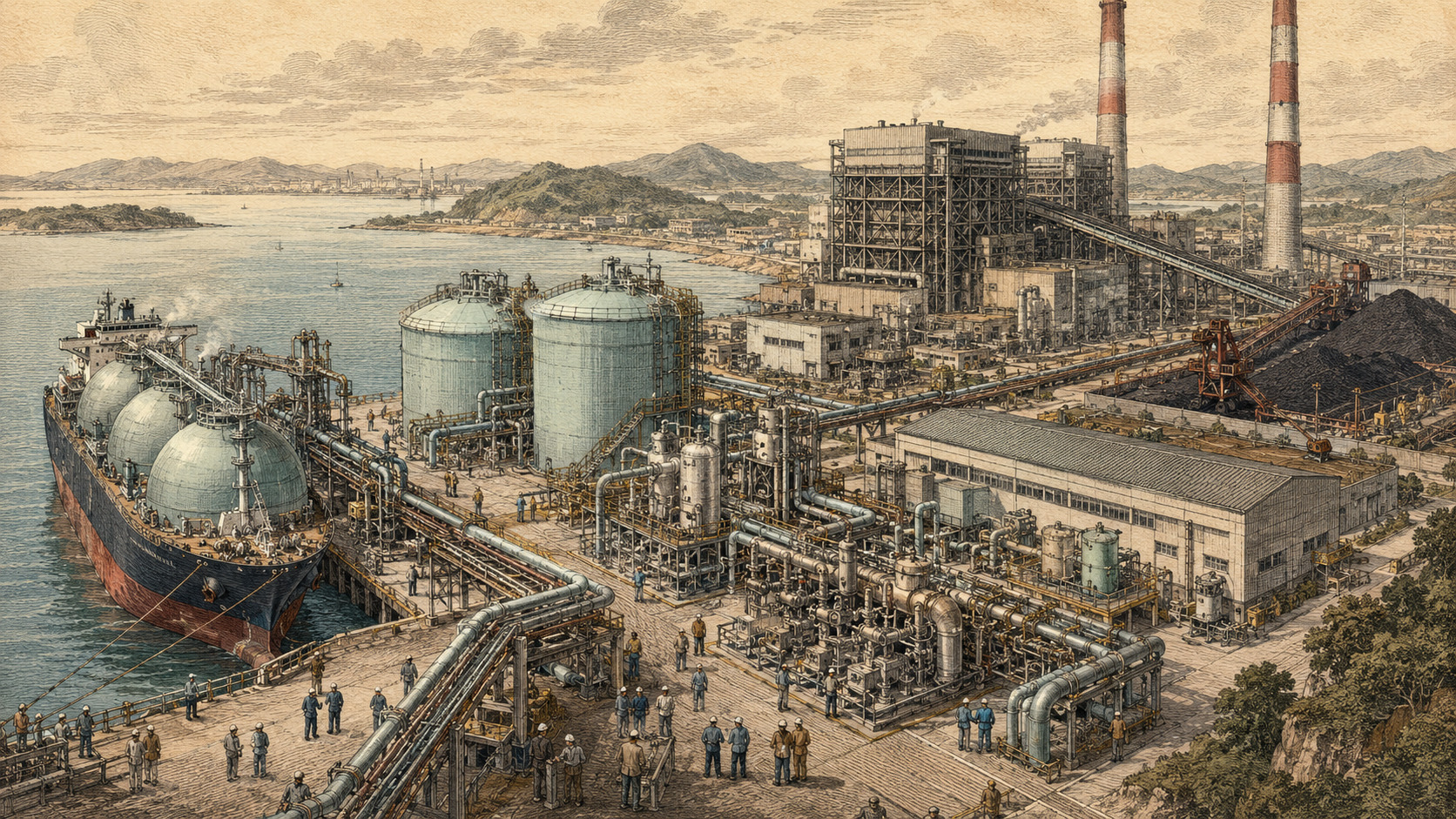
From Kinuura Bay, Hekinan Thermal Power Station looks like the architecture of Japan’s industrial century: coal conveyors crossing the grounds, a vast stockyard, boilers and two tall stacks. Its five generating units, commissioned from 1991 through 2002, can produce 4.1 gigawatts. JERA calls it Japan’s largest coal-fired power station.
Now a second architecture is rising beside it. Dedicated tanks are being built to hold refrigerated liquid ammonia. New pipelines will connect a marine unloading point to the station. Four ocean carriers are intended to shuttle fuel from a natural-gas-and-carbon-capture project in Louisiana. The old coal plant is becoming the receiving end of a hydrogen supply chain measured not in laboratory cylinders, but in half a million tonnes a year.
The attraction is chemical. Ammonia—NH₃—packs hydrogen into a carbon-free molecule that industry already knows how to liquefy, ship and store. Burned ideally, it yields nitrogen and water rather than carbon dioxide. Mixed into a coal boiler at 20% of its heat input, it can reduce the unit’s smokestack CO₂ by roughly the same share without replacing the turbine, grid connection, port or most of the boiler.
But the qualification is as important as the promise. The other 80% of heat still comes from coal. And the ammonia arriving in 2029 is planned to begin with natural gas, not renewable electricity. Carbon capture at the production plant may sharply reduce manufacturing emissions, yet the climate result also depends on upstream methane, residual CO₂, capture energy, transport and storage. Hekinan is therefore not merely a combustion project. It is Japan’s most visible experiment in whether a subsidized global fuel chain can turn an existing coal asset into a credible bridge rather than a longer lease on coal.
A coal monument built for Japan’s expanding electricity demand
Hekinan began operating on October 18, 1991, when Unit 1 entered service with 700 megawatts. Units 2 and 3 followed in June 1992 and April 1993. A later expansion added two 1,000-megawatt machines in November 2001 and November 2002. On a 2.08-million-square-meter site in Aichi Prefecture, the complex became both a regional power source and a lesson in scale.
By November 2013, it had generated a cumulative 500 billion kilowatt-hours—the fastest Japanese thermal station then to reach that mark, according to Chubu Electric. By August 2016, Hekinan had received 200 million tonnes of coal, another domestic first for one coal station. Its stockyard alone covers roughly 300,000 square meters. Operators learned to blend and burn around 160 varieties of coal from countries including Australia and Indonesia.
Those statistics explain why Hekinan is technically attractive for the ammonia experiment. One retrofit touches a very large block of generation. The port, cooling water, transmission lines, turbine and trained workforce already exist. If ammonia can enter through modified burners while the rest of the plant remains useful, each percentage point of substituted heat affects more electricity than it would at a smaller facility.
They also explain the controversy. Hekinan’s value is inseparable from the durability of a coal system constructed to run for decades. A transition fuel can use that inherited machinery to reduce emissions quickly; it can also make continued coal operation easier to justify. The difference will be determined by carbon intensity, cost, utilization and whether the ammonia share actually rises.
1991–1993 Hekinan Units 1–3, each 700 MW, begin operation.
2001–2002 Units 4 and 5 add 1,000 MW each, taking the station to 4.1 GW.
2014–2019 TEPCO and Chubu create JERA, then fully integrate their existing thermal-power businesses.
FY2017–2019 Japanese research programs develop the basis for direct ammonia combustion in coal boilers.
2021 NEDO selects the JERA–IHI Hekinan demonstration.
April–June 2024 Unit 4 completes the world-first 20% demonstration at a large commercial coal unit.
April 2025 JERA, CF Industries and Mitsui take final investment decision on Blue Point in Louisiana.
December 2025 The Hekinan supply project is certified for Japan’s price-gap support.
February–June 2026 The subsidy grant is decided; construction is reported on track; four carriers are chartered.
FY2029 Target for commercial-scale 20% heat substitution at Unit 4.
Why carry hydrogen as ammonia?
Hydrogen is difficult cargo. Its molecules are tiny, its volumetric energy density is low and liquefaction requires about minus 253 degrees Celsius. Ammonia offers a denser package and becomes liquid at about minus 33 degrees at atmospheric pressure. A century-old fertilizer trade already has tankers, terminals, storage practices and international handling experience.
The synthesis is familiar too. Hydrogen and nitrogen are combined through the Haber–Bosch process. The climate question is how the hydrogen was made. “Green” ammonia generally begins with renewable electricity splitting water. “Blue” or low-carbon ammonia generally begins with natural gas, while a large share of the resulting CO₂ is captured and stored. The molecule at the power station is the same; its production history is not.
Ammonia is not easy boiler fuel. It ignites reluctantly, burns slowly and can form nitrogen oxides. Incomplete combustion can allow ammonia to pass through unburned; some conditions can produce nitrous oxide, a powerful greenhouse gas. The engineering task is to place the flame, air and fuel so that ammonia disappears into useful heat without trading CO₂ for NOx, N₂O or ammonia slip.
That is why IHI’s burner work matters. It began ammonia-combustion research in the mid-2010s, continued through Japan’s Strategic Innovation Promotion Program and NEDO studies, and moved to the full-scale Hekinan test with JERA. The project was not simply pouring a new liquid into a coal line. It was controlling a chemically different flame inside one of the country’s largest boilers.
The 2024 trial proved more than a laboratory flame—and less than a commercial market
Hekinan Unit 4 has 48 burners and six coal mills, normally running five while one remains available. IHI added an ammonia nozzle to each burner and built a temporary receiving and supply system: unloading equipment, a refrigerated tank, boil-off-gas handling, pumps, vaporization, superheating, valves and dedicated pipework.
Ammonia firing began on April 1, 2024. On April 10, JERA and IHI reached 20% substitution by heat while Unit 4 generated at its rated 1,000 MW. Over roughly three months they tested different coal-mill patterns, load changes and emergency cutoffs. The companies reported no trial-related accident or incident and said basic operability was equivalent to coal-only operation.
The stack results were important. Relative to coal-only firing, CO₂ fell about 20% and sulfur oxides about 20%. Nitrogen oxides were at the same level or lower. Nitrous oxide and unburned ammonia were at or below their measurement limits, while unburned material in the ash remained equivalent. These are company-reported demonstration results, not an independent lifecycle assessment, but they answered the immediate boiler question: a large commercial unit could hold rated output with 20% ammonia and without a measured pollution penalty in the tested conditions.
| The 2024 demonstration established | It did not establish |
|---|---|
| 20% ammonia by heat input at a rated 1,000 MW. | Continuous multiyear reliability or commercial availability. |
| About 20% lower stack CO₂ and SOx during the test. | The delivered fuel’s full lifecycle greenhouse-gas intensity. |
| NOx at the same level or lower; N₂O and ammonia slip below measurement thresholds. | Performance at every load, fuel composition, higher blend or future plant. |
| Normal load changes and safe emergency ammonia cutoff. | A competitive delivered price without public support. |
| Limited boiler-area modification centered on burners and supply equipment. | That every coal plant can be converted for the same cost or design effort. |
Commercial scale means four tanks, four ships and one continuous rhythm
JERA estimates that continuous 20% substitution at Hekinan requires about 500,000 tonnes of ammonia a year. That is roughly 1,370 tonnes every day on an annual average. The company has noted that this single demand would be more than twice Japan’s total ammonia imports at the time of its earlier planning.
In February 2026, JERA said four very large ammonia tanks were under construction at Hekinan and work on the unloading jetty and pipelines was progressing. In June it announced time-charter contracts with NYK Bulkship Asia and Mitsui O.S.K. Lines for two vessels each. The four ships are planned to move approximately 500,000 tonnes annually from Louisiana to Japan.
This is the overlooked significance of Hekinan. A three-month demonstration can rely on a temporary system and a scheduled cargo. A power station requires inventory through storms, ship delays, maintenance and demand swings. Refrigerated storage must control boil-off gas. Unloading arms, pumps, valves and detectors must work repeatedly. Operators and local emergency services must prepare for a fuel that is widely handled but toxic and corrosive.
JERA says its design considers earthquake, high tide, tsunami and flood risks; leaked ammonia can be detected and isolated, contained behind dikes and suppressed with water spray because it dissolves readily in water. Those measures are essential, but safety at commercial scale will be a record accumulated across thousands of transfers and operating days, not a certification earned once.
Blue Point supplies the hydrogen history inside the molecule
The planned source is Blue Point, a roughly $4 billion low-carbon ammonia project in Ascension Parish, Louisiana. CF Industries owns 40%, JERA 35% and Mitsui 25%. The partners took final investment decision in April 2025 and target production in 2029 at an annual nameplate capacity of about 1.4 million tonnes.
Blue Point will use natural gas as feedstock. The project is designed to capture more than 95% of CO₂ generated in the ammonia-production process—about 2.3 million tonnes a year—then dehydrate and compress it for transport to 1PointFive’s Pelican sequestration hub. That is a substantial intervention in plant emissions. It is also a more bounded claim than “carbon-free.”
Capture percentage at the ammonia plant does not automatically include methane emitted during gas production and transport, residual uncaptured CO₂, energy used by capture and compression, ship fuel, refrigerant and storage losses, or the permanence of underground storage. Peer-reviewed lifecycle studies repeatedly find that the upstream production route dominates ammonia’s climate result. One Australia–Japan study found renewable ammonia reduced emissions in both countries across its examined scenarios, while fossil-derived pathways were much more sensitive to assumptions.
Blue Point’s project-specific delivered carbon intensity at Hekinan was not disclosed in the public materials reviewed for this article. That number—and the methodology, boundaries and verification behind it—will be more informative than the color attached to the fuel.
There is an intriguing numerical fit. JERA’s 35% share of Blue Point’s 1.4-million-tonne capacity is 490,000 tonnes, almost Hekinan’s stated annual requirement. That is simple arithmetic, not proof that every tonne of JERA’s equity share will go to Unit 4: the company also plans to serve commercial and industrial users. It does show how one giant coal boiler can anchor a production project across the Pacific.
| Link in the chain | Confirmed plan | Question to track |
|---|---|---|
| Production | 1.4 million t/year at Blue Point from 2029; natural gas plus CCS. | Actual output, capture rate, methane accounting and verified carbon intensity. |
| CO₂ storage | About 2.3 million t/year intended for permanent sequestration. | Injection performance, monitoring, leakage responsibility and energy penalty. |
| Ocean transport | Four chartered carriers for about 500,000 t/year. | Vessel fuel, schedule resilience, delivered cost and transport emissions. |
| Hekinan terminal | Four very large tanks, unloading facilities and pipelines under construction. | Completion, commissioning, safety performance and inventory buffer. |
| Power generation | 20% by heat at Unit 4 around FY2029. | Availability, net efficiency, annual coal displaced and actual net emissions. |
Japan is not merely subsidizing a plant; it is underwriting a market
The economics are the project’s least visible component. In December 2025, the Japanese government certified JERA’s project under the Hydrogen Society Promotion Act’s price-gap support. JOGMEC followed in February 2026 with the grant decision. The mechanism is designed to bridge the difference between a low-carbon hydrogen or derivative fuel’s base price and a reference price linked to the conventional fuel it replaces.
For selected projects, the support runs for 15 years. That duration is the point: a new ammonia plant, carbon-storage system, ships and import terminal cannot be financed on a one-year promise. Long-term support can turn uncertain future demand into a bankable chain.
It also transfers risk to the public. If ammonia remains structurally more expensive than coal, the price gap can persist. If the reference fuel price changes, the support calculation changes. If technology or policy moves faster than expected, infrastructure can be left behind. JERA and the government have not disclosed the project’s strike price, reference price, expected annual payment or maximum public exposure, so outside readers cannot yet calculate subsidy per tonne, kilowatt-hour or tonne of CO₂ avoided.
A separate March 2026 certification supports Hekinan as a supply hub, including truck-loading infrastructure for other users in the Chubu region. JERA has named potential industrial destinations involving Toyota Industries, AGC, NGK Insulators and Aisin Fukui. That hub logic is economically important: power generation provides anchor demand, while furnaces and other hard-to-electrify processes broaden the customer base.
- Price-gap support: long-term assistance for the difference between low-carbon ammonia and a conventional reference fuel.
- Hub-development support: assistance for shared receiving, storage and distribution infrastructure.
- The 2024 NEDO demonstration: publicly supported engineering proof at Unit 4, not the commercial fuel contract.
Why Japan sees a bridge where critics see coal lock-in
Japan imports most of its energy and has limited space for renewable generation compared with its demand centers. The country also needs dispatchable power when solar and wind output fall. From that perspective, ammonia offers a way to use ports and thermal assets while importing low-carbon chemical energy from places with cheaper gas, renewable resources or carbon storage.
JERA is central to that strategy. Created in 2015 by TEPCO and Chubu Electric and expanded through the 2019 integration of their existing thermal businesses, it has a generating footprint large enough to create demand rather than wait for it. Its roadmap proposes replacing coal first with ammonia and LNG later with hydrogen, increasing substitution ratios and eventually moving toward dedicated firing while also expanding renewables.
The counterargument is equally concrete. At 20%, Unit 4 remains an 80%-coal machine by heat input. New tanks, ships and subsidies may extend the economic life of coal assets. Every public yen committed to ammonia is unavailable for some combination of grids, storage, renewables, efficiency or firm zero-carbon generation. And if low-carbon ammonia stays expensive, a higher blend can make electricity costlier even as it lowers stack CO₂.
A 2024 academic modeling study—not a forecast of Hekinan—illustrated the risk: its modeled 20% blue-ammonia case had lower retrofit capital than carbon capture on the coal unit but much higher fuel-driven operating cost. Such studies depend heavily on fuel and carbon assumptions. Their useful warning is that an easy boiler retrofit does not make the imported molecule cheap.
Japan’s climate commitments tighten the test. Its current national targets call for greenhouse-gas reductions of 60% in FY2035 and 73% in FY2040 from FY2013. G7 members have also committed to a fully or predominantly decarbonized power sector by 2035. A 20% cut can be a first step, but it cannot be the destination on that timetable.
The true unit of measurement is the tonne of avoided CO₂
Three carbon ledgers can produce three different impressions. The smokestack ledger is simple: ammonia contains no carbon, so replacing 20% of heat reduces direct coal CO₂ by roughly 20%. The production ledger asks how much CO₂ was created and captured while making the ammonia. The full supply-chain ledger adds natural-gas extraction, methane leakage, electricity, capture and compression, ocean shipping, storage and any nitrous oxide.
Policy needs the third ledger. It should report greenhouse-gas intensity in a comparable unit, state boundaries and warming factors, identify whether capture is measured or modeled, and reconcile stored CO₂ with monitored reservoir data. The result should be disclosed for delivered fuel and for electricity sent to the grid after plant auxiliary energy.
Cost should be reported just as plainly: total public support, ammonia landed price, incremental generation cost, tonnes of coal displaced and subsidy per tonne of lifecycle CO₂ avoided. Without those figures, Hekinan can prove operational scale while leaving economic and environmental scale unproven.
FY2029 needs a scoreboard, not a ceremony
The ceremonial milestones are easy to imagine: the first dedicated carrier at the jetty, the first commercial flow from a new tank, the first generator synchronized with a 20% blend. The more consequential evidence will accumulate later.
- Commissioning date, annual ammonia received and days of inventory.
- Unit 4 availability, output, net efficiency and operating hours at 20% heat substitution.
- Coal displaced and stack CO₂, NOx, SOx, N₂O and ammonia-slip performance across load ranges.
- Verified lifecycle greenhouse-gas intensity, including upstream methane and shipping.
- CO₂ captured, transported and durably stored at Blue Point and Pelican.
- Delivered ammonia price, public support per tonne and per kilowatt-hour, and cost per tonne of CO₂ avoided.
- A dated plan for moving beyond 20%, retiring coal use or repurposing the asset.
IHI’s June 2026 announcement that it had completed practical verification of a 100% ammonia burner shows that the engineering path does not necessarily stop at co-firing. It does not mean Hekinan has operated commercially on 100% ammonia. Higher ratios bring new burner, boiler, fuel-volume, safety and cost questions; the leap from a verified burner to a dispatchable power station remains large.
That distinction captures the entire Hekinan story. Japan has often been strongest at making the machine work. The 2024 trial deserves recognition as a genuine engineering achievement. The next task belongs equally to commodity traders, ship operators, reservoir engineers, regulators, auditors and taxpayers.
Stradanus’s Renaissance engravings turned mines, mills and workshops into theaters of invention because progress could be seen in gears, furnaces and human motion. Hekinan’s new theater will be even larger: a gas field, an ammonia plant, a carbon reservoir, four ships, a Japanese port and a 1-GW boiler moving in sequence. Whether it represents decarbonization will not be decided by the grandeur of that machinery. It will be decided by the coal it actually displaces, the carbon it actually keeps from the atmosphere and the price Japan pays for both.
Reporting notes and principal sources
“20%” means share of boiler heat input, not 20% by fuel mass and not a 20% ammonia share across all five Hekinan units. Dollar conversion for Blue Point uses the project’s own approximately $4 billion disclosure; no conversion from dollars to yen is performed in the article. JERA’s 35% equity share multiplied by 1.4 million tonnes equals 490,000 tonnes; this is a Japan.co.jp scale comparison, not a disclosed allocation. The project’s subsidy amount, strike and reference prices, delivered fuel price and project-specific lifecycle intensity were not found in the public primary materials checked by the reporting cutoff.
- JERA: Hekinan station capacity, units and site data
- Chubu Electric: Hekinan commissioning dates and 500-billion-kWh milestone
- Chubu Electric: 200 million tonnes of cumulative coal received
- JERA: Hekinan history, coal yard and role in the power system
- JERA: start of the 20% ammonia demonstration, April 2024
- JERA: completion and emissions results of the 2024 demonstration
- IHI: 1-GW test results, emissions and operability
- IHI: burner, mill, supply-system and trial engineering details
- IHI: history of Japanese ammonia-combustion development
- JERA: FY2029 status, four tanks and approximately 500,000 t/year
- JERA: four ammonia-carrier time charters, June 2026
- JERA: Blue Point final investment decision, ownership and scale
- CF Industries: Blue Point design, capture rate and CO₂ storage chain
- Mitsui: Blue Point production and sequestration plan
- JERA: price-gap support certification under the Hydrogen Society Promotion Act
- JOGMEC: subsidy grant decision and planned industrial users
- JERA: separate supply-hub support certification
- Tosoh: official description of the price-gap support’s 15-year period
- JERA: ammonia properties and Hekinan safety measures
- JERA: scale of Hekinan demand compared with historical Japanese imports
- METI: Seventh Strategic Energy Plan and 2040 climate target
- METI: G7 power-sector decarbonization commitment and carbon-intensity standards
- Ozawa and Kudoh: lifecycle uncertainty for hydrogen power generation, Energies
- Journal of Cleaner Production: lifecycle implications of Australia–Japan ammonia co-combustion
- International Journal of Green Energy: modeled economics of ammonia co-firing and coal CCS
- IHI: practical verification of a 100% ammonia burner, June 2026