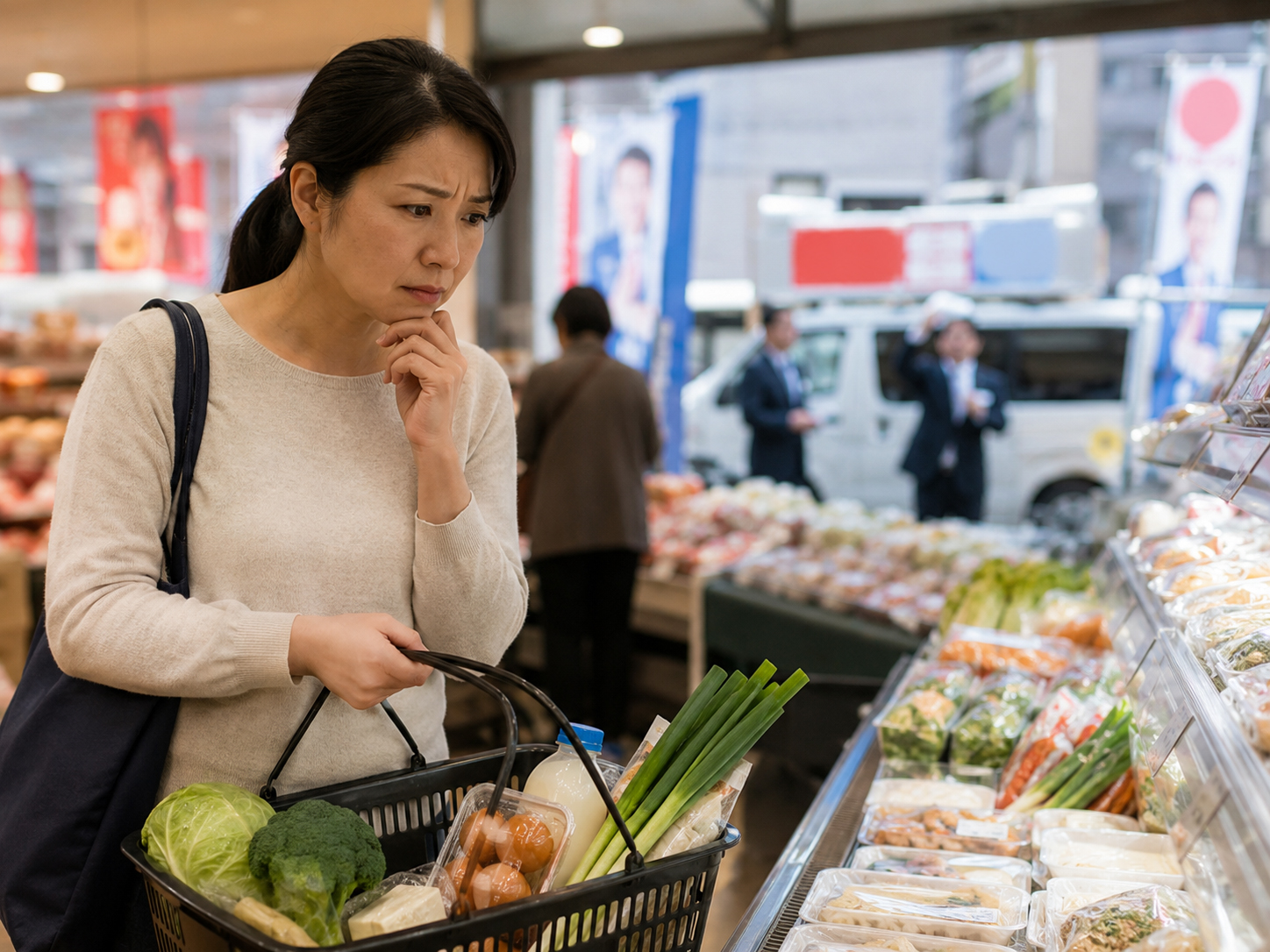
A proposal to cut Japan’s consumption tax on food to zero is not just a tax story. It connects supermarket shelves, campaign vans, finance-ministry spreadsheets, cash-register systems and the everyday shopping basket. With inflation still pressing on households, the ruling party is again debating whether to take the existing 8% reduced tax rate on food all the way down to zero.
Since October 2019, Japan’s standard consumption tax has been 10%, while food and beverages — excluding alcohol and dining out — have remained at a reduced 8% rate. The Ministry of Finance describes the reduced-rate system as a way to lessen the burden on household budgets, especially lower-income households. The current debate asks whether that reduced rate should temporarily become zero.
Why food?
Food is politically powerful. A household may postpone buying a car or a television, but nobody skips food as a category. Rice, eggs, milk, bread, vegetables, bento meals and seasoning appear on the receipt every week. When prices rise, everyone notices. The burden is especially heavy for lower-income households, families with children and older households whose budgets are already tight.
That makes a food-tax cut easy to explain. Unlike a cash benefit, it is visible at the register. Unlike a fuel subsidy, it is visible at the supermarket. For politicians, it is a direct way to say: we are helping daily life. But the clearer a policy sounds, the easier it is to hide the hard questions of funding and implementation.
The political history of consumption tax
Japan introduced consumption tax in 1989 under Prime Minister Noboru Takeshita at 3%. It was politically dangerous from the beginning. The rate rose to 5% in 1997, 8% in 2014 and 10% in 2019. Governments have defended the tax as a stable revenue source for an aging society, but every increase has raised questions about consumption, recession risk and political punishment.
The 1997 increase is remembered alongside economic weakness. The 2014 increase also cooled spending. The 2019 increase introduced the reduced rate for food, creating a daily-life boundary: eat in and pay 10%, take away and pay 8%; alcohol 10%, groceries 8%. Tax policy moved directly into the checkout line.
Would zero really work?
If food tax falls to zero, prices should decline in theory. In practice, the question is how much of the cut is passed through. Will retailers lower prices exactly by the tax amount? Will manufacturers and distributors adjust prices at the same time? With the yen, energy, logistics, wages and imported food costs all moving, consumers may not cleanly separate the tax effect from the broader inflation picture.
Still, tax cuts have psychology on their side. If receipts look lighter every day, households feel some relief. The political problem is durability. A two-year zero rate means a future moment when the tax must return. Restoring a suspended tax can feel like a tax hike, even if it was always meant to be temporary.
The cold reality of funding
Japan’s consumption tax is designed as a stable source of social-security revenue. Cutting the food portion to zero reduces tax revenue. If the government says it will not issue new debt, it needs another source of funding. Foreign-exchange reserves, spending cuts, fund drawdowns and other revenue adjustments have all been floated in one form or another, but none is painless.
Markets are watching fiscal policy too. With the Bank of Japan raising rates and the JGB market becoming more sensitive, an unfunded tax cut could feed into interest-rate and currency pressure. A measure intended to help households could indirectly hurt them through a weaker yen or higher financing costs.


The cash-register wall
The debate has an unexpected obstacle: cash registers. The Guardian reported that some major retail systems were not designed to process a zero tax rate without major upgrades. Changing tax policy in Tokyo means changing POS systems, price displays, invoices, accounting software, inventory systems, loyalty points and audit procedures across the retail economy.
That is why a 1% compromise sometimes appears. If zero is technically difficult, perhaps 1% is faster. But 1% is a weaker political message. It helps households, but it does not fit campaign rhetoric as cleanly as zero. Policy, software and elections meet in a very Japanese place: the register.
Who benefits?
A food-tax cut is often described as help for low-income households, but higher-income households also benefit. In absolute yen terms, households that spend more on food save more. Targeted cash benefits can be more efficient, but they require income checks, paperwork, administration and time.
Tax cuts are broad, thin and visible. Benefits are narrower, targeted and slower. The choice is not only economics; it is politics. Japan’s inflation policy keeps moving between efficiency and felt relief.
- Whether the government chooses 0%, 1%, or delays again
- Whether the cut is two years only or becomes politically hard to reverse
- How the revenue loss is funded
- Whether registers, POS systems and invoices can adapt in time
- Whether the policy actually lowers felt food inflation
Public finance, seen from the kitchen
The food-tax debate is powerful because it turns national finance into something visible in the kitchen. Social security, public debt, inflation, elections, supermarket prices and digital payment systems all meet on one receipt. Japanese politics is often explained through ministry documents. This policy can be understood through a shopping basket.
Households need relief. But Japan’s debt burden and aging society leave little room for painless answers. Zero food tax sounds kind. The question is who pays for that kindness, when, and how.
Sources and references
This Japan.co.jp report is based on Japan Times, the Ministry of Finance, the National Tax Agency, Reuters and Guardian public reporting.
- Japan Times: LDP still considering cutting sales tax to zero for food
- Japan Times: Consumption tax cut on groceries and fiscal concerns
- Ministry of Finance: 2019 consumption tax hike and reduced tax rate system
- National Tax Agency: Consumption tax rates and reduced-rate items
- Reuters: Takaichi election win and sales-tax pledge
- The Guardian: Cash register implementation issue