The decisive scores have yet to be earned.
A return to Rotterdam, with a different generation
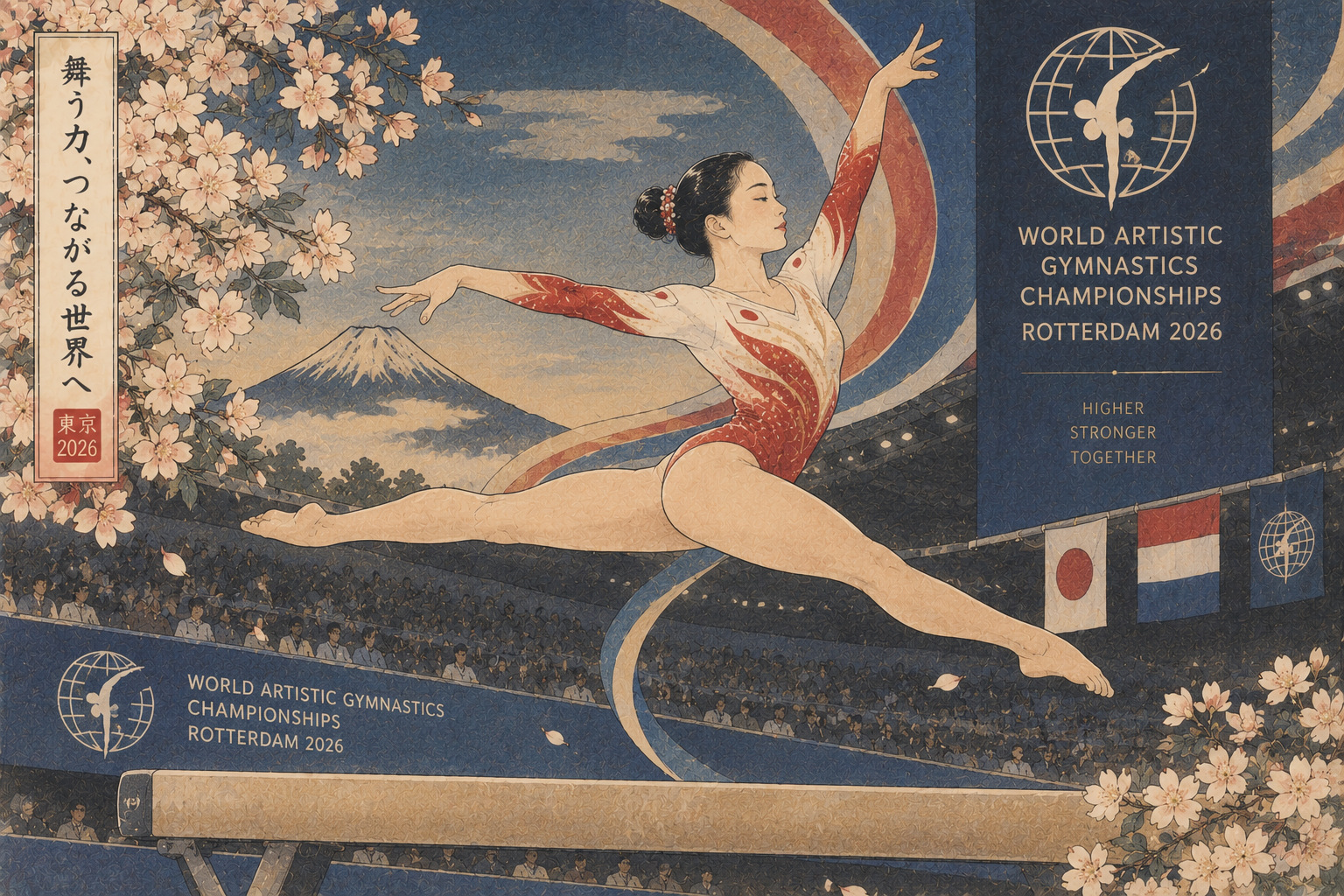
Sixteen years after Kohei Uchimura won the world all-around title in Rotterdam, Japanese gymnastics is returning to the Dutch city with a generation carrying its own expectations. The 54th Artistic Gymnastics World Championships open at Rotterdam Ahoy on October 17 and continue through October 25. For Japan, the opening day is not merely ceremonial: its men are assigned to the fourth qualification subdivision, beginning on pommel horse. The women are scheduled to enter qualifying on October 18, starting with vault.
That timetable comes from the Japan Gymnastics Association’s October 9 championship page and the international federation’s published programme. No medals or qualification scores from the 2026 championships were available at the October 15 reporting cutoff. The essential story, for now, is the contest about to unfold and the unusually rich history Japan brings back to Rotterdam.
The ten names representing Japan
Japan’s listed men are Shinnosuke Oka of Tokushukai Gymnastics Club, Daiki Hashimoto of Nippon Life and Central Sports, Shohei Kawakami of Tokushukai, Ryosuke Doi of Central Sports, and Fusuke Maeda of Leaf Gymnastics Club. The listed women are Misa Nishiyama, Rina Kishi, Aiko Sugihara, Mana Okamura and Haruka Nakamura, representing a combination of clubs, educational institutions and training programmes.
The names matter for more than medal projections. They reveal a competitive ecosystem in which professional clubs, university pathways, schools and coaching networks coexist. Successful national teams must unite athletes who train in different places, sometimes under different routines, into consistent performances across multiple apparatus. These are planned entries; the definitive starting lists are subject to official confirmation.
Hashimoto’s declaration of intent
After official training on October 14, Hashimoto told reporters he was feeling good and intended to surrender first place to no one, whether in the team or individual competition, according to a Kyodo report carried by the Japanese Olympic Committee on October 15. He is seeking a fourth consecutive world all-around title.
The same report said Chinese star Zhang Boheng would miss the event. A formidable rival’s absence can shift expectations but cannot create a score for Japan, or for anyone else. A poor landing or missed connection can change a competition in seconds. Hashimoto’s confidence is newsworthy because the challenge remains ahead, not because the outcome is settled.
How an all-around champion is made
Men’s artistic gymnastics consists of floor exercise, pommel horse, still rings, vault, parallel bars and horizontal bar. Women compete on vault, uneven bars, balance beam and floor. Judging takes account of difficulty and execution, with technical control, composition and landings crucial to the resulting score.
For viewers new to the sport, the spectacular release move is only one part of the contest. A slight break in body line, a balance check or a stumble after a dismount can matter as much as a signature skill. In team competition, repeated reliability often means more than any single breathtaking routine. Japan’s tradition of disciplined execution is therefore an issue to examine against actual results, rather than simply celebrate in advance.
The road from qualifying to the medals
Men’s qualification takes place October 17–18, while the women qualify October 18–19. The men’s team final is set for October 20, the women’s for October 21, the men’s all-around for October 22 and the women’s for October 23. Apparatus finals conclude the championships on October 24–25. These dates refer to Rotterdam local time.
The second part of Saturday’s men’s qualifications begins at 16:00 local time, 23:00 in Japan. A championship unfolding across time zones can produce confusion when a television broadcast date differs from the competition date. For journalists and fans alike, the governing body’s official start lists and live scoring should take priority over anticipated social-media celebrations.
What happened here in 2010
The last Rotterdam world championships provide a remarkably concrete historical comparison. In 2010, Uchimura won the men’s all-around with 92.331 points, as shown in the international federation’s result archive. Japan’s men took team silver behind China, 273.769 to 274.997, a gap of 1.228 points.
Those numbers are part of gymnastics history, not a usable scoring forecast. Codes of Points evolve; raw totals from 2010 cannot be used to judge how close the Japanese team may be to its modern competitors. Yet the continuity is striking. Rotterdam once helped define Uchimura’s era, and now serves as a stage on which another Japanese cohort can establish its own record.
Why individual brilliance is not enough
A world-leading all-arounder must deliver across every event, combining the strength demands of rings, the rhythm of pommel horse and the precision of parallel bars and high bar. Team medals require a different equation: a broader group of athletes must share responsibility and limit mistakes.
The question for Japan is how Oka and Hashimoto’s competitive strengths fit alongside Kawakami, Doi and Maeda in the event-by-event team structure. No responsible pre-event analysis can presume particular final placements, scores or apparatus assignments without verified competition documents. Real performance on October 17 will provide the first answers.
The women’s programme carries its own story
Women’s artistic gymnastics is sometimes reduced to its most photogenic moments. That overlooks the extraordinary differences between apparatus: the explosive approach to vault, continuous transitions on uneven bars, the small margin for error on beam, and the choreographic and tumbling demands of floor.
Nishiyama, Kishi, Sugihara, Okamura and Nakamura must first navigate qualification, scheduled for Japan’s second subdivision on October 18. A place in the October 21 team final is an ambition conditional on those scores, not an entitlement that follows from Japan’s history. Their competition deserves evaluation on its own terms, not simply as a companion narrative to the men’s medal campaign.
Beyond Rotterdam: Los Angeles 2028
The stakes also stretch toward the Los Angeles Olympics in 2028. The Japanese Olympic Committee’s October 15 account described Japan’s men as seeking one of the Olympic places attached to the top three positions. The precise qualification mechanism, eligibility requirements and allocation of quotas require consultation of the federation’s formal qualification documentation.
Regardless of quota mechanics, the world championships offer an unusually demanding stress test. Coaches can learn which athletes sustain form under international pressure, which apparatus remain vulnerable and how much tactical room exists in the team’s selection. A medal helps, but so does unvarnished evidence that guides better preparation over the next two years.
The hidden infrastructure of excellence
Artistic gymnastics may seem to be an entirely individual encounter between an athlete and a piece of apparatus. Behind it are coaches, physiotherapists, equipment specifications, officiating rules, travel planning, training facilities and recovery programmes. Organiser documents for Rotterdam describe competition apparatus and technical arrangements—reminders that championship gymnastics depends on a carefully controlled sporting environment.
Japan’s long-term challenge is to develop elite athletes without relying on a tiny group of household names forever. Club-level coaching, age-appropriate development and a broad participation base are not glamorous subjects, but they are where the next generation of exceptional routines begins.
What readers should watch on opening day
Saturday’s first concrete test is the Japanese men’s qualification in subdivision four. Their opening rotation on pommel horse places a notoriously unforgiving apparatus at the start of a high-pressure programme. Watch the completed team total, verified apparatus scores and the actual athletes who perform, rather than projecting medals from practice reports.
The women enter the story on Sunday, and team and individual finals follow only after qualification has decided who advances. The 2026 Rotterdam championships should be judged from the performances the athletes deliver, not from medals imagined before the opening salute.