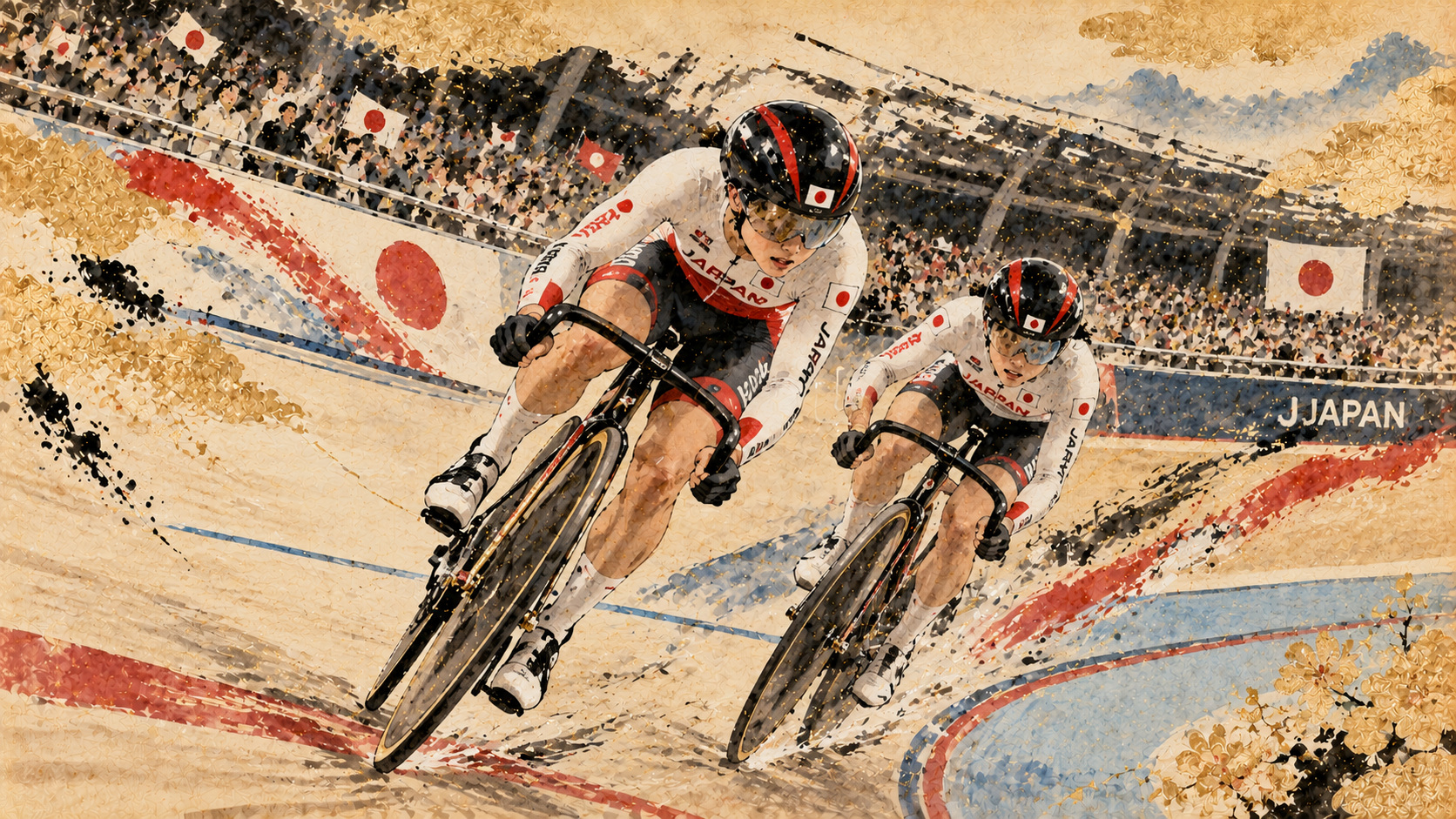
One medal rewards four races of endurance and tactical calculation. The other rewards split-second nerve in a head-to-head contest.
Two medals, two kinds of courage
At the Shanghai Velodrome on October 16, Japan’s women delivered two podium finishes in events that demand very different forms of excellence. Tsuyaka Uchino claimed silver in the women’s omnium, while Mina Sato secured bronze in the women’s sprint after winning her third-place contest. Japan’s Olympic Committee reported both results that evening. The story is not simply two medals: it is a reminder that modern track cycling rewards both the ability to read an endurance race over several formats and the nerve to decide a sprint in fractions of a second.
The 2026 Tissot UCI Track World Championships ran October 14–18 on Shanghai’s Chongming Island, China’s first hosting of the championship. Twenty-two titles were contested, split evenly between men and women. Japan’s results came on the third day, in an international field that included established stars from Britain, the Netherlands, China and elsewhere.
The omnium: four races, one medal
An omnium is not one long race. Riders contest a scratch race, tempo race, elimination race and points race; the combined ranking rewards consistency, position, acceleration and the ability to calculate under fatigue. A rider strong in an opening event can lose ground as the tactical demands change. Uchino’s silver therefore reflects a full day of racing rather than a single finishing sprint.
In the scratch race, Uchino placed first, according to the event results; the intermediate tempo and elimination races challenged her, and the final points race determined the overall medals. The official JOC report confirms silver, but it is important not to confuse rankings in intermediate races with the final omnium standings. Those are different tables and produce different results.
Britain’s Anna Morris took the title, according to the championship results. Uchino’s achievement also extends a Japanese history of women’s endurance-track medals, in which Yumi Kajihara helped make omnium and other endurance disciplines visible to a wider audience. The omnium is an Olympic event, so its tactical lessons carry beyond one world championship.
Sato’s sprint bronze was decided on the track
Sato reached the women’s individual sprint semifinals, fell short of the gold-medal final and then defeated Britain’s Sophie Capewell in the bronze-medal match. The official Tissot Timing result shows Sato winning the deciding contest. The final itself was won by China’s Yuan Liying over Britain’s Emma Finucane. These facts matter: the Japanese medal was bronze in the individual sprint, not keirin, and her opponent in the bronze contest was Capewell.
The match sprint is often misunderstood as a simple test of who can pedal fastest for 200 meters. Speed is indispensable, but riders also maneuver, observe their rival and choose exactly when to launch. In a close contest the difference can come from timing, positioning and the ability to sustain an explosive effort after several earlier rounds. The official final records razor-thin margins in the deciding races.
A champion learning to remain a contender
Sato was already a major name before Shanghai. She won the women’s keirin world title in 2024, becoming the first Japanese woman to do so, according to the Japan Cycling Federation. She retained that crown at the 2025 championships in Santiago and also took silver in the individual sprint that year. Her 2026 sprint bronze therefore belongs to a longer progression rather than representing her first international breakthrough.
Keirin and match sprint are related but distinct. Keirin riders accelerate behind a pace-setting motorcycle before racing for position after it leaves the track; individual sprint competitors meet head-to-head in a short tactical duel. The two demand overlapping physical capabilities but different racecraft. Sato’s medal record across both shows why she is a central figure in Japan’s sprint programme.
At the 2024 Paris Olympics, Sato placed tenth in women’s sprint and thirteenth in keirin, as recorded in her official athlete profile. World-championship podiums since then show significant strengths, but do not predetermine Olympic results. They are evidence of progress in a highly competitive, fast-evolving field.
From keirin’s Japanese roots to a global laboratory
The word keirin comes from Japan, where the professional sport developed after the Second World War. Its domestic organization, training and competitive culture gave Japan an unusual institutional base for producing specialists capable of competing internationally. Yet modern Olympic track cycling cannot be reduced to Japanese professional keirin: it includes team events, timed pursuits, endurance formats and technical regulations that differ from domestic racing.
Track cycling itself reaches back to the earliest modern Olympic Games. The UCI notes that the sport featured at Athens in 1896, and that the world championship tradition began in 1893. At Shanghai, the programme combined historical disciplines with today’s equipment science, aerodynamics, highly structured training and real-time tactical analysis.
Japanese competitors have appeared on the world podium across generations, but continuity should not be mistaken for guaranteed dominance. Each medal requires adaptation to competitors whose training systems, equipment and race plans are equally sophisticated.
Why two different medals matter
Endurance and sprint programmes depend on different physiological profiles and coaching systems. The omnium rewards recovery across four events, strategic awareness in a bunch and the ability to make or cover attacks. Sprint competitions emphasize maximal acceleration, positioning and repeated explosive efforts, often against the same elite rivals across several rounds.
For Japanese cycling, podium finishes in both areas signal breadth. For spectators, they offer a chance to see two very different sporting stories: Uchino’s ability to manage a complicated sequence of races and Sato’s fight through a knockout bracket. Neither should be flattened into the generic claim that Japanese cycling is suddenly dominant.
There is also a wider sports-economy angle. Investment in velodromes, youth development, coaching, women’s competition and international experience determines whether current results turn into a durable pipeline. The medal table is a snapshot; the underlying training system is the longer story.
Shanghai and the road ahead
The championship continued through October 18. This report is specifically about confirmed results from October 16, not a final accounting of every Japanese athlete’s subsequent performance. On October 15, Japanese riders also recorded men’s keirin bronze for Shinji Nakano and women’s elimination silver for Yumi Kajihara, illustrating that the Japanese delegation’s achievements were broader than the two medals featured here.
That broader context should encourage precision, not sweeping predictions. Conditions at a world championship differ from those at the Los Angeles 2028 Olympics, and selection procedures, form and rival performance can change. The most useful question now is how Japan preserves its sprint strengths while investing in the skills and tactical depth needed for repeatable endurance medals.
On the boards in Shanghai, a single week of racing supplied evidence of both: an endurance rider on the omnium podium and a sprint champion who returned to take another medal after a semifinal disappointment. Japan can celebrate without pretending that the next race is already won.
Sources and reporting notes
- JOC — October 16 medal report
- UCI — Shanghai championships overview
- Tissot Timing — women’s sprint final
- Tissot Timing — women’s omnium results
- JOC — Sato official athlete profile
- JCF — 2024 Sato keirin world title
- JOC — 2025 Sato double podium
- UCI — events explained and historical background
- KEIRIN official — 2025 championship report
- JOC — October 15 men’s keirin and women’s elimination