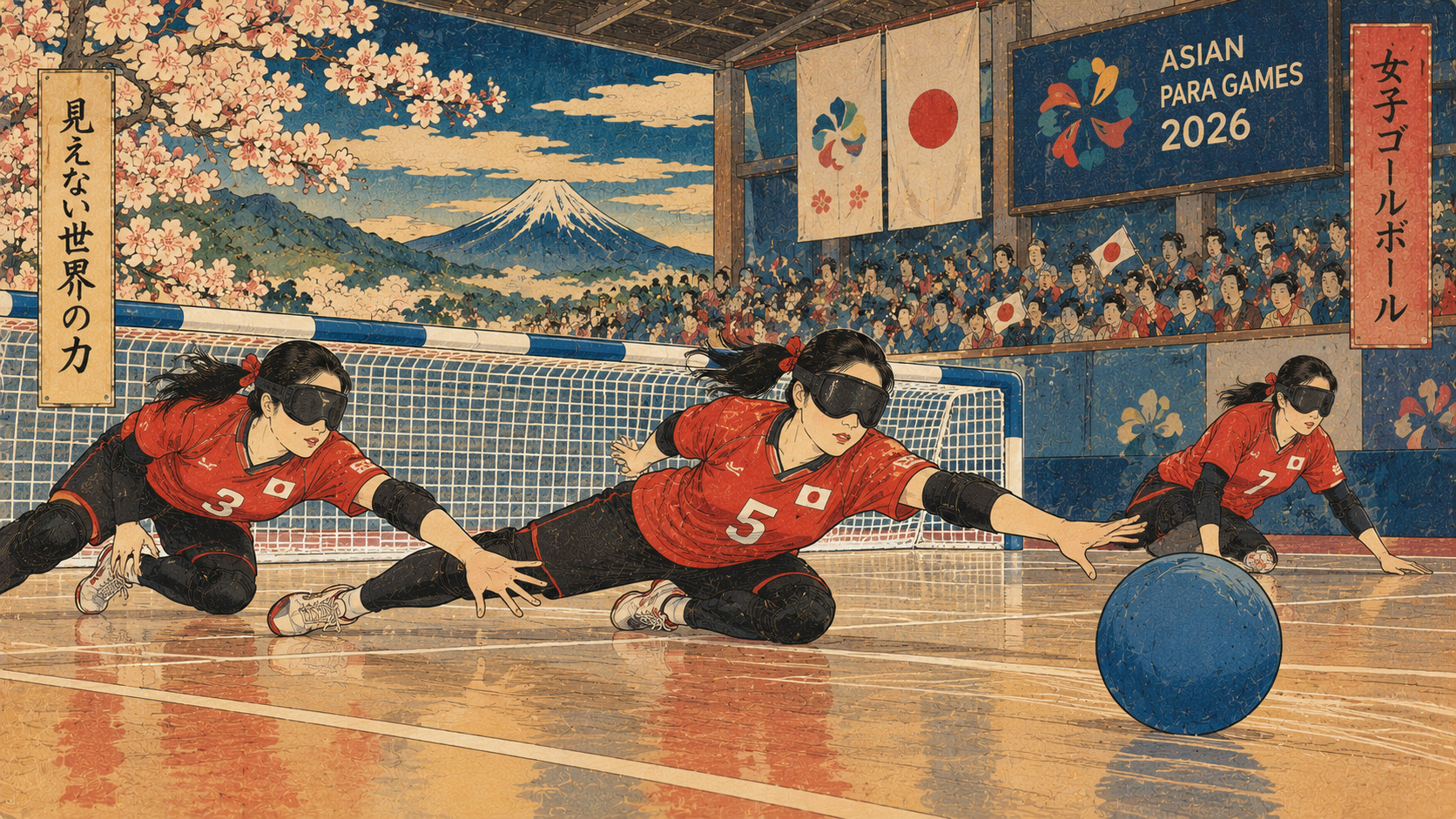
Three players defend nine meters. In goalball, silence is part of the contest.
A shutout heard before it was seen
On October 20 at Toyohashi City General Gymnasium in Aichi Prefecture, Japan's women defeated South Korea 6–0 in goalball, booking a semifinal place at the Aichi–Nagoya 2026 Asian Para Games. The game was not decided by an extraordinary last-second play. Japan took command early, kept its goal untouched and then delivered a second-half scoring surge. The achievement invites a broader question: what does defending brilliantly look like in a sport built on listening?
Six goals, no concessions
According to the Japanese Goalball Association's detailed report, Yu Kimura opened the scoring just 29 seconds into the match. Minami Arai added goals at 6:09 and 11:02, sending Japan into halftime 3–0 ahead. Japan began with Arai, Kimura and Kamiya; its second-half starting group was Saki Yasumuro, Kamiya and Norika Hagiwara. Hagiwara struck at 2:46, 3:01 and 6:22 of the second half to complete a run of three consecutive goals. The association credits Hagiwara with three, Arai with two and Kimura with one. Kamiya, the center defender, played throughout the contest. The same report identifies no South Korean goal scorers, because the team did not score.
What qualification actually means
The 6–0 result completed Japan's group stage at two wins and one defeat. Japan had beaten Thailand 10–0 on October 17, then lost a tense encounter with China 0–1 on October 19. The three-game sequence matters: a shutout of Korea did not establish Japanese supremacy over every rival, and the slim loss to China remains part of the tournament picture. The women's semifinal was scheduled for October 22, at either 10:30 a.m. or 1:30 p.m. Japan time. At this article's October 21 research cutoff it had not taken place. Its result, opponent and consequences must be confirmed from fresh official reporting before a post-semifinal headline is published.
The rules of sound
Goalball is played on an 18-by-9-meter court. Three players from each team defend a goal spanning the full nine-meter width. The ball weighs approximately 1.25 kilograms and contains bells. Athletes wear eyeshades, which standardize visual conditions for competitors with different degrees of visual impairment. Raised tactile lines let players locate themselves and their positions. The quiet demanded of spectators during active play is not ceremonial: a shout from the stands can interfere with the clues athletes need to determine where a fast-moving ball is headed.
Why three defenders have to move as one
In many sports, a goal is guarded primarily by sight. In goalball, every defensive rotation depends on hearing a rolling or bouncing ball, recognizing the throw's angle and coordinating a dive so that no gap opens between bodies. The association's record singles out the center defender Kamiya for playing the entire Korean match. That detail helps explain what the scoreline alone conceals: holding an opponent scoreless across two halves demands positioning, communication, endurance and the ability to reorganize as personnel change. Without possession-by-possession film, one should not claim to know exactly which defensive adjustment made the difference.
Six–zero is emphatic, but not a mercy win
A ten-goal difference triggers the sport's mercy rule and ends a contest early under standard international rules. Japan's 10–0 opening defeat of Thailand therefore has a distinct competitive context from the completed 6–0 Korean match. A clean sheet matters in either case, but the score must not be embellished into an early stoppage when the source does not establish one. The first two goals against Korea came from the players' coordinated opening formation, and the final three from Hagiwara in the second period; that is what the primary match report documents.
A history far longer than one tournament
Japan's women's team has been an established Paralympic contender for more than two decades. It won bronze at Athens in 2004, gold at London in 2012—the country's first Paralympic gold in a team sport—and bronze at the Tokyo Games staged in 2021. At Paris 2024 the women finished sixth; the men's national team won gold there. Those results are important context for the current generation. This team is not an improbable newcomer suddenly introduced to elite sport by a home Asian Para Games. Rather, its challenge is to sustain a demanding national tradition through generational change and difficult Asian competition.
A sport born after war
Goalball was devised after World War II as a form of rehabilitation and physical activity for veterans with visual impairments before evolving into a high-performance competitive sport. The rules make sound central without reducing athletes to a single skill. Throwers exploit angles, timing and changes of pace; defenders make split-second decisions under pressure. The game rewards technical training and team trust. Explaining its mechanics accurately helps readers appreciate that its athletes do not simply compensate for an impairment—they master a distinctive discipline with its own complexity.
The opponent deserves more than a blank score
South Korea conceded six goals, but a single result cannot tell us its training quality, resources or longer-term competitiveness. Japan's account supplies scorers and a match timeline, not detailed Korean tactical explanations or player interviews. The journalist's responsibility is to report the result without turning an opponent's defeat into a judgment of its athletes. Equally, the earlier 0–1 defeat to China shows how thin the margin can be between teams competing for the same medal.
A venue that needs silence
The tournament's goalball competition runs at Toyohashi City General Gymnasium, while the wider Asian Para Games spans the Aichi–Nagoya region. The contrast with conventional cheering is especially striking. A crowd can celebrate between phases of play, but when the ball is in motion, listening is part of the contest. Broadcasters and first-time spectators who understand that etiquette can help grow the sport's audience without undermining the athletes' competitive environment.
What we still need to know
Before publication on October 23, editors should check the organizing committee or Japanese Goalball Association for the October 22 semifinal opponent, final score and official match chronology. The October 23 medal fixtures were scheduled for 9 a.m. (women's bronze-medal game) and noon (women's final). Whether Japan appears in either contest depends on the unconfirmed semifinal. The responsible headline at the current cutoff is that Japan reached the semifinals after a 6–0 shutout—not that it advanced to a final or won a medal.
The performance worth remembering
The clearest verified sporting moment remains the precise sequence: a goal after 29 seconds, two more before halftime, and Hagiwara's three in the second half, supported by a full-match defensive shutout. It is tempting to photograph a spectacular dive and treat this as merely a story of individual courage. Its deeper subject is skilled coordination under a different sensory discipline. Japan's players have earned their place in the medal round; what happens next must be reported when it happens.
Sources and documentation
Research cutoff: October 21, 2026 (Japan time). The October 22 semifinal had not yet been played; this report does not claim its result.
- Japanese Goalball Association, October 20 match report
- Japanese Goalball Association, October 19 report
- Japanese Goalball Association, October 17 opening report
- Official Asian Para Games match schedule
- Japanese Goalball Association: Japan national team record
- Japanese Goalball Association: history
- Japanese Goalball Association: rules
- IBSA: about goalball
- IBSA: official rules