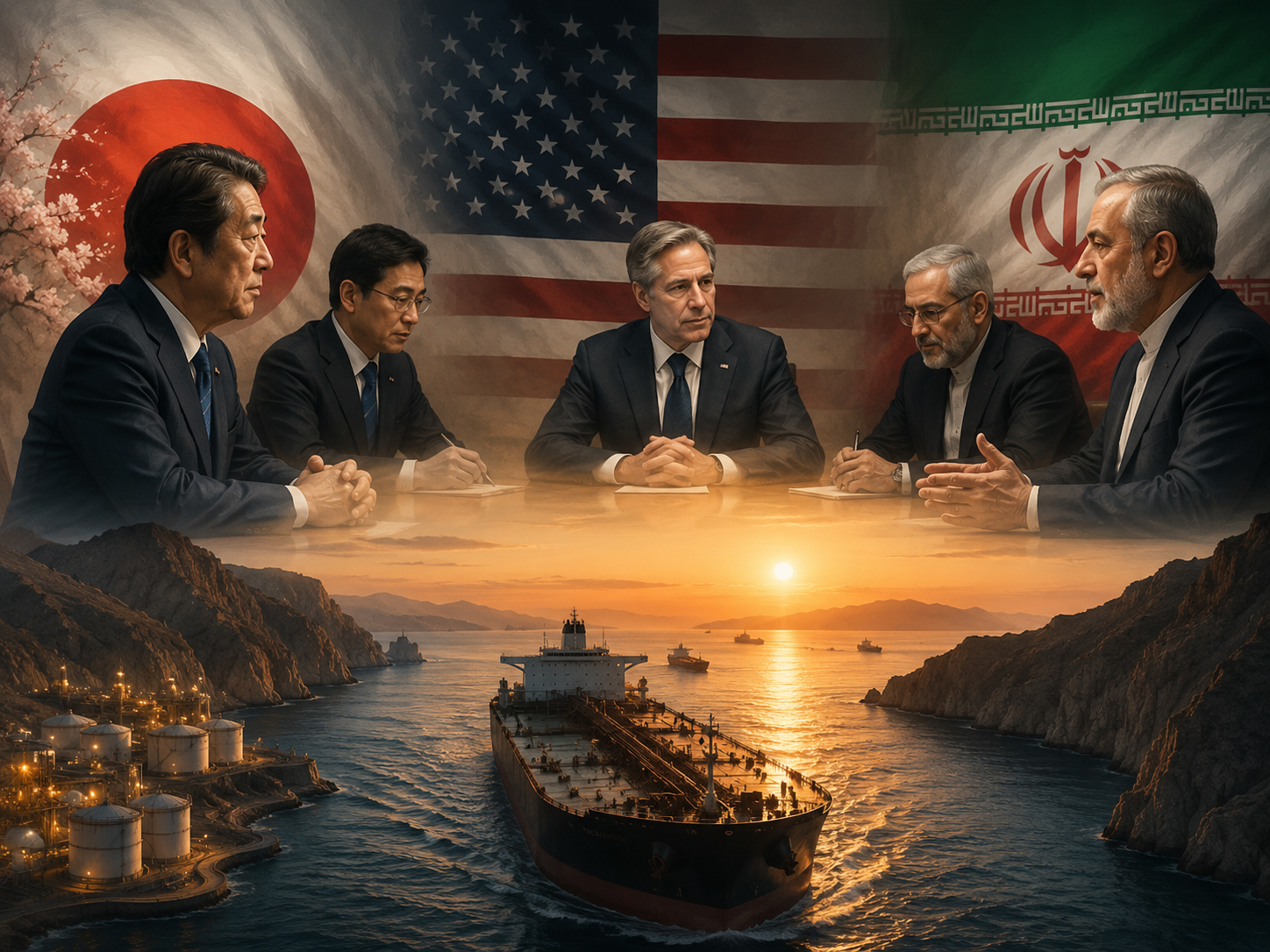
On June 15, Japan’s foreign minister welcomed the memorandum announced by the United States and Iran on the cessation of hostilities and related matters, calling it “a big step” toward resolving the situation. The statement praised the parties for seeking a diplomatic solution and recognized the role of mediating countries. For Tokyo, however, the meaning of the announcement is larger than diplomatic etiquette. The real story begins in the Strait of Hormuz.
Hormuz is not a distant waterway for Japan. Reuters has reported that Japan relies on the Middle East for roughly 95% of its oil supplies. The International Energy Agency says nearly 15 million barrels per day of crude oil — about 34% of global seaborne crude trade — moved through the strait in 2025, with most of that oil heading to Asia. Japan and South Korea are among the countries especially exposed. When Hormuz is blocked, the effect is not confined to energy traders: it reaches gasoline prices, electricity costs, petrochemicals, fertilizer inputs, marine insurance and, ultimately, the Bank of Japan’s inflation calculations.
What Japan actually welcomed
The Japanese statement was short, but revealing. Tokyo framed the U.S.-Iran agreement as a diplomatic achievement. That fits Japan’s long habit in the Middle East: avoid becoming a direct military actor, preserve channels, and support de-escalation where possible. Japan was not the main broker this time, but its instinct is familiar — praise a cooling of tensions, protect space for diplomacy and avoid rhetoric that closes doors.
At the same time, Japanese officials and companies know that a peace announcement is not the same thing as instant normalization. Reuters reported that Japanese shipping companies remained cautious even after the deal, saying they needed more clarity on mine clearance and safe passage before returning to normal operations. The Japanese Shipowners’ Association welcomed the announcement, but not as a reason for haste. Reuters said 38 Japanese-linked vessels had been affected.
A crisis history that starts in the 1970s
The emotional memory behind Japan’s Middle East sensitivity goes back to the 1973 oil shock. The Arab oil embargo, triggered by the Yom Kippur War, hit a country whose postwar growth had been built on imported oil. The famous toilet-paper panic became a symbol, but the deeper lesson was economic: Japan had structured its prosperity around the assumption of abundant, affordable imported energy. That assumption could break suddenly.
Then came the second oil shock in 1979, the Iran-Iraq War and the “tanker war” of the 1980s, the 1990 Gulf crisis, the 2003 Iraq War, tanker attacks in 2019 and the 2026 Hormuz emergency. Each episode reminded Japan that distance does not protect a nation whose energy lifelines pass through contested waters. Middle East news, for Japan, is never just foreign news. It is domestic economics, industrial policy and household affordability by another route.
Abe’s 2019 mediation and the logic of Japanese diplomacy
Seen from 2026, Shinzo Abe’s June 2019 visit to Iran stands out as a revealing moment. According to Japan’s foreign ministry, it was the first visit to Iran by a Japanese prime minister in 41 years. Abe met Supreme Leader Ali Khamenei and President Hassan Rouhani in an attempt to ease U.S.-Iran tensions. Later that year, Rouhani visited Japan. The effort did not produce a historic reconciliation, but it showed how Japan understood its role: an ally of Washington that still wanted to remain a country able to speak with Tehran.
That diplomatic memory matters now. Japan’s quick welcome of the 2026 agreement reflects a long preference for keeping communication circuits alive. Tokyo rarely talks about the Middle East in maximalist terms. It tends to choose language of restraint, continuity and practical de-escalation. That style can look quiet, but in periods of regional crisis, it becomes one of Japan’s few distinct assets.
An energy self-sufficiency rate of 15.3%
The harder truth is that even successful diplomacy does not dissolve Japan’s structural exposure. The 2025 Energy White Paper says Japan’s energy self-sufficiency rate in FY2023 was 15.3%, one of the lowest in the G7. Japan remains heavily dependent on imported fossil fuels. Renewable energy has grown, but grid limits, cost issues and local resistance remain. Nuclear power has been restarting slowly, but its politics remain complicated and uneven.
So Japan may be moving away from pure oil dependence in one sense, yet it is far from free of Middle Eastern risk. Its energy policy must pursue decarbonization and security at the same time. A Hormuz crisis exposes the contradiction with unusual clarity. In normal times, the vulnerability is abstract. In a shipping emergency, it becomes visible overnight.


Shipping, fertilizer and inflation
It is a mistake to treat Hormuz only as an oil story. Instability there disrupts the movement of crude, LNG, aluminium, petrochemical feedstocks and urea. Urea matters for fertilizer and chemical manufacturing. Disruption raises shipping costs, insurance premiums and inventory stress, which in turn feed into agriculture, food prices and factory margins. A Middle East crisis can become a Japanese cost-of-living story without any tanker physically stopping at a Japanese port.
That is why policymakers care less about a one-day fall in oil prices than about logistics reliability and recurrence risk. Even if the strait is politically “reopened,” normality does not return instantly. There are war-risk premiums, ship scheduling problems, safety inspections and mine-clearance questions. Diplomacy can halt escalation, but maritime security has to be rebuilt physically, not rhetorically.
- The practical timetable for reopening Hormuz and clearing mines
- How Japanese shipping and insurers judge the residual risk
- The path of crude, LNG and fertilizer-input prices
- Whether Japan taps public or commercial reserves
- Whether the crisis strengthens arguments for renewables, nuclear restarts and fuel diversification
Japan’s widening concept of security
Hormuz also shows how Japan’s understanding of security has widened. For much of the postwar period, Japan thought of energy security as something achieved through diplomacy and commerce. Today the language is broader: supply chains, economic security, sea lanes, food, cyber resilience and critical minerals all sit in the same frame. The Middle East is not only about oil prices; it is about where the external infrastructure of Japanese daily life actually sits.
Even so, Japan is not likely to rush into a front-line military role. The government statement emphasized diplomatic resolution, not coercive posture. Japan’s comparative advantage remains its ability to maintain relations across multiple sides of a conflict while staying anchored in its alliance with the United States. It is not dramatic, but it matters every time a regional crisis threatens to spill into global markets.
What peace does — and does not — solve
The 2026 agreement brought relief. Oil prices dropped, shipping companies began preparing for more clarity and Tokyo publicly welcomed the step. But the deeper question comes after the relief. Before the next Hormuz crisis, how much can Japan actually change its energy structure? How far can it move on renewables, storage, electrification, demand reduction, nuclear restarts and fuel diversification? In that sense, the peace deal is not an ending for Japan. It is a reminder that an unresolved homework assignment has come back into view.
Japan’s welcome was appropriate. Peace deserves to be welcomed. But from Tokyo’s perspective, the lesson goes one step further: a country cannot build its energy security only on hope for calm seas. Real resilience means designing an economy that benefits from diplomacy without depending on diplomacy alone.
Sources and references
This Japan.co.jp report is based on the Japanese foreign ministry statement, Reuters reporting, IEA material, the Agency for Natural Resources and Energy, and MOFA background on Japan-Iran relations.
- Ministry of Foreign Affairs of Japan: Statement by the Foreign Minister (June 15, 2026)
- Reuters: Japanese shippers await details on Hormuz reopening
- Reuters: Japan’s Middle East energy dependency
- IEA: Strait of Hormuz overview
- Agency for Natural Resources and Energy: Energy White Paper 2025 summary
- MOFA: Prime Minister Abe Visits Iran (June 12–14, 2019)
- MOFA: Japan-Iran Relations (Basic Data)