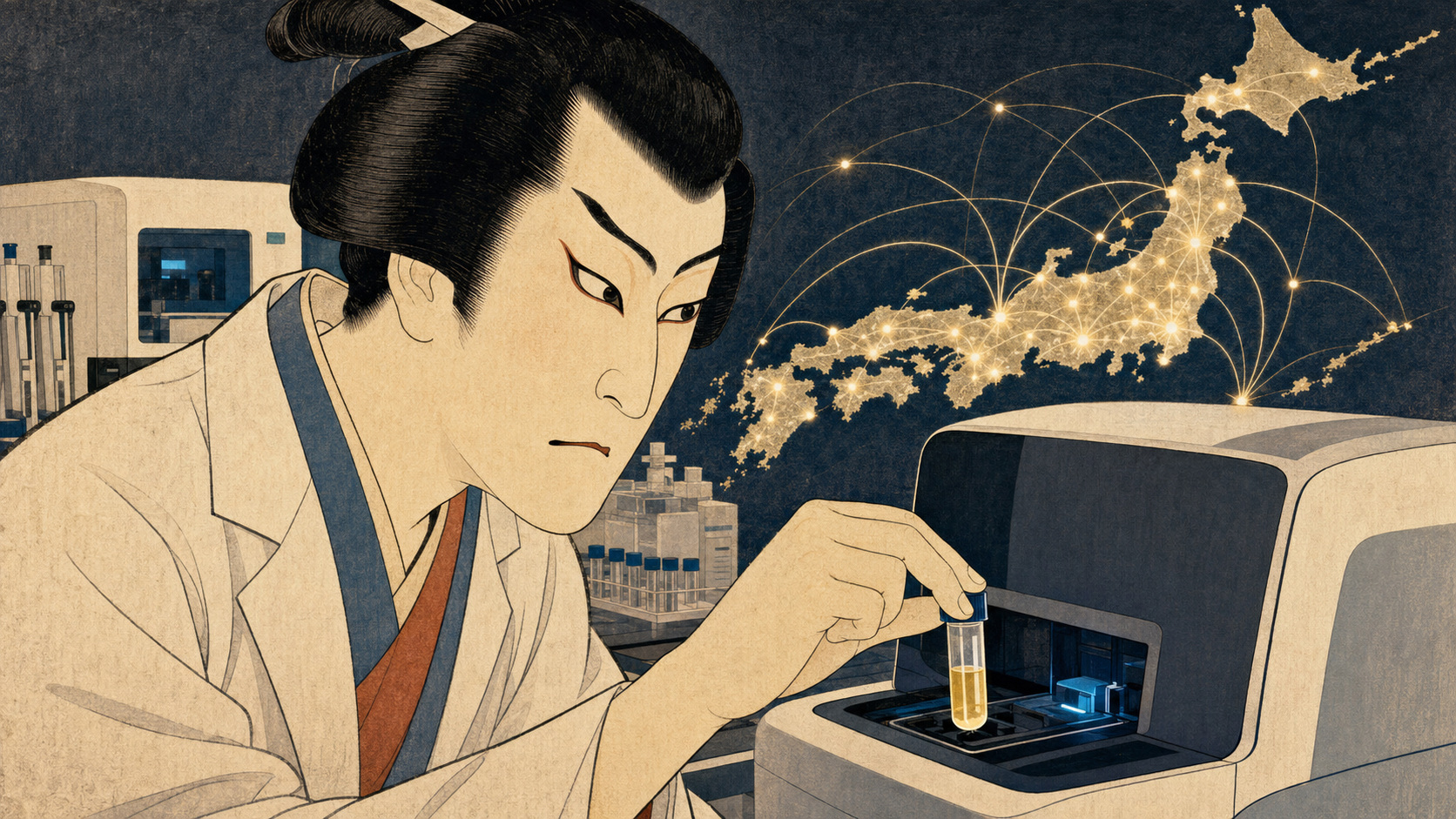
A urine cup may be the least futuristic object in a clinic. It needs no needle, contrast agent or room-sized scanner. Yet once a few milliliters reach a modern laboratory, microscopic membrane parcels can be enriched, the short strands of RNA sheltered inside them can be counted, and a machine-learning model can weigh the pattern across scores or hundreds of molecules. Medicine’s ancient practice of reading urine by color and sediment has become an attempt to hear a molecular chorus.
Craif, founded in 2018 as a startup with roots at Nagoya University, said on July 23 that its MySignal urine cancer-risk testing service had been adopted by 2,500 medical institutions across Japan. The company describes a network spanning general and university hospitals, cancer centers, health-screening facilities and clinics, with use in comprehensive checkups, mobile programs and corporate examinations. It is a striking expansion from the service’s February 2022 launch: 900 institutions in March 2025, 1,000 in April, 1,500 in August, 2,000 in February 2026 and 2,500 five months later.
That is an important operational achievement. A local clinic does not need to install advanced imaging equipment or employ a sequencing team; it can collect a specimen for centralized processing. Craif has previously reported adoption in all 47 prefectures and research agreements with more than 50 medical institutions. But 2,500 is a measure of distribution. It is not the number of people tested, cancers found, unnecessary investigations avoided or deaths prevented. The public directory also lists only institutions that agreed to be displayed.
Read the most important sentence first: this is not a diagnosis
MySignal Scan extracts microRNA from urine and uses AI to assign cancer-specific risk. Craif says it can assess risk “from stage 1” for as many as ten cancer types: nine for women, excluding prostate cancer, and eight for men, excluding breast and ovarian cancer. The company emphasizes the ease of urine collection and offers consultation and information about follow-up institutions after results.
It also states that MySignal Scan is not a medical device. The score is a statistical risk calculation, not a substitute for a clinical diagnosis; a low-risk result does not establish that a person has no cancer or will not develop it. That warning is not peripheral legal language. It is the center of an honest interpretation. High risk means “discuss appropriate standard diagnostic testing,” not “you have cancer.” Low risk does not authorize someone to ignore symptoms or skip the established screening recommended for their age and sex.
How could urine speak for a distant pancreas or lung?
MicroRNAs are short, noncoding RNA molecules, usually about 22 nucleotides long. Rather than providing a recipe for a protein, they help regulate how much protein other genes produce. Cancer can alter the pattern of microRNA expression not only in malignant cells but also in immune cells, fibroblasts and the tissue surrounding a tumor. Some microRNAs travel within extracellular vesicles, lipid-membrane parcels that protect their cargo in body fluids.
Direct shedding into urine is intuitive for bladder and urinary-tract disease. Pancreatic and lung cancers pose the harder problem. The proposed biology is that changes in a tumor and its microenvironment create systemic molecular signals, some of which ultimately appear in urine after renal handling or through the body’s broader response. Craif-related studies enrich urinary extracellular vesicles, count many microRNAs with small-RNA sequencing and feed the multivariable profile to a classifier. The algorithm is not looking for one uniquely cancerous substance. It is drawing a boundary across a pattern.
That breadth is also a vulnerability. Hydration, kidney function, infection, collection time, storage temperature, transportation, medication, smoking, age and laboratory site can all influence a molecular profile. With many features and relatively few cases, a model can accidentally learn where a sample was collected or how it was stored instead of learning cancer biology. Strong performance on development data can weaken when the test meets an ordinary, asymptomatic population. Standardized pre-analytics, quality controls, locked model versions and genuinely external prospective validation are therefore essential.
Six thousand years of urinalysis: from color to cells to code
Urine is among medicine’s oldest sources of evidence. Ancient Mesopotamian texts recorded urinary observations. Hippocratic medicine around the fourth century BCE used urine largely to judge the course and prognosis of illness. The Byzantine physician Theophilus, around the seventh century CE, organized color, sediment and layers into a diagnostic system; by the Middle Ages the urine flask had become an emblem of the physician. Much later uroscopy mixed observation with elaborate error. Its importance is not that a color wheel could reliably name disease, but that physicians kept returning to the idea that the body leaves internal information in what it excretes.
In 1847, Henry Bence Jones described a peculiar heat-dependent precipitate in urine from a patient with bone pain and fractures. The “Bence Jones protein” was later understood as monoclonal immunoglobulin light chains associated with multiple myeloma, a landmark in urinary tumor markers. In 1945, George Papanicolaou and urologist Victor Marshall reported urine-sediment smears as a way to find abnormal cells from urinary-tract cancers in Science. The object of inspection had moved from appearance, to chemistry, to cells.
The molecular clock behind today’s test started in 1993. Rosalind Lee, Rhonda Feinbaum and Victor Ambros showed that the worm gene lin-4 produced short RNAs that did not encode a protein but regulated another gene. Work by Gary Ruvkun and colleagues helped establish a vast new layer of gene control. Ambros and Ruvkun received the 2024 Nobel Prize in Physiology or Medicine for the discovery of microRNA and post-transcriptional gene regulation. The thread from the ancient flask to the sequencer is not mystical continuity; it is a relentless increase in resolution.
Promising studies are not yet the answer for population screening
One of the clearest peer-reviewed studies supporting Craif’s platform was published in eClinicalMedicine in 2024. Researchers used urine from 153 people with pancreatic cancer and 309 noncancer controls. A model was developed with 99 cases and 216 controls, then tested on 54 different cases and 93 controls. In that held-out test set, the area under the receiver operating characteristic curve was 0.963, overall sensitivity was 77.8% and specificity was 95.7%. Sensitivity for stage I or IIA cancer was also 77.8%—but that estimate came from just nine early-stage cases, producing a wide 95% confidence interval of 44.2% to 95.9%.
The paper also reports an early-stage sensitivity and specificity of 92.9% at a favorable threshold when training and test results are combined. That is the tidier promotional figure. For judging performance on unfamiliar people, however, the independent test result and its small early-stage denominator matter. The assay was more sensitive than CA19-9 for early cases in the available comparison, but CA19-9 values were unavailable for the noncancer controls. This was not a prospective trial that enrolled a cross-section of the public and followed everyone for cancer.
A lung-cancer paper published in npj Precision Oncology in April 2026 studied 278 people with lung cancer and 213 controls across four institutions. The held-out AUC was 0.941; early-stage sensitivity was 88.2% and specificity 87.0%. Yet the median age was 72 in the test-set cancer group and 47 among controls, with differences in smoking, recruitment site and sample storage. Age-matched analyses remained encouraging. The authors nevertheless wrote that the retrospective case-control design could not establish positive or negative predictive value and called for large prospective screening studies, including comparison with low-dose CT in relevant high-risk groups.
A 2026 Cancer Science study of esophageal squamous-cell carcinoma used 99 cases and 93 controls for proof of concept and 50 cases with 61 controls for blinded validation. The validation AUC was 0.85, sensitivity 84% and specificity 66%. Sensitivity of 100% for stage 0 and 91% for stage I sounds compelling, but the subgroups were small. In a low-prevalence screening population, 66% specificity could generate a large volume of false alarms.
Together, these papers provide serious evidence that urinary extracellular-vesicle microRNA contains detectable cancer-associated information. They do not constitute one prospective validation of the marketed ten-cancer service in consecutive asymptomatic customers. The studies disclose involvement and funding from Craif, along with authors who were employees, directors, shareholders, advisers or option holders. Those disclosures do not invalidate the results; they make independent replication and transparent protocol-level comparison especially important.
| Peer-reviewed study | Main held-out result | What remains unknown |
|---|---|---|
| Pancreatic cancer eClinicalMedicine, 2024 | 54 cases, 93 controls; AUC 0.963, sensitivity 77.8%, specificity 95.7%; only nine early-stage cases | Real-world PPV, benign pancreatic disease, mortality impact and equivalence to the commercial ten-cancer product |
| Lung cancer npj Precision Oncology, 2026 | Held-out 70 cases, 54 controls; AUC 0.941, early sensitivity 88.2%, specificity 87.0% | Effects of age, smoking, benign lung disease and storage; prospective comparison with low-dose CT |
| Esophageal squamous-cell cancer Cancer Science, 2026 | Blinded 50 cases, 61 controls; AUC 0.85, sensitivity 84%, specificity 66% | False positives in low-prevalence groups, multicenter replication and improved outcomes |
Even 90% sensitivity and 90% specificity can produce mostly false alarms
The least intuitive property of screening is the base-rate problem. Sensitivity asks what share of people who have cancer test positive. Specificity asks what share without cancer test negative. What a patient wants to know—“If I am positive, what is the chance I actually have cancer?”—also depends on how rare that cancer is in the tested population.
Consider a teaching example, not an estimate of MySignal. In 10,000 people with 1% cancer prevalence, a test with 90% sensitivity and 90% specificity would identify 90 of the 100 cancers and miss 10. It would also mark 990 of the 9,900 people without cancer as positive. Only 90 of 1,080 positive results would be true: a positive predictive value of about 8.3%, or roughly 11 false positives for every true one. If the target cancer is rarer, the ratio worsens unless specificity rises substantially.
| Illustrative 10,000-person model | Cancer present: 100 | No cancer: 9,900 |
|---|---|---|
| Test positive | 90 true positives | 990 false positives |
| Test negative | 10 false negatives | 8,910 true negatives |
| Interpretation | Of 1,080 positives, 90 are true—about 8.3%. This is a teaching assumption, not a product forecast. | |
A real multicancer, organ-specific score is more complicated. Each cancer has its own prevalence and threshold; age, sex and medical history alter prior risk; more than one site may be elevated. The principle remains: a few percentage points of specificity can translate into hundreds of CT scans, MRI examinations, endoscopies, repeat tests and sometimes biopsies when applied to an asymptomatic population.
Screening is a system, not a specimen
An elevated score begins a clinical journey. A pancreatic signal may lead to contrast-enhanced CT, MRI/MRCP or endoscopic ultrasound. A lung signal may prompt low-dose or diagnostic CT. An esophageal or gastric signal may require endoscopy. If nothing is found, who decides when to repeat the examination, investigate another site or close the episode? That unresolved-result pathway is one of the central problems facing every multicancer detection test.
False positives carry more than worry: time away from work, out-of-pocket costs, radiation or contrast exposure, complications from endoscopy and biopsy, incidental findings and months of uncertainty. False negatives can produce false reassurance and delay care for bleeding, persistent cough, jaundice or unexplained weight loss. Screening may also find slow-growing disease that would never have caused harm, known as overdiagnosis. Finding a cancer earlier on the calendar without changing the date of death creates lead-time bias.
The U.S. National Cancer Institute says standard-of-care screening should continue after a multicancer test and that randomized trials are needed to weigh benefits against harms. As of July 2026, no definitive clinical trial has shown that use of a multicancer detection test reduces overall cancer mortality. That is not a special indictment of Craif. It is the evidentiary threshold facing the global field. “Earlier detection” is a valuable intermediate endpoint; screening succeeds only if it leads to effective care and reduces late-stage disease and death without imposing excessive harm.
It must complement, not replace, Japan’s established screening
Japan’s Ministry of Health, Labour and Welfare centers organized population screening on five cancers: gastric, colorectal, lung, breast and cervical. Methods such as fecal occult-blood testing, chest radiography, mammography, cervical cytology and HPV testing have defined ages, intervals and referral pathways. The government’s Fourth Basic Plan to Promote Cancer Control set a 60% participation target, while survey rates have generally remained in the 40% to 50% range depending on the test and population.
A single urine sample that might flag pancreatic or ovarian cancer—sites without an established general-population screening program—addresses a profound unmet need. That is precisely why complement and replacement must not be confused. A low urine-risk result should never cancel scheduled fecal testing, gastric screening, lung screening, mammography or cervical screening. Symptoms require medical attention regardless of a recent risk score. An elevated result should be interpreted with a clinician who can incorporate family history, smoking, pancreatic or biliary disease, kidney function and the organ-specific prior probability.
Convenient collection may genuinely change behavior. In Hokkaido’s Rishiri Town, Craif, the municipality and the local hospital formed a project aimed at doubling screening participation from rates described as being in the 20% range. The company has developed specimen logistics for Okinawa and participated in publicly funded municipal programs. If urine collection helps someone who lives far from a hospital, cannot miss work or fears invasive testing take a first step, that has value. But success should be measured by completion of recommended screening and diagnostic follow-up, cancers found at treatable stages and outcomes—not merely by kits distributed.
Separate today’s non-device service from tomorrow’s regulated device
MySignal Scan is, by Craif’s own labeling, not a medical device. That does not automatically mean “unsafe,” nor does it mean “clinically proven.” It means its regulatory position and permitted claims differ from those of an approved diagnostic device. A customer or clinician should ask which study, population, algorithm version and threshold supports each performance number in the advertising.
Craif is separately developing software intended to assist pancreatic-cancer diagnosis as a software medical device, or SaMD. A July 2026 alliance with in-vitro diagnostics company TAUNS included Japanese rights connected with that program. The commercial risk service and a regulated diagnostic-assistance product under development must not be blended. A formal device pathway can require a clearer intended use, patient population, performance case, quality system and change controls. It could also provide a route toward stronger confidence in the underlying platform.
The 2,500-clinic footprint could become a learning network
Scale creates both responsibility and an unusual research opportunity. With consent, privacy protection and a common protocol, participating institutions could record age, symptom status, risk result, follow-up procedures, final diagnosis, stage, treatment and later cancers. That would move the evidence from selected case-control collections toward actual screening performance. Researchers could measure not only predictive value, but the accuracy of organ localization, time to resolution, follow-up completion, cancers that arise after a low-risk result, complications and geographic inequities.
- A prospective consecutive cohort: enroll asymptomatic people before their status is known and follow everyone.
- Cancer-specific PPV and NPV: report them at real prevalence, stratified by age, sex and smoking.
- Diagnostic burden: count scans, endoscopies, biopsies, costs and complications per elevated result.
- Time to resolution: measure days from report to diagnosis or closure of the workup.
- Stage shift: determine whether late-stage cancers fall and curable-stage diagnoses rise against a comparator.
- Interval cancers: capture cancers diagnosed 6, 12 and 24 months after a low-risk result.
- Independent external validation: reproduce performance outside the developer’s centers and laboratory.
- Subgroup calibration: test older adults, kidney disease, infection, smoking and benign conditions.
- Model governance: disclose algorithm updates, threshold changes, assay failures and repeat rates by version.
- Final outcomes: compare quality of life, cost-effectiveness, late-stage incidence and cancer and all-cause mortality.
Negative participants must be followed as carefully as positives. Publishing a cancer discovered after a high-risk result shows a possibility, but it hides the denominator and cannot establish sensitivity. Craif has highlighted a stage 0 lung cancer found after MySignal testing; that case can be meaningful to the patient and still not prove a mortality benefit. The 2,500 sites could be more than a distribution milestone. They could supply the transparent prospective evidence that the entire multicancer-screening field needs.
Urine is not a verdict; it is the next question
The attraction is undeniable. Urine collection does not break the skin, can be done at home and can be repeated. If molecular patterns from a pancreas or lung can point physicians toward the right examination, the service might connect screening avoiders to care and increase the time in which cancer remains curable. The pancreatic, lung and esophageal studies show that this future is more than fantasy.
Medical history also warns that a convenient measurement is not automatically a beneficial screening program. The ancient observer of color, Bence Jones precipitating a protein, Papanicolaou staining cells and the scientists who discovered a 22-nucleotide regulator all changed what could be seen. The modern question is harder: did acting on what we saw help people live longer and better?
Craif’s 2,500 doorways give Japanese cancer screening a new entrance. The next meaningful milestone is not 3,000 or 5,000. It is a pathway that does not abandon people after an elevated result, communication that does not let a low score displace proven screening, independent prospective data, and fewer late cancers and deaths. A urine sample is not a cancer verdict. It is a faint possible signal—and a request for medicine to ask the next question well.
Sources and references
This report checked Craif’s announcements and product disclaimer against peer-reviewed studies, Japan’s health ministry and National Cancer Center, the U.S. National Cancer Institute and foundational medical history. Product-performance statements are attributed to the company. Case-control studies of the underlying platform are not treated as prospective validation of the full commercial ten-cancer service or evidence of reduced mortality. Individual medical decisions require a clinician who knows the patient’s symptoms and history.
- Craif: MySignal reaches 2,500 adopting medical institutions (July 23, 2026)
- Craif: 2,000-institution milestone, target cancers and product disclaimer (February 2026)
- Craif: 1,500-institution milestone (August 2025)
- Craif: 1,000-institution milestone (April 2025)
- Craif: 900-institution milestone (March 2025)
- MySignal official site: test explanation, covered cancers, support and disclaimer
- Kato et al.: urinary microRNA assay for pancreatic cancer (eClinicalMedicine, 2024)
- Kiritani et al.: urinary microRNA assay for lung cancer (npj Precision Oncology, 2026)
- Urinary extracellular-vesicle microRNA assay for esophageal squamous-cell cancer (Cancer Science, 2026)
- National Cancer Center Japan: blood microRNA classification of 13 cancers (2022)
- Ministry of Health, Labour and Welfare: cancer-screening policy and guidance
- Ministry of Health, Labour and Welfare: screening participation in Japan
- U.S. National Cancer Institute: benefits, harms and open questions for multicancer detection tests
- Diamandopoulos: Hippocratic and Theophilean uroscopy (2007)
- Papanicolaou & Marshall: urine-sediment smears in urinary-tract cancer (Science, 1945)
- Lee, Feinbaum & Ambros: short RNA transcripts of lin-4 (Cell, 1993)
- The Nobel Prize: the 2024 award for the discovery of microRNA