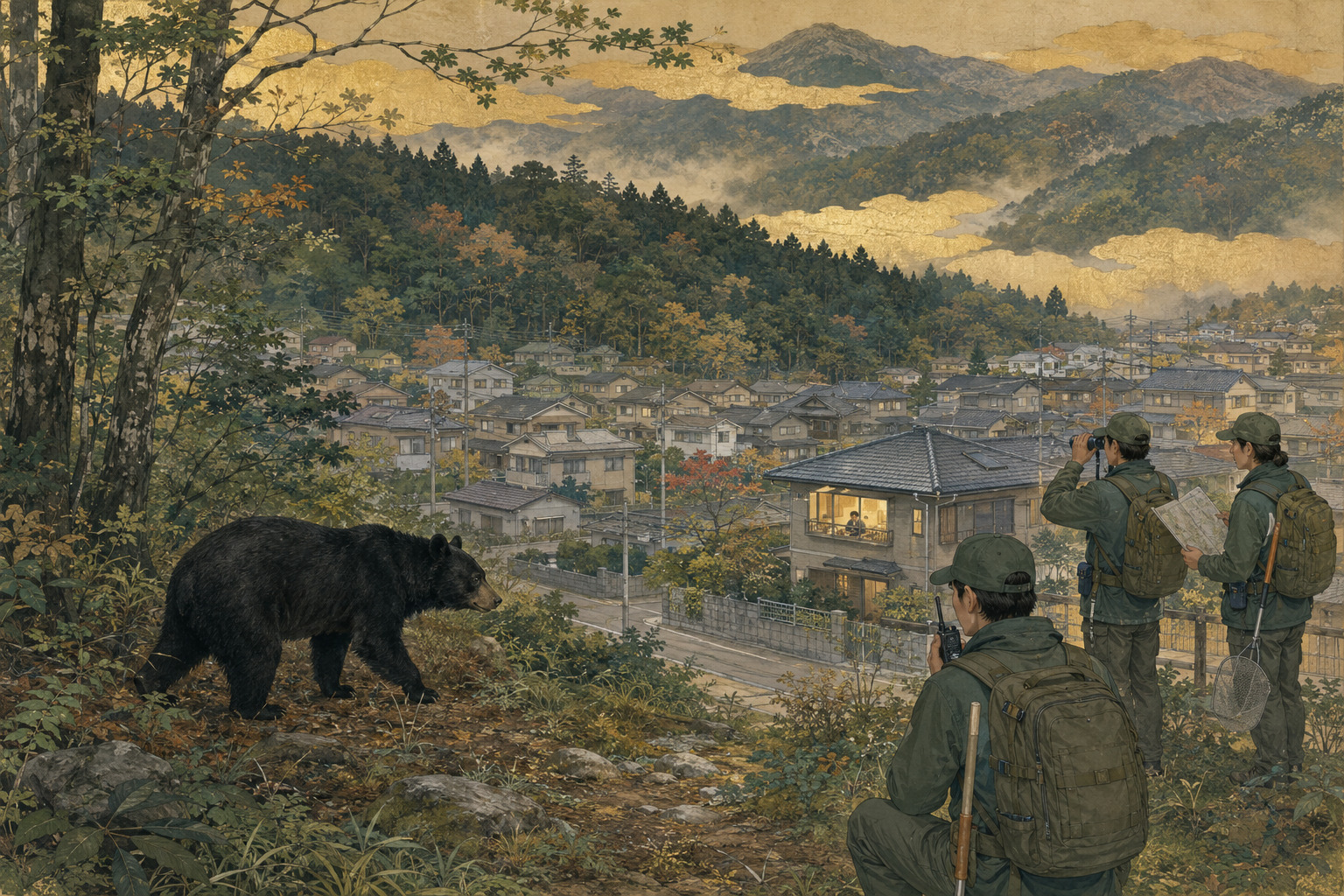
A bear warning reaches a city hall that has rarely needed one. The animal may be moving along a river, sheltering in dense vegetation or feeding from an untended persimmon tree. Schools need instructions, police need a perimeter, residents need reliable alerts and trained responders need to decide whether the bear can be driven away, trapped, immobilized or—under tightly controlled conditions—shot. None of those decisions can be improvised safely after the first sighting.
Japan's Environment Ministry is now trying to move expertise to the places where experience is thin. On September 4 it opened applications for the Bear Appearance Countermeasure Consulting Demonstration Project, a fiscal 2026 program for prefectures and municipalities seeking to strengthen their response to bears entering human living areas.
If applications exceed capacity, the ministry expects to select about ten local governments. Each will be assigned an adviser and a team of roughly two or three specialists chosen for the community's problem. Together they will examine the site, identify gaps, refine a countermeasure, test part of it when appropriate and evaluate the result.
The application window runs through 5:00 p.m. on October 2. Eligible governments must have comparatively little bear-management knowledge or experience, be considering stronger measures in human living areas, assign a staff member during the demonstration and work directly with the experts. Selection is to be based primarily on the applications, with the review conducted privately.
Consulting that must leave something behind
The word “consulting” understates the design. The ministry's three-page application notice describes a sequence: collect local needs, analyze the problem, choose relevant expertise, conduct meetings and field inspections, sharpen a proposal, try part of the plan if needed and examine its effect. The national project is expected to bear costs directly associated with that work, up to ¥50 million in total for roughly ten cases. Local employees' salaries and travel are excluded.
The local government cannot simply hand the problem to Tokyo. It must name a responsible staff member and participate. The notice says the longer aim is for municipalities, residents and other local actors to continue the work after the demonstration, rebuilding a workable separation between people and bears.
That requirement matters because the physical and administrative geography differs everywhere. In one town, the vulnerable route may be an overgrown riverbank. In another, it may be abandoned farmland, a school-side thicket, an orchard with unharvested fruit or a garbage collection point. The same camera, fence or trap cannot be assumed to solve each case.
A 20-person national team born from city encounters
The consulting program sits inside the ministry's Urban Bear Appearance Countermeasure Team, commonly called the Urban Bear Team. Environment Minister Hirotaka Ishihara announced it in July after visits to Hachinohe in Aomori Prefecture, where an emergency shooting had been carried out, and Hachioji in Tokyo, where officials and a school had to adapt their precautions after a bear appeared.
The national team began with about 20 officials, led by the director-general of the Nature Conservation Bureau and including ministry headquarters staff and bear specialists in regional environment offices. Its two stated pillars are stronger safety systems for urban appearances and faster, evidence-based introduction of countermeasure technology.
Ishihara highlighted an uncomfortable gap: private companies offer cameras, drones, automated brush cutters, repellents and other products, but effectiveness is not always established for bear work. The ministry therefore says trials and verification should precede official recommendations. Its August work on bear-spray performance made the point tangible: products sold under the same general label differed, and Japan had no unified domestic standard.
Existing local practice shows the range of possible interventions. An Environment Ministry casebook updated August 31 describes Iwate's “Bears” information-sharing application and urban-response drills; electric mats and chain-style fencing in Akita; drone-assisted capture work in Yamagata and Fukui; emergency-shooting training in Gunma and Kyoto; maps, communications systems and trained personnel in Niigata; and removal of abandoned fruit trees in Shimane and Hiroshima.
An expert team may therefore include wildlife ecologists, capture specialists, veterinarians, emergency planners or people experienced in community outreach. The September notice does not yet identify the roster or promise a particular discipline. That tailoring is a strength, but it also makes transparency about selection and evaluation important.
The numbers behind the policy turn
Japan has two native bear species: brown bears in Hokkaido and Asiatic black bears across much of Honshu and more limited parts of Shikoku. Their conservation status and local abundance differ sharply. The government explicitly excludes the endangered Shikoku black-bear population from the broad “designated management wildlife” treatment applied to other bear populations.
National policy hardened after fiscal 2023 produced 198 injury incidents involving 219 people, including six deaths—the highest incident and victim totals then recorded. Fiscal 2025 was worse: provisional ministry data list 216 incidents, 238 victims and 13 deaths. Through July 2026, the provisional count stood at 49 incidents, 53 victims and six deaths.
Those figures need care. The ministry compiles reports from prefectures, labels the recent numbers provisional and warns that they may be revised. Appearance counts are even less comparable because prefectures collect them differently. A sighting, an incident and a person injured are not interchangeable units.
| Fiscal year | Injury incidents | People affected | Deaths | Status |
|---|---|---|---|---|
| 2023 | 198 | 219 | 6 | Full-year ministry series |
| 2025 | 216 | 238 | 13 | Full-year provisional series |
| 2026 through July | 49 | 53 | 6 | Provisional as published August 12 |
The totals combine brown- and black-bear cases. They describe reported harm, not the probability of an encounter in any particular city.
From protection to active, zoned management
Japan's bear policy has changed in stages. After severe twentieth-century range losses, restrictions and conservation efforts helped some populations recover. By the 2000s, appearances and captures were rising in many regions. The 2023 disaster accelerated a national reassessment.
In April 2024, the government added bears—apart from the Shikoku population—to the designated-management framework, allowing stronger national support for planned population management. A 2025 amendment to the Wildlife Protection, Control and Hunting Management Act then created “emergency shooting.” Since September 2025, a mayor may commission a qualified hunter to shoot a bear in a human living area when urgent danger and safety conditions are met, alongside road restrictions, evacuation and coordination with prefectures and police. By April 2026, the ministry said the system had been used more than 50 times and revised its guidance with actual cases.
The April 2026 bear-management guideline marked another shift. The Environment Ministry said 29 prefectures had adopted or were preparing specific bear plans. It moved beyond a default emphasis on maintaining or increasing populations to include maintaining or reducing abundant populations. The guidance defines urban and agricultural land as an “exclusion area,” where a bear is treated as a problem animal and killing is generally considered appropriate, while a surrounding “enhanced management area” is intended to prevent settlement and entry. The stated condition is that bear populations themselves remain viable.
A March 2026 interministerial roadmap carries the policy through 2030. It calls for emergency systems and zoning plans in every municipality within regular bear range, clear population estimates and capture targets for each population, 2,500 municipal employees engaged in capture work, 10,000 cage traps and 20,000 bear-spray units. These are national output targets, not proof that local capacity already exists.
2023 — Record injury totals force a national reassessment.
April 2024 — Most bear populations enter the designated-management framework.
September 2025 — The emergency-shooting system takes effect in human living areas.
March–April 2026 — A national roadmap and revised management guideline set stronger population and zoning goals.
July–September 2026 — The Urban Bear Team forms and opens its community consulting demonstration.
Why the boundary moved
No single cause explains every bear in a neighborhood. Short-term movements can change with the production of beechnuts, acorns and other hard mast. Forest and Forest Products Research Institute researchers have long cautioned that poor mast years are associated with more black bears appearing near settlements in parts of northeastern Japan. Individual age, sex, learning and local food also matter.
The longer trend is a change in land use and human presence. A 2025 nationwide study in Communications Earth & Environment compared the distribution of six large Japanese mammals over four decades. It found that their ranges expanded from mountainous landscapes toward more human-dominated areas and identified agricultural abandonment and declining snowfall as important correlates. That is evidence for broad range expansion, not a claim that climate or abandonment caused each specific attack.
Ecologist Yoshikazu Sato has shown why “green connection” can cut both ways in Hokkaido. Rivers and connected urban green space benefit biodiversity, but they can also give brown bears concealed routes from forest to city. He characterizes an urban incursion as disaster-like: uncommon, hard to manage once underway and capable of severe harm. The planning implication is to combine emergency preparation with prevention at the approach routes.
What a defensible local plan looks like
Five layers of community readiness
- Detect: Verify sightings, map repeat routes and connect cameras, field signs and public reports without spreading rumor.
- Remove incentives: Secure garbage and crops, harvest or remove abandoned fruit, and prevent access to feed and compost.
- Shape the boundary: Clear concealment near homes, maintain buffers and install properly designed electric fencing where appropriate.
- Rehearse the emergency: Define who closes roads, warns schools, directs residents, contacts police and hunters, and authorizes each response.
- Measure: Track whether the intervention reduces entries, response time or exposure rather than counting equipment purchased.
Capture is only one layer. In a built-up area, a bullet can pass through the animal or ricochet; immobilizing drugs take time and require a plan for where the bear may run before sedation; driving an animal away can redirect it toward another neighborhood. An expert's value lies partly in ruling out unsafe options.
Public communication is similarly technical. A warning issued too slowly exposes people; one that is vague or repeatedly false can lose trust. Schools, elder-care facilities, delivery workers and farmers face different risks. Good protocols decide in advance which sightings close a path or school, what geographic area receives an alert and when restrictions end.
The new project acknowledges that the weakest link may be administrative capacity. A small municipality can buy a drone but still lack a trained operator, a legal protocol, a response roster, a back-up hunter or a way to maintain the system after the fiscal year ends. Expertise has to become routine, budgeted work.
Ten demonstrations cannot carry a national system
The project is deliberately small. If ten governments share the full ¥50 million ceiling evenly—a distribution the ministry has not promised—the average would be ¥5 million. That can fund diagnosis and a limited trial; it cannot permanently staff every exposed community, restore all abandoned land or maintain a regional capture force.
Its wider value will depend on what is published afterward. Comparable measures—response time, verified entries, attractants removed, drills completed, false alarms, costs and maintenance burden—could turn ten cases into reusable guidance. Without common evaluation and candid reporting of failures, they risk becoming isolated success stories.
The Environment Ministry has chosen the right unit of intervention: not “the bear” in isolation, but the community system around it. Yet the program will succeed only if it joins ecology, land management, policing, schools, waste collection, veterinary practice and trained capture personnel. Urban bears expose the seams between those institutions.
Japan's immediate objective is public safety. Its harder objective is durable separation: viable bear populations in appropriate habitat, and human living areas where food, cover and delayed decision-making do not invite dangerous overlap. A two-to-three-person team can begin that work. The measure of success will be whether the town can continue it.
Primary documents and research
- Environment Ministry, “Recruitment of local governments for the Bear Appearance Countermeasure Consulting Demonstration Project” — September 4, 2026.
- Environment Ministry application notice for the fiscal 2026 demonstration — eligibility, two-to-three-person teams, work sequence, cost ceiling and conditions.
- Environment Ministry, bear information and policy portal — provisional injury, appearance and capture series and policy documents.
- Interministerial Conference on Bear Damage Countermeasures, Bear Damage Countermeasure Roadmap — March 27, 2026.
- Environment Minister Hirotaka Ishihara's post-Cabinet press conference — July 17, 2026; official team name, composition, purpose and technology-verification rationale.
- Environment Ministry, revision of the Bear Guidelines for Specified Wildlife Protection and Management Plans — April 3, 2026.
- Environment Ministry, revision of the emergency-shooting guidelines — April 6, 2026; implementation history and actual cases.
- Environment Ministry, casebook of designated-wildlife population management — updated August 31, 2026; prefectural measures and training examples.
- Baek et al., “The range of large terrestrial mammals has expanded into human-dominated landscapes in Japan”, Communications Earth & Environment 6, Article 292 (2025).
- Yoshikazu Sato, “Establishment of ecological networks and urban encroachment by brown bears”, Japanese Journal of Ecology 75 (2025), DOI: 10.18960/seitai.2304.
- Forest and Forest Products Research Institute, “Background and countermeasures for Asiatic black bear appearances” — ecological and prevention context; updated January 22, 2024.
Reporting note: This report uses information available through 8:00 a.m. JST on September 5, 2026. Japanese primary sources were used for the program name, official titles, policy terminology, deadlines, funding structure and statistics. National injury data are identified as provisional where the ministry does so. No selected municipality, outside expert, individual award or guaranteed post-demonstration funding had been announced. Causes of bear appearances are described as multiple and context-dependent; broad research associations are not presented as explanations for particular incidents. The Japanese and English editions were written independently.
Image rights: © 2026 Japan.co.jp. This AI-assisted editorial illustration may not be reproduced or reused without permission. For licensing, visit the contact page.