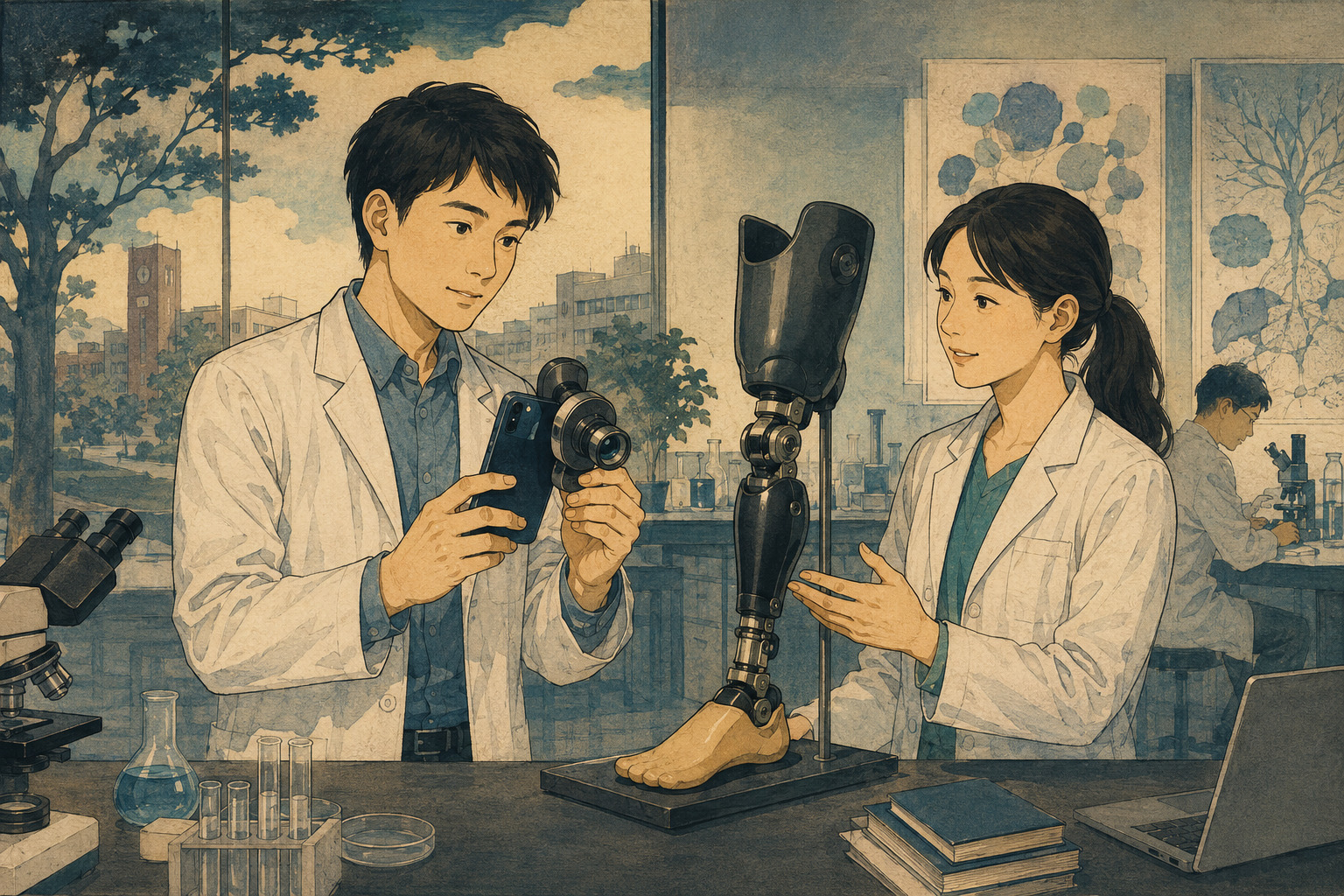
A small optical attachment can turn a smartphone into an instrument for photographing the eye. Sensors and a motor can help a prosthetic knee rise from a chair or climb a flight of stairs. Neither device becomes useful merely because the engineering works. It must be manufacturable, regulated, affordable, teachable and connected to a system of care.
That long passage from research to use is what Japan’s University Venture Awards 2026—Award for Academic Startups, formally 大学発ベンチャー表彰2026 in Japanese, recognized on August 27. The Japan Science and Technology Agency, or JST, and the New Energy and Industrial Technology Development Organization, or NEDO, announced the recipients during University Fair 2026—Innovation Japan at Tokyo Big Sight.
OUI Inc., a company originating from Keio University School of Medicine, received the Minister of Education, Culture, Sports, Science and Technology Award. Keio University and medical-device manufacturer Liberworks Co., Ltd. were honored as its principal supporters. BionicM Inc., which grew from University of Tokyo robotics research, received the Minister of Economy, Trade and Industry Award. The University of Tokyo and the University of Tokyo Edge Capital Partners Co., Ltd., known as UTEC, were named as its supporters.
The award program began in fiscal 2014 and is now in its 13th year. Organizers accepted applications from March 19 to April 27, 2026. Outside experts reviewed written submissions and conducted interviews before selecting six companies from 41 applicants. The program deliberately recognizes supporting universities and businesses alongside the startups, reflecting how many institutions are required to move a scientific result into the market.
OUI puts an ophthalmic instrument on a smartphone
OUI’s central product is the Smart Eye Camera, or SEC, an ophthalmic medical device attached to a smartphone. Different models use the phone’s camera and light source to observe and record the front of the eye or the retina. In Japan, product models have been notified under the medical-device categories for a slit-lamp microscope and a direct ophthalmoscope.
The portability changes where an eye image can be captured. A conventional slit lamp is a substantial piece of clinic equipment. A smartphone attachment can travel to islands, home visits, screenings and communities with few eye specialists. Images and video can then be sent to an ophthalmologist for a remote opinion or used to determine whether a patient needs specialist care.
OUI says clinical work has found evaluation performance comparable with a conventional slit lamp for studied applications. That does not mean a pocket-size attachment independently provides a definitive diagnosis for every eye disease. Image quality depends on the operator, lighting, patient condition and the part of the eye being examined. The limits of each study and each registered indication still matter.
The company was founded in 2016 by ophthalmologist Eisuke Shimizu, a faculty member in Keio University’s Department of Ophthalmology. Official profiles describe international medical-aid settings in which a lack of ophthalmic equipment helped define the problem he wanted to solve. The product therefore emerged not only from optical engineering but from a clinical question: how can a specialist assess a patient when neither specialist nor full-size instrument is nearby?
JST’s award citation says OUI has conducted demonstrations and deployment activities in more than 60 countries. That wording covers several different stages—research, trials, medical-aid projects, partnerships and commercial activity. It should not be read as evidence that the product has regulatory authorization, regular sales or routine clinical use in every one of those countries.
- Keio University School of Medicine: ophthalmic research and clinical knowledge. JST specifically names Professor Kazuno Negishi and Senior Lecturer Risa Hokama among the university supporters.
- Liberworks Co., Ltd.: the OEM partner supporting medical-device development, manufacturing, regulatory work under Japan’s Pharmaceuticals and Medical Devices Act, and required registrations.
- Clinical partners: the people who capture usable images, ophthalmologists who interpret them, and facilities able to accept patients who need examination or treatment.
Access is a care pathway, not a piece of pocket hardware
The SEC’s promise is easy to understand: move the imaging tool instead of requiring every patient to travel first. Its impact is harder to measure. A camera improves access only when someone is trained to use it, a specialist is available to read the image, the connection protects patient information, and a referral system can deliver treatment after a problem is found.
Those dependencies are particularly important in remote and low-resource settings. A technically adequate image that sits unread does not prevent blindness. Nor does a screening program help if patients who are flagged cannot afford transport or find an ophthalmologist. As OUI expands, the strongest evidence will join device performance to patient outcomes: how many people are assessed, how quickly images are interpreted, how often referrals are completed, and whether earlier care changes vision.
Artificial intelligence may assist parts of that chain, but it brings a separate obligation. Performance must be checked across devices, capture conditions and patient groups rather than assumed to travel unchanged from one dataset or country to another.
BionicM starts with the experience of using a prosthesis
BionicM’s Bio Leg® is a powered prosthetic leg for people with lower-limb amputations. Sensors detect movement and intended motion, while a motor assists the knee’s flexion and extension. The design aims to supply part of the muscular power missing from a passive prosthesis during standing, walking and stair use.
The technical program was shaped by founder and CEO Xiaojun Sun’s own experience as a prosthesis user. After working as an engineer at Sony, Sun entered a doctoral program at the University of Tokyo in 2015 and began studying powered prosthetics in the Information Systems Engineering Laboratory, drawing on humanoid-robot and biomechanical research.
In an official company account, the research team says a survey of 88 prosthesis users identified recurring problems that included stairs, knee buckling, fatigue, changes in walking speed and posture. That is an important design distinction. Instead of beginning with the maximum force a motor could produce, the team began with situations users said restricted daily movement.
The work entered JST’s Program for Creating Start-ups from Advanced Research and Technology, known as START, in 2016. An early prototype called Suknee won the Student Innovation category at the SXSW Interactive Innovation Awards in 2017. BionicM was incorporated in December 2018.
JST says University of Tokyo intellectual property, JST and NEDO research support, and university incubation facilities helped mature the technology. UTEC supported the company before incorporation and through financing, team building, business development and governance. That support is less visible than the moving knee, but it determines whether a prototype can become a maintained medical product.
What “FDA registered” and “PDAC verified” actually mean
BionicM’s U.S. progress is part of the official rationale for its award, but the regulatory terms require care. JST describes Bio Leg as having obtained U.S. Class II medical-device registration and approval for health-insurance coverage before entering the U.S. market. The underlying steps do not amount to FDA premarket approval or a guarantee that an insurer will pay every claim.
BionicM’s 2023 announcement concerned FDA establishment registration and product listing as a Class II device exempt from 510(k) premarket notification. Registration and listing are regulatory requirements; they are not an agency finding that the product passed premarket approval. Describing the result as an FDA approval would therefore be inaccurate.
In 2024, the company announced coding verification by the Pricing, Data Analysis and Coding contractor, or PDAC. That process associates the product with Healthcare Common Procedure Coding System, or HCPCS, codes used in U.S. medical billing. It can make a device billable under the assigned codes, but billable is not the same as payable.
That distinction does not erase the commercial milestone. Moving from a university prototype to a listed medical device with billing codes and U.S. sales is difficult. JST also says BionicM is conducting clinical research with a U.S. rehabilitation hospital. The next important record is real-world performance: falls, fatigue, activity, satisfaction, training time, component failures and outcomes across users with different bodies and daily routines.
| Category | OUI Inc. | BionicM Inc. |
|---|---|---|
| 2026 award | Minister of Education, Culture, Sports, Science and Technology Award | Minister of Economy, Trade and Industry Award |
| Research base | Ophthalmic clinical practice and research at Keio University School of Medicine | Humanoid robotics, biomechanics and information-systems engineering at the University of Tokyo |
| Product | Smart Eye Camera, a smartphone-attached ophthalmic medical device | Bio Leg®, a motor-assisted prosthetic leg |
| Problem addressed | Imaging, remote consultation and earlier referral where eye specialists and conventional equipment are scarce | Standing, walking, stairs, knee buckling and fatigue experienced by prosthesis users |
| Beyond the device | Regulatory compliance, manufacturing, operator training, remote interpretation and a referral pathway | Regulatory listing, prosthetist fitting, user training, maintenance, safety systems and insurance billing |
| Supporting company | Liberworks Co., Ltd. | The University of Tokyo Edge Capital Partners Co., Ltd. (UTEC) |
Six winners show the range of academic entrepreneurship
The ministerial prizes were two parts of a broader award slate. The six winners work in medical technology, aquaculture, atmospheric carbon removal and emergency-care software. NEDO says five of the six have previously received support from the agency.
| Award | Company | Work recognized | Principal supporting university or institute |
|---|---|---|---|
| Education minister’s award | OUI Inc. | Smartphone ophthalmic device and remote-care system | Keio University |
| Economy minister’s award | BionicM Inc. | Bio Leg® powered prosthesis | University of Tokyo |
| JST president’s award | Sakana Dream Inc. | New farmed fish using surrogate broodstock technology | Tokyo University of Marine Science and Technology |
| NEDO chairman’s award | Planet Savers Inc. | Direct air capture of carbon dioxide | University of Tokyo |
| Academic entrepreneurship society president’s award | Adriachime Inc. | Vagus-nerve stimulation device for controlling acute inflammation | National Cerebral and Cardiovascular Center |
| Special award | fcuro Inc. | AI diagnostic-support system for emergency medicine | Osaka General Medical Center |
| Early Edge Award | No recipient | — | — |
Four gates stand between a paper and a useful product
Placed side by side, OUI and BionicM reveal four jobs that academic startups must complete. The first is product design: laboratory performance has to survive in something portable, durable and repairable. The second is quality and regulation: a medical device needs controlled manufacturing, documented risks and compliance in every market it enters.
The third is payment. A clinic, patient, insurer, public program or donor has to bear the cost. Coding a product for a claim does not settle coverage, just as a low-cost camera does not finance the specialist who reads the image. The fourth is operation: users need training, and the system needs a safe route to a professional when the technology identifies a problem or fails.
For OUI, the meaningful unit is not simply the number of attachments distributed. It is the completed episode of care—from a usable image through interpretation and, where necessary, treatment. For BionicM, more motor power is not automatically a better outcome. The knee must respond to the wearer’s intent, reduce the risk of falling, behave safely when the battery is depleted, and be adjustable by a qualified prosthetist.
Fiscal 2014 JST and NEDO begin the academic startup award program.
2015 Xiaojun Sun begins powered-prosthesis research at the University of Tokyo.
2016 Eisuke Shimizu founds OUI; BionicM’s precursor project enters JST START.
2017 The BionicM precursor team wins the SXSW student innovation award.
December 2018 BionicM Inc. is incorporated.
2023 Bio Leg is listed with the FDA as a 510(k)-exempt Class II device.
2024 BionicM announces PDAC coding verification for Bio Leg.
August 27, 2026 OUI and BionicM receive the two ministerial awards.
An award is recognition, not proof of every outcome
The Award for Academic Startups recognizes companies and supporters expected to contribute through the commercialization of university research. It does not certify clinical effectiveness, cost-effectiveness or long-term business stability. Selection from 41 applicants signals the judges’ assessment of promise and execution; it does not replace product-specific evidence of safety and benefit.
Both companies have a compelling strength: an intended user’s perspective sits near the center of development. OUI’s product was formed around an ophthalmologist’s view of missing access. BionicM’s was shaped by an engineer who uses a prosthesis. That proximity can reveal problems a distant designer might overlook. It still cannot establish that the same product works equally well for every age, diagnosis, body, location or health system.
The award’s decision to name universities and outside supporters is therefore more than ceremony. No inventor can carry a medical device alone through clinical research, intellectual property, production, regulation, finance, reimbursement, sales and maintenance. A break in any one link can leave an elegant technology in a laboratory or an unusable product in a storeroom.
One winning device can fit in an ophthalmologist’s pocket. The other places a motor at a prosthesis user’s knee. Their real achievement is not miniaturization or motion by itself, but the organizational work required to make research usable beyond the university. Their next test will be to show, in measured outcomes, how much that work improves access to eye care, safety in movement and quality of life.
- Japan Science and Technology Agency — 2026 Award for Academic Startups recipients and award citations
- New Energy and Industrial Technology Development Organization — 2026 award announcement, August 27, 2026
- Ministry of Education, Culture, Sports, Science and Technology — 2026 award announcement
- Ministry of Economy, Trade and Industry — Minister’s Award presented to BionicM Inc.
- University Fair 2026—Innovation Japan — official event outline
- OUI Inc. — official company and Smart Eye Camera overview
- OUI Inc. — company profile and Eisuke Shimizu biography
- OUI Inc. — Smart Eye Camera product and clinical-research information
- Keio University — Eisuke Shimizu profile and the founding of OUI
- Liberworks Co., Ltd. — Smart Eye Camera manufacturing and medical-device information
- BionicM Inc. — company profile and University of Tokyo research
- BionicM Inc. — research, incorporation and support history
- BionicM Inc. — Xiaojun Sun’s official account of powered-prosthesis development
- University of Tokyo — founder profile and prosthesis research
- The University of Tokyo Edge Capital Partners — support provided to BionicM
- BionicM Inc. — company announcement on FDA registration, listing and PDAC coding
- Centers for Medicare & Medicaid Services — lower-limb prostheses billing and coding requirements
- PDAC — distinction between billable HCPCS coding and coverage or payment