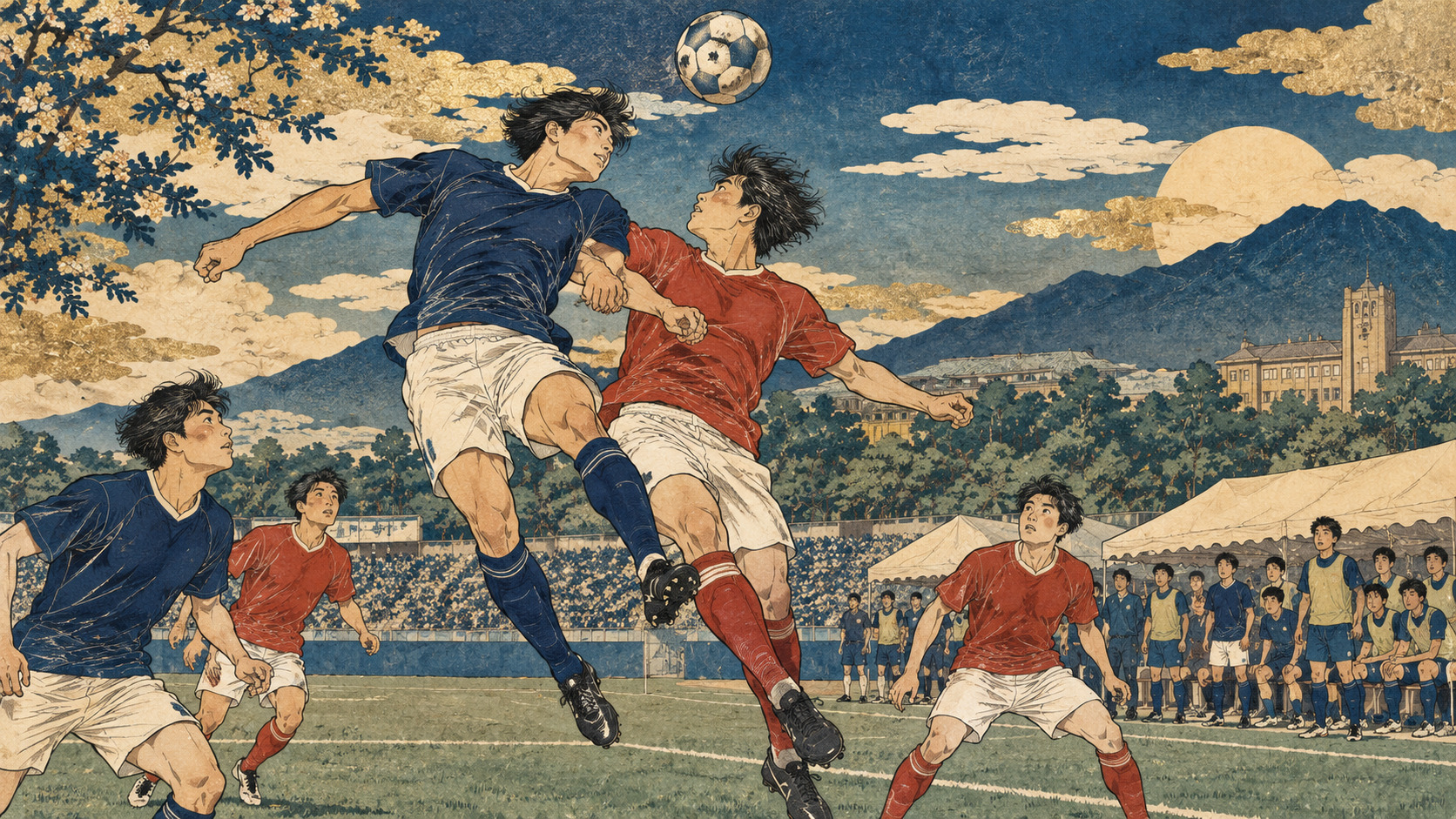
Two minutes separated Hosei University from the quarterfinals. The Kanto champion led Toin University of Yokohama 2–1 on September 4, having scored twice before halftime and survived a goal just after the restart. In a knockout cup, the clock had almost become another defender.
Takumi Miyashita equalised for Toin in the 88th minute. The match remained 2–2 through extra time. Immediately before the shootout, Toin sent on goalkeeper Ben Mamun Amin. The official university federation report says he stopped two penalties; Toin prevailed 5–4 and the regional champion disappeared from the national bracket.
It would be wrong, however, to call that a Kanto collapse. Five of the eight quarterfinalists came from the region. Osaka University of Health and Sport Sciences and Kyoto Sangyo University represented Kansai; Tokai Gakuen University was the lone Tokai survivor. A field drawn from all nine university-football regions had contracted to three after only two rounds.
The four quarterfinals
The September 6 slate contained two all-Kanto matches, one Kansai–Tokai contest and one Kanto–Kansai meeting. Regional seeding had done its work; recovery, matchup and the tolerance of chaos would now matter more.
| Scheduled kickoff | Fixture | What brought them here |
|---|---|---|
| Sept. 6 · 11 a.m. | Nippon Sport Science University vs Ryutsu Keizai University | NSSU eliminated 2024 champion Hannan 2–0; Ryutsu Keizai beat Fukuoka 3–1. |
| Sept. 6 · 11 a.m. | Toin University of Yokohama vs Kokushikan University | Toin escaped on penalties; Kokushikan recovered from two goals down. |
| Sept. 6 · 2 p.m. | Kyoto Sangyo University vs Tokai Gakuen University | Kyoto Sangyo won in stoppage time; Tokai Gakuen reached its first quarterfinal in eight tournaments. |
| Sept. 6 · 2 p.m. | Rissho University vs Osaka University of Health and Sport Sciences | A 12-goal, no-concession start against the side that removed last year’s runner-up. |
There is more than one way to look strong
Rissho University produced the cleanest numbers. It won both of its opening matches 6–0. Daigo Niino scored a second-half hat trick against Hachinohe Gakuin University, leaving Rissho with 12 goals and none conceded. That dominance is real, although knockout football preserves one unanswered question: how will the team respond if it falls behind?
Kokushikan University has already answered that question repeatedly. Osaka Gakuin University scored in the fourth minute, led 2–0 at halftime and later restored its advantage at 3–2. Kokushikan replied with goals in the 68th, 70th and 82nd minutes to win 5–3. A rematch of the 2022 final became a demonstration of how quickly a cup tie can change its meaning.
Osaka University of Health and Sport Sciences also conceded first, to a ninth-minute penalty against Kwansei Gakuin University, before winning 3–1. Kwansei Gakuin had finished runner-up in 2025. Nippon Sport Science University dispatched 2024 winner Hannan University 2–0. The reigning champion, Toyo University, had not qualified from Kanto. None of the champion or runner-up from the previous two tournaments reached this quarterfinal stage.
A cup tie is also a view of Japan’s player pathway
Kyoto Sangyo trailed Kyushu Sangyo University twice and equalised twice. Yuya Fukunaga, a third-year midfielder with Japan under-21 experience, scored the decisive goal three minutes into second-half stoppage time. His university had also defeated J1 club Mito HollyHock in the 2026 Emperor’s Cup, a reminder that the boundaries between campus football and the professional pyramid are porous.
Rin Honma scored Kokushikan’s go-ahead fourth goal. Kawasaki Frontale has announced that the defender will join the club in 2027. Taro Kagawa, already announced as a future Kataller Toyama player, opened the scoring in Tokai Gakuen’s 2–1 victory over Chukyo University. Future professionals were not watching from outside the student game; they were still responsible for carrying their universities through it.
Yet treating the tournament only as a scouting catalogue misses the institution. University teams build tactics and leadership over four academic years. Players balance coursework, regional leagues and development at different rates. Some go to the J.League, many do not, and the strength of the competition depends on all of them.
What exactly is the Prime Minister’s Cup?
The formal Japanese title is the Prime Minister’s Cup All Japan University Football Tournament. The JFA’s official roll of champions begins with the 1977 academic-year competition: Hosei won the first title, Waseda finished second and Chuo third. The 2026 tournament is the 50th edition. The 2020 competition was cancelled during the coronavirus pandemic, so elapsed calendar years and editions do not align perfectly.
Thirty-two clubs qualify through nine regional organisations. Matches last 90 minutes; a tie brings 20 minutes of extra time, split into two ten-minute periods, and then a penalty shootout. There is no third-place match, so both losing semifinalists are placed third. The champion receives the Prime Minister’s Cup and certificates from the prime minister, the education minister and the JFA, among other honours.
Japanese university football has another major national prize in winter, the All Japan University Football Championship, commonly called the Intercollegiate or Inkare. The Prime Minister’s Cup has a sharper cup identity: regional qualification feeds directly into a five-round knockout commonly presented as the contest for Japan’s “summer university champion.” It exposes a different kind of excellence from a season-long league.
Recent champions underline the tournament’s openness. Hosei won in 2021, Kokushikan in 2022, Fuji University in 2023, Hannan in 2024 and Toyo in 2025. Five different schools won the last five editions that were played.
A national competition staged in Tohoku
The 2026 tournament runs from September 2 to 12 across ten grounds in Miyagi and Iwate prefectures. The semifinals are scheduled for September 9; the final for September 12 at Q&A Stadium Miyagi in Rifu.
The regional allocation is unequal: Hokkaido 2, Tohoku 2, Hokushinetsu 2, Kanto 10, Tokai 3, Kansai 6, Chugoku 2, Shikoku 1 and Kyushu 4. Kanto has the largest share. Staging the national rounds in Tohoku nevertheless produces a different map, spreading matches among Morioka, Tono, Ishinomaki, Onagawa, Shichigahama and Rifu rather than treating Tokyo as the automatic centre.
By the end of the second round, clubs from only Kanto, Tokai and Kansai remained. That is evidence of concentration, but not a verdict on every regional programme. Berth totals differ; two matches are a tiny sample; the draw matters. The distribution is best read as one tournament’s result and a question worth tracking over time.
How to follow a tournament built beyond television
The All Japan University Football Federation, known as JUFA, is livestreaming every match on its official YouTube channel and plans to retain each archive for about one month. The streams carry no commentary, player captions or lineup graphics, so the federation advises viewers to pair them with the JFA’s live match information.
The final is the only ticketed match: adult admission is ¥2,000, while high-school students and younger spectators are admitted free with identification. The open early rounds and online coverage give a national cup a reach larger than its modest media footprint.
At the reporting cutoff, the eight survivors were chasing the same trophy by incompatible routes. Rissho had never trailed or conceded. Toin had been two minutes from elimination. Kokushikan had rebuilt a match that twice looked lost. Kyoto Sangyo had transformed the final seconds into a winning goal.
A bracket preserves none of that texture. It advances one name and deletes another. The real prize of the Prime Minister’s Cup is therefore larger than a piece of silverware: for one group of students, it is proof that four years of work could survive the most unforgiving format in football.
- Japan Football Association, 2026 Prime Minister’s Cup schedule and results — official bracket, dates and match records.
- Japan Football Association, tournament regulations — format, regional allocation, awards and admission.
- Japan Football Association, past results — champions, runners-up and third-place finishers since 1977.
- Japan Football Association, venue access — ten grounds in Miyagi and Iwate.
- All Japan University Football Federation, official second-round report — match narratives, scorers and eight quarterfinalists.
- JUFA, tournament announcement — 32-team field and competition dates.
- JUFA, streaming announcement — full-match livestream and archive policy.
- Kawasaki Frontale, Rin Honma signing announcement — official name reading and 2027 commitment.
- Kyoto Sangyo University, Yuya Fukunaga Japan U-21 selection — official name reading, year and national-team status.
- Kataller Toyama, Taro Kagawa signing announcement — official name reading and commitment.