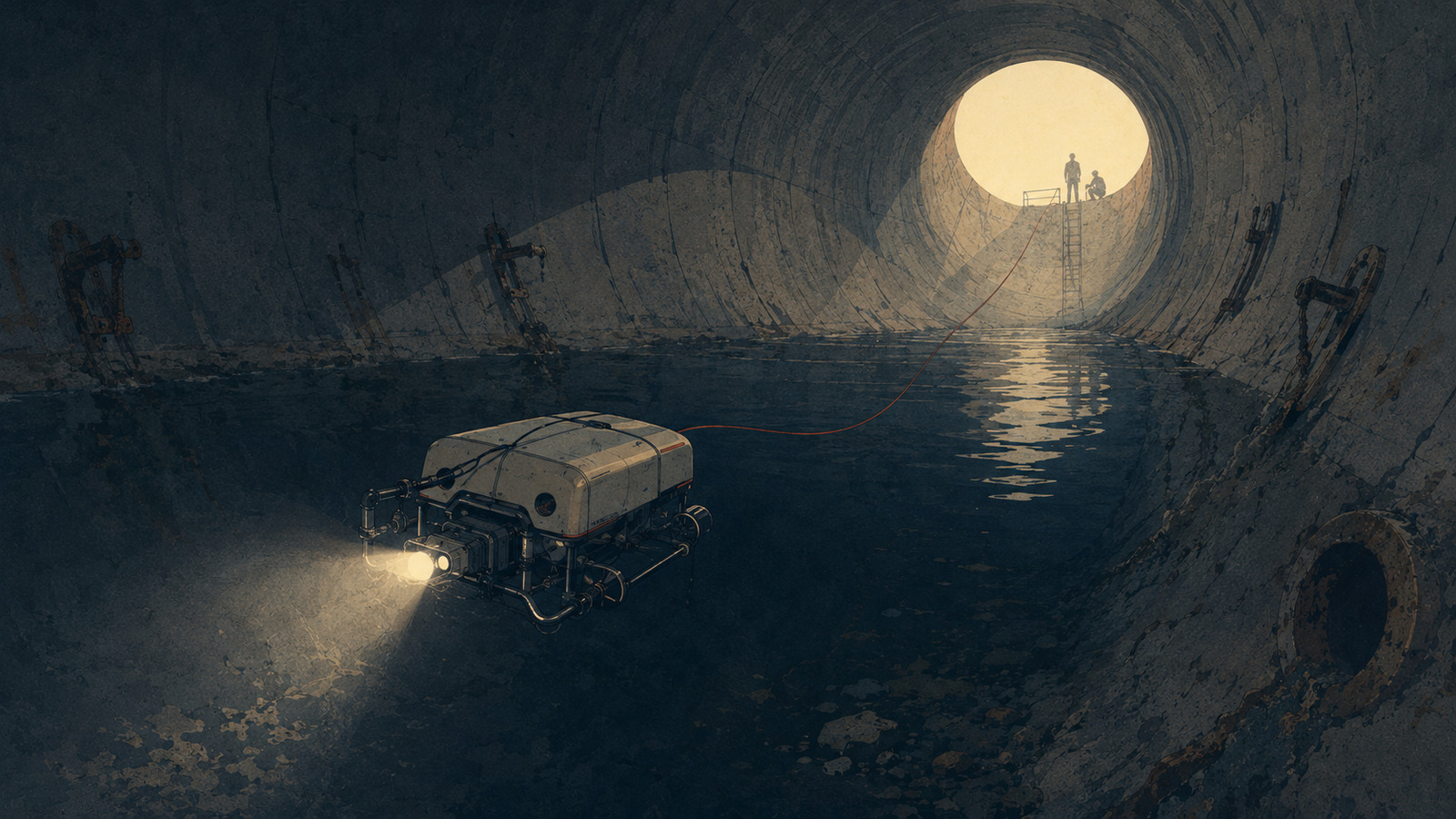
Below the manhole is a river omitted from the city map. Wastewater fills a concrete cylinder. There is no daylight, no GPS and little useful radio. Hydrogen sulfide can gather above the water while infiltrating groundwater quietly carries soil away behind the wall. The reach may be too dangerous for a person and too deep for a wheeled camera. Into that darkness Japan is beginning to lower a compact machine with a lamp, propellers and a thin cable leading back to technicians above.
Space One, a Japanese underwater-drone supplier and service company, will make its first appearance at Sewage Works Exhibition 2026 Tokyo from Aug. 4 to 7. The event has created a new “NO Entry Pipe Diagnosis Zone.” Space One plans to show the CHASING M2 configuration it has used inside sewer pipes, the professional Deep Trekker PHOTON remotely operated vehicle and a PIPETREKKER A-200S crawler. Their purpose is to supplement human observation, conventional television cameras and aerial drones in submerged and persistently flooded sections that those methods cannot adequately see.
The futuristic name can obscure the larger story. This is not an aerial drone dipped into dirty water. It is a shift in infrastructure management: deciding which machine, sensor and evidence standard to send through which part of Japan’s roughly 490,000-kilometer sewer network as the country moves from an era of construction into an era of maintenance. The urgency was brought violently to the surface by a fatal road collapse and a series of worker deaths in 2025.
Not a Trade-Show Toy, but Another Way to See
Space One is not proposing a single universal robot. The CHASING M2 PRO MAX and Deep Trekker PHOTON are ROVs—remotely operated vehicles propelled underwater. The pilot remains above ground, connected by a tether that carries video and control signals and provides a physical recovery line. Cameras, lights, sonar and other sensors can be configured to investigate walls, joints, obstructions and sediment where the water is too high for a conventional camera.
The PIPETREKKER A-200S does not swim. It crawls along the invert, the bottom of the pipe. It can be transported in hard cases without a large dedicated camera truck. Where the floor is firm and clear, a crawler may hold a more stable position and orientation than a floating ROV. Where mud, debris, drops or obstructions block the floor, a swimming machine may have the advantage. In a large pipe that is only partly full, a floating or powered surface camera can be the better tool.
“Drone” now covers aircraft, drifting cameras, powered surface craft and fully submerged ROVs. Each sees different surfaces and has different limits on range, position and recovery. Progress does not come from selecting the most dramatic machine. It comes from matching diameter, water depth, current, turbidity, bends, sediment and shaft depth to the right instrument.
An ROV may inspect high-water reaches, permanently flooded facilities, obstructions a crawler cannot cross and the pipe floor hidden from a surface camera. Turbidity, current, long bends, tether entanglement and precise localization remain serious constraints.
Yashio Turned an Underground Problem Into National Politics
On Jan. 28, 2025, a prefectural road suddenly collapsed in Yashio, Saitama Prefecture, swallowing a truck. The driver died. The cavity expanded during the rescue, forcing evacuations and road closures. Because the large downstream sewer could not simply be switched off, about 1.2 million people were temporarily asked to restrain laundry and bathing. The failure of one pipe disrupted transport, rescue operations, household wastewater and the regional economy at the same time.
An interim finding by Saitama Prefecture’s investigation committee said the collapse was believed to have originated in a sewer pipe corroded by hydrogen sulfide. This was more than an old pipe breaking. Large diameter, deep burial, continuous flow, limited redundancy and a dangerous internal environment combined to make inspection, repair and rescue difficult even after the failure was known.
The Land Ministry ordered a nationwide special priority survey. It generally targeted pipes at least two meters in diameter that had been installed by fiscal 1994. The first 813 kilometers included locations prone to corrosion and those where failure could have major social consequences. Visual inspection, sounding tests and underground-void investigation were combined in an emergency attempt to manage pipes according to risk instead of waiting for failure.
Seventy-Five Kilometers Within One Year; 243 Within Five
By the end of September 2025, visual investigation by human entry or television camera had covered about 785 of the 813 priority kilometers. Of 666 kilometers already classified, an estimated 75 kilometers in Urgency I required prompt action in principle within one year. About 243 kilometers in Urgency II required temporary measures followed by work within five years. Investigators examined 316 kilometers for underground voids, confirmed seven and had already treated five; work was under way on the other two.
The findings revealed two truths. Even after limiting the survey to higher-risk large pipes, roughly one-tenth of the classified length required immediate rehabilitation or equivalent action. And a camera was not enough. Sounding tests found deterioration that images could not; defects inside a pipe and cavities behind it had to be connected through separate methods. An underwater drone’s video is one layer of diagnosis, not the diagnosis itself.
The survey also revealed how early the technology remains. In a supplemental review covering 2,647 pipe spans, completed work included 1,459 spans using entry inspection, 324 using drifting television cameras and 247 using self-propelled cameras. Flying drones had been used in four spans and a submerged drone in one. The technology has entered the system, but it has not become the system. The 2026 exhibition is less a victory lap than the beginning of a market that still needs performance standards, suitable-use rules, procurement methods and credible costs.
From Osaka’s Ancient Drain to 490,000 Kilometers
Japan’s sewer history is both ancient and modern. Fujiwara-kyo and Heijo-kyo had roadside drainage channels. In 1583, Osaka built the Taiko Sewer, a back-lot drainage system of which portions remain in service. It is a reminder that a city’s underground works are inherited public assets, expected to serve generations that did not build them.
Modern sewerage began in the treaty ports. Yokohama’s foreign settlement received buried earthenware drains in 1869. Tokyo built a modern sewer in Kanda in 1884, driven in part by urban sanitation and cholera. The first Sewerage Law arrived in 1900; Tokyo’s Mikawashima sewage disposal plant began operating in 1922; and Nagoya introduced Japan’s first activated-sludge treatment in 1930.
Postwar urbanization transformed the scale. The current Sewerage Law was enacted in 1958. A 1970 amendment, amid severe pollution, made protection of public water bodies an explicit goal alongside sanitation and flood control. From the 1970s through the 1990s, cities built networks and treatment plants at enormous speed to restore rivers and bays and bring flush sanitation to growing neighborhoods.
That success has returned as a replacement wave. Of approximately 490,000 kilometers in service at the end of fiscal 2022, about 30,000 kilometers—7 percent—had passed the 50-year standard service life. The ministry projects 90,000 kilometers, or 19 percent, a decade later and 200,000 kilometers, about 40 percent, after two decades. Of roughly 2,200 sewage-treatment plants, about 2,000 already had mechanical and electrical equipment beyond a typical 15-year service life. When the visible city was completed, the underground replacement clock began.
The Invisible Chemistry That Eats Concrete
Sewer pipes do not fail by age alone. Material, flow, slope, joints, groundwater, soil, construction and chemistry determine the rate. Hydrogen-sulfide corrosion is especially destructive. In oxygen-poor wastewater, sulfate-reducing bacteria create sulfides. Turbulence, drops and the outlets of force mains release hydrogen sulfide gas. On the damp crown of the pipe, other microorganisms turn it into sulfuric acid, converting alkaline concrete into weak gypsum and consuming the lining from the inside.
The 2025 survey documented a three-meter pipe installed in 1981 where a 250-millimeter secondary lining had disappeared and steel segments were exposed. In another large pipe from 1982, reinforcement was visible. Both had structural features such as drops where hydrogen sulfide could be released. Rainwater pipes showed other mechanisms, including abrasion, weathering, carbonation and joint failure. “Old” is not a sufficient diagnosis.
When a pipe cracks, groundwater can enter and carry surrounding soil with it. A void grows outside the pipe until the pavement can no longer bridge it and the surface collapses. An internal camera may see a crack or infiltration but cannot measure the hidden cavity by sight. That is why internal imaging must be combined with sounding, ultrasonic or thickness measurements, ground-penetrating radar, probing and, in future, fiber-optic sensing.
In 2015, Inspection Became a Maintenance Standard
Sewer-related road collapses had long numbered in the thousands each year. Most are less than 50 centimeters deep, but Japan recorded about 4,000 in fiscal 2014 and about 2,600 in fiscal 2022. A 2015 amendment to the Sewerage Law established maintenance and repair standards. Facilities must be inspected at appropriate times; pipe locations at high risk of corrosion must be examined visually or by another suitable method at least once every five years.
That rule does not mean filming all 490,000 kilometers at the same intensity every five years. Drops, force-main outlets, inverted siphons, stagnant reaches, previous damage, diameter, burial depth and consequences for roads or railways must shape priority. The government’s third recommendation after Yashio calls for sharper differentiation: combine likelihood of damage with the impact of an accident, then inspect the highest-risk places more often and with multiple methods.
This is where robotics has institutional value. Increasing the frequency of inspection cannot sustainably mean increasing the number of manhole entries. Smaller equipment, shorter road occupations and sensors operated with crews above ground could turn compliance into preventive maintenance that measures change before a defect becomes an emergency.
“NO Entry” Is About Safety Before Efficiency
A sewer combines oxygen deficiency, hydrogen sulfide, sudden inflow, falls and confined-space rescue. At low concentrations hydrogen sulfide has a rotten-egg odor; at dangerous concentrations it can disable the sense of smell, removing its own warning. One person loses consciousness, a colleague enters without full protection, and multiple rescuers become victims—a recurring pattern in confined-space deaths.
Three workers died during sewer repair in Oga, Akita Prefecture, in March 2025. Four died during a pipe investigation in Gyoda, Saitama Prefecture, that August. The national committee subsequently called work safety the fundamental precondition of sewer management. If robots are judged only by labor savings, the central point is lost. The first cost to reduce is the number of human exposures to a lethal space.
An ROV still requires people: a site supervisor, pilot, tether handler, traffic control, gas monitoring, video diagnosis, cleaning and recovery. Skilled workers are indispensable when a defect requires detailed examination, emergency stabilization or rehabilitation. “Unmanned” should mean moving the team’s work from inside the pipe to the surface, not imagining a site without humans.
What an Underwater Drone Can—and Cannot—Do
| Capability | Meaning in the field |
|---|---|
| Submerged imaging | See high-water reaches, inverted siphons, storage facilities and the invert hidden from pipe-mouth or flying cameras. |
| Imaging sonar | Supplement optical video when turbid water obscures walls and obstacles, though with less surface detail. |
| Remote control and recovery | Use the tether for video, command, range clues and retrieval after a failure or loss of orientation. |
| Portable deployment | Expand access where a large inspection truck cannot approach or setup room is limited. |
| Limit: turbidity and flow | Reduce optical visibility, destabilize the vehicle and complicate tether control. Sonar alone cannot grade fine surface decay. |
| Limit: outside the wall | Video cannot confirm remaining thickness, reinforcement condition, a rear void or weak soil; other tests remain necessary. |
| Limit: position | Without GPS, long or curved pipes require reliable localization so engineers can excavate and later revisit the same defect. |
Sewage is not a clear swimming pool. Grease, fibers, sand and suspended sediment scatter light. Current pushes the vehicle and catches its cable on joints or debris. A long bend increases tether drag while wireless signals perform poorly underground and around curves. Even when a crack appears on video, the record is of limited engineering value unless its width, depth, location and progression can be measured.
The Land Ministry has identified camera performance, localization and movement around curves as development needs. Current research combines GPS-denied distance estimation, hydrogen-sulfide sensing and digital twins that place video and gas readings along a virtual pipe. The next competitive test is not maximum vehicle speed. It is whether an operator can return to the same defect five years later and make a defensible comparison.
People, Assets and Revenue Are Shrinking Together
Robotics is needed because the management organizations are thinning as well as the pipes aging. Japan’s sewerage workforce has fallen about 43 percent from its peak. In fiscal 2022, roughly 1,060 utilities serving 50,000 people or fewer averaged only about five employees. About 74 percent of sewer operators were in this size class. A handful of people may be responsible for treatment, pumps, pipes, billing, procurement and disaster response.
Population decline and water conservation reduce fee revenue while replacement needs rise. Materials, electricity and construction labor cost more. It is unrealistic for every municipality to own an expensive specialist truck and maintain a full inspection team. Portable equipment, shared regional fleets, service contracts and remote expert review are therefore changes in the operating model, not merely purchases of technology.
Cheap video in large quantities can still increase maintenance cost if location, format and classification are inconsistent. Japan needs common defect codes, reproducible routes, integration with asset registers, rules for responsibility and a clear path from an image to a repair order. AI diagnosis requires reliable training data across pipe materials, condensation, dirt and lighting conditions. Municipalities should purchase verified information that supports a decision, not drone operating hours.
Seven Conditions for Real Adoption
Turning an underwater drone from an exhibition attraction into standard public-infrastructure equipment requires at least seven foundations.
| Condition | What Japan must implement |
|---|---|
| Application rules | Choose among ROV, crawler, surface craft and aircraft according to diameter, water, current, turbidity, curvature and range. |
| Independent validation | Measure detection, misses, location error and repeatability against known cracks and corrosion in realistic pipes. |
| Data standards | Link video, sonar, gas and distance to asset registers in formats that remain comparable across manufacturers. |
| Safety procedures | Keep plans and stop-work thresholds for gas, inflow, traffic, electricity and tether recovery even when nobody enters. |
| Skilled personnel | Train operators in pipe structure, corrosion, image grading and confined-space hazards—not piloting alone. |
| Shared procurement | Pool equipment and specialists across municipalities or watersheds so smaller operators can achieve useful scale. |
| Connection to repair | Join discovery to detailed diagnosis, emergency work, lining, replacement and funding in one management cycle. |
What the Small Light Reveals
An underwater drone’s lamp may illuminate only a few meters of wet concrete. Behind that narrow view stand Meiji sanitation reform, postwar urbanization, the defeat of industrial pollution, half a century of public investment and decades of coming replacement costs. Sewerage is infrastructure designed to disappear from public attention when it works. It becomes visible only when a road opens beneath us.
The new “NO Entry” zone in 2026 is not a declaration that robots will expel people. After the lives lost in 2025, it is a commitment to see places once visible only by sending a person into danger. ROVs, crawlers, aircraft, camera boats, sonar, radar, fiber sensing and AI are all partial eyes. Together, they can bring underground conditions into decisions made above.
The question is not how many drones Japan will buy. It is whether, before the aging wave peaks, the country can connect risk discovery, consistent data, skilled engineers and repair money into one cycle. The small tethered vehicle is not the answer. But it can become a new eye—one that looks before failure and does not demand a human life as the price of entering the dark.
Sources and References
Product and exhibition details are based on Space One’s July 23, 2026 announcement. Network length, aging, legal duties, priority-survey findings and technology limits were checked against primary Land Ministry materials. Underwater drones supplement established inspection; application to a specific sewer requires safety and performance review by the system owner and qualified professionals.
- Space One: Underwater Drones at Sewage Works Exhibition 2026 Tokyo
- Land Ministry: Sewerage Business and Asset Management
- Land Ministry: Third Recommendation After the Yashio Collapse
- Land Ministry: National Special Priority Survey Results, September 2025
- Land Ministry: Request for the National Special Priority Survey
- 2025 Land Ministry White Paper: Yashio Road Collapse
- Land Ministry: Sewer Pipe Maintenance Annual Report
- Land Ministry: 2015 Sewerage Law Maintenance Standards
- Land Ministry: Development and Deployment of Pipe-Maintenance Technology
- NJS: Flying and Surface-Running Drone Inspection Technology
- Japan Sewage Works Association: History of Sewerage
- Land Ministry: The Role and Legal History of Sewerage