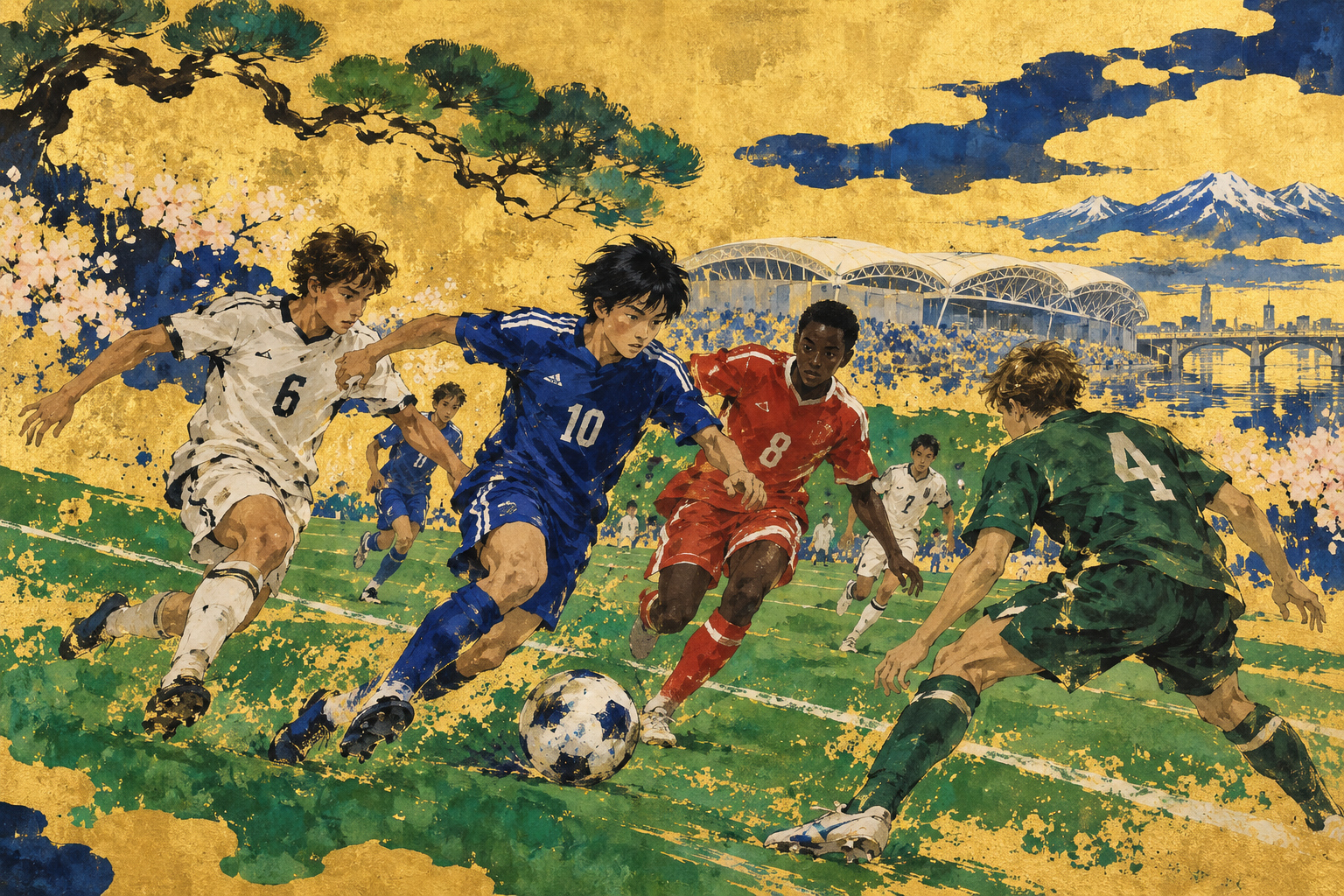
Before a player becomes a familiar name, there are matches in which the next step remains uncertain. Niigata’s international youth tournament gives spectators a chance to watch that stage of football closely: national selections, a local representative side and teenagers trying to make their decisions work against unfamiliar opponents.
Japan announced its squad on September 9 for the 28th International Youth Soccer in Niigata. Coach Takashi Yamahashi leads the September 14–21 activity, with players drawn from high schools and professional clubs’ youth organisations. [1]
Japan, New Zealand and Myanmar will field U-17 national teams alongside a Niigata U-17 selection. The four sides play a round robin, and admission to every match is free. [2]
A local connection on both sides of the fixture
Japan’s call-up includes goalkeeper Rento Kida and forward Masaki Koyama of Teikyo Nagaoka High School. Their presence places a local school within the national squad, while the separate Niigata selection offers another group of players an international competitive opportunity. [1]
The prefectural association’s Niigata list includes players from Albirex Niigata U-18 and local high schools. It is a representative selection assembled from different teams, rather than a single club entering under another name. [7]
That distinction makes the tournament more interesting than a simple visiting-teams event. Football development in the host region appears on both sides of the national-versus-local divide. Players can reach the same tournament through different environments and selections.
A call-up records an opportunity at a particular moment. It does not settle a player’s future, and absence from the national list does not settle it either. The local selection has its own matches to contest and lessons to take back to its constituent teams.
Three Japan matches, two venues
| Date | Kickoff | Opponent and venue |
|---|---|---|
| September 17, Thursday | 3 p.m. | Myanmar U-17 — Niigata City Athletics Stadium. |
| September 19, Saturday | Noon | Niigata U-17 selection — Niigata City Athletics Stadium. |
| September 21, Monday, public holiday | 3 p.m. | New Zealand U-17 — Denka Big Swan Stadium. |
The first two matchdays use the city athletics stadium; the last moves to Big Swan. The official match card confirms that distinction, which matters when planning a visit. [4]
Japan’s programme includes training between matchdays. That creates an opportunity to carry questions from one game into the preparation for another. It is not an announcement that training sessions are open to spectators. JFA says the schedule may change because of weather or team conditions. [1]
A competition that allows another attempt
The regulations specify 90-minute matches and 15-minute intervals. A win earns three points, a draw one and a loss none; goal difference and then goals scored are among the ranking criteria when points are level. Eligibility is for players born on or after January 1, 2009. [2]
A round robin gives every side a match against each opponent. An opening defeat does not remove the opportunity to respond in another game, yet each result still affects the table. Development and the pressure to win occupy the same schedule.
Japan.co.jp suggests watching how decisions change when the opposition changes. When pressure arrives quickly, can a player find information before receiving the ball? After possession is lost, who responds first, and how do teammates support that response?
These are viewing questions, not assertions about the tactics of Myanmar or New Zealand. They direct attention towards adaptation without assigning a national stereotype to teenage players.
A legacy that began before the World Cup
Niigata City dates the tournament’s beginning to 1997, commemorating the city’s selection as a host for the 2002 World Cup in Japan and South Korea. The youth competition therefore began during the approach to the World Cup, rather than as a retrospective celebration created after it. [3]
That origin offers a useful way to think about hosting major sport. A legacy can include opportunities arranged for later generations, alongside buildings and memories. Niigata’s tournament can be understood as one way of sustaining an international relationship through younger players.
The 28th edition should not be taken to mean the event ran without interruption every year. What the dates establish is the length of the relationship between the original initiative and the competition taking place in 2026.
Recognisable names, without a promise of stardom
The prefectural association’s historical lists record Eiji Kawashima playing for Japan in 2001 and Keisuke Honda in 2004. Its separate Niigata list records Gotoku Sakai appearing in 2006 and 2007. Both the national and local selections have included players who subsequently built prominent careers. [5][6]
That history is an attraction, but it needs careful interpretation. A list of successful former participants does not describe every participant’s subsequent path. Nor does it demonstrate that this tournament, by itself, produced those careers.
The more rewarding approach may be to watch today’s players without requiring an immediate prediction about who will become famous. A player asking for the ball again after an error, communicating with a teammate or adjusting a position provides something worth noticing in the present.
Such moments need not end in a goal to matter to the contest. They can show the work through which a team keeps an attack alive or prepares for the next challenge.
The wider U-17 calendar
There is also a world tournament on this age group’s horizon. In May, JFA announced Japan in Group L with Colombia, Serbia and Honduras for the FIFA U-17 World Cup Qatar 2026, scheduled to begin in November. Its announcement describes 48 participants and a 32-team knockout stage. [8]
That is relevant background, but the Niigata call-up should not be presented as the final World Cup squad. The September announcement identifies players for this activity. It does not pre-empt later selection decisions.
Keeping those stages separate allows the Niigata matches to be judged on what happens there. They are competitive assignments for the selected players, rather than evidence that a future place has already been secured.
International football within local reach
Free admission makes the tournament approachable for people who do not normally follow youth football. The city asks visitors to consider public transport because parking is limited. It identifies free P3 parking at Big Swan for the final matchday, without guaranteeing an available space. [3]
Check the prefectural association’s tournament page before travelling. The published programme covers all six matches, so the event offers more than Japan’s fixtures. Watching other sides face one another can add context to a later meeting with Japan.
Japan.co.jp analysis: watch the next step happen
Counting future senior internationals would be too narrow a measure of this tournament. There is also what players learn from a new opponent, what they take back to their clubs and schools, and what local children see when slightly older players test themselves.
None of that removes the importance of winning. The effort to win gives the decisions their urgency. Niigata offers an opportunity to watch players pursuing a result while discovering what they need to do better—a stage of the game worth seeing in its own right.
- JFA, Japan U-17 squad and schedule, September 9, 2026
- Niigata Football Association, 28th tournament regulations
- Niigata City, event information and origins, updated August 19, 2026
- Niigata Football Association, 2026 match schedule
- Niigata Football Association, past Japan participants; club column dated June 2025
- Niigata Football Association, past Niigata selection participants; club column dated June 2025
- Niigata Football Association, 2026 Niigata U-17 selection
- JFA, 2026 FIFA U-17 World Cup draw, May 22, 2026