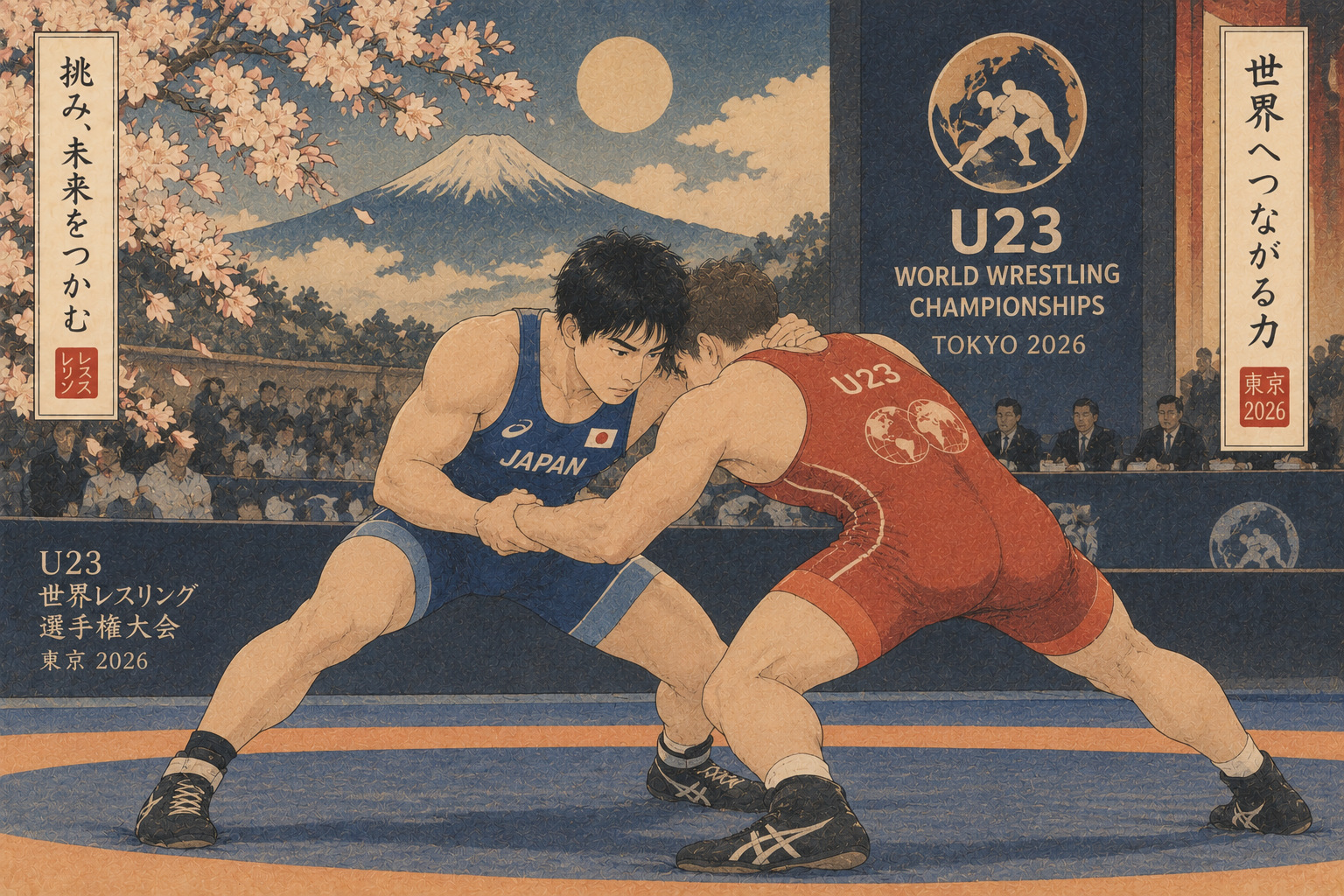
A one-point margin can be a breakthrough—and a blueprint for what must improve.
A silver medal decided in the margins
At the Under-23 World Wrestling Championships in Las Vegas, Japan’s Masato Nakamura came within the narrowest margins of winning a world title in Greco-Roman wrestling. The Ikuei University athlete reached the 63-kilogram final on October 14 and finished with silver against Iran’s Erfan Behnam Jarkani. The recorded score was 2–1 to the Iranian, but the route to that number tells a more intricate story.
Nakamura trailed 1–0, drew level in the second period and kept pressing. Under wrestling’s criteria, equal points do not always mean the same competitive position. Japan challenged an aspect of the officiating late in the bout; the challenge was unsuccessful, adding a point to the recorded score. It was not a comfortable two-point domination dressed up as a close result.
Four victories before the final
The Japanese specialist publication Wrestling Spirits records four wins on Nakamura’s route to the title bout: 9–0 over Clisman Adrian Carracedo Veliz of Ecuador, 5–3 over Aykhan Javadov of Azerbaijan, 10–0 over Ozodbek Khalimboev of Uzbekistan, and 5–3 over Igor Punchenko of Russia. Twenty-four wrestlers entered the weight class.
That sequence matters because opponents presented different styles and problems. The two five-point-to-three-point wins demanded sustained control rather than an immediate technical shutout. Nakamura’s reward was his first medal on his fourth appearance in international competition, according to the specialist report. Detailed tactical claims beyond the published records would require full bout footage.
Japan’s two other Greco-Roman medals
The result was not an isolated medal. Seima Tokuhara of Senshu University won bronze at 60kg, while Ikuei University’s Hiraku Suzuki took bronze at 67kg. Suzuki’s third-place contest was a striking comeback: down 4–1 against Georgia’s Anri Khozrevanidze, he executed a four-point standing throw and emerged a 5–4 winner.
Japan finished the men’s Greco-Roman competition with one silver and two bronzes, 50 classification points and tenth place in the team standings. That improved on the previous year’s 35 points and twelfth place, but was well behind champions Iran with 119 points. Both truths belong in a serious account: visible progress and a substantial remaining gap.
Why Greco-Roman is its own discipline
Greco-Roman wrestling permits neither attacks below the waist nor the use of the legs as offensive tools. Its decisive exchanges involve upper-body ties, balance-breaking, lifts and throws, as well as ground-based par terre wrestling. A viewer accustomed to freestyle or mixed martial arts may therefore misunderstand why a passive call, a point sequence or a challenge can carry enormous weight.
The Japanese Wrestling Federation lists ten Greco-Roman classes for the U23 level, but only six Olympic weight categories. Nakamura’s 63kg world medal does not correspond to an Olympic 63kg event; there is no such class in the current Olympic program. His future international trajectory will require technical development and decisions about weight management as well as more medals.
A university pipeline under pressure
Japan’s wrestling pathway has long relied on schools, universities, clubs and national competitions to develop the athletes who eventually enter senior international wrestling. This year’s medalists connect at least two universities to the world stage, underscoring how campus coaching and competition remain part of the national system.
The triumph can obscure the economics of a young athlete’s career. Overseas travel, nutrition, physiotherapy, specialized partners, training camps and balancing study against sport all carry costs. The available result reports do not reveal the funding and coaching resources behind each medal, so those should be reporting questions rather than assumptions.
An Olympic history, and a different kind of Japanese success
Japan has a deep Olympic wrestling tradition, extending through postwar men’s competition and the dramatic international rise of its women after women’s wrestling entered the Olympic Games in Athens in 2004. More recently, Nao Kusaka’s victory in the men’s 77kg Greco-Roman category at the Paris 2024 Games demonstrated what Japanese athletes can achieve in a field often dominated by powerful Eurasian programs.
One champion does not by itself create an enduring system, and one age-group medal does not guarantee senior-level success. That is precisely why the Under-23 championship is useful: it offers evidence of the depth of the next cohort and the international opposition it must learn to defeat.
What the Under-23 label actually means
The 2026 championships run October 12–18 in Las Vegas, under United World Wrestling, with men’s Greco-Roman followed by women’s wrestling and men’s freestyle. The U23 classification generally covers athletes aged 18 through 23, bridging university competition and the senior international circuit. It is not a schoolchildren’s tournament.
Some entrants already have significant senior experience. Nakamura’s final opponent, for example, was a senior Asian Championships runner-up, according to the Japanese match report. The competition thus provides a more demanding assessment of emerging athletes than the age label might imply.
The women’s tournament brings more unfinished business
Japanese specialist reporting on October 15 said two women had advanced to finals from the opening women’s categories: Haruna Morikawa of Shigakkan University at 50kg and Yuna Sawaya of Ikuei University at 55kg. These are finalists as reported at the research cutoff—not gold medalists, and not final competition standings.
Their emergence also widens the story beyond a single male medalist. Japan’s wrestling strength exists across distinct rules, weight classes and collegiate programs. By October 17, editors should update the final results from United World Wrestling before publishing the story as a current tournament report.
A challenge is not proof of officiating error
The close final is tempting material for a controversy headline. It would be wrong, however, to assert that Nakamura was denied a world title by an incorrect decision simply because Japan requested a video review. The challenge was rejected. The governing rules explicitly provide for reviews and consequences if a challenge fails.
A trustworthy description distinguishes the score shown at different moments, the Japanese team’s claim, and the adjudicated outcome. Video footage and the full score sheet would be needed to offer a confident technical reconstruction of each point.
Beyond the podium: what should happen next?
An athlete’s first international medal is a milestone, not a finish line. The longer test is whether Nakamura can translate this result into senior-level excellence, maintain the physical requirements of his category and find high-level international training opportunities. Suzuki and Tokuhara face similar questions after their bronze-medal performances.
Japan’s story in Las Vegas should therefore not end with a nationalistic medal count. It should follow the people and institutions turning a close defeat into a learning opportunity. The difference between a talented age-group wrestler and an Olympic contender is measured over years, against changing opponents and across difficult decisions off the mat.
Sources and reporting record
- 日本レスリング協会・大会概要 / Japan Wrestling Federation event
- 世界レスリング連合・大会日程 / UWW tournament
- 中村真翔の決勝 / Nakamura final report
- 男子銅メダル / Two bronze medalists
- 中村の準決勝 / Nakamura semifinal
- 日本協会の競技ルール / Federation rule guide
- UWW 大会詳細 / Official event portal
- 女子決勝進出 / Women finalists report
- 2025年学生選手権 / 2025 university women results