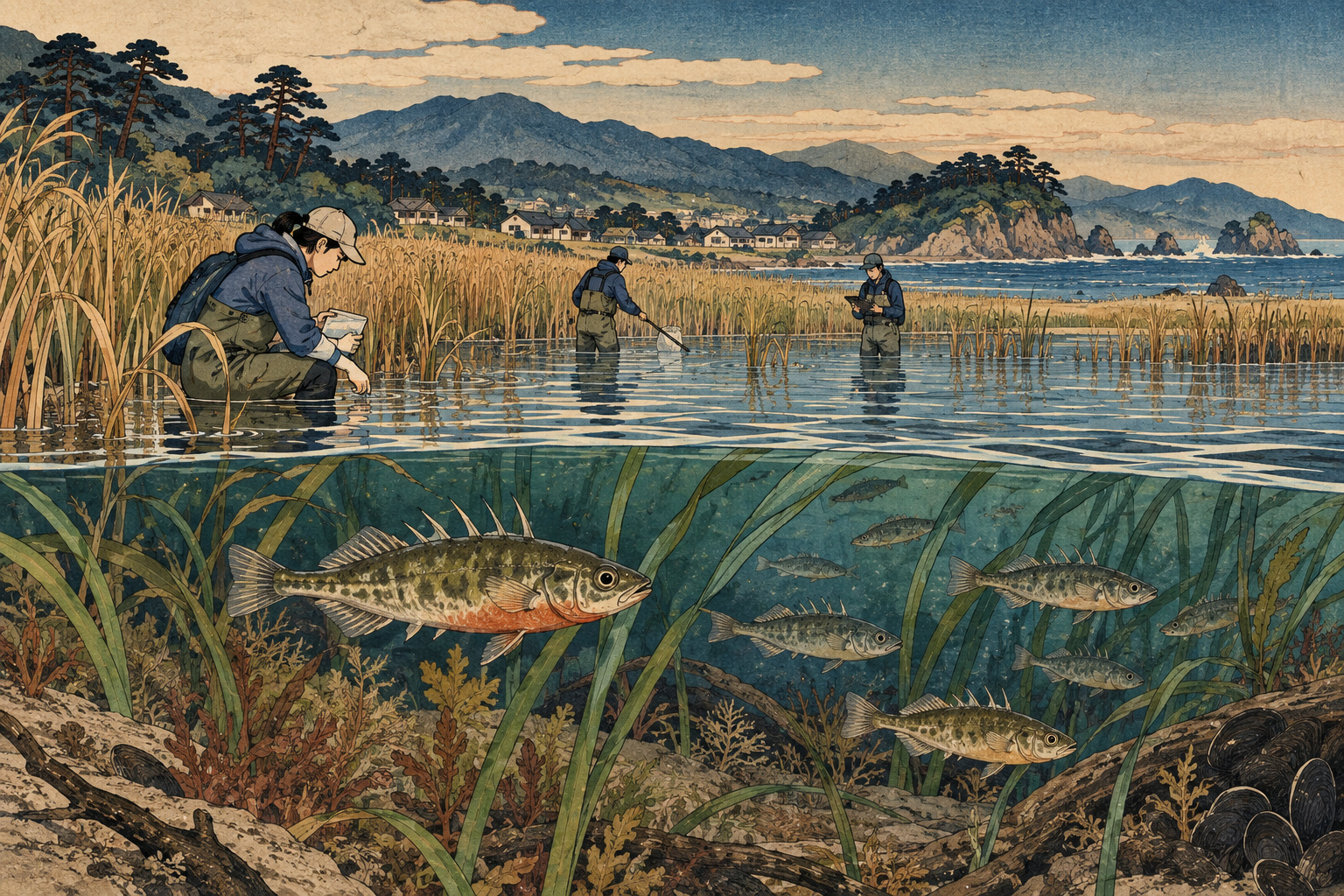
A sample taken in 2012 would have told a striking story: two fish species had interbred extensively in freshwater ponds formed after Japan’s devastating 2011 tsunami. A sample taken in 2020 would have suggested something quite different. By then, the population’s genetic composition was overwhelmingly that of the local freshwater stickleback. The scientific value lies in the years between those snapshots.
A study published in Nature Ecology & Evolution on September 25 follows that change in Otsuchi, Iwate Prefecture. Researchers tracked the population from 2012 through 2020; 38% of sampled fish were hybrids in the first year. Most of the genetic contribution from Japan Sea stickleback subsequently declined. Interbreeding had occurred, but it did not simply dissolve the boundary between the species.[1]
The collaboration includes Takuya K. Hosoki, a specially appointed assistant professor at Hokkaido University’s Field Science Center for Northern Biosphere, and Jun Kitano, professor at the National Institute of Genetics. Their work combines repeated sampling, field experiments, genetic analysis and simulations to investigate how species differences persist after contact.[1],[9],[10]
The water has a history of its own
Otsuchi’s springs long predate the disaster. The town describes groundwater emerging through flowing wells in the Machikata district, between the Otsuchi and Kozuchi rivers, and feeding the Gensui River. Residents historically used that water in everyday life. The freshwater habitat was part of the town’s human geography as well as its ecology.[6]
The March 11, 2011 earthquake, tsunami and land subsidence transformed part of the built environment into new ponds fed by springs. The researchers infer that tsunami waves transported marine fish inland and returning water carried freshwater fish from upstream. This is a reconstruction of how contact occurred, not an eyewitness record of individual fish being transported.[1],[2]
A 2018 study had already compared conditions and sticklebacks before and after the tsunami. It reported recovery of water conductivity in the Gensui River toward its earlier level over about two and a half years, with spring water apparently flushing out seawater. Conductivity measures an aspect of water chemistry; that recovery did not establish that every part of the ecosystem had returned to its previous condition.[3]
The town’s disaster archive also preserves a record of river-cleaning work undertaken to protect sticklebacks. That history matters when interpreting a genetic recovery story: natural selection operated in a landscape where people were also working to sustain habitat. A finding about species boundaries is not evidence that damaged ecosystems need no care.[7]
Two species, rather than two names for the same fish
The freshwater residents in this study are Gasterosteus aculeatus, the threespine stickleback. Their relatives are Gasterosteus nipponicus, the Japan Sea stickleback, formally described as a species in 2014. The naming date records a scientific classification, not the moment an organism originated. Older research used the terms Pacific Ocean and Japan Sea forms, which can make the historical literature look less consistent than the underlying research is.[3],[5]
The life histories also require precision. G. aculeatus includes both freshwater residents and migratory populations. G. nipponicus is marine or anadromous, moving into fresh or brackish water to reproduce. The freshwater description in this story applies to the local population; it is not a definition covering every threespine stickleback.[3]
A species boundary need not prevent every mating. Reproductive isolation can act through where organisms live, which mates they accept and whether their offspring survive and reproduce. Interbreeding can therefore occur without ultimately making two populations genetically indistinguishable. The interesting question is what happens to inherited variation in the generations that follow.[1]
A research trail that began before the tsunami
In 2009, Kitano and colleagues reported that a newly evolved sex chromosome in Japanese sticklebacks carried genetic regions associated with male courtship traits. The ancestral X chromosome contained regions associated with behavioral isolation and hybrid male sterility. This established a connection between chromosome evolution and traits that restrict reproduction between the groups.[4]
That finding provided a basis for asking a harder question outside the laboratory. Do the same regions resist the movement of genetic material when animals actually interbreed in the wild? Identifying a reproductive barrier in a cross is one kind of evidence; watching its consequences accumulate across generations in a natural habitat is another.
A 2025 conference abstract from the research team described bringing together genetic mapping and the tsunami population’s history, adding freshwater survival and movement toward the sea to previously studied barriers. It also set out the question of why changes spread beyond the regions with the strongest known effects. The new journal publication develops that long-running investigation rather than reporting the first discovery of hybrids at the site.[11]
Survival and departure can both change a population
The joint Japanese announcement describes outdoor tests in which Japan Sea stickleback survived less well in freshwater than the local threespine stickleback, while experimental hybrids were intermediate. A separate test found a greater tendency for Japan Sea stickleback to move seaward. Those results distinguish two processes that can reduce a genetic contribution in a pond: its carriers may survive less well, or they may leave.[1]
Neither requires a fish to discard DNA during its lifetime. The measured change concerns inherited variants becoming less common in a population over generations. That distinction is essential to understanding the paper’s term “purging.” It is population change, not a cellular editing mechanism or a deliberate return to an earlier genetic state.
The new paper links early declines to regions involved in reproductive isolation. Simulations then suggest that many weaker genetic incompatibilities, distributed more widely, could help explain the later broad decline. Such incompatibilities arise when variants that function within their respective species work poorly in a new combination. The model supports this explanation; it does not identify every responsible gene.[2]
An earlier presentation of the work likewise distinguished the major effects associated with sex chromosomes from smaller effects elsewhere. That gives the story a more informative structure than “the strongest fish won.” Which fish remain, which reproduce and how different inherited combinations perform can all influence the outcome. A result at one genetic region need not determine the fate of every other region.[11]
What nine years of monitoring can—and cannot—show
The methods describe sampling across several ponds whose geography changed, with collections pooled because the waters could become connected. The main time series used RAD sequencing, a method that samples selected DNA regions across the genome. It was not an annual reading of every DNA base in every fish. Some Japan Sea stickleback ancestry remained, so “almost entirely” must not become “completely.”[2]
These qualifications make the evidence more useful. They tell readers what was actually measured and what a future investigation could improve. A changing field site is not a sealed experimental tank: the availability of samples, connections between habitats and movement of animals all affect the questions a time series can answer.
The team has published analytical scripts and associated data through Dryad, covering ancestry analysis, survival-related genetic regions, habitat-choice mapping and simulations. That allows other researchers to inspect the route from sequence data to inference. Access to code is a foundation for scrutiny, not a substitute for checking assumptions or collecting independent observations.[8]
Chance also needs a precise place in the explanation. A genetic variant can become less common without being disadvantageous, simply because not every individual leaves the same number of descendants. The researchers tested chance-based models against the observed history. Their conclusion is that chance alone did not account for the pattern under the models examined; that is more specific than claiming random change played no role at all.[1]
A lesson for environmental decisions
For conservation teams, environmental consultants and public agencies, Japan.co.jp’s assessment is that the most useful implication concerns the duration and scope of monitoring. A single survey may accurately describe a population at one moment while giving a misleading impression of where it is heading. Keeping comparable samples and records makes later questions possible that nobody could answer from the final snapshot alone.
The study does not justify assuming that other disturbed populations will follow Otsuchi’s trajectory. Nor does preservation of a species boundary certify the health of an entire wetland. Population abundance, water conditions, habitat continuity and genetic composition answer different questions. Environmental decisions need to keep those measures distinct rather than treating any one of them as a complete verdict on recovery.
Otsuchi’s ponds reveal evolution continuing after a dramatic encounter between species. The result is consequential because the researchers stayed long enough to see that the initial mixing was not the end of the story. In a landscape carrying the memory of catastrophe, patient observation has made a normally hidden biological process visible.
