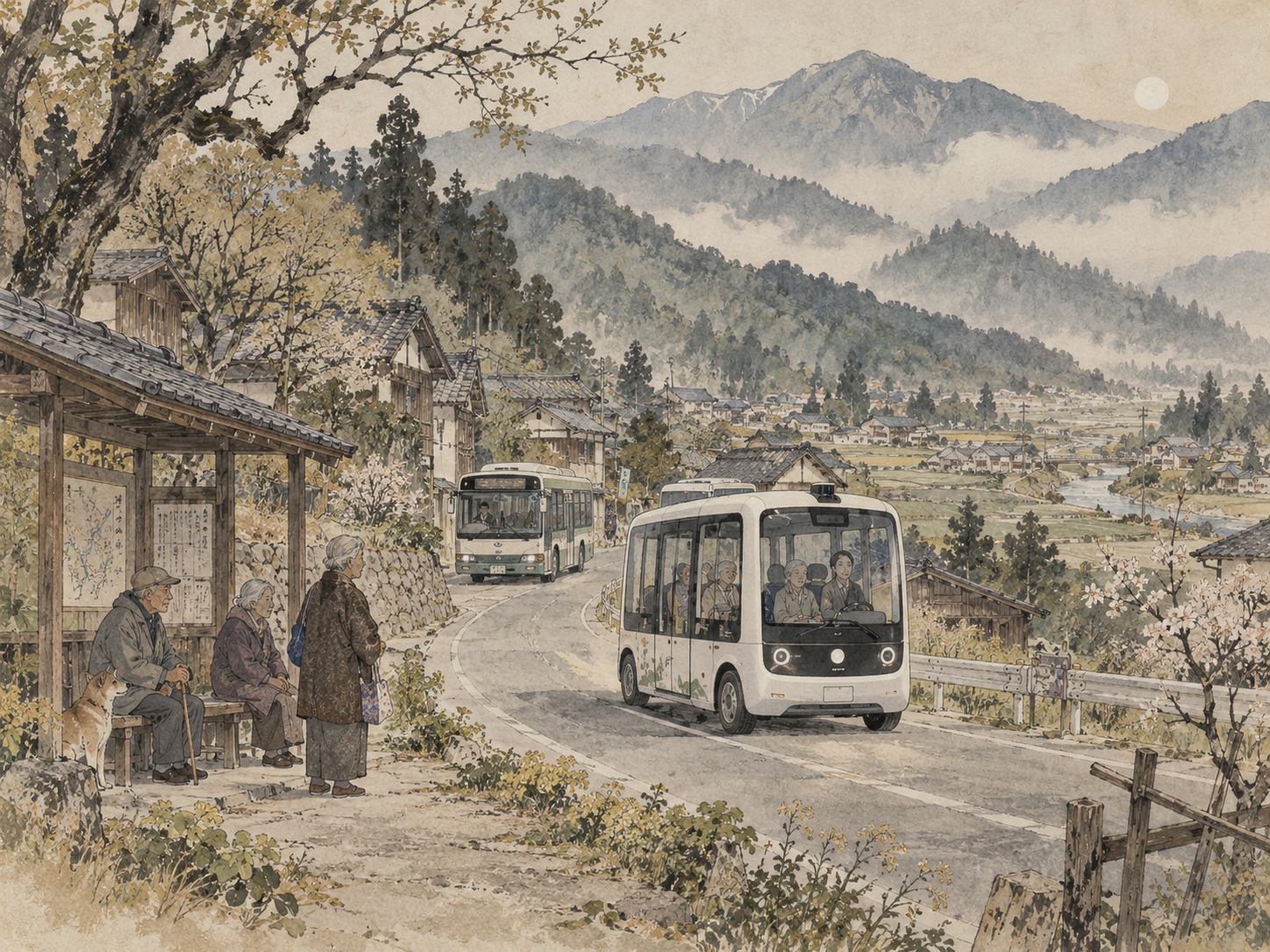
A bus route loses one trip. A taxi company closes. An older resident gives up a driver’s license. A hospital consolidates and becomes farther away. None of those changes alone creates a transportation crisis, but together they can leave a community with mobility demand and no practical way to meet it.
Japan increasingly calls these gaps “transport deserts.” On October 7, the Ministry of Land, Infrastructure, Transport and Tourism added a new project in western Kagawa to its regional-mobility digital-transformation program: two taxi companies serving Mitoyo and Kanonji will create a joint dispatch operation and share vehicle information through a common system.[1]
The project is notable because it is not built around forcing passengers onto a new app. Telephone booking will remain. The digital change happens behind the scenes, where scarce dispatch staff and vehicles can be coordinated across company boundaries.[2]
A transport desert is not simply a place far from a bus stop
Japan’s policy definition is broader than a geographic gap on a map. The ministry uses the term for situations in which residents or visitors cannot realistically access taxis, shared taxis, Japan-style rideshare, public rideshare or other needed transport services.[4]
That means the underlying problem differs from place to place. A mountain community may have lost its bus. A regional city may lack taxis at night. A tourist destination may run short of drivers during peak periods. A suburban district may become isolated when older residents stop driving.
Kagawa’s new project is digital transformation that keeps the telephone
The newly selected Seisan-area project covers Mitoyo and Kanonji in Kagawa Prefecture. Takuma Kotsu and Seisan Kanko plan to consolidate telephone dispatch into a shared operating structure and introduce a common dispatch-management system.[2]
MLIT’s project sheet says older residents still rely heavily on calling for taxis, while shortages of drivers and dispatch operators mean that vehicles increasingly cannot be arranged even when customers call.
The solution is therefore deliberately hybrid: preserve the familiar telephone interface while digitizing vehicle information and dispatch on the back end.
The important word may be “shared,” not “digital”
In shrinking markets, maintaining separate dispatch rooms, systems and administrative processes for every operator can itself become inefficient.
Japan’s 2026 mobility-DX program supports integration of mobility data, common technical standards and standardized operating models across companies and sectors.[5]
The policy question is increasingly whether competing operators can share infrastructure and back-office functions without giving up their identities or customer relationships.
Why transport supply is shrinking so quickly
Population decline is only part of the problem. Japan’s bus and taxi industries face serious labor shortages and aging workforces. Tighter working-time constraints have also reduced how much service one driver can provide.
The government’s response is increasingly multimodal: demand-responsive transit, shared taxis, public rideshare, Japan-style rideshare, collaboration among operators and links with health, welfare and education services.[6]
Japan has been moving toward locally designed transport since 2007
For much of the postwar period, transport operators ran routes while government primarily regulated and subsidized them.
The 2007 Act on Revitalization and Rehabilitation of Local Public Transportation changed that structure by creating a framework in which municipalities could lead planning for the network their communities actually needed. Amendments in 2014 linked mobility with compact-city planning; the 2020 reform emphasized local public-transport plans and use of all available transport resources; and the 2023 reform placed collaboration, DX and decarbonization even more centrally in the system.[7]
“Redesign” means changing the operating model, not preserving every old route
MLIT now describes its strategy as local public-transport “redesign.” Its pillars include cooperation between government and business, cooperation among transport operators, cooperation with other sectors, transport DX and transport GX.[8]
A region may already have buses, taxis, school vehicles, hospital shuttles, welfare transport and community volunteers. The redesign approach asks whether those resources can be coordinated instead of operated as separate islands.
Demand-responsive transport addresses the empty-bus problem
Fixed-route buses are efficient where demand is dense and predictable. In sparsely populated areas, they can end up running largely empty.
Demand-responsive services alter route or timing based on reservations. Algorithmic dispatch can combine several requests, reduce unnecessary mileage and use fewer vehicles. Japan’s transport-gap funding explicitly supports demand-responsive transport and shared taxis.[6]
Public rideshare and Japan-style rideshare are different systems
The terminology can be confusing.
Public rideshare generally refers to paid transport using private vehicles operated by municipalities or nonprofit bodies where ordinary bus and taxi service is insufficient. Japan-style rideshare is managed through licensed taxi companies using ordinary drivers and private vehicles to supplement taxi supply.
Both can fill gaps, but the legal structure, operator responsibility and policy purpose differ.[4]
DX is aimed at the back office as much as the passenger
The 2026 program supports much more than reservation apps. It targets dispatch management, data integration, system standardization and common operating processes.
This matters because fragmented administration can be expensive in its own right. Telephone booking, paper records, separate company dispatch, incompatible municipal datasets and duplicated staffing all consume resources that shrinking transport operators increasingly lack.
Japan is starting to describe transport-gap spending as growth investment
In 2026, MLIT increasingly used the phrase “solving transport gaps is growth investment.” At a June ministry meeting, Land Minister Yasushi Kaneko described inadequate mobility as an invisible barrier that can consume working-age residents’ time through family driving duties and reduce opportunities for work and other activity.[9]
Under that logic, transport is not merely welfare expenditure. The ability to commute, attend school, reach health care, shop and receive visitors is economic infrastructure.
Twenty-eight DX projects — then more
In April 2026, MLIT selected 28 projects for its regional mobility DX program. Five more were chosen in the first phase of a second application round in August, and the western Kagawa joint-dispatch project was added on October 7.[5][1]
Meanwhile, other categories — direct transport-gap projects, shared-operation initiatives and mobility-workforce programs — expanded rapidly. By September, the ministry said 441 projects had been selected through the first three rounds.[10]
The hard question begins after the subsidy ends
Pilot projects are easier to start than to sustain. A national grant can pay for a new system, but maintenance, dispatch staffing, vehicle replacement and software costs continue in later years.
Even a more efficient demand-responsive or shared-dispatch service may not become profitable in a very low-density area. If transport is treated as health, welfare and education infrastructure, municipalities still have to decide how much public funding is justified.
An app-only solution can exclude the people who need transport most
The Kagawa project’s decision to preserve telephone booking is important. Many older passengers either do not use smartphones or are uncomfortable with app-based reservations.
Successful mobility DX therefore often means digitalizing operations while preserving multiple customer channels: telephone, counter service, family proxy booking and apps.
Autonomous driving is promising, but not a universal answer
Autonomous vehicles could eventually reduce dependence on scarce drivers, and Japan is investing heavily in deployment.
But automated mobility still requires vehicles, remote supervision, maintenance, communications, accessible boarding, incident response and capital. Snow, narrow roads and rural terrain also complicate deployment. Even highly automated transport will not eliminate every human role.
Filling a transport desert is not about adding one new vehicle
Japan’s shrinking communities are unlikely to solve mobility by preserving every conventional bus route unchanged. Nor can they simply hand responsibility to private cars and smartphone platforms.
The emerging model is a portfolio: buses where fixed routes still make sense; taxis where flexible point-to-point service matters; demand-responsive vehicles where density is low; public rideshare where commercial service cannot survive; and shared digital systems connecting the whole network.
The western Kagawa project may look modest beside billion-yen infrastructure projects. Yet it captures the direction of Japanese transport policy. Before buying more vehicles, connect the vehicles already there. Before forcing passengers to change behavior, make the operating system behind the service work better.
A transport desert is not really an empty space on a map. It is a place where people cannot reliably reach the activities that make daily life possible. Japan’s mobility-DX experiment is ultimately an attempt to redesign that access with fewer people and fewer vehicles.
Sources and references
- MLIT, second selection of regional mobility DX projects, October 7, 2026.
- MLIT, Seisan-area joint dispatch project sheet, October 7, 2026.
- MLIT, amendment bill for the Local Public Transportation Act, March 10, 2026.
- MLIT, initiatives to eliminate transport gaps.
- MLIT, first 2026 regional mobility DX selections, April 10, 2026.
- MLIT, transport-gap redesign project, February 27, 2026.
- MLIT, Act on Revitalization and Rehabilitation of Local Public Transportation.
- MLIT, local public transportation redesign policy.
- MLIT, sixth Transport Gap Elimination Headquarters meeting, June 10, 2026.
- MLIT, fourth application round, September 11, 2026.
Reporting and verification cutoff: October 7, 2026. Selected projects are based on application-stage plans, and MLIT explicitly notes that details may change. Expected improvements in dispatch success or efficiency are project objectives, not yet verified outcomes.