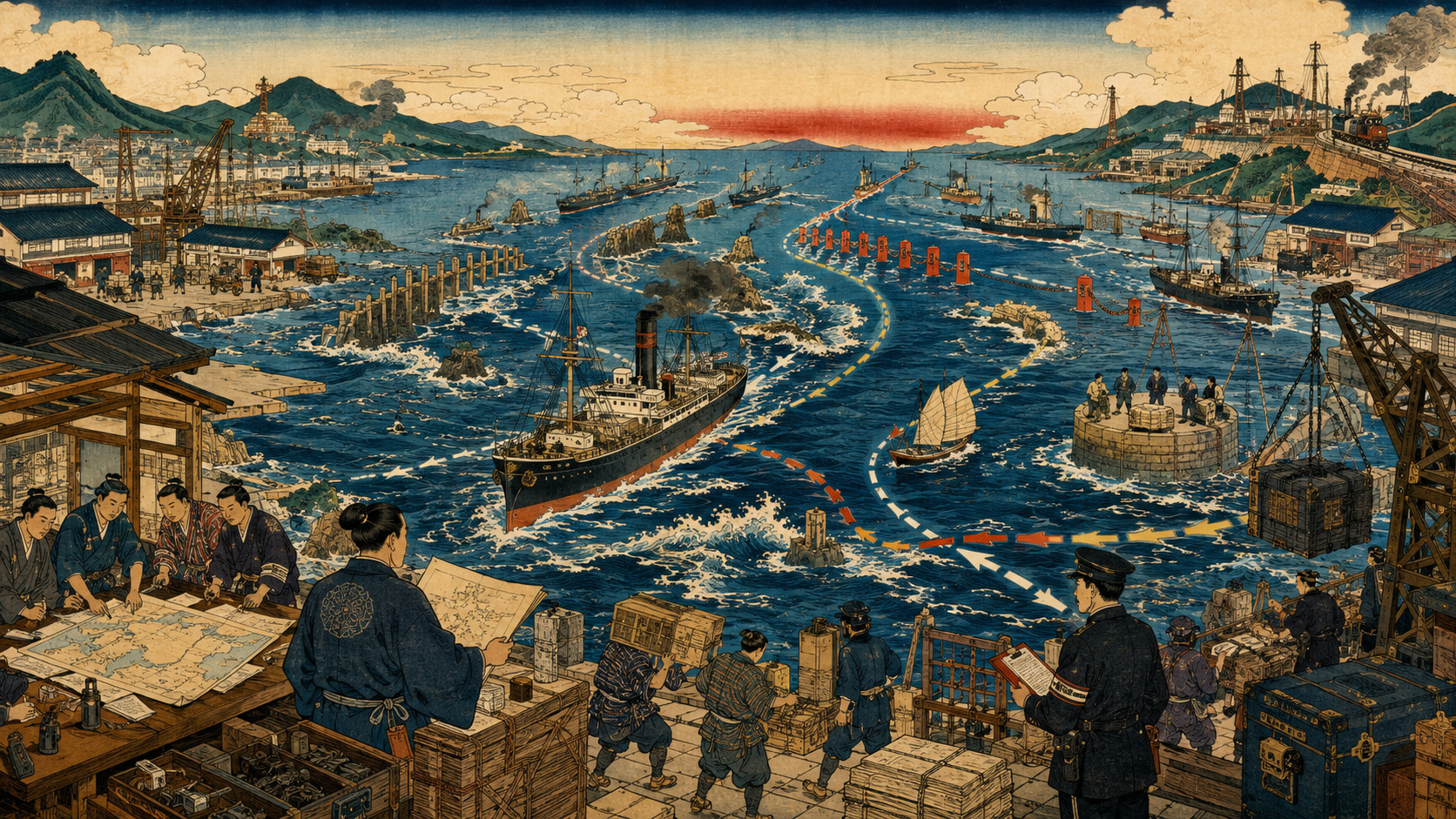
At six in the morning, gantry cranes begin moving over Yokohama. Politics is invisible on the outside of a container. Inside might be nickel mined in Indonesia, graphite refined in China, electronics assembled in Vietnam, American design and a machine tool made in Japan, all traveling as one product. The customs form can name an origin in one line. The dependency cannot fit in one line.
Japan’s 2026 White Paper on International Economy and Trade, released June 30 as the 78th in the series, restores those hidden lines to the map. Its theme is the global economy in turmoil and the growing weight of emerging economies. The global Economic Policy Uncertainty Index reached its highest level since 2000. China’s share of imports by emerging economies rose from about 4% in 2000 to about 26% in 2024. Critical minerals become more concentrated as they move from the mine into refining.
The paper’s answer is not isolation. It seeks less excessive dependence on any one state while expanding exports, investment, economic partnership agreements and cooperation with allies and emerging markets. It proposes a “trusted economic sphere” that treats crisis investment as a source of demand and reconciles security with free trade. The phrase is appealing. It can also conceal difficult politics: who decides which partner deserves trust, who pays for resilience, and when security becomes ordinary protectionism?
Uncertainty Became an Operating Condition
Uncertainty once looked like a wave that rose during war, financial crisis or disaster and then receded. The global policy uncertainty measure presented by the white paper shows episodic peaks in the 2000s becoming an upward tendency after the 2010s. The United States, Canada, Mexico and Brazil recorded high levels in 2025. China, South Korea and Singapore also show rising trends.
The index counts newspaper articles that simultaneously discuss the economy, policy and uncertainty. It is not a direct thermometer of fear and is affected by each country’s media. Yet it captures a central business fact. A high tariff is often easier to plan around than a rate that may change next month. An announced export ban may be easier to manage than a permit process whose duration cannot be estimated.
The world economy still grew 3.4% in 2025, unchanged from 2024. After the United States raised tariffs, the IMF’s April 2025 forecast had fallen to 2.8%, but national economies and trade proved more resilient. The danger is not that commerce vanishes. It is that commerce carries a larger friction bill: insurance, inventories, duplicate plants, compliance and capital held back while policy remains unsettled.
1859: Japan Opened Without Control of the Terms
Modern Japanese trade did not begin with a freely designed free-trade policy. It began under the pressure of warships. Commodore Perry arrived in 1853, the Convention of Kanagawa followed in 1854, and the commercial treaties of 1858 led to the opening of Yokohama, Nagasaki and Hakodate in 1859. Customs offices grew out of the unjosho established at the ports.
The unequal treaties granted extraterritorial privileges and constrained Japan’s authority to set its own tariffs. Raw silk and tea flowed out; machinery and cotton goods came in; domestic prices and producers were exposed to a market whose rules the government did not control. More trade and sovereignty over trade were not the same achievement.
The Meiji state promoted silk reeling, textiles, railways, shipping, trading houses and banks while making treaty revision a national objective. It opened the path to removing extraterritoriality in 1894 and recovered tariff autonomy in 1911. Japan’s first lesson in economic security was not to make everything at home. It was to participate in markets while regaining the authority to shape the conditions of participation.
The 1930s: The Memory of Blocs and Catastrophe
World War I interrupted European supply and briefly expanded Japanese manufacturing and exports. The reversal after the war, financial instability and the Great Depression drove countries toward tariffs and imperial preference. Trade was fenced into political blocs. Japan pursued an imperial yen area and resource sphere through colonial rule and aggression in Asia.
That history marks a boundary modern economic security policy must not cross. If “autonomy” means taking another country’s sovereignty and enclosing its resources, it cannot create security. Conflict over sanctions, oil supply and sea lanes became inseparable from military expansion, ending in war and the destruction of Japanese industry and ports.
The 2026 white paper does not claim that today is a replay of the interwar era. The WTO, economic partnerships, private value chains and international finance make the system fundamentally different. But states are again intervening deeply in markets, defending export controls and subsidies through national security, and separating technology into political groupings. The old question has returned: efficiency alone cannot guarantee peace.
1949: The First White Paper Knew Japan Had to Sell to Buy
The first trade white paper appeared in 1949, the year the Ministry of International Trade and Industry was established. Occupied Japan lacked food, fuel, industrial material and foreign exchange. Reconstruction was not a project of avoiding imports. It was the problem of earning the dollars needed to pay for them. Industrial promotion, technology imports, foreign exchange allocation and exports were parts of one system.
Japan provisionally entered the General Agreement on Tariffs and Trade in 1953 and became a full contracting party in 1955. Entry was not an uncomplicated welcome. Fourteen countries, including Britain, France and India, invoked Article XXXV to withhold GATT relations, reflecting fear of surging Japanese goods as well as memories of prewar commerce and empire.
Even so, multilateral rules gave a resource-poor country a shield against leaving every market-access question to political bargaining among great powers. Reciprocal tariff concessions made foreign demand more predictable. Japan imported oil, ore, cotton and food, and exported textiles, steel, ships, cars and electronics. Free trade was an operating system for survival before it was a slogan.
The Export Miracle Also Exported Friction
During high growth, Japanese companies connected domestic banks, suppliers, subcontractors and ports, winning markets through price and quality. Success also closed factories abroad and changed foreign politics. Textiles and steel dominated disputes in the 1970s, cars and consumer electronics in the 1980s, semiconductors in the 1990s. At the 1991 peak, Japan accounted for 53% of the U.S. trade deficit.
A trade balance is an accounting result, not a moral score. Behind it lie saving, investment, fiscal policy and exchange rates. But those explanations are abstract to a region losing its plants. When gains are distributed unevenly at home, public support for openness weakens. The backlash confronting China in the 2020s echoes some of the resistance once aimed at Japan.
Japan responded through export restraints, local production, local purchasing and technology transfer. It became less a country that placed finished goods on ships and more a network of companies with plants and employees abroad. Two outside pressures completed that change: energy and the exchange rate.
1973: Oil Demonstrated How Dependence Becomes Leverage
Oil supplied 75.5% of Japan’s primary energy in fiscal 1973. Nearly four fifths of that oil came from the Middle East. When producers used price and supply for political ends, shortages, inflation and panic buying shook the country. Japan traded because it lacked resources; if that trade route failed, manufacturing skill could not keep machines running.
The response was not a simple move from one supplier to another. Japan combined petroleum reserves, conservation law, natural gas, coal, nuclear power, renewable energy and diversified sourcing. From fiscal 1973 to 2023, final energy use in industry fell to 70% of its earlier level. Vulnerability drove innovation, and efficient products later became an export strength.
The white paper’s “crisis management investment” follows that logic: turn reserve capacity, diversified supply and backup infrastructure from an apparent peacetime cost into insurance and a growth technology. Yet substitution also creates new dependencies. Electrification reduces oil use while requiring lithium, nickel, graphite and rare earth supply chains.
1985: A Stronger Yen Moved the Factory Across Asia
The Plaza Accord of 1985 coordinated action to reverse an overvalued dollar. The yen rose rapidly, damaging a model based on producing at home and selling for dollars. Japanese companies expanded production in North America, Europe and ASEAN. Parts makers followed customers, trained local staff and connected with ports, roads and industrial estates.
This was not simply hollowing out. Overseas plants imported Japanese components and equipment, and later remitted dividends. The Fukuda Doctrine of 1977, aid, training and private investment deepened Japan’s relationship with ASEAN. “Made in Japan” evolved into value designed, financed, sourced and manufactured by Japanese companies across several countries.
Efficiency also produced concentration. When one region offered the lowest costs, skilled labor and a dense supplier base, the next investor had a rational reason to go there too. Scale lowered cost and attracted more scale. Today’s asymmetric dependencies are not solely the product of a state plan. They are also the cumulative result of sensible company decisions.
1995 and the Promise of One World Market
The World Trade Organization began in 1995, extending rules beyond goods tariffs into services, intellectual property, subsidies and dispute settlement. China joined in 2001, connecting immense manufacturing capacity and a vast market to the global system. Container logistics, telecommunications, finance software and common standards let companies cut inventory and optimize each stage across borders.
Consumers received cheaper products. Emerging economies gained jobs and technology. Japanese companies reached growing markets. Japan layered agreements such as the CPTPP, the Japan-EU partnership and RCEP over the multilateral system. The CPTPP took effect in 2018 and RCEP in Japan in 2022.
The gains were not shared evenly. Industrial communities in advanced economies lost jobs, digital platforms and capital captured large returns, and China combined state support, scale and intense competition to build extraordinary supply. Consensus-based WTO rulemaking and dispute settlement struggled with subsidies, state enterprises, data and export controls. A single market required domestic political consent that efficiency alone could not supply.
From 2010, Efficiency Revealed Its Failure Points
Rare-earth supply anxiety and price spikes in 2010, followed by the 2011 Tohoku earthquake and Thai floods, showed how an obscure upstream component could halt a global product. U.S.-China trade and technology conflict after 2018 turned tariffs and export controls into tools of strategic competition. The pandemic created simultaneous shortages of masks, drugs, semiconductors and containers.
Russia’s invasion of Ukraine in 2022 made energy, food, fertilizer and financial settlement security questions. Companies shifted part of their logic from just in time toward just in case. Japan’s 2022 Economic Security Promotion Act created support for critical goods including semiconductors, batteries, permanent magnets, minerals and cloud programs.
Reshoring everything is not a universal solution. A resource-poor Japan would raise costs and weaken exports if it tried to reproduce every stage inside its borders. A domestic factory may still rely on imported feedstock, equipment, software and ships. Security should be measured by the ability to substitute when second and third tier suppliers fail, not by a “domestic” label.
China Moved From the Shop Shelf Into the Factory
One of the white paper’s most important findings is that final-goods exports understate China’s role. China’s share of imports by emerging economies rose from about 4% in 2000 to about 26% in 2024. The U.S. share fell from about 23% to 13%, and Japan’s from about 9% to 3%. The amounts from several countries still increased; it was their relative weight that changed.
Much of China’s flow to emerging economies consists of intermediate inputs and capital goods. Chinese value added embedded in Vietnam’s exports rose from about 2% in 2000 to about 16% in 2022. A product shipped from Vietnam to the United States may contain Chinese material, components and machinery. Bilateral data can mistake a redirected route for true diversification.
This does not make trade with China inherently unsafe. Excluding one of the world’s deepest manufacturing clusters would impose enormous costs on companies and households. The danger is asymmetric dependence on a supplier, port, country or process that cannot be replaced and whose owner alone can stop the relationship.
- Direct imports: the country and product visible in customs data.
- Embedded inputs: material and value from another state inside a third country’s finished product.
- Process control: refining, equipment, intellectual property or software concentrated even when mining is dispersed.
- Switching time: the months needed for qualification, testing, equipment changes and transport, not merely the existence of an alternative.
Critical Minerals Narrow at the Refinery
Among six critical minerals studied by the white paper, the Democratic Republic of Congo supplied 65% of mined cobalt in 2023, Indonesia 52% of nickel, and China 82% of graphite and 61% of rare earths. Deposits exist across several countries, but China’s position becomes greater at the refining stage for many materials. Opening a mine does not by itself reproduce chemical processing, waste management, knowledge and customer qualification.
Resource countries no longer accept a role limited to digging and shipping ore. Indonesia restricted exports of unprocessed nickel and attracted refining and battery investment. From 2015 to 2025, its exports of nickel matte and related products rose 4,960-fold, while ferronickel rose 1,059-fold. Advanced economies seek secure supply; producers seek domestic jobs, technology and value through downstream processing.
Japan therefore cannot diversify by purchasing ore alone. It must help build environmental safeguards, community consent, processing, electricity, ports, finance and local employment. A resource relationship framed only as extraction in the name of security will reproduce a nineteenth-century pattern and destroy the trust it claims to seek.
Excess Capacity Delivers Low Prices and Destruction
Chinese steel capacity declined for a time in the late 2010s, then began growing again. In electric vehicles, batteries and solar equipment, state and local support, a vast market, full supply chains and fierce company competition drove rapid expansion. Cheap products benefit consumers and climate goals, but production beyond demand can flow abroad and destroy the investment base of other producers.
The proper test is not whether a product is Chinese. Subsidies, finance, land, energy, capacity, prices and injury must be examined product by product. Japan used industrial policy during its own high-growth era and faced criticism for a protected market. Trade rules need to distinguish genuine competitiveness from support that shifts losses across borders.
In July 2026, after the white paper’s release, Japan decided on provisional anti-dumping duties of 3.6% to 42.1% on certain nickel stainless cold-rolled products from China and Taiwan. Anti-dumping action is a rule-based defense with an investigation and time limit. If governments convert every industrial complaint into a permanent national-security tariff, others will use the same logic and fragmentation will fulfill itself.
Economic Coercion: Market Access as a Political Lever
Economic coercion has no single settled definition in international law. The EU Anti-Coercion Instrument covers a third country’s use or threatened use of measures affecting trade or investment to pressure policy decisions by the EU or a member. It first seeks dialogue; if that fails, the EU can respond in goods, services, investment, finance, procurement, intellectual property and export controls.
The boundary among coercion, sanctions, trade remedies and legitimate security regulation is difficult. A sender may cite health, quarantine, domestic law or national security and deny any political pressure. A receiver may use “coercion” too broadly and politicize an ordinary rule. Purpose, discrimination, transparency, proportionality, international rules and access to review all matter.
A company can be threatened through sales as well as supply. Heavy dependence on one giant consumer market places corporate strategy and government policy under simultaneous pressure. Economic security therefore cannot sit only in the legal department. Boards need one view of dependence across revenue, bills of material, data, technology and talent.
Is the Trusted Economic Sphere an Alliance or Insurance?
The white paper says Japan should remain a dependable partner and build a free, reciprocal “trusted economic sphere” with willing states. It combines existing agreements such as the CPTPP with joint investment in energy, resources, medical goods and critical technology. In April 2026, the new POWERR Asia framework announced $10 billion in financial cooperation for emergency finance, reserves and diverse energy supply.
The government presents this not as a closed bloc but as insurance for open trade. More partners increase autonomy and make coercion harder. A resilient network may indeed be stronger when it crosses political systems and regions rather than remaining inside one camp.
Trust, however, changes. Elections replace governments, allies impose tariffs, and resource states demand more domestic processing. A country label cannot substitute for risk management. Trust must be decomposed into contracts, transparent support, dispute procedures, data exchange, corporate governance, reserve capacity and a history of actual delivery.
The Global South Is Not a Substitute for China
The paper places emerging economies at the center of growth and diversification because of their populations, rising incomes and mineral resources. India, Indonesia, Vietnam, Bangladesh and Egypt are approaching income levels at which appliances and vehicle ownership accelerated in China. They are new consumer markets as well as possible production locations.
They are not empty space waiting to be assigned to Washington or Beijing. They want employment, technology, data sovereignty, resource processing and finance. China is already deeply embedded through inputs, infrastructure and credit, while Japan’s relative import share has declined. If Japan approaches only to relocate away from China, local governments will recognize that “co-creation” has little content.
Since fiscal 2023, Japan has allocated roughly $1 billion annually to Global South programs and supported 422 demonstrations and projects across 79 countries. The next test is turning a subsidized pilot into customers, local finance, maintenance, skilled staff and accepted standards. The paper notes that JETRO has 76 overseas offices in 56 countries, a network whose breadth trails organizations such as Korea’s KOTRA.
Japan Became an Overseas-Income Nation
Japan’s current-account surplus reached ¥32.235 trillion in 2025, the largest since the current series began in 1996. Yet it is not the surplus of the old export model. Primary income—interest, dividends and reinvested earnings from overseas assets—carried the result while goods trade remained in modest deficit.
Goods exports were ¥110.4 trillion in 2025 and imports ¥113.3 trillion. Transport equipment accounted for 21.9% of exports, electrical machinery 16.8% and general machinery 17.9%. Mineral fuels were 19.5% of imports and electrical machinery 16.6%. Japan still sells vehicles and buys energy and electronics, but services, intellectual property, digital flows and foreign affiliate income have changed the national accounts.
Outward direct investment stock stood at ¥331 trillion in 2024: ¥121 trillion in manufacturing and ¥210 trillion in nonmanufacturing. North America alone accounted for ¥125.8 trillion. That stock is income and insurance, but also the surface area exposed to foreign policy. Local production may avoid a border tariff while remaining vulnerable to rules on remittances, data, sanctions and components.
Being Chosen by Foreign Investors Is Security Too
Inward direct investment stock rose from ¥23.7 trillion in 2014 to ¥53.3 trillion in 2024. The government targets ¥120 trillion by 2030 and ¥150 trillion as early as possible in the first half of the 2030s. Foreign factories, research sites and data operations can bring employment, competition and knowledge, and make Japan a node that global supply chains cannot easily omit.
Sensitive technology, data and critical infrastructure still require investment review. If economic security is applied too broadly, it excludes the capital and talent needed to increase Japan’s strategic importance. Reconciling openness and control is the same fundamental problem Japan has faced since the treaty ports.
Quality matters more than the stock total. Finance and insurance represented 37% of inward investment in 2024; an acquisition and a new factory have different spillovers. The useful questions are how many people a project hires, how much it purchases from Japanese suppliers, what research it performs and what exports it creates.
Companies Must Ask “How Many Days?”
Economic security is not reserved for large corporations. Small parts makers increasingly receive customer demands about origin, cyber protection, human rights, carbon and export controls. Dependency remains invisible when procurement sees only unit price, legal sees only regulation and executives see only revenue.
A useful map overlays sales markets, bills of material, lower-tier suppliers, production equipment, software, logistics, payments, intellectual property and qualification time for every critical product. Duplicating everything would erase profit, so priorities must reflect loss during a stoppage and the cost of substitution. A cheap, obscure component can matter more than its purchasing value suggests.
Diversification is not two vendors on a spreadsheet. If both use the same refinery, cloud platform or port, the physical chain is still single. Management must find common failure points beneath corporate nationality. Boards must also explain why reserve stock that slightly reduces quarterly profit is business continuity capital, not waste.
Nine Tests for a Trusted Economic Sphere
| Question | Measure | Common blind spot |
|---|---|---|
| Concentration | Dependence by country, company, plant and port | Several vendors may share one upstream source |
| Substitution | Qualification days and available alternative capacity | An alternative is not the same as an immediate switch |
| Inventory | Operating days by criticality | A low-cost part can stop an entire line |
| Market exposure | Revenue, profit and data by country | Lost sales can coerce as effectively as lost supply |
| Fair competition | Support, price, injury and remedy duration | Security must not become permanent shelter |
| Resource partnership | Local processing, jobs, environment and benefit sharing | Ore-only relationships undermine trust |
| Investment quality | Domestic purchasing, research, jobs and exports | FDI stock alone does not show spillovers |
| Rules | Transparency, appeals and dispute settlement | Friendly politics cannot replace institutions |
| Cost | Burden shared by state, company and consumer | Hidden resilience costs lose public support |
From Treaty Port to Trusted Network
1853–59 Perry, commercial treaties and the opening of Yokohama, Nagasaki and Hakodate. Trade begins under unequal constraints.
1911 Japan recovers tariff autonomy and the authority to set core conditions of trade.
1930s Depression, protectionism and imperial blocs connect resource control with expansion and war.
1949 MITI opens and the first trade white paper links exports, foreign exchange and reconstruction.
1955 Japan formally joins GATT, making multilateral rules a base of growth.
1973 and 1979 Oil shocks drive reserves, conservation and diverse energy supply.
1985 The Plaza Accord and a rising yen accelerate overseas production.
1995 The WTO expands the trading system into services, intellectual property and stronger dispute rules.
2001 China joins the WTO and transforms the scale of global manufacturing.
2010–11 Rare-earth anxiety, the Tohoku disaster and Thai floods expose upstream bottlenecks.
2018 U.S.-China tariff and technology conflict intensifies; the CPTPP takes effect.
2020–22 Pandemic, Russia’s invasion and Japan’s economic security law reorder efficiency priorities.
2026 The 78th white paper proposes trusted economic relations, crisis investment and co-creation with emerging economies.
Reduce Dependence to Preserve Openness
The white paper’s paradox is that economic security is necessary not to abandon free trade but to preserve it. When dependence is so asymmetric that one state can interrupt essential supply, the relationship is not fully free. Alternatives, reserves, domestic capacity and joint investment allow a country to withstand pressure without closing its market.
Economic security can still decay into protectionism. If every uncompetitive industry declares itself strategic and requests tariffs and subsidies, consumers pay, innovation slows and retaliation follows. Support needs deadlines, measurable outcomes, competition and exit rules. A security exception cannot become a rule-free normal condition.
Japan carries two memories. In 1859 it entered open markets without power over the terms. After 1955 it became one of the greatest beneficiaries of rules-based openness. Choosing only one memory gives the wrong answer for 2026. Openness without autonomy is dangerous; autonomy without openness is impoverishing.
Security does not mean stopping the container at Yokohama. It means knowing what is inside, maintaining another route when one line fails, leaving value with the trading partner and resolving disputes through rules rather than force. A trusted economic sphere must be a practice tested daily, not an alliance colored on a map.
The cranes will move again tomorrow at six. The question is not only which country appears on the container. It is who can stop it, how many days substitution takes, and how benefits and costs are shared. A country that can answer those questions can remain open even in a fragmenting world.
Reporting Notes and Principal Sources
Public information was checked through August 7, 2026, 9:02 a.m. JST. Global forecasts in the white paper include the IMF’s April 2026 update. Trade and investment figures differ by year, nominal or real basis, and balance-of-payments or customs methodology. Dependence, trust and coercion are not captured by one measure; this article follows the paper’s definitions and cautions.
- METI: 2026 Trade White Paper and Trade Strategy
- METI: White Paper on International Economy and Trade 2026
- METI: Complete 2026 White Paper
- METI English Release: 2026 White Paper
- Ministry of Foreign Affairs: Japan’s Accession to GATT
- Ministry of Foreign Affairs: The WTO
- Yokohama Customs: Institutional History
- National Diet Library: Treaty Revision and Modern Japan
- Bank of Japan: Exchange Rates and U.S.-Japan Trade Friction
- Agency for Natural Resources and Energy: Japan’s Energy History
- METI: Supply Chain Resilience and Critical Minerals
- METI: Provisional Duties on Nickel Stainless Products
- Japan Customs: CPTPP Overview
- METI: Japan-ASEAN Economic Co-Creation Vision
- METI: Economic Security Management Guidelines