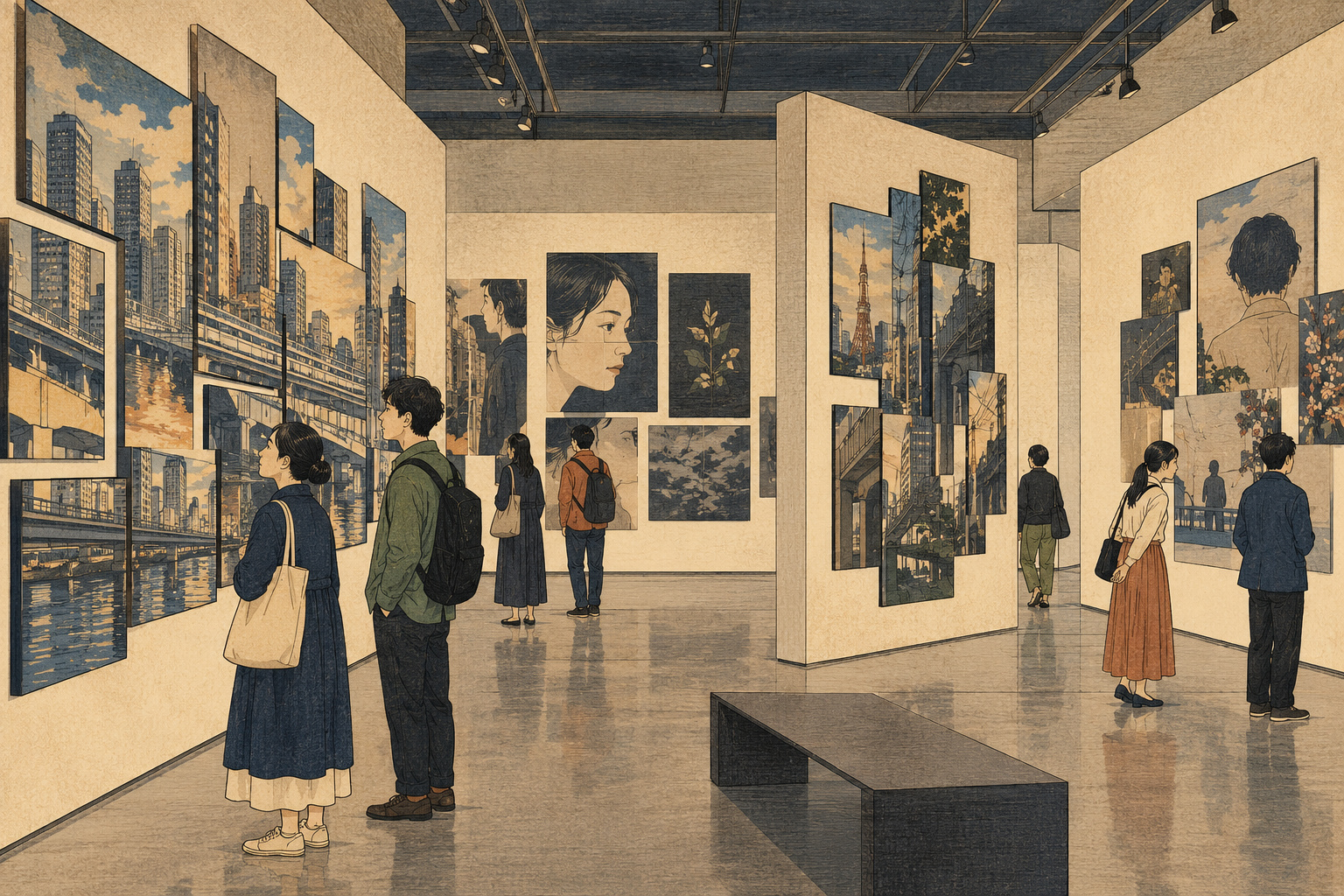
A photograph can begin as a record and become the material for another image. At Tokyo Photographic Art Museum, five artists approach that transformation through objects, software, light and moving-image production. Their methods offer a useful question for a world crowded with pictures: what happened between the source material and the image now asking for our attention?
Scheduled for September 30, 2026–January 17, 2027, Assembling Anew: Memories, Materials, Context, Technology is the 23rd edition of the museum’s Contemporary Japanese Photography series. It brings together Sayuri Ichida, Taro Karibe, Zai Nomura, Baku Hashimoto and Asako Fujikura in the third-floor gallery.[1],[2]
An institution with room for a changing medium
The museum’s own history begins with an initial facility in June 1990, followed by the full opening at Yebisu Garden Place on January 21, 1995. Photography and moving images belonged to its remit from the beginning. The emerging-artists series started in 2002.[1],[3]
That background matters because the current exhibition extends well beyond framed photographic prints. The artists have established practices and previous projects; “emerging” here should not be confused with making a first public appearance. The interest lies in bringing different ways of constructing images into conversation.
Sayuri Ichida: the surface remembers
Photoworks, which supported Ichida’s Kūseki, describes the project in relation to Japan’s declining population and empty schools. It brings together photography, collage, sound and sculptural installation. The school is both an architectural subject and a place whose purpose depended on people gathering there.[4]
For Tokyo, the museum announces an installation that reconstructs fragments of school buildings through silkscreen printing on blackboards, presented in Japan for the first time. The choice of surface is therefore part of the work’s meaning, not merely a way to mount an image.[1]
A blackboard invites writing and erasure. Placing an image of school architecture on it allows memory and disappearance to occupy the same surface. One way into the work is to ask what changes when a photograph moves from paper to something already associated with instruction, repetition and generations of classroom use.
Taro Karibe: when noise becomes scenery
Karibe’s account of Aim an Arrow at the Rock in the Ocean describes photographing deliberately generated glitches on an LCD television, then feeding those images into an AI-equipped landscape recognition system. The process produces invented scenery from material that did not begin as a view of a landscape.[5]
The operation makes recognition itself a subject. A viewer may search for a shoreline or rocky form in an ambiguous image, just as the system has been steered toward a landscape interpretation. The result invites attention to the act of assigning meaning, rather than simply to whether the picture looks convincing.
This is an artistic proposition, not scientific proof that human and machine cognition work identically. Its practical force is more immediate: when we identify something in an image, how much of that recognition follows from the image, and how much from expectation? Reading a title before looking can already change the answer.
Zai Nomura: recording the loss of a record
Nomura’s practice includes burning old portrait photographs and recording their flames through long exposure. Shiseido Gallery’s account of his 2024 art egg award places that process alongside other works concerned with remembering and recording the traces of human existence.[6]
The Tokyo exhibition returns to the transformation of collected portraits into recorded light. Here the source photograph is not preserved intact. Its destruction becomes the event from which another image is made.[1]
The distinction creates an uncomfortable, productive distance between a person, their portrait, the physical print and the new picture. These are connected, but none is interchangeable with the others. Looking can become an exercise in asking what a transformation retains and what it makes impossible to recover.
Baku Hashimoto: the apparatus enters the picture
Hashimoto’s earlier Milling Stop-Motion project, described on his site in 2022, used practical stop-motion production and a CNC milling machine for a Vice TV ident. It provides context for an approach in which designing tools and manipulating material belong to making the image.[7]
For the museum, a new installation using his own devices is announced, together with public production during the exhibition period. The earlier commercial project is not evidence of the exact equipment or finished arrangement in this new work.[1]
Showing a process can change how an audience understands movement. What appears continuous on a screen has been assembled through separate decisions and operations. Attention shifts toward what the tool makes possible, what its limits require and where the maker intervenes. Technical knowledge need not remove a work’s surprise; it can relocate that surprise to the choices that produced it.
Asako Fujikura: the city as an arrangement
Fujikura’s biography describes a practice centered on infrastructure running through urban and suburban spaces, often using 3DCG animation. Her interests include logistics and the spaces that develop around organized systems of movement.[8]
A separate collaborative project with Takahiro Ohmura, Fixing Garden, arranges research materials in an imagined digital terrain while developing a relationship with the proposed repair of a real vacant house and its surroundings. It is useful background to her practice, not a claim that this project is included in the Tokyo show.[9]
The announced exhibition installation uses live-action footage, CG and AI to construct a fictional city and society. A fruitful question is therefore how its world is arranged: what sits beside what, what seems connected and what kinds of life those connections suggest.[1]
An invented city need not be read only as an escape from an actual one. It can provide a place to notice assumptions about how cities are organized. A convincing surface is one part of that encounter; the relations between spaces are another.
A longer history than generative AI
Photographic reconstruction has a substantial history before digital tools. The Metropolitan Museum of Art’s 2012–13 exhibition Faking It traced manipulation from the 1840s onward through techniques including photomontage, combination printing, overpainting and retouching. Some early photographers combined separate negatives for land and sky to overcome technical limits.[10]
That history provides context without flattening differences between methods. Combining negatives, photographing a burning print and generating an image from a model are different operations with different relationships to a source. Calling all of them “altered” is only the beginning of an explanation.
Nor does the history imply that every photographic claim deserves equal distrust. An artwork that makes its construction part of the encounter and a news photograph offered as evidence establish different expectations. Asking about origin, process and context helps preserve that distinction.
A visit built around a second look
Regular hours are 10 a.m.–6 p.m., extending to 8 p.m. on Thursdays and Fridays, with final admission 30 minutes before closing. Adult admission to this exhibition is ¥700. Monday closures have holiday exceptions; the exhibition page specifies a December 28–January 1 year-end closure. Check that page for concessions, free dates and public-production information.[1],[11]
A useful approach is to look before reading the explanation, then return to the same work with its process in mind. What changed? The image itself may be unchanged, while a detail acquires a different significance because its source or material has become clear.
That second look is the exhibition’s most portable invitation. It offers a way to carry curiosity beyond the gallery: not merely asking what a picture shows, but noticing how it was made to show it—and what we supplied while looking.
