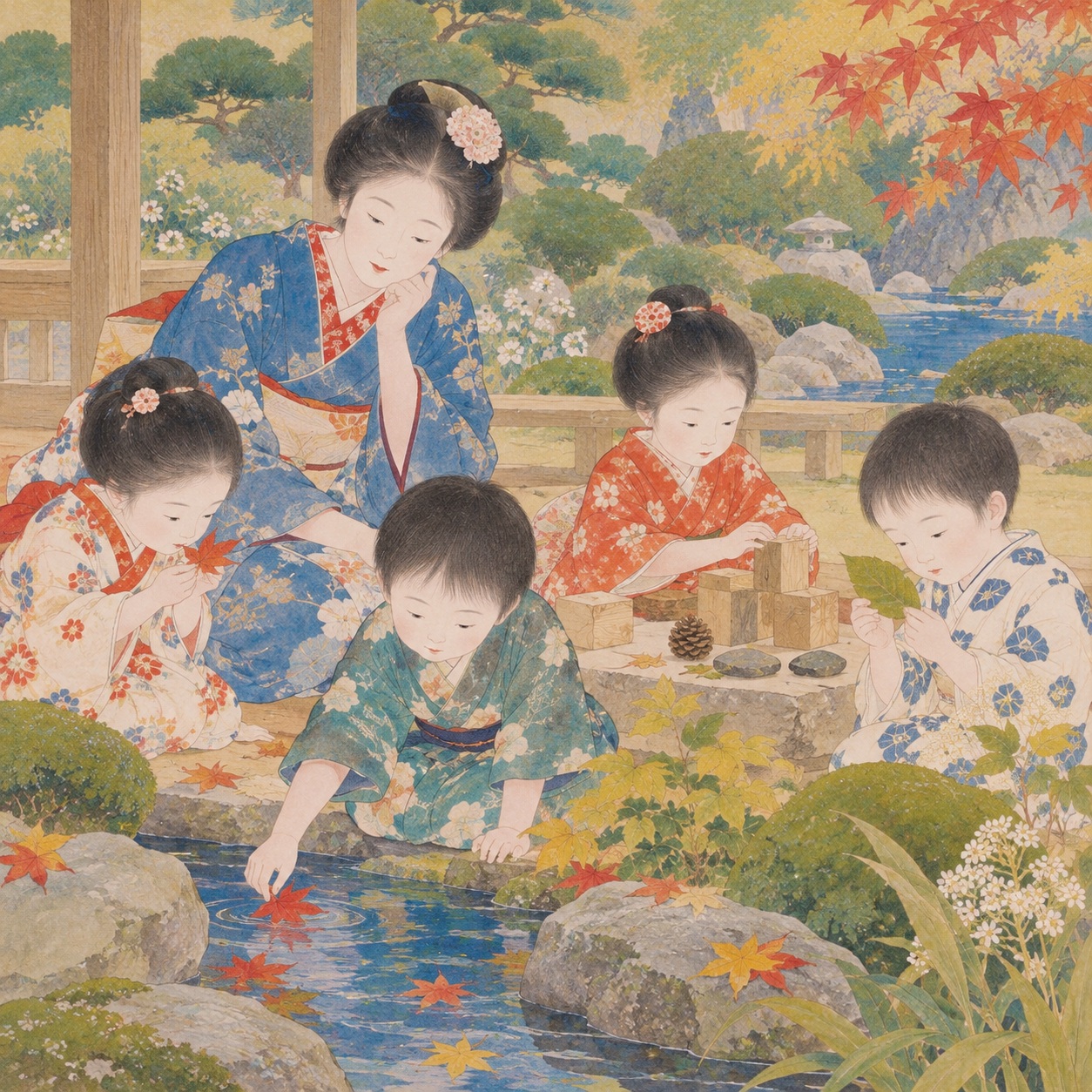
“Inquiry learning” can sound oddly formal when applied to three-year-olds. Tokyo’s version begins with something simpler: a child notices light reflecting in water, compares the feel of wet and dry soil, experiments with sound, becomes absorbed in a picture book, or asks a question an adult did not plan.
The Tokyo Sukuwaku Program is designed to help early-childhood educators turn those moments of curiosity into sustained exploration without turning preschool into an early version of elementary school. On September 25, Tokyo announced the program’s first symposium and disclosed a striking scale: about 3,400 kindergartens, nursery schools and other centers implemented the program in fiscal 2025. The first year of citywide rollout, FY2024, involved 1,591 centers. Participation therefore more than doubled in a year.[1][4]
“Sukuwaku” combines growing and wondering
The name combines two Japanese ideas: sukusuku, growing healthily, and wakuwaku, the excitement of curiosity. Tokyo describes the program as a common framework across institutional categories—kindergartens, nursery schools, certified centers and other early-childhood settings—rather than a curriculum limited to one administrative system.[2][3]
That cross-system design matters in Japan. Kindergartens and nursery schools developed historically under different administrative and professional frameworks. Certified child centers have blurred those boundaries, but differences in governance, staffing and funding remain. Sukuwaku tries to place the child’s exploratory activity above those institutional distinctions.
The adult frames the environment, not the answer
Tokyo’s portal gives examples of inquiry themes such as light, color, mud, sound, nature and picture books. The process includes choosing a theme, thinking about questions, designing the environment, carrying out and recording activities, then reflecting and sharing.[2]
The idea is not to teach elementary-school science early. Young children already compare, test, repeat, negotiate and revise their ideas through play. The educator’s role is to notice those processes and create conditions in which they can deepen.
Tokyo links that work to what it calls non-cognitive capacities: self-esteem, motivation, persistence, empathy, consideration for others and cooperation. Those are important goals, but also difficult to measure. A program can document rich classroom activity without automatically proving that a particular intervention caused a durable change in those capacities.
Participation rose from 1,591 to about 3,400 centers
The program was formulated in March 2024 and began Tokyo-wide rollout in FY2024. That first year involved 1,591 centers. In October 2025, Tokyo said more than 2,750 centers were expected to participate during that fiscal year. The September 2026 announcement now gives the FY2025 result as about 3,400—well above the earlier plan.[1][4]
Rapid growth is a policy achievement, but it changes the management problem. A program involving hundreds of centers can be supported relatively directly. A program involving thousands needs scalable training, documentation, peer support and quality control.
Navigator centers turn expansion into peer learning
Tokyo responded by creating Sukuwaku Navigator centers in 2025. The first 35 were selected in December, another 20 in January 2026, and later rounds continued. By the fourth round in March, 106 centers had been selected in total.[4][5]
Navigator centers host visits, share practices and advise other participating centers. Their activities are gradually being posted on the Sukuwaku portal.[6]
This is a sensible design for a form of education that cannot be standardized by script. A mud-play inquiry in one center cannot simply be photocopied into another with a different yard, age mix or staffing pattern. What can travel are methods of observation, questioning, environmental design and reflection.
Tokyo funds time, not just materials
The program is supported by subsidies rather than rhetoric alone. For eligible institutions, Tokyo’s rules provide up to ¥1.5 million per facility at a 100% subsidy rate. Covered expenses can include supplies, equipment, travel, outsourcing, training and, under relevant schemes, wages and allowances for non-regular staff.[7][8]
That is more important than it may sound. Inquiry-based practice requires educator time: observing children, documenting what happened, discussing interpretations with colleagues and redesigning the environment. A policy that merely says “do more inquiry” without creating time or staffing can become another unpaid obligation for already-stretched childcare workers.
One-off science days do not qualify
The subsidy rules also require continuity. Participating centers must conduct inquiry activities over multiple months, take part in Tokyo training, submit implementation and activity reports, and publish activity reports through their websites or similar channels. A single annual event is not enough.[8]
That condition is intended to make inquiry part of everyday practice rather than a showcase event. But documentation has its own risk: if evidence collection becomes an administrative exercise, it can consume the same educator time the program is trying to free.
Why the University of Tokyo connection matters
Tokyo developed the program in cooperation with the Center for Early Childhood Development, Education, and Policy Research (CEDEP) at the University of Tokyo’s Graduate School of Education. The center’s role connects developmental research, practice and public policy.
The value of that partnership will ultimately depend on whether implementation data can feed back into training and policy improvement. Academic affiliation alone does not validate a program. What matters is whether evidence from thousands of classrooms helps Tokyo distinguish between practices that are engaging, practices that are sustainable and practices that actually improve the quality of early-childhood education.
The first Sukuwaku symposium, announced September 25, is explicitly framed as a venue to share what has been learned so far and improve early-childhood education and care.[1]
3,400 centers do not make this a randomized experiment
The scale is impressive, but the language matters. Tokyo is not running a randomized controlled trial across 3,400 centers. It is implementing a policy at large scale.
Those are different achievements. Large-scale implementation can generate rich practice data, professional networks and examples. Demonstrating causal impact would require different evaluation designs: before-and-after measures, comparison groups, adjustment for differences in families and institutions, and clearly defined outcomes.
The next policy question is not simply how many centers join, but which practices work, for whom, under what conditions—and whether they last after subsidies end.
Inquiry should not become accelerated schooling
Another risk comes with success. As “inquiry” becomes a policy label, adults can accidentally turn open-ended play into a performance requirement.
For a young child, lining up stones, changing the water content of mud, chasing a shadow or testing which object makes a louder sound can already be serious inquiry. The goal is not to force a polished presentation or arrive rapidly at the “correct” explanation. It is to preserve the cycle of noticing, trying, revising and sharing.
If expansion creates pressure for photogenic projects, formal outcomes or excessive documentation, the policy could undermine the child-led quality it was designed to support.
The next metric is quality, not scale
FY2024: 1,591 centers. FY2025: about 3,400. As an expansion story, Sukuwaku has moved quickly.
But a mature program will need different measures. Did educators change how they observe children? Are children sustaining inquiry for longer periods? Do outcomes vary by institution type or neighborhood? Does practice continue when subsidies end? Is reporting workload manageable? Are Navigator centers improving weaker programs or mainly showcasing strong ones?
Tokyo’s creation of peer-learning networks and its first symposium suggest that the policy is already entering that second phase.
The hardest thing about institutionalizing curiosity is that too much structure can crush it, while too little support lets it disappear under everyday workload. Tokyo is now trying to manage that tension across roughly 3,400 early-childhood settings at once.
Sources
- Tokyo Metropolitan Government: first Sukuwaku symposium announcement, Sept. 25, 2026
- Tokyo Sukuwaku Portal: program overview
- Tokyo Office for Children Policy Coordination: Sukuwaku promotion program
- Tokyo: first Sukuwaku Navigator centers
- Tokyo: fourth round of Sukuwaku Navigator centers
- Sukuwaku Portal: Navigator-center activities
- Tokyo Bureau of Citizens, Culture and Sports: FY2026 subsidy materials
- Tokyo subsidy rules: up to ¥1.5 million per facility, 100% subsidy rate
