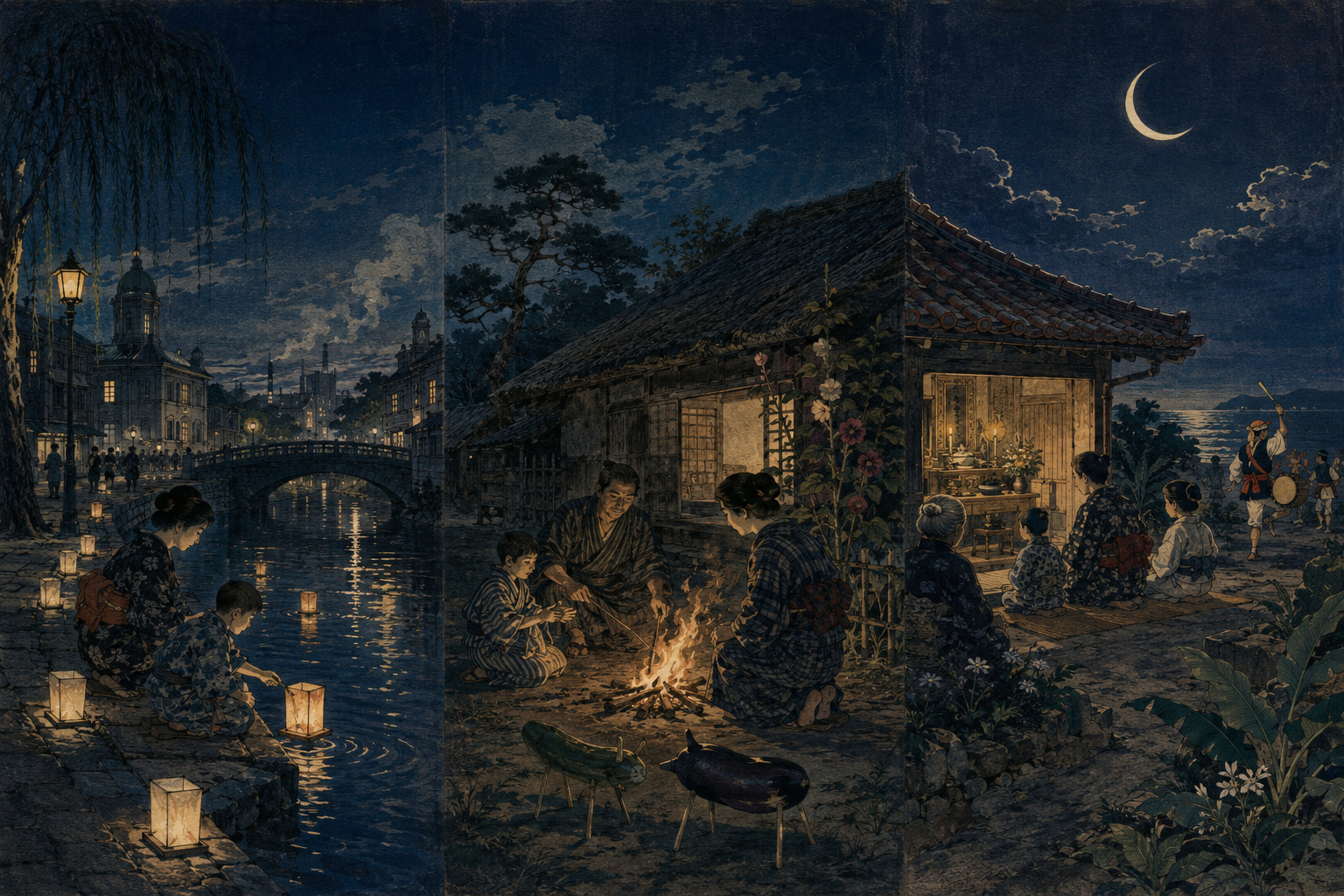
On the evening of August 15, three Japans can occupy the same moment. In much of the country, a family may be halfway through Obon: incense has been lit, the grave cleaned, food placed before a household altar, and the return journey already discussed. In parts of Tokyo and other July-Bon communities, those observances ended a month earlier. In Okinawa, the most important nights are still ahead. Ancestors will be welcomed on August 25 and sent back on August 27.
No national authority assigns these families to three different pasts. They are living inside three answers to a question created in the nineteenth century: when the state changes its calendar, what should a community preserve—the written date, the season around it, or the moon that once defined it?
The answer matters because Obon is not merely an entry in an almanac. It is a choreography of return. The dead are imagined as coming close; the living cross cities and prefectures to meet them. Graves, altars, lanterns, dances, gifts, food and transport schedules all gather around a few days. Move those days and the entire social landscape moves with them.
Before Three Calendars, There Was the Fifteenth Day
The deep history begins long before railways, paid summer leave or the word “homecoming rush.” Obon developed from the Buddhist Ullambana observance, known in Japanese as Urabon-e. A Chinese Buddhist scripture tells of the monk Maudgalyayana—Mokuren in Japanese—seeking relief for his suffering mother by making offerings to the monastic community. In Japan, the rite joined older and broader practices of honoring the dead and sustaining relationships with ancestors.
The documentary trail reaches into Japan’s ancient court. A 606 entry in the Nihon Shoki says that feasts or offerings were to be established at temples on the eighth day of the fourth month and the fifteenth day of the seventh. The term Urabon-e appears explicitly in a 657 account of a ceremony west of Asuka-dera. In 659, temples in the capital were ordered to lecture on the Ullambana Sutra for the benefit of “parents of seven generations.” By the Nara period, the observance had become a regular court Buddhist event.
Those early ceremonies were not identical to a modern household Obon. Over centuries, temple liturgy, memorial rites, local beliefs about ancestral spirits, seasonal gatherings and community performance met one another. The result was not one standardized national ritual but a family of practices: welcoming fires and sending fires; lanterns; graveside visits; offerings; Bon odori; and ceremonies in which water, flame, drums or boats carry the dead away again.
Yet beneath that diversity stood a shared calendrical anchor: the middle of the seventh month. Before 1873, “the seventh month” did not mean July as printed on today’s wall calendar.
The Calendar Was a Model of the Sky
Japan’s premodern calendars were lunisolar. The new month began with a new moon. Because the interval from one new moon to the next averages about 29.5 days, months alternated between 29 and 30 days. Twelve such months make roughly 354 days—about eleven days short of the solar year. To keep the calendar from wandering away from the seasons, an intercalary month was inserted from time to time.
This meant that old seventh-month Obon moved against the modern Gregorian calendar. It usually arrived in what now feels like late summer, under a moon approaching fullness. The date was lunar, but the experience was also seasonal: heat, fields, insects, night air and the agricultural year formed part of the setting.
The old system was sophisticated, not simply “inaccurate.” It coordinated the moon with the solar seasons through rules refined across centuries. But it was complex, and it differed from the Gregorian calendar increasingly used in diplomacy, trade and science. The Meiji government, determined to reorganize the state and signal that Japan operated within an international system, chose a dramatic solution.
The Winter When Most of a Month Disappeared
On November 9 in the fifth year of Meiji—late 1872—the government announced that Japan would abandon its lunisolar calendar and adopt the solar calendar. The order defined a 365-day year, twelve months, a leap year every four years and a 24-hour day. Most startlingly, it declared that the day after old-calendar Meiji 5, twelfth month, second day would not be the third. It would be January 1, Meiji 6: January 1, 1873.
The public had only about three weeks to absorb the change. A diary preserved by the National Diet Library catches the rupture with remarkable economy. On December 31, 1872—the old calendar’s final day—statesman Shishido Tamaki wrote that the lunisolar calendar ended there. The next day he recorded the first use of the solar calendar.
The reform made sense to a government building railways, ministries and international relations. The National Astronomical Observatory notes that the Gregorian system was simpler in its treatment of leap years, stayed close to the solar seasons and was useful in dealings with other countries. But administrative logic did not instantly reorganize custom. Old-calendar dates continued to appear alongside the new calendar in official almanacs until the early twentieth century because people still needed them.
Every festival tied to the old calendar now faced a choice. Tanabata could become July 7 even when the Milky Way lay behind the rainy season, or it could be observed later. New Year could follow January 1, while some seasonal practices lingered. Obon’s old seventh-month center posed an especially intimate problem: should “seventh month, fifteenth day” become July 15, should it be delayed by roughly one month to recover its late-summer setting, or should it continue to be calculated as the old seventh lunar month?
606 The Nihon Shoki records temple offerings on the fifteenth day of the seventh month.
657 An Urabon-e ceremony is recorded near Asuka-dera.
659 Capital temples lecture on the Ullambana Sutra for ancestors.
1872, November 9 The Meiji government announces adoption of the solar calendar.
1873, January 1 The new calendar takes effect; the preceding day had been the old twelfth month’s second day.
Today July Bon, August Bon and lunar Obon remain active regional choices.
First Answer: Keep the Seven
The most literal response was to preserve the date’s written form. If Obon had belonged to the seventh month, it would still belong to July. This produced July Bon, generally centered on July 15 and commonly observed from July 13 to 16. It took root in parts of Tokyo and in a scattered set of urban, temple and regional communities elsewhere.
“July Bon” is safer than calling it shin-bon, or “new Bon.” The same Japanese sounds can refer to the first Obon after a person’s death, usually written with a different character and also read niibon or hatsubon. Calendar vocabulary becomes confusing precisely because custom was not redesigned from one central office.
Why did July persist strongly in some cities? There is no single mechanism that explains every neighborhood. Government offices, commercial schedules and urban institutions adjusted early to the new calendar, and communities connected to them could retain the familiar number 7 without waiting for an astronomical conversion. Temples and households then reproduced that decision year after year. Once priests’ rounds, market supply, family expectations and neighborhood ceremonies settle around a date, custom builds its own infrastructure.
July Bon should not be reduced to “Tokyo versus the countryside.” The official history museum in Arita, Saga Prefecture, for example, explains that the town observes July Bon even though many surrounding areas associate Obon with August. Ritual geography is granular. A city, a former castle district, an island, a temple parish or even a household lineage may keep a calendar different from the wider prefecture.
Second Answer: Keep the Season
For much of Japan, the durable answer was to delay the modern-calendar date by one month. August 13 to 16 became tsuki-okure Bon—month-late Bon. It kept the familiar 13-to-16 sequence while restoring the observance to a time closer to the old lunar seventh month.
Agriculture is central to the usual explanation. Fixed Gregorian July could collide with demanding work in the fields and with the end of the rainy season. A month’s delay brought the rites closer to a traditional late-summer pause. But agriculture should not be treated as a universal switch that every village flipped at once. Local temple networks, school calendars, transport, employer leave and the movement of people into cities all reinforced the August pattern over time.
Modern Japan made August Bon visible on a national scale. Factories close, offices thin out, trains fill, expressways slow, air fares rise and metropolitan neighborhoods briefly empty. Yet Obon is not one of Japan’s sixteen statutory national holidays. The great pause is created by custom and institutional coordination rather than a single holiday law. That distinction helps explain both its power and its unevenness: a company can close, a shop can remain open, a municipality can follow one calendar, and a family inside it another.
The result is a ritual date supported by an economic migration system. “Going home for Obon” now sounds as natural as the rite itself. The living reproduce the August calendar each time they reserve a seat, prepare a guest room, buy flowers, clean a grave or tell children which train they must catch.
Third Answer: Keep the Moon
Okinawa preserved a different principle: the observance remains tied to the thirteenth through fifteenth days of the seventh lunar month. Its Gregorian dates therefore change each year. In 2025, Okinawa’s Obon fell in early September. In 2026, it arrives earlier, from August 25 to 27.
The Okinawa Prefectural Archives describes these three days as one of the islands’ most important annual observances. The first day is Unkē, when ancestors are welcomed. The second is Nakanuhi, the middle day. The last is Ūkui, when relatives gather at the house containing the family altar and send the ancestors back. Gifts and food move through kinship networks; the calendar is experienced through obligations among the living as much as through rites for the dead.
Lunar observance also survives in parts of Amami and on other islands, often alongside highly local performing traditions. Cabinet Office descriptions of border-island festivals note rites pegged to old-calendar dates, including the Boze visitation on Akusekijima on the sixteenth day of the seventh lunar month. Here the calendar is not an antique notation. It determines when masks appear, drums sound and a community recognizes the proper night.
Okinawa makes the moon’s role especially legible, but “lunar Obon” should not be presented as one identical Ryukyuan ceremony. Islands and districts differ. Nor does using a smartphone calendar erase the old one. Modern Okinawan calendars often print lunar dates because work, shopping, travel and family preparation still depend on them.
| Obon calendar | 2026 dates | What it preserves | Common description |
|---|---|---|---|
| July Bon | July 13–16 | The old month number—seven—on the Gregorian calendar | Parts of Tokyo and scattered local communities |
| Month-late August Bon | August 13–16 | A fixed schedule closer to the old late-summer season | The most widespread observance in Japan |
| Lunar Obon | August 25–27 in 2026 | The thirteenth to fifteenth days of the seventh lunar month | Okinawa and some other island communities |
One Word, Several Meanings
The language around Obon can hide the three-calendar system. Kyū-bon, “old Bon,” is sometimes used for fixed August Bon because it approximates the old season. In Okinawa it more strictly means Bon calculated by the old lunar calendar. Shin-bon can mean July Bon, but a near-identical word can mean a recently deceased person’s first Obon. The cleanest reporting terms are therefore July Bon, month-late August Bon and lunar-calendar Obon.
Even the familiar four-day sequence is not universal. Many mainland observances describe August 13 as the welcoming day, the 14th and 15th as the time ancestors remain, and the 16th as the sending day. Okinawa’s principal sequence runs for three days, ending on the lunar fifteenth. A date table can orient the visitor, but it cannot replace asking a family or temple how that place observes.
- Ask which calendar the household, temple or community follows; do not infer it only from the prefecture.
- Use “July Bon,” “month-late August Bon” and “lunar Obon” when precision matters.
- Remember that a grave visit is not a tourist performance. Follow local rules on photography, fire, offerings and access.
- For Okinawa, check that year’s lunar dates rather than copying the previous year’s Gregorian dates.
What the Three Dates Reveal About Japan
It is tempting to treat the calendar split as historical clutter that modernization failed to clear away. The opposite is more revealing. The three Obons show how modernization actually works: a national rule changes the frame, but communities decide how inherited meaning will fit inside it.
July Bon preserved textual continuity. August Bon preserved seasonal and practical continuity. Lunar Obon preserved astronomical and ritual continuity. None is simply the original untouched form. July translated the old numeral into a new calendar. August created a regular one-month delay rather than recalculating the moon. Okinawa continues a lunar calculation in a society whose schools, flights and businesses otherwise run on Gregorian time. Each tradition is an adaptation, and the adaptation became heritage.
That is why the dates carry regional identity. A person can discover that a spouse’s family “does Obon” in another month. A migrant can return to an August hometown after completing July rites in Tokyo. An Okinawan shopkeeper can plan for the late-August Ūkui while national media speak as though Obon ended on August 16. The calendars reveal overlapping Japans rather than a clean national-local divide.
They also reveal that memory requires logistics. Ancestors may be spiritual presences, but their return depends on material work: cleaning, cooking, buying, driving, booking, arranging time away from employment and keeping track of the correct night. A calendar survives when people repeatedly organize life around it.
August 15, 2026: The Middle of One Obon, Between Two Others
Today’s edition appears on the central day of the most widely observed August Bon. July-Bon lanterns have long been put away. In Okinawa, preparations for Unkē are still gathering pace. The same country is therefore after Obon, inside Obon and before Obon at once.
That apparent contradiction is the real story. Calendars look like neutral grids, but they distribute labor, worship and belonging. The Meiji state could announce that one day would follow another under a new name. It could not command every field, temple, household and memory to experience summer in the same way.
More than a century and a half later, the three calendars remain less a failure of standardization than a record of negotiation. A number survived in July. A season survived in August. A moon survived in Okinawa. Across all three, the purpose remained recognizable: make a place at home, bring the family near, remember the dead and then let them go.
Reporting Notes and Principal Sources
This article uses public information checked through August 14, 2026 at 7:04 AM JST. Regional labels are descriptive, not statutory boundaries. The 2026 Okinawa dates correspond to the thirteenth through fifteenth days of the seventh lunar month; the conversion was checked against current calendar references and National Astronomical Observatory lunar data.
- National Archives of Japan: Adoption of the solar calendar in November 1872
- National Diet Library: Shishido Tamaki’s diary on the last day of the lunisolar calendar
- National Astronomical Observatory of Japan: Calendar reform and modernization
- National Astronomical Observatory of Japan: What the “old calendar” means
- National Astronomical Observatory of Japan: August 2026 lunar data used to check the old-calendar conversion
- Nara National Research Institute for Cultural Properties, Asuka Historical Museum: Ancient Obon and Urabon-e
- Okinawa Prefectural Archives: Lunar Obon, Unkē, Nakanuhi and Ūkui
- Arita Town History and Folklore Museum: Why Arita observes Obon in July
- Cabinet Office: Old-calendar island festivals and Bon traditions
- Government of Japan: The sixteen national holidays in 2026