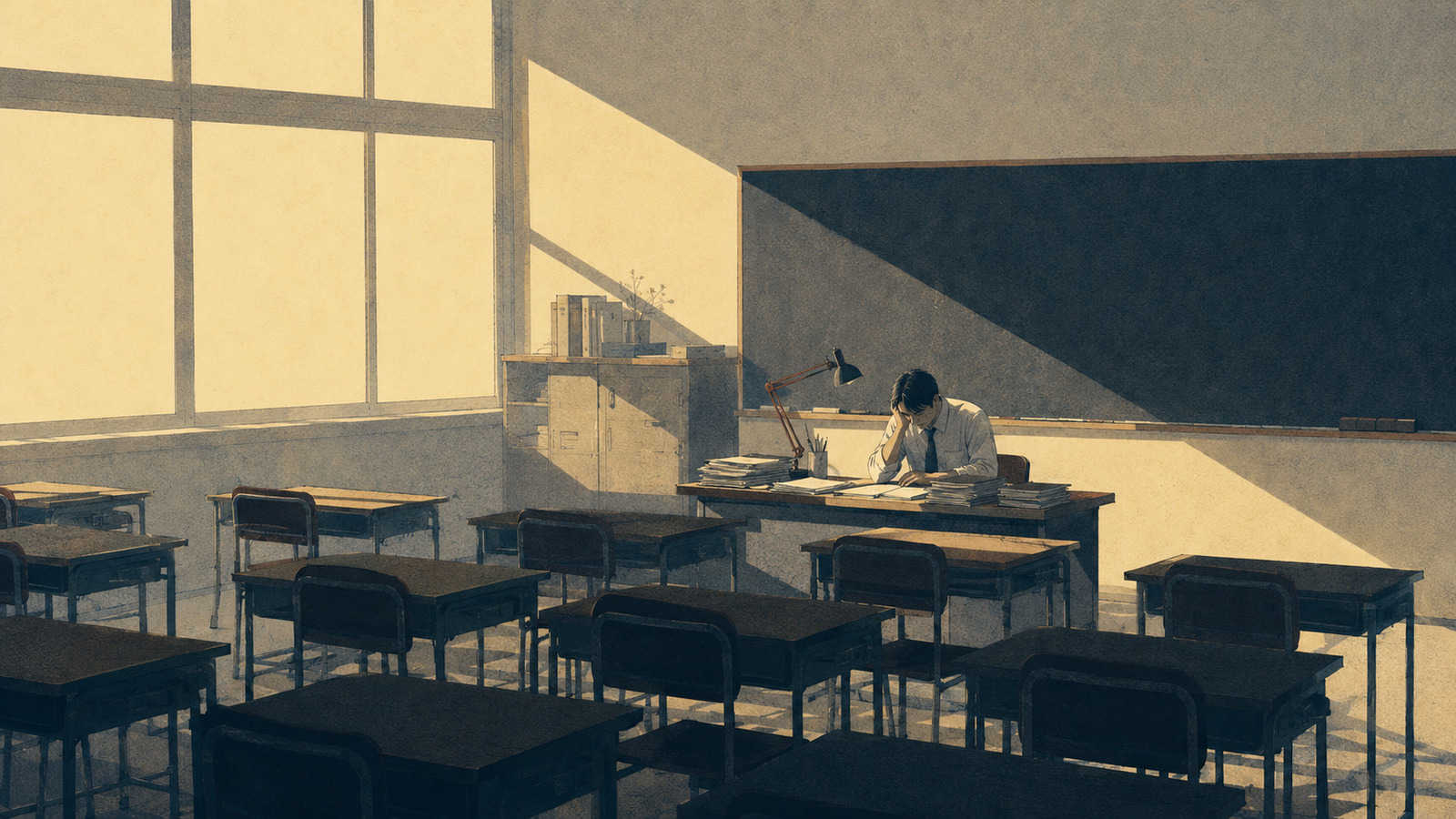
A classroom enters a second day after its children go home. Desks must be straightened, a parent called, the attendance record of a missing child reviewed and tomorrow’s materials prepared. Long after the corridor lights go dark, survey forms and school-management documents remain open on staff-room screens. In Japan, a teacher’s work has never ended with the last bell.
At the far end of that long day sits a brutal new statistic. In fiscal 2024, 1,319 teachers at public elementary, junior-high and high schools left their jobs because of mental illness, according to an interim report from the Ministry of Education’s School Teacher Statistical Survey. The total was 369 higher than in the previous 2021 survey—a 38.8 percent rise—and exceeded 1,000 for the first time. It represented roughly 8.5 percent, or almost one in twelve, of the 15,540 departures excluding mandatory retirement.
These were not people recorded as merely tired or dissatisfied. Mental illness was entered as the reason their employment ended. Their cases had passed beyond treatment, temporary leave or reassignment to the point of departure. Yet 1,319 is not the full number of teachers in distress. It excludes many who recovered and returned, those who left under another recorded reason, those whose condition was never disclosed, and those still working while unwell. It is not the boundary of the crisis. It is a lagging indicator of people the system ultimately lost.
Two Numbers That Must Not Be Confused
The new total of 1,319 comes from the School Teacher Statistical Survey, conducted once every three years, and counts departures. By school level, 801 were elementary teachers, 365 worked at junior highs and 153 at high schools. Every category set a record. Elementary departures rose by 232 from 2021 and reached 2.4 times the 331 recorded in 2015. Junior-high departures rose by 88 and high-school departures by 49.
A second number often appears in coverage of the same crisis: 7,087. That is the number of public-school education personnel placed on sick leave because of mental illness during fiscal 2024 in a separate annual personnel survey. Its population is broader, covering 922,776 teachers, principals, nurses, lecturers and other education staff at elementary, junior-high, high, secondary and special-needs schools. The 7,087 represented 0.77 percent of that workforce. It was 32 below the record 7,119 in fiscal 2023, but the rate remained unchanged.
The two figures cannot be added or treated as the same cohort. Their coverage, definitions and survey cycles differ. Read together, however, they describe stages in a pipeline. A teacher becomes unwell and takes leave. Some receive treatment and return. Some experience repeated or extended absences. Some eventually leave. A high plateau of sick leave combined with a sharp record in permanent departures suggests that schools are struggling not only to let people recover, but to retain them afterward.
1,319 counts public elementary, junior-high and high-school teachers whose recorded reason for leaving in fiscal 2024 was mental illness. 7,087 counts mental-health sick leave among a wider public-school workforce in the same year. The populations differ and may overlap, so they must not be combined.
An Alarm That Has Been Ringing Since 2002
Japan’s teacher mental-health crisis did not suddenly begin in 2024. Ministry records show mental-illness sick leave rising from 2,687 cases in fiscal 2002 to 5,400 in 2008. In fiscal 2011, 5,274 education personnel were on such leave, accounting for 61.7 percent of all sickness absences. In 2013, the ministry issued a major report calling for prevention, early detection, return-to-work programs and measures against relapse.
The count settled onto a plateau, but the problem never disappeared: 5,009 in fiscal 2015, 5,478 in 2019 and 5,203 in 2020. It then accelerated—5,897 in 2021, 6,571 in 2022 and a record 7,119 in 2023—before remaining at 7,087 in 2024. That latest level was 2.6 times the 2002 total.
Part of the increase may reflect better recognition of mental illness and a reduced, though still formidable, stigma around taking leave. An employee receiving treatment instead of being forced to work is not evidence of failure. But recognition alone cannot explain a high leave rate occurring alongside record departures. The machinery creating strain appears to be moving faster than the machinery designed for recovery.
The Longest Week in International Education
In the OECD’s Teaching and Learning International Survey 2024, full-time lower-secondary teachers in Japan reported working 55.1 hours in a normal week. That was 3.9 hours less than in 2018, but more than fourteen hours above the OECD average of 41.0 and still the longest among participating systems. Japanese elementary teachers reported 52.1 hours, compared with a 40.4-hour average among participating primary systems.
The structure of the week matters as much as its length. Japanese lower-secondary teachers reported 17.8 hours of classroom teaching, below the OECD average of 22.7. But they spent 5.2 hours on general administrative work, against an OECD average of 3.0, and 8.2 hours preparing lessons, against 7.4. School management, student counseling, parent communication, extracurricular activities and meetings filled more of the calendar. The popular explanation that Japanese teachers work long only because they teach so devotedly misses where the time goes.
In the same survey, 63 percent named excessive administrative work as a major source of stress, 56 percent cited addressing parent or guardian concerns, and 43 percent cited keeping up with changing government requirements. Twenty-seven percent experienced a lot of work-related stress, while 14 percent said the job harmed their mental health a lot. Among teachers under 30, one in five intended to leave teaching within five years. The departure count may be the future tense of those survey answers turning into the past.
How “Teacher” Came to Mean Almost Everything
Japan’s postwar school developed as more than a place for academic instruction. A homeroom teacher monitors health, behavior and friendships; supervises lunch and cleaning; communicates with families; organizes ceremonies and trips; and guides a child’s life inside the institution. At junior highs, teachers have long carried responsibility for sports and cultural clubs after school and on weekends. This density helped create cohesive schools and deep public trust. It also left the limits of the job dangerously indistinct.
Each new social challenge gave schools another function. Teachers respond to bullying and chronic absenteeism, support disabilities and special educational needs, detect abuse, manage allergies, prepare for earthquakes, prevent crime and mediate online conflict. The pandemic added infection control and remote lessons. Its aftermath left one-device-per-student management, digital materials, online family communications and new data systems. New work arrives much faster than old work disappears.
The Ministry of Education now says that school commuting supervision, night patrols, fee collection and coordination with community volunteers should generally be done outside the school. It says surveys, recess monitoring, cleaning, club activities, meal supervision, printing, grading support and event preparation can be shared with administrators, aides and communities. The government’s need to classify these tasks into three categories is itself an admission that teaching’s perimeter expanded beyond control.
The 1971 Bargain and Time Without a Price
At the institutional foundation of long hours is the 1971 Special Measures Act for public-school teacher pay, commonly called the Gakkyū Tokubetsu-hō or Special Pay Act. In principle, public teachers are not to be ordered to work overtime. Formal overtime orders are restricted to four categories, including practical training, school events, staff meetings and emergencies. In exchange, teachers historically received a flat four percent salary adjustment rather than overtime or holiday pay.
The four percent was rooted in a 1966 workload survey. Yet lesson preparation, grading, parent communication and club supervision were often treated not as formally ordered overtime but as work undertaken through professional “voluntariness.” The school needed the task; the accounting system avoided naming it overtime. Once time is separated from price, an organization loses one of the strongest incentives to eliminate unnecessary work.
A law passed in 2025 will raise the adjustment gradually to 10 percent by fiscal 2030, beginning with an increase from four to five percent in January 2026. Better pay is necessary, especially as Japan competes for graduates. But five percent does not turn a 55-hour week into a healthy one. A larger flat payment does not remove a single report or provide a substitute for one absent teacher. It can even be misunderstood as an all-inclusive price for continued overwork.
Why 801 Elementary Teachers Left
Elementary teachers accounted for about 61 percent of the new departure total. Most teach many subjects while serving as the central adult for one class. They track students’ daily lives, field family concerns and have fewer open periods than subject teachers at secondary schools. When a homeroom teacher is absent, finding someone who can reproduce the whole role at short notice is exceptionally difficult. Principals, specialist teachers and neighboring homeroom teachers fill the gap.
Special-needs enrollment has also grown rapidly. The ministry reports that students in special-needs classes rose from about 201,000 in fiscal 2015 to nearly 420,000 in fiscal 2025. Much of that reflects overdue access to support. It also creates demand for specialists and aides, while ordinary classrooms must respond to wider ranges of need. The attention, documentation and family coordination placed on each homeroom teacher increase accordingly.
The rise from 331 elementary departures in 2015 to 801 in 2024 should not be read as a decline in teachers’ resilience. It is better read as a homeroom-centered system running without slack. If no replacement is available when one teacher becomes ill, everyone else divides the classes and administrative duties. The next person loses the time that might have protected their own health.
The Vacancy That Creates the Next Vacancy
On May 1, 2025, Japan’s public schools were short 3,827 teachers compared with the staffing allocations set by their education boards. The 0.45 percent shortage was up sharply from 2,065 in 2021. It comprised 1,699 vacancies in elementary schools, 1,031 in junior highs, 508 in high schools and 589 in special-needs schools. Only eight of the 68 surveyed authorities reported no shortage.
A national percentage makes the problem look small. But teachers cannot be spread fractionally across the map. One missing homeroom teacher is a complete vacancy inside one school. A vice-principal begins teaching, a small-group instructor takes a class, and colleagues divide the sick teacher’s administration and clubs. Professional learning, lesson design and breaks move to the bottom of the list. The vacancy produces conditions for another vacancy.
The supply pipeline has narrowed. Private-sector recruitment reaches students earlier than the teacher-selection calendar. Large waves of regular hiring have absorbed many experienced temporary teachers who once filled short-term gaps. The number of university graduates obtaining teaching licenses fell from 72,825 in fiscal 2014 to 65,904 in fiscal 2024. Reports of exhausting work deter candidates; fewer candidates make the work more exhausting.
There Is No Single Cause
Mental illness does not arise from a single linear cause, and people in the same workplace respond differently. Health history, family circumstances, physical illness, relationships and events interact. The ministry’s cause data are education boards’ perceptions, not medical findings about every individual case. Even so, the three most common categories were instructive: the work of guiding students itself; relationships with supervisors, colleagues or subordinates; and administrative duties such as school assignments and survey responses.
Conflict with families and unreasonable demands are real, but blaming “difficult parents” would misdiagnose the institutional problem. Most families want to cooperate with teachers. What turns a hard conversation into occupational danger is routing every demand directly to one homeroom teacher, expecting instant responses at night, and leaving legal, welfare or psychological expertise too far away. Organizations must absorb conflict that is now personalized.
Staff-room relationships work the same way. A cohesive faculty can be the strongest protective factor in a school. Vacancies and overload eliminate the time to notice or ask for help. Teachers know that absence will increase colleagues’ burdens, so they conceal symptoms. A sense of mission “for the children” becomes guilt about reaching a limit. Delayed leave can make treatment and a durable return more difficult.
From a System That Grants Leave to One That Prevents Harm
Japan has not ignored the problem. A 2019 guideline set limits for extra time at school of 45 hours a month and 360 hours a year. Yet only about 58 percent of junior-high teachers remained at or below 45 hours throughout fiscal 2023. Put differently, roughly 42 percent exceeded the target in at least part of the year. Recording practices differ, and work taken home is difficult to capture, so better time clocks alone cannot erase the workload.
Club activities are moving gradually from schools to community organizations. Governments have expanded school support staff, club instructors, counselors, social workers and technology aides. The 2025 law requires education boards to plan workload and health measures and publish their progress. The ministry is also testing a Japanese version of supply teachers to fill short absences more quickly.
Mental-health measures include stress checks, confidential counseling, manager training, phased trial attendance and follow-up after a return. In 2026, the ministry and the public-school mutual-aid association released separate guides for managers and employees on leave. These are important. But treatment and return-to-work programs can become a revolving door if they send a recovered person back into an unchanged job.
Schools Need Capacity, Not More Courage
| Reform | What must change in practice |
|---|---|
| Immediate vacancy cover | Create permanent regional substitute pools so a teacher’s absence does not transfer the entire load to colleagues the next morning. |
| A limit on total work | When a new initiative is introduced, retire an equivalent amount of existing work. Audit meetings, surveys and reports at national and local levels. |
| Team-based homerooms | Expand elementary subject teaching, co-homeroom systems and aides so one absence does not become a crisis for a whole class. |
| Organized family response | Set boundaries on evening contact and standardize escalation to managers, lawyers, social workers and psychologists. |
| Confidential health care | Make counseling independent of evaluation, enable early treatment and flexible leave, and design phased returns around the employee. |
| Better accountability | Publish not only exit times but leave, relapse, departure, vacancy, preparation time and psychological-safety measures by education board. |
Higher pay, more counseling and work-style campaigns are all defensible. The scarce resource beneath them is slack: enough people for a school to continue when someone is absent without breaking those who remain; enough time to improve a lesson, consult a colleague, eat lunch sitting down and finish the day’s work during the day. Public policy must purchase that capacity, not ask teachers for another reserve of endurance.
Beyond the Empty Desk
One teacher’s departure does not end as a line in a personnel table. Children experience another adult leaving. Families learn a new point of contact. Colleagues inherit a class, a club and school assignments. The departing teacher gives up a professional identity built through licensing, competitive selection and years of relationships. Mental-health departures are a health statistic and a direct reduction in Japan’s capacity to educate.
Leaving should not be treated as shame. Walking away from a workplace to protect life and recovery is not a moral failure. The failure is asking an ill person to continue “for the children” and using individual dedication to plug a vacancy that the institution cannot fill.
The solitary teacher behind a pile of papers after school can look like an image of noble commitment. A healthy education system should not depend on heroic self-erasure. If Japan does not want 1,319 to become the next record, it must do more than switch off classroom lights earlier. It must change the machinery that keeps placing work on the desk after everyone else has gone home.
Sources and references
The 1,319 departure count is based on Kyodo’s report of the ministry’s interim School Teacher Statistical Survey. Historical leave, working-time, vacancy, compensation and reform data were checked against primary Ministry of Education and OECD materials.
- Kyodo / Oita Press: Record 1,319 teacher departures because of mental illness
- Ministry of Education: Fiscal 2024 public-school personnel survey
- Ministry of Education: Teacher mental-health measures and leave trend
- Ministry of Education: Fiscal 2011 leave data and ten-year history
- Ministry of Education: Key results from OECD TALIS 2024
- OECD: TALIS 2024 country note for Japan
- Ministry of Education: Fiscal 2025 teacher-shortage survey
- Ministry of Education: Enactment of the 2025 teacher-pay reform
- Central Council for Education: History of the teacher-pay system
- Ministry of Education: Guideline on public-school teacher working hours
- Ministry of Education: Three-category division of school work
- Ministry of Education: Mental-health, return-to-work and relapse-prevention resources