A return with an important boundary
Japanese-linked supertankers are beginning to approach Middle Eastern loading points again after months of avoiding the wider Gulf region. It is a small operational change with significant implications for a country whose refineries rely overwhelmingly on imported crude. But the boundary matters more than the headline: the ships described in new reporting have not re-entered the Persian Gulf through the Strait of Hormuz.
Bloomberg reporting published October 13, based on vessel-tracking data and shipping-industry sources, describes the Idemitsu Maru, associated with Japan's Idemitsu Kosan, bringing Omani crude to Japan after loading at Mina Al Fahal. Brokers also expected at least two other Japan-controlled very large crude carriers to call at Fujairah in the United Arab Emirates for Japan-bound cargoes. Those expected calls are not completed voyages.
Idemitsu told the news organization that its position on sending ships through Hormuz had not changed. The emerging adjustment, then, is not a vote of confidence in the strait. It is a search for ways to bring Japanese-controlled tonnage closer to the supply chain while staying on the seaward side of the most consequential chokepoint.
Why one route carries such weight
Japan's oil vulnerability is often summarized as an import-dependence problem. More precisely, it is a combination of import dependence, supplier concentration, refining configuration, and constrained maritime routes. Japan's Agency for Natural Resources and Energy has reported that roughly 95% of crude imports came from the Middle East in fiscal 2024. Its May 2026 briefing also showed that petroleum represented 34.8% of Japan's total primary energy supply in fiscal 2024.
These figures describe different denominators. Japan has reduced petroleum's share of its overall energy system since the oil shocks, yet the oil that it still needs has become extraordinarily concentrated in Middle Eastern sources. A Kpler estimate cited by Bloomberg put Middle Eastern crude at 93% of approximately 823 million barrels imported in calendar 2025. That cannot be directly equated with an official fiscal-year figure.
Refineries add a further constraint. Processing crude is not simply a matter of replacing one nation's barrels with another's. Sulfur content, density, product yields, storage logistics, blending, contract terms and refinery operating settings can determine whether an alternative cargo is commercially and technically attractive.
How the supply chain moved farther from danger
Through much of the conflict, Japanese buyers and shipowners preferred not to expose their own vessels to the risks surrounding the Gulf. Oil could instead travel on other tonnage before being transferred farther away, including off India or in Southeast Asia. A ship-to-ship transfer, usually shortened to STS, can separate the high-risk collection leg from a lower-risk onward voyage.
That protection has a cost. Additional vessel hire, positioning, waiting time, transfer operations, insurance and scheduling uncertainty all make a barrel more expensive to deliver. Buyers may also relinquish some control over cargo handling and shipping arrangements. Over time, a route designed to reduce danger can become a persistent economic drag.
Bloomberg reported that Japan-linked operations had also been gradually using transfer locations nearer the Middle East, with nearly 3.7 million barrels moved by early October, compared with roughly 4 million during all of September. Those are reported tracking estimates, not an official all-industry vessel census. The comparison demonstrates a shift in practice but does not establish that the sea has become safe.
Tokyo acts on the very same day
October 13 brought a second development that makes the shipping story larger than a set of tanker movements. Japan's Cabinet approved three bills intended to strengthen energy procurement and transportation. The Prime Minister's Office published the formal Japanese titles: a bill dealing with rationalizing dependence on designated waterways to secure stable transport of crude and other commodities; special measures to support fulfillment of specified cargo and vessel insurance contracts; and amendments to the law governing the Japan Organization for Metals and Energy Security, or JOGMEC.
Contemporary reporting summarized the intended measures as support for extra costs of sourcing outside the Hormuz route, a government backstop when reinsurance capacity becomes inadequate, and a wider possible role for JOGMEC in alternative pipeline infrastructure. Economy, Trade and Industry Minister Ryosei Akazawa described diversification and risk reduction as an effort to reinforce the resilience of Japan's energy supplies.
Cabinet approval is not enactment. The bills require Diet deliberation, and the eventual eligibility, funding and implementation details depend on the legislative process. Nonetheless, the timing is telling: private shipping decisions and public policy are responding to the same structural risk.
A maritime route is more than a line on a map
A tanker may be physically capable of navigating a passage without that passage being commercially usable. Owners, operators, charterers, banks, insurers and crews must assess exposure to missiles, drones, detention, disrupted communications and changing military restrictions. War-risk premiums, reinsurance availability and contract clauses can determine whether a voyage takes place.
Reuters reported on October 8, using Kpler data, that commodity-vessel transits through Hormuz had fallen to seven on one Tuesday, the fewest in more than two months. Yet crude movements using export outlets on the Gulf of Oman and Red Sea coasts can partly offset disruption inside the strait. A decline in Hormuz crossings and a decline in all Middle Eastern oil exports are not the same statistic.
For energy consumers, the distinctions extend further. Tanker rates, insurance charges, crude benchmarks and the yen exchange rate can move independently. Higher freight costs may eventually affect refiners and consumers, but one ship's return cannot be translated into an immediate or quantifiable change in petrol prices.
The long shadow of 1973 and 1979
Japan learned the strategic cost of oil dependence during the first oil shock in 1973 and the second in 1979. Energy conservation, public and private petroleum stockpiles, nuclear power, natural gas, coal and diversification all became pillars of a decades-long response. According to Japan's official energy-history series, the Middle Eastern share of crude imports fell to 67.9% in fiscal 1987 before climbing again over subsequent decades.
The modern paradox is that Japan diversified the energy system more effectively than it diversified the origin of the petroleum remaining within that system. An economy can consume a smaller share of oil while still facing severe disruptions when the shipping system for that oil falters.
Strategic stocks remain crucial but should not be mistaken for a permanent substitute for imports. Their purpose is to create time during interruptions. Long-lasting route restrictions, high shipping costs and insurance shortages can still pressure the energy system even when physical barrels remain available.
Why Fujairah and Oman matter
Fujairah sits on the Gulf of Oman, outside the Strait of Hormuz. Oman's Mina Al Fahal is likewise accessible without entering the Persian Gulf. These locations offer something less dramatic than reopening the strait but more realistic for cautious operators: a way to load closer to producing and trading networks without accepting the entire risk profile of a Hormuz transit.
That does not mean these locations are immune to attack or supply interruption. Nor is a vessel's commercial nationality always evident from its flag. A ship may be Japanese-owned, Japanese-operated, chartered to a Japanese refiner, or carry Japan-bound oil while flying a foreign flag. Reporting on 'Japan-controlled' tankers requires care about those distinctions.
The decisive indicators in coming weeks will be completed cargo liftings, safety of crews, transport costs, insurance conditions, legal progress on the government's bills and whether alternative routes actually sustain refinery deliveries. A headline about a return should not be allowed to turn into an unsupported claim that shipping through Hormuz has normalized.
A test of resilience rather than a return to normal
Japan's tanker operators are balancing hazards that cannot be made to disappear by commercial optimism. Staying far from the Gulf may protect ships while imposing sustained costs. Moving closer can recover control and efficiency while exposing crews and assets to a more complicated security environment. Neither option is risk-free.
The significance of the October developments lies precisely in that uncomfortable middle ground. Japan is not declaring the chokepoint safe. It is attempting to redesign the connections between suppliers, ships, insurance and state support so that essential energy can keep moving when normal assumptions no longer hold.
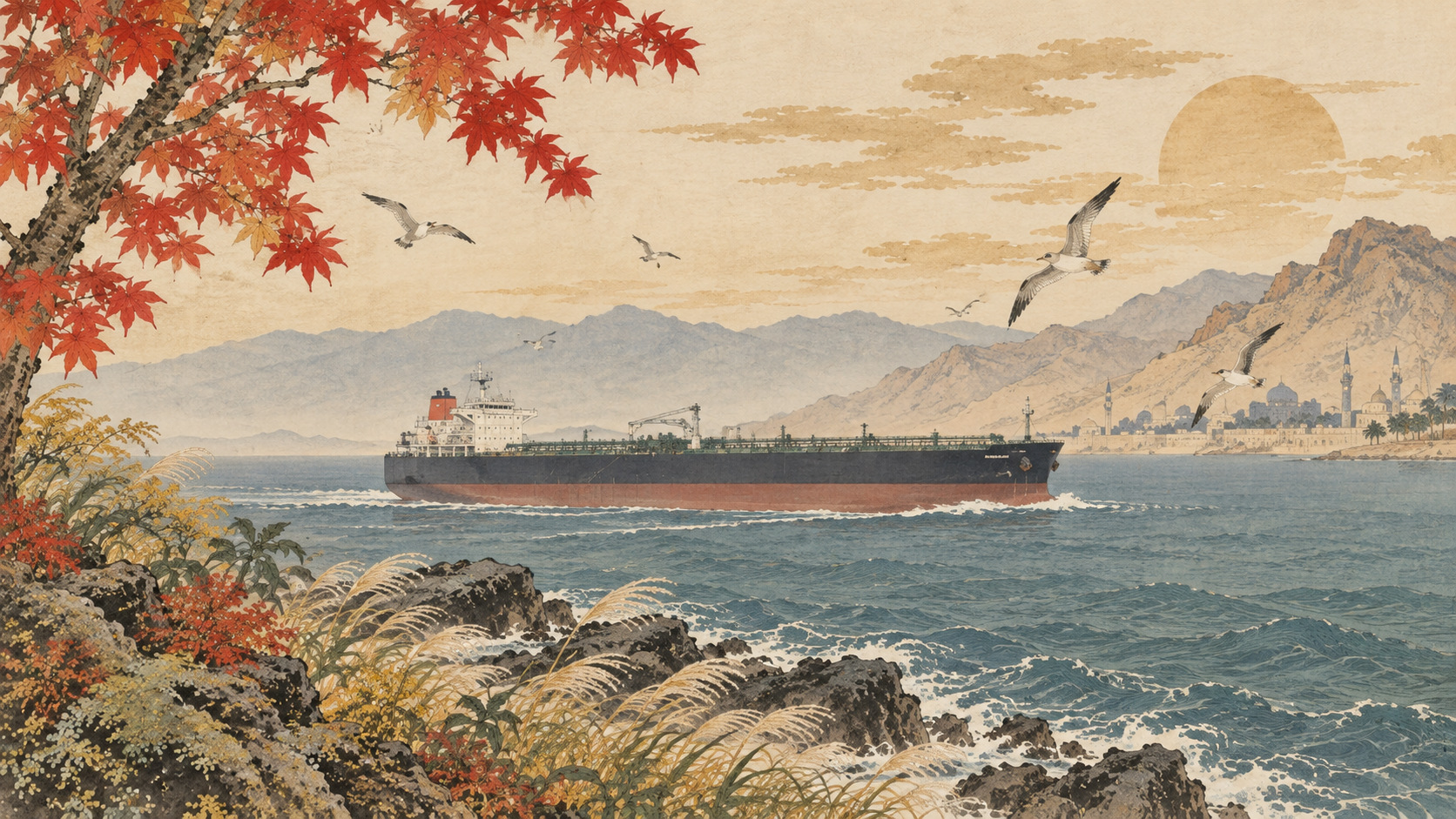
The image of a supertanker returning to Middle Eastern waters is striking. The larger story is of a country learning, once again, that energy security depends not only on where a resource exists but on every mile and every contract required to bring it home.
Sources and documentation
- Bloomberg via The Japan Times (October 13): tracked Japanese-linked tanker movements
- 首相官邸/Prime Minister’s Office: October 13 Cabinet agenda and formal bill titles
- 資源エネルギー庁/Agency for Natural Resources and Energy: 2025 energy supply briefing
- 資源エネルギー庁: May 2026 briefing on petroleum dependence
- Reuters (October 8): maritime traffic and attack risks
- 日本船主協会/Japanese Shipowners’ Association: 2026 safety statements
- Reuters (October 13): Japanese Cabinet action
- 資源エネルギー庁/Agency for Natural Resources and Energy: history of oil dependence
Research cutoff: October 13, 2026. Vessel movements are attributed to the reporting cited; Japan.co.jp did not independently access raw ship-tracking records.