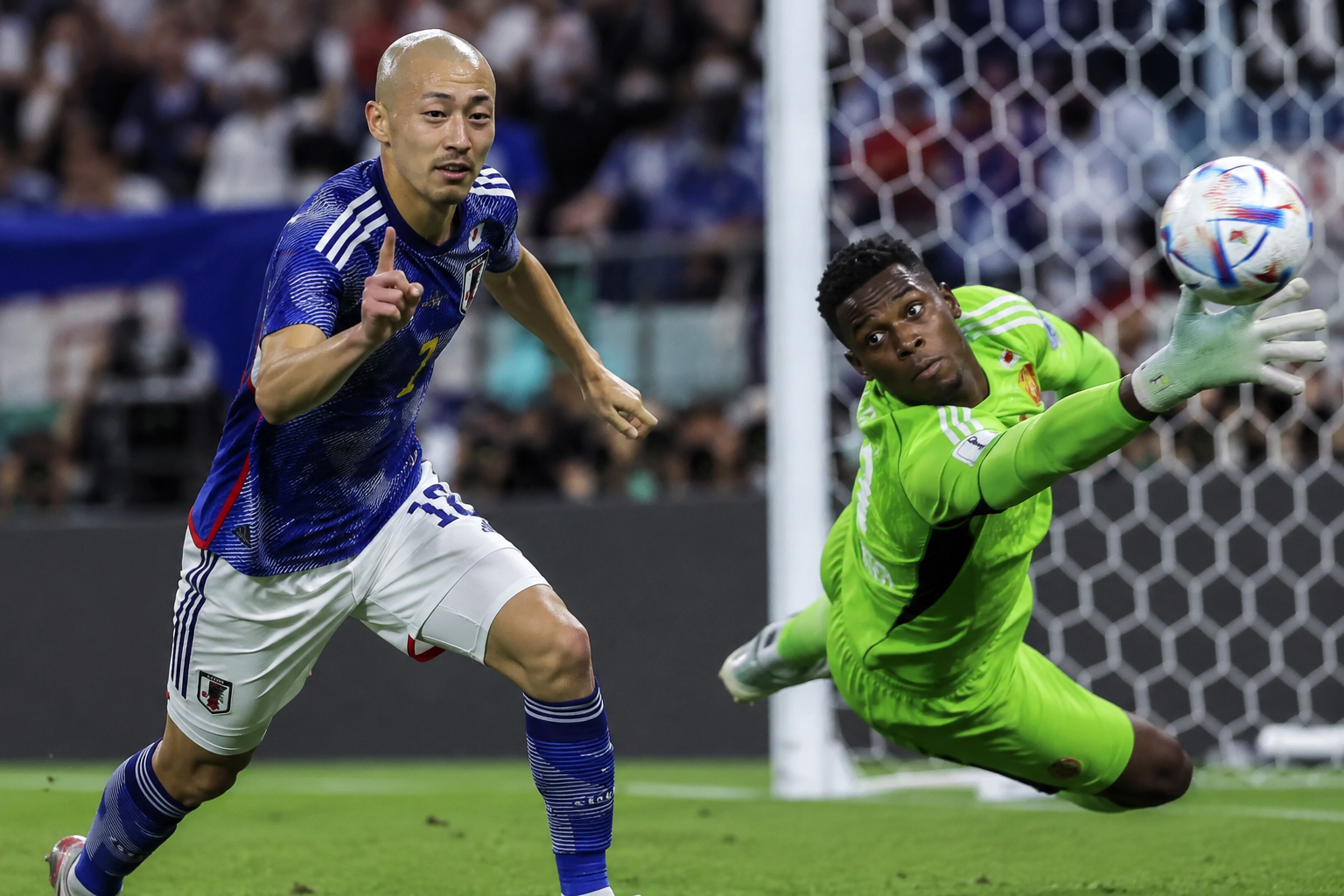
Daizen Maeda gave Japan the goal. Zion Suzuki protected the result. Japan’s 1-1 draw with Sweden was not the loudest kind of World Cup night, but it may become one of the most instructive: a match in which the Samurai Blue showed that their unbeaten Group F run was built on more than one kind of excellence.
The draw that felt like a passport
Reuters reported that Sweden rescued a 1-1 draw through Anthony Elanga’s 62nd-minute equalizer, six minutes after Maeda had finished off a high-quality Japanese move. The result confirmed both teams’ passage to the knockout stage. Japan finished second to the Netherlands in Group F with five points and earned a Round of 32 meeting with five-time world champion Brazil.
On paper, it was a draw. In feeling, it was a passport. Japan had already shown different faces in the group: resilience in the 2-2 draw with the Netherlands, attacking authority in the 4-0 win over Tunisia, and then game management under stress against Sweden. It did not win every match. It did not lose any. That matters.
World Cup groups are not only about beauty. They are about survival, rhythm, rotation, injuries, goal difference, other results, and the strange psychology of knowing that a draw may be enough. Japan entered the Sweden match with ambition, but also with the burden of calculation. That is often where teams lose their shape. Japan did not.
Maeda arrives before the moment
Maeda’s goal in the 56th minute was the kind that looks simple only after it has happened. The Guardian described a sharp Japan move in which Ritsu Doan combined with Ayase Ueda before slipping the ball into Maeda’s path. Maeda timed his run and finished. That is the visible part of the goal. The invisible part was the habit: the run before the pass, the trust before the opening, the movement before the defender can turn.
Daizen Maeda has always been more than speed. Speed is the easy description. His real gift is pressure. He shortens the opponent’s time. He turns a comfortable center back into a rushed passer. He turns a goalkeeper’s second touch into danger. He changes the emotional temperature of a back line.
His career has trained that instinct. From Matsumoto Yamaga to Marítimo, Yokohama F. Marinos and Celtic, Maeda has learned to turn running into a football language. He was the J.League’s top scorer in 2021. At Celtic, he became both a scorer and a pressing weapon, the kind of forward who makes tactical plans feel physical.
Celtic’s own profile notes that Maeda scored Japan’s opener against Croatia in the 2022 World Cup Round of 16. Four years later, he has again scored a goal that belongs to Japan’s knockout story. Against Croatia, it was a lead that Japan could not fully protect. Against Sweden, it was the goal that made the point valuable enough to carry Japan forward.
The six minutes that changed the match
Japan’s lead lasted six minutes. Elanga’s equalizer was an excellent finish, curling left-footed through the moment of confusion and beyond the reach of an unsighted Suzuki. Al Jazeera described the strike as bending over the Japanese defence and past Suzuki, whose view was blocked.
That is the cruelty of tournament football. A team can work for an hour to create one clean moment and lose it in six minutes. Japan had to shift from celebration to containment, from Maeda’s run to Suzuki’s reach. The match became less about adding another goal and more about refusing to let the next one in.
Zion Suzuki and the new Japanese goalkeeper
Suzuki is one of the most fascinating figures in modern Japanese football. Born in New Jersey to a Ghanaian father and Japanese mother, raised in Japan, developed through Urawa Reds and then tested in Europe, he represents a different kind of Japanese goalkeeper: tall, explosive, confident with his feet, and visibly comfortable in international athletic spaces.
Olympics.com described Suzuki as Japan’s long-awaited answer in goal during this tournament. NBC New York and other outlets have noted the American birth story. But in a World Cup match, biography is only background. The penalty area is wonderfully unfair. There is no essay there, only reaction.
Against Sweden, Suzuki’s reaction became the result. Al Jazeera reported that three minutes after Elanga’s equalizer, Suzuki had to be sharp to keep out Alexander Isak’s attempt with a sprawling save to his left. The Guardian’s live coverage recorded a late fingertip intervention that sent Isak’s header onto the crossbar. Field Level Media credited Suzuki with four saves, including two significant stoppage-time stops to preserve the draw.
Those saves are not decorative. They are tournament architecture. Without them, Japan does not leave the group unbeaten. Without them, the mood around the Brazil match is different. Without them, Maeda’s goal becomes a memory instead of a foundation.
The shape of an unbeaten group
| Match | What Japan proved |
|---|---|
| Japan 2-2 Netherlands | Japan could suffer, recover, and still take something from a heavyweight opponent. |
| Japan 4-0 Tunisia | Japan had enough attacking variety to punish a vulnerable side decisively. |
| Japan 1-1 Sweden | Japan could score first, absorb pressure, and protect the result needed to advance. |
That is a complete group-stage education. Japan did not simply cruise. It learned, adjusted, and survived different kinds of pressure. A tournament team needs all of those skills. The knockout stage does not ask whether a team has a favorite mode. It asks whether a team can change modes quickly.
History in two bodies
Japan’s World Cup story has often been told through collective discipline. That is fair. The national team’s rise since its 1998 debut has been a triumph of structure, coaching, domestic league development, overseas experience, and a cultural willingness to improve without declaring the job finished.
But sometimes history needs individual bodies to make itself visible. Maeda is one body: relentless, unglamorous, exhausting to play against, willing to run until defenders make worse decisions. Suzuki is another: tall, powerful, international in background, modern in technique, standing in a position where Japan has long searched for a truly world-class presence.
Together, they tell a useful story about where Japan is now. This is not only the Japan of tidy passing. It is also a Japan of speed, pressure, height, reach, and athletic authority.
The shadow of the quarterfinal
Japan has reached the knockout stage before. It reached the Round of 16 in 2002, 2010, 2018 and 2022. But the quarterfinal remains unopened. Turkey, Paraguay, Belgium, Croatia: different opponents, different heartbreaks, same ceiling. The country has become respected. The next step is to become feared.
That is why the Sweden draw matters emotionally. It did not provide the full release of a win, but it kept Japan’s old dream alive. Maeda, who scored against Croatia in 2022, now gets another chance to help Japan push past the wall. Suzuki, who belongs to the new generation, gets the kind of match that can define a goalkeeper’s career.
Brazil and the simplest path to an upset
Brazil now waits in Houston. Reuters reported that coach Hajime Moriyasu said Japan will not be pushovers and believes his side has a real chance to win. That is the right tone. Brazil deserves respect. It does not deserve surrender.
Japan’s path against Brazil is narrow but visible. Maeda must make Brazil’s buildup uncomfortable. He must chase, angle, press, and force the first pass into worse spaces. If Brazil strolls through the opening half-hour, the match can become too large. If Maeda and Japan’s front line make the favorite hurry, the game can shrink into moments.
At the other end, Suzuki must be ready for the kind of chance that feels inevitable. Brazil will create something. The upset may depend on one save that keeps Japan level long enough for doubt to enter the stadium. Sweden gave Suzuki that rehearsal. Brazil will demand the performance.
The beauty of a draw
Not every great football story is a victory. Sometimes the story is a draw that contains enough courage to move a team forward. Japan did not overpower Sweden. It did not collapse after being caught. It found the goal it needed and the saves it had to have.
Maeda ran into the right place. Suzuki flew to the right places. Between them, Japan crossed from group stage into knockout football unbeaten.
Now the story gets heavier. Brazil waits. But before Houston, this much should be recorded clearly: Japan’s Group F campaign was not luck, not fantasy, not merely the kindness of an expanded format. It was earned by a team that could score, suffer and stay alive.
Sources and references
This article draws on public reporting and reference material from Reuters, The Guardian, Al Jazeera, Field Level Media, Celtic FC, Olympics.com, NBC New York, FIFA, and historical World Cup records. Match details and tournament scheduling may update as the competition progresses.
- Reuters: Japan draw 1-1 with Sweden to finish second in Group F.
- Reuters: Moriyasu says Japan will not be pushovers against Brazil.
- The Guardian: Japan and Sweden both reach World Cup last 32.
- Al Jazeera: Japan draw 1-1 with Sweden and Suzuki saves.
- Field Level Media: Suzuki credited with four saves.
- Celtic FC: Daizen Maeda player profile.
- Olympics.com: Zion Suzuki profile.
- NBC New York: Suzuki’s New Jersey birth and Japan story.