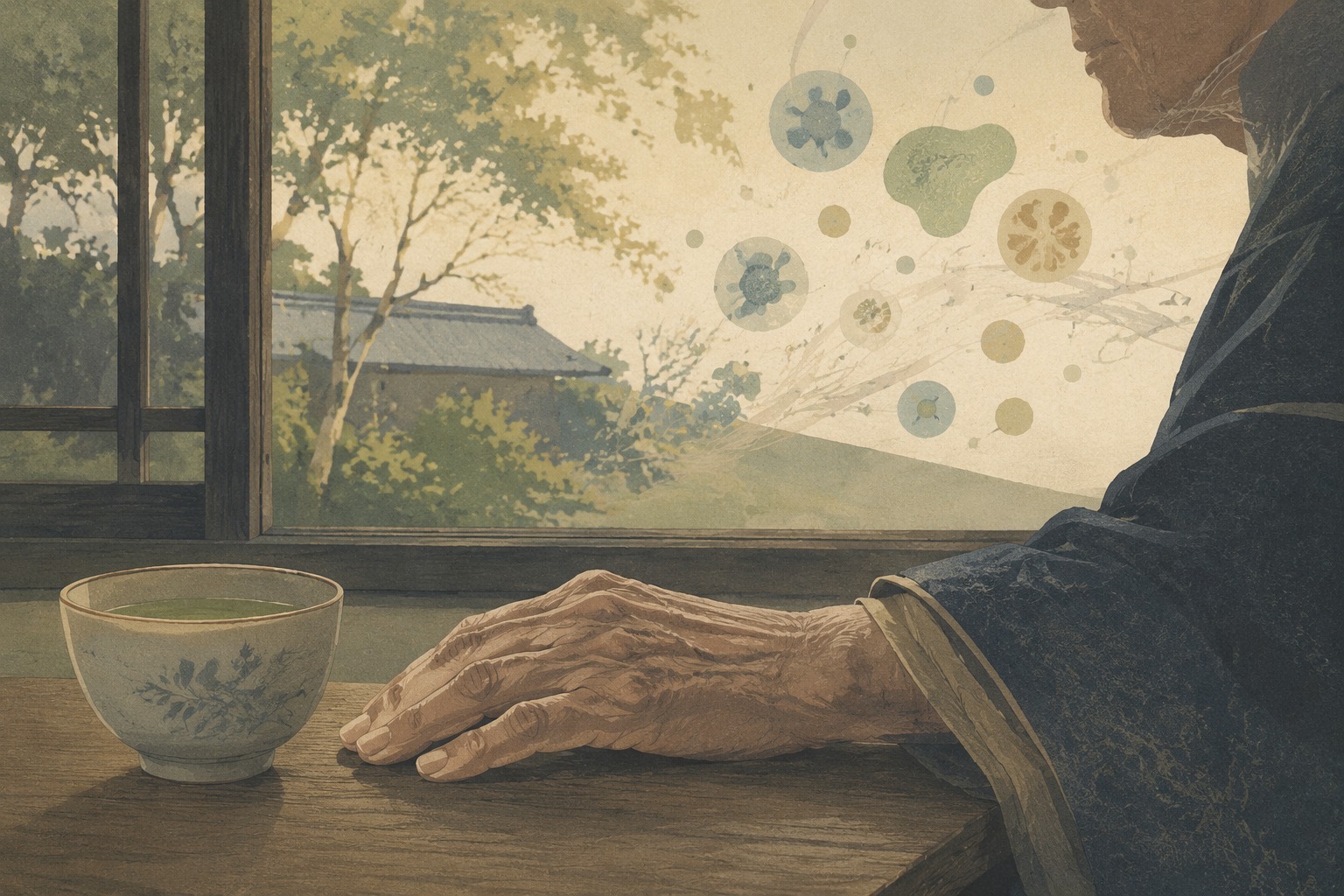
Every person who reaches 110 has already passed through a severe biological selection. They have survived infections, injuries, environmental exposures and the rising risks of cancer and cardiovascular disease. When researchers find an unusual immune population in their blood, the discovery is therefore both compelling and difficult to interpret: did the cells help them survive, or did surviving for 110 years create the conditions in which those cells expanded?
A new study by researchers at the University of Osaka, RIKEN and Keio University cannot settle that direction of cause. It does, however, describe a striking late-life change. Cytotoxic CD4 T lymphocytes—rare cells that retain the traditional “helper” marker while acquiring cellular weapons—rose sharply after the century mark and formed large, highly individual clones.
A cell that crosses the textbook divide
Introductory immunology assigns two familiar roles. CD4 T cells coordinate other immune cells; CD8 T cells kill infected or malignant targets. Cytotoxic CD4 T lymphocytes, abbreviated CD4 CTLs, do not fit neatly into that division. They retain CD4 while producing proteins such as granzymes and perforin that can damage a target cell.
These cells are normally a small part of the blood T-cell population. They have often been studied in chronic infection, autoimmune disease and cancer. In 2019, a RIKEN and Keio team reported that seven supercentenarians—people aged 110 and older—had unusually large populations of CD4 CTLs and evidence that particular clones had multiplied.
The unanswered questions were temporal and functional. Did the cells accumulate gradually across adulthood or emerge only in exceptional old age? Were they worn-out remnants of repeated stimulation, or did they retain the ability to respond?
Twenty-eight people, examined one cell at a time
The 2026 work was led by Associate Professor Kosuke Hashimoto of the University of Osaka’s Institute for Protein Research, Yasumichi Arai, director of Keio University School of Medicine’s Centre for Supercentenarian Medical Research, and RIKEN team director Piero Carninci. It was published in Cell Reports.
Blood came from eight participants aged 70–99, ten centenarians aged 100–109 and ten supercentenarians aged 110 or older. The researchers combined single-cell gene-expression analysis, surface-protein measurements and T-cell-receptor sequencing. A total of 43,584 T cells passed quality controls.
The direct cohort was necessarily small. To fill the enormous age gaps that no supercentenarian study can sample densely, the team trained a classifier on the cellular signatures and applied it to public datasets representing more than 1,500 people from newborns through those in their 110s. That expansion gives the age pattern broader support, but public datasets differ in collection, technology and population. A model prediction is not the same as directly drawing blood from the same person over a lifetime.
A bend in the curve near 100
| Age group | Participants | Median CD4 CTL share |
|---|---|---|
| 70–99 | 8 | 4.0% |
| 100–109 | 10 | 9.6% |
| 110 and older | 10 | 17.6% |
The medians rose across the three groups, and the public-data analysis suggested that the population remained relatively uncommon through the 90s before expanding in the 100s. This is not a biological switch thrown on a person’s 100th birthday. One participant under 100 had the highest individual proportion in the study, a reminder that distributions overlap and individual variation is substantial.
The study is cross-sectional. Different people represent different ages. It did not follow one immune system from 70 to 110, and it cannot show the trajectory that any one participant took.
Large clones carry a history of stimulation
Each T cell carries a receptor assembled to recognize particular molecular features. When a cell repeatedly encounters a target, it can divide into a clone whose members carry the same receptor. Among the CD4 CTLs in this study, a few clones dominated. The largest clone accounted for an average 33.3% of each participant’s CD4 CTL pool; in one centenarian it reached 53.8%.
Such concentration is consistent with repeated exposure to persistent antigens. It does not identify those antigens. They might relate to chronic infection, senescent cells or abnormal cells arising over time, but the study did not determine what the dominant clones actually recognized.
The expanded cells may be a defense that helped produce exceptional longevity—or an immunological record left by exceptional longevity. This study cannot yet choose between those explanations. — Japan.co.jp analysis
The cancer resemblance is a clue, not a verdict
When the researchers compared receptor sequences with public databases, some sequences from dominant clones matched sequences found in T cells expanded inside tumors, particularly lung cancers. That overlap supports a hypothesis that the cells could participate in surveillance against abnormal cells.
It does not prove that the supercentenarians’ cells recognized the same antigen, killed an incipient tumor or prevented cancer. Similar receptor sequence information is not equivalent to a functional test against a participant’s tumor. The paper presents cancer suppression as a possible route by which the cells might contribute to longevity, not as a demonstrated clinical effect.
Repeated stimulation without classic exhaustion
Persistent antigen exposure can drive T cells into exhaustion, a state in which their ability to respond deteriorates. The expanded CD4 CTLs did not display the expected exhaustion pattern. Surface markers suggested an ordered transition in which cells lost CD27 before CD28 as they moved toward a cytotoxic state.
In ex vivo stimulation experiments, cells within the same receptor-defined clone produced different combinations of interleukins. The result suggests functional plasticity rather than a clone made of perfectly identical responders. Yet behavior under laboratory stimulation does not by itself establish what the cells were doing inside tissues of a 110-year-old person.
Japan’s three-decade search for the biology of long life
Keio researchers began systematic centenarian studies in 1992, building medical and social data through home visits and clinical assessments. The work expanded toward the exceptionally rare people who reached 110. RIKEN brought single-cell transcriptomics and receptor analysis to the collaboration, producing the 2019 discovery that the new study extends.
The population context changed dramatically. Japan had 153 people aged 100 or older when the government began its centenarian recognition program in 1963. By September 2025, the resident registry counted 99,763. Reaching 100 is no longer vanishingly rare at a national scale; reaching 110 remains so rare that every direct study is constrained by small numbers.
1963 — Japan begins formally recognizing people reaching 100; 153 centenarians are recorded nationally.
1992 — Keio researchers begin systematic centenarian studies.
2019 — Single-cell analysis of seven supercentenarians identifies abundant cytotoxic CD4 T cells and clonal expansion.
2026 — The new study adds an age trajectory, cell-state analysis and large public datasets.
Not a young immune system preserved in amber
Immune aging includes weaker responses to infection and vaccination, chronic low-grade inflammation and changes across many cell populations. An increase in one cytotoxic population does not mean the entire immune system is young, stronger or healthier. The better interpretation is selective remodeling under decades of pressure.
- Whether CD4 CTLs extended the participants’ lives.
- Which antigens drove the dominant clones.
- Whether blood reflects the same cell behavior in tissues.
- Whether increasing these cells artificially would be safe or useful.
- Whether the pattern is the same in non-Japanese populations.
Survivor selection is fundamental. People who died earlier from infection, cancer or frailty cannot appear in a supercentenarian sample. The cellular pattern may be protective, neutral, compensatory or a consequence of other traits that enabled survival. Longitudinal studies, tissue analysis and functional experiments will be needed to separate those possibilities.
The important shift is conceptual but modest. Immune aging may include continued selection, expansion and diversification, not decline alone. The blood of a person who has lived for 110 years can contain an archive of repeated biological encounters. Researchers have begun to read that archive; they have not yet found a prescription for longevity.
- The University of Osaka: immune remodeling in extreme old age
- RIKEN: official research announcement
- Hashimoto K, et al. CD4 CTLs in supercentenarians
- RIKEN: 2019 supercentenarian T-cell study
- Keio University: history of Japan’s centenarian research
- Japan’s Ministry of Health, Labour and Welfare: 2025 centenarian population
Editor’s note: This report is based on the peer-reviewed paper, institutional releases and official statistics. Japan.co.jp did not interview the researchers and uses no direct quotations. The study is a cross-sectional analysis of blood and does not establish that cytotoxic CD4 T cells cause longevity or prevent cancer. Proposed cancer surveillance is identified as a hypothesis rather than a demonstrated clinical effect.