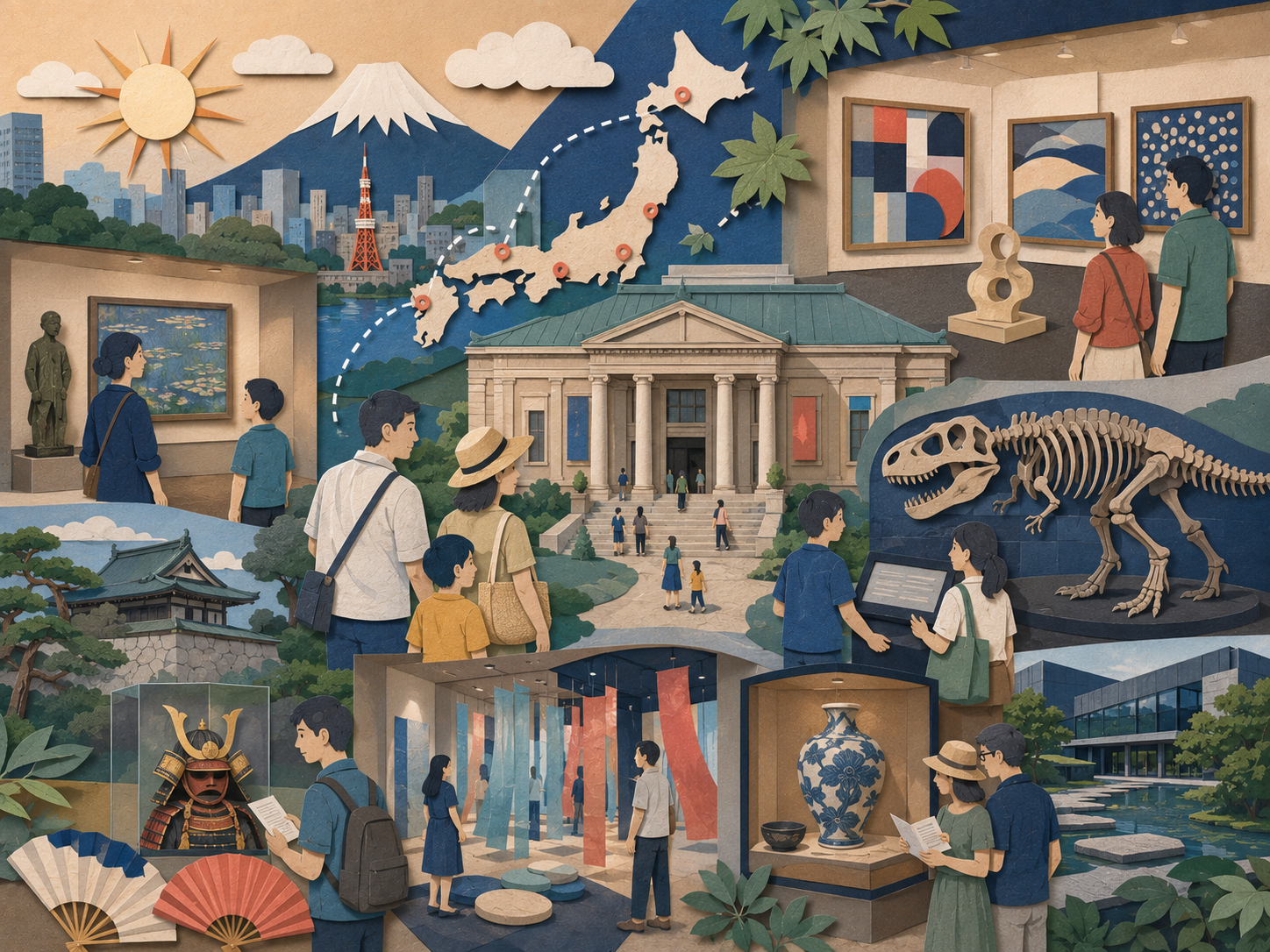
In the Japanese summer, a museum is more than a cool room. Outside, the heat slows the city down. Pavement shimmers, train platforms feel heavy, and families plan their days around shade, air conditioning, and short walks from the station. Then the museum door opens. The light drops. Voices soften. Time changes. In the summer of 2026, Japan’s museums are not simply offering refuge from the heat. They are turning the season into a national map of discovery.
Internet Museum has published both a national and a Tokyo edition of recommended summer exhibitions for June, July, and August 2026. The national list highlights, among others, the Pola Museum of Art’s “New Eyes: Monet and Art of the 21st Century,” a major show marking both the centenary of Monet’s death and the museum’s 25th anniversary. The Tokyo list points to the Tokyo Metropolitan Art Museum’s British Museum Japanese art exhibition, Mitsubishi Ichigokan Museum’s show on café culture and modern artists, and The National Art Center, Tokyo’s “Picasso meets Paul Smith.”
This is more than a seasonal listings story. The summer exhibition calendar reveals what Japan’s museums are being asked to do now: recover Japanese art from global collections, make Impressionism speak to the age of images and AI, connect photography to food and society, introduce children to science and craft, and give travelers a reason to slow down in places that might otherwise be reduced to a station, a hotel, and a famous temple.
Why summer exhibitions matter
Summer is a special season for Japanese museums. Schools close. Families travel. Children need projects. Grandparents receive visitors. Domestic tourism and day trips rise. Museums gain an audience that may not come during the normal work-and-school rhythm of the year. In an era of intense heat, indoor cultural spaces also gain a practical value. They are cool, sheltered, and often located near transport. But the best museums offer a deeper kind of cooling: a break from the speed of daily information.
Summer exhibitions have two faces. One is family-oriented: dinosaurs, science, anime, hands-on installations, and exhibitions that can become a child’s first real encounter with a museum. The other is serious and slow: major retrospectives, international loans, historical collections, and ambitious photography or contemporary art shows. The strongest summer programs now combine these two impulses. They make the doorway wide without making the experience shallow.
Monet in Hakone: seeing the act of seeing
The Pola Museum of Art’s summer Monet exhibition is a natural anchor for the season. The museum’s setting in the forests of Hakone matters. Monet painted light, water, atmosphere, weather, and the instability of perception. To encounter his work in a mountain museum surrounded by mist, foliage, and shifting daylight is different from seeing it in the center of a city. The building, landscape, and exhibition all become part of the visual experience.
The key is that the show does not appear to treat Monet as a sealed historical figure. It asks how Monet’s way of seeing can be read through the eyes of contemporary artists. That matters because Monet’s late water lilies already pushed landscape toward immersion and abstraction. They are not simply pictures of a pond. They are pictures of attention itself: how light lands, how water receives, how time changes the same place.
Japan has long loved Impressionist exhibitions. Monet, Renoir, Van Gogh, Cézanne, and their circle have repeatedly drawn large museum audiences. But in 2026, the challenge is no longer simply to bring famous works to Japan. The challenge is to make famous works urgent again. By pairing Monet with twenty-first-century artists, the Pola Museum places a familiar name inside a contemporary question: in an age of screens, AI images, and endless visual feeds, what does it mean to truly see?
Tokyo’s exhibition map: Edo, cafés, Picasso, photography
Tokyo’s summer lineup reads like a cultural map of the city. At the Tokyo Metropolitan Art Museum, the British Museum’s Japanese art collection brings Edo painting and prints back into Japanese public view. This is not only a homecoming. It is also a story about how Japanese art traveled, how it was collected abroad, and how international institutions shaped the way Japan’s visual culture was studied and preserved.
At Mitsubishi Ichigokan Museum, the exhibition on cafés and artists turns modern art into a social history. In late nineteenth-century Paris, cafés and cabarets were not background scenery. They were creative laboratories. Painters, writers, critics, editors, performers, and dealers met there. Ideas moved across tables before they moved into museums.
The National Art Center, Tokyo’s “Picasso meets Paul Smith” points in another direction. It suggests that museums are increasingly willing to use design, fashion, and playfulness as interpretive tools. Picasso can be trapped by his own fame. A design lens can open him again, returning attention to color, line, wit, pattern, and visual surprise.
At the Tokyo Photographic Art Museum, “TOP Collection: Tomorrow’s Dining Table” uses photography and video to think about food. Eating is intimate, but it is also social and political. A table can hold family memory, labor, agriculture, climate, logistics, class, and care. In summer, a photography exhibition about food may seem gentle. It is not. It asks how people live together.
From Meiji institutions to summer public culture
Japan’s museum history is bound to the making of the modern state. In the Meiji period, exhibitions and museums helped define what counted as civilization, industry, science, craft, and national heritage. Objects in cases were not merely objects. They were arguments about progress, order, and identity.
The national museum system grew alongside the effort to preserve, classify, study, and display cultural properties. After the war, museums increasingly became democratic public spaces. They belonged not only to scholars and collectors, but also to students, families, local communities, and citizens who wanted access to world culture.
During the high-growth decades, Japan developed a distinctive exhibition culture. Newspapers, broadcasters, department stores, railways, publishers, and museums cooperated to produce blockbuster shows. Posters appeared in stations. Catalogues became keepsakes. Television specials explained artists to mass audiences. Long lines formed for European masterpieces, archaeological treasures, ukiyo-e, Buddhist sculpture, and modern art.
Museums in the age of extreme heat
The heat changes the museum visit. Visitors may choose morning or late afternoon. Families may favor locations close to stations. Cafés, lockers, stroller access, restrooms, and places to sit become part of the cultural experience. For older visitors, the route from the train gate to the museum matters. For tourists, a museum can become the calm center of a day otherwise organized around heat and crowds.
Museums also face operational challenges. Works require stable temperature and humidity. Buildings require energy. Crowds require safe circulation. Summer programming must consider not only artistic value, but also comfort, safety, and time. A good exhibition in 2026 is not only well curated. It is well hosted.
The strength of regional museums
Tokyo’s major exhibitions get attention, but Japan’s regional museums often provide the most memorable summer experiences. A museum in Hakone is not only a building; it is part of the mountain atmosphere. A museum in Kyoto or Nara carries a different sense of time from one in Marunouchi or Roppongi. A coastal museum, a craft museum, a local history museum, or a small regional art museum can change the way a traveler understands a place.
Regional museums are not simply tourist facilities. They preserve local artists, crafts, festivals, industries, archaeological finds, and community memory. They make the cultural map of Japan more complex than Tokyo, Kyoto, Osaka, and a handful of famous sites. For a visitor, adding one museum to a trip can shift the whole journey from consumption to attention.
Children, robots, and the slow question
Summer museums are also for children. A child rarely begins with an art-historical category. A child begins with questions: Why is this color here? Is that real? How did someone make it? Why did people keep it? Why is the dinosaur so big? Why does the old painting still shine?
That is especially important in the same edition of Japan.co.jp that is full of AI, robots, space semiconductors, and digital transformation. Technology accelerates answers. Museums slow questions down. The future needs both. Engineers, designers, scientists, founders, teachers, and editors all need the capacity to look closely at something that does not immediately explain itself.
Japan.co.jp view
Japan.co.jp is covering the summer museum season as a news story because it reveals something important about Japan now. This is a country that preserves old things, but also needs new ways of seeing them. Edo painting returns through a British collection. Monet is re-read through contemporary art. Picasso is filtered through design. Photography turns toward the dining table. Regional museums become destinations in a country trying to rethink tourism.
Museums rarely make the loudest headlines. But they measure cultural stamina. What does a society keep? What does it show children? What does it lend and borrow? How does it make room for silence? How does it connect local memory to global attention? How does it offer refuge during heat without becoming merely another air-conditioned facility?
A reader’s guide to summer museums
| Approach | How to enjoy it |
|---|---|
| Start with a famous name | Monet, Picasso, Edo painting, or major photography can be a doorway. Ask why the work matters now, not only why it mattered then. |
| Choose by place | Hakone, Ueno, Marunouchi, Roppongi, and Ebisu each create a different kind of museum day. |
| Go with children | Let one question lead the visit. A single object can be more memorable than an entire checklist. |
| Plan for heat | Check station access, timed tickets, cafés, rest areas, and the walk from the train before you go. |
| Add a regional museum | A local museum can turn a trip into a deeper encounter with the place itself. |
Sources and reference materials
This article draws on Internet Museum’s 2026 summer exhibition features, public museum schedules, GO TOKYO cultural listings and Tokyo Art Beat exhibition previews, with Japan.co.jp analysis on museum history, summer travel and the role of cultural spaces in an age of extreme heat.
- Internet Museum: 2026 summer exhibition picks, national edition.
- Internet Museum: 2026 summer exhibition picks, Tokyo edition.
- Tokyo National Museum: 2026 exhibition and events schedule.
- Tokyo Art Beat: best exhibitions starting in June 2026.
- Tokyo Art Beat: best exhibitions starting in July 2026.
- GO TOKYO: Tokyo art and exhibition guide.