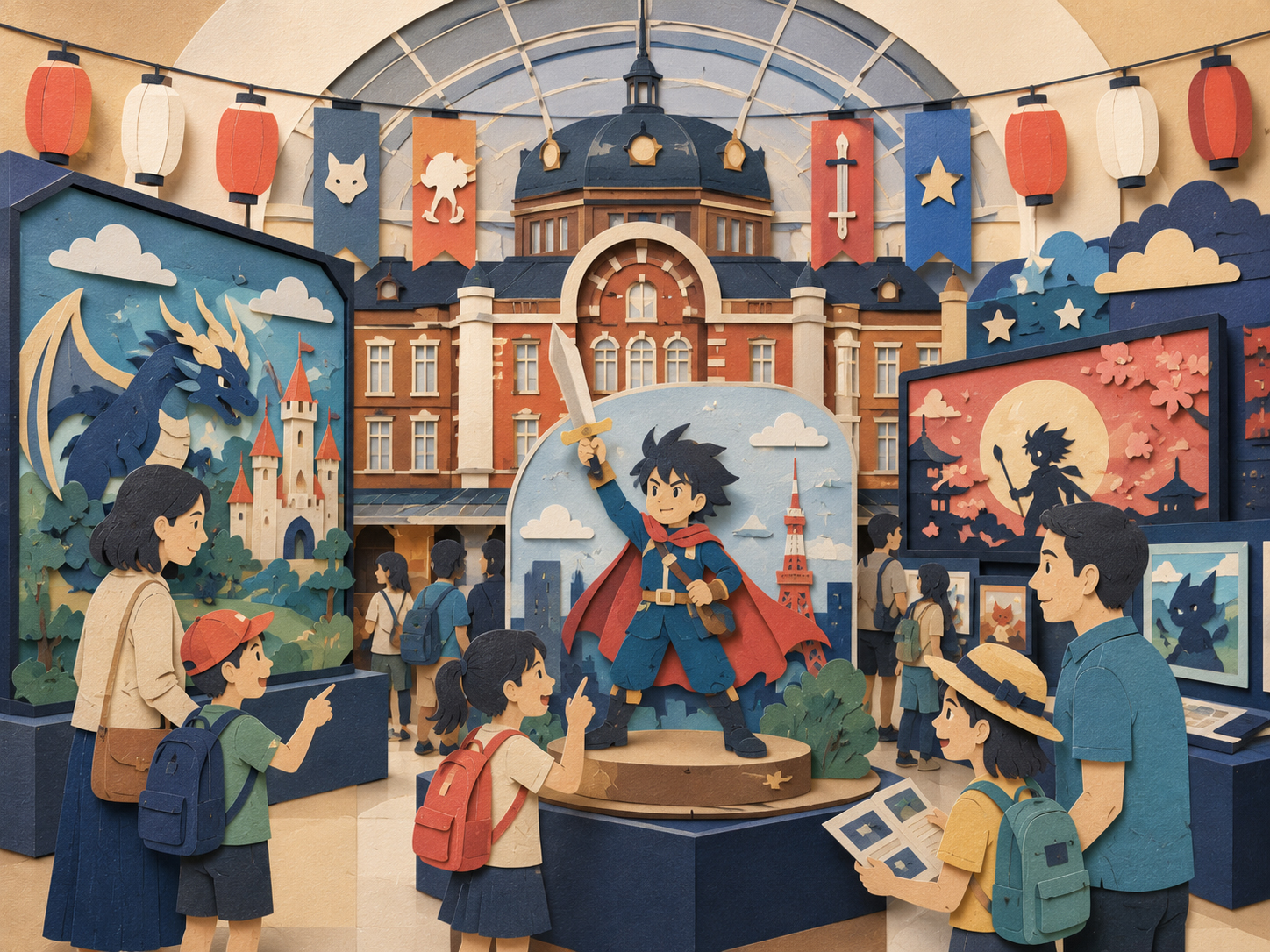
Tokyo’s summer vacation is getting an anime classroom. Anime Tokyo Station, the exhibition hub operated by the Tokyo Metropolitan Government and the Association of Japanese Animations, is staging “Anime Tokyo Station Summer Festival 2026,” a family-oriented season of screenings, children’s classes, workshops and free original-character fans. The July 3 announcement said the facility, built around the motto “Making ANIME more interesting, Bringing ANIME far into the future,” had welcomed 302,957 visitors from Japan and abroad as of June 28, 2026.
At first glance, this is a local summer event in Ikebukuro. But the deeper story is larger. Tokyo is trying to move anime from the category of entertainment consumed on screens into something more durable: a public cultural infrastructure that can preserve production materials, educate children, guide tourists, support fandom, and explain the craft behind one of Japan’s most globally powerful creative industries.
That is why a children’s summer program matters. Anime is no longer only children’s entertainment. It is a global language of streaming, cinema, games, fashion, music, tourism and fan identity. Precisely because it has become so large, there is value in returning to the basics: how a drawing moves, how voice and timing create emotion, how old television heroes shaped Japan’s robot imagination, and how a young visitor might move from “I like anime” to “I understand how anime is made.”
What the Summer Festival includes
The second wave of the 2026 summer program centers on “watch together” screenings and “exciting summer vacation classes” for children. The screening series, presented as an Eiken Classical Selection, looks back to the dawn of Japanese television animation. On July 19, Anime Tokyo Station plans to screen the first episode of Tetsujin 28-go, “The Birth of Tetsujin.” On August 16, it plans to screen the first episode of Eight Man, “Eight Man Appears.” Both screenings are scheduled for the first-floor special venue, with talk segments and quiz corners after the shows.
The children’s classes begin July 26 with “Acting is fun!” and continue in August with classes on how cel animation is made, beginner and intermediate anime drawing experiences, and hands-on workshops. On August 8, children can try making origami animation. On August 22, they can make original coasters. From July 18 to August 30, the facility also plans to distribute hand fans decorated with original characters.
The programs are free, which is part of their civic importance. This is not simply a premium fan convention or a merchandise drop. It is a low-barrier cultural program that parents and children can use as a summer outing, a research project, or a first step into the world behind animation. The public value lies in turning fandom into curiosity.
Why Ikebukuro matters
Anime Tokyo Station sits in Minami-Ikebukuro, within walking distance of one of Tokyo’s busiest rail hubs. Ikebukuro was once overshadowed in the tourist imagination by Shinjuku, Shibuya and Akihabara. But over the last generation it has become one of Tokyo’s essential anime and manga districts. Otome Road, Sunshine City, anime shops, character goods stores, theaters, cafes and fan events have made Ikebukuro a different kind of anime city from Akihabara.
If Akihabara symbolizes the route from electronics town to otaku mecca, Ikebukuro represents a broader fan geography: female fandom, stage adaptations, character goods, live events, cosplay culture and family-friendly circulation. Placing Anime Tokyo Station in Ikebukuro signals that Tokyo’s anime strategy is not limited to one district or one stereotype of fandom. It recognizes anime as a citywide ecosystem.
Tokyo’s official tourism site describes Anime Tokyo Station as a facility that opened in Ikebukuro on October 31, 2023, as a starting point for the further development of Japanese animation, related industries, culture and tourism. Admission is free. The facility runs from basement level through the second floor, with exhibitions, merchandise, archives, production-process displays and event spaces. In other words, it is both a destination and a station: a place to arrive, learn, and then continue into Tokyo’s wider anime landscape.
Preserving anime, experiencing anime
The facility’s importance is not limited to current exhibitions. According to the official overview, Anime Tokyo Station preserves roughly 50,000 animation-related materials generated in the production process, including planning documents, scenarios, storyboards, cels, original illustrations and master tapes. Its permanent displays also explain how animation moves from planning to finished work.
That combination of preservation and experience is crucial. Anime is consumed as moving images, but it is built out of thousands of decisions: lines, color, timing, voice, sound, editing, background art, layout, production management and labor. In an age of digital production and AI-assisted creative tools, showing children the cel-animation era and the craft behind anime is not nostalgia. It is cultural literacy.
That is why the summer program’s classes on cel animation and drawing are more than activities. They introduce children to the grammar of animation. A line becomes a gesture. A gesture becomes a character. A character becomes a story. For a young visitor, that can change anime from something received passively into something made by human hands and creative teams.
Why Tetsujin 28 and Eight Man still matter
The two classic screenings are carefully chosen. Tetsujin 28-go and Eight Man are not just nostalgic titles. They belong to the early 1960s moment when Japanese television animation began to define robot heroes, science fiction morality, postwar anxiety and children’s adventure for mass audiences. Tetsujin 28-go framed a giant robot as a tool that could become a force for justice or destruction depending on who controlled it. Eight Man imagined memory, personality and electronic intelligence inside a steel body.
For children growing up in 2026, surrounded by generative AI, smartphones, robotics, avatars and streaming platforms, those old robot stories are not obsolete. They ask very current questions: Who controls technology? Can a machine carry human intention? What separates protection from violence? What happens when a human mind is extended through electronics? The visual language may be old, but the questions are new again.
Family screenings also create intergenerational conversation. For parents and grandparents, these works may carry the atmosphere of early television. For children, they may look strange, direct and powerful. That difference is useful. It lets families talk about how animation has changed, and also about what has not changed: courage, fear, friendship, technology, responsibility, and the thrill of watching drawings come alive.
Anime as a global market
The wider economic context is impossible to ignore. The Association of Japanese Animations has long tracked the Japanese animation industry, and recent reporting on its industry data has described 2024 as a record year, with the total anime market reaching roughly ¥3.84 trillion. The industry’s expansion has been driven not only by domestic television or theatrical releases, but by overseas streaming, licensing, merchandise, games, events and global fandom.
That growth creates opportunity and pressure at the same time. More demand can mean more revenue, more tourism, more export power and more international fans. It can also intensify pressure on studios, schedules and young creators. Japan has increasingly discussed content as a strategic industry, but the health of that industry depends on talent, archives, education, rights management and respect for the production process.
Anime Tokyo Station fits into that debate because it does something the market alone cannot do. It slows anime down. It asks visitors to look at materials, process and history. It teaches that anime is not just characters on a screen, but a chain of creators, companies, techniques and audiences. For a booming industry, that kind of public explanation is not decorative. It is infrastructure.
The age of anime tourism
For many overseas visitors, anime is now one of the reasons to come to Tokyo. Akihabara, Ikebukuro, Nakano, Shibuya, Shimokitazawa, real-life anime locations, character shops, collaboration cafes, theaters and live events form a map of fandom. Anime has moved from screen culture into urban movement. People travel because stories made them curious about places.
Anime Tokyo Station is trying to become an official gateway into that map. Rather than directing visitors only to one title or one neighborhood, it offers a broader explanation of the industry, the archive and the city’s anime ecosystem. Its multilingual website and official tourism listing underline that role. For a visitor who has one afternoon in Tokyo, it can function as an orientation point. For a child living in Japan, it can be a first workshop. For a specialist, it can point toward archives and production history.
It also matters as an indoor summer destination. Tokyo’s heat makes family outings difficult in July and August. A free, accessible, air-conditioned cultural site near a major station has practical appeal. Visitors can learn inside, then move into the larger Ikebukuro anime district. That is good tourism design.
Anime as public culture
Anime was once easy to dismiss as children’s programming or niche fandom. Today it is framed as export industry, soft power, tourism, design influence and global youth culture. But that elevated status brings a risk. If anime is treated only as a money-making national asset, the weirdness, freedom, grassroots fan energy and individual craftsmanship that made it powerful can be flattened.
The strength of Anime Tokyo Station’s summer festival is that it does not begin with industrial slogans. It begins with children watching a classic, drawing, learning how cels worked, making paper animation and walking out with a fan. Culture becomes durable through precisely that kind of small encounter. A child sees a line move and wants to know how it happened.
Tokyo’s task is not simply to export anime. It is to explain the city that helped anime grow: studios, publishers, toy companies, voice actors, television networks, theaters, specialist shops, schools, archives and fans. Anime Tokyo Station is one attempt to put that ecosystem behind a public front door.
Japan.co.jp view
“Anime Tokyo Station Summer Festival 2026” is not the largest event in Japan’s summer calendar. But it is one of the most revealing. At a time when anime is growing into a global market and government planners speak about creative industries as national strategy, Tokyo is building an everyday cultural mechanism: a place where families can enter for free, watch an early robot anime, learn how animation is made, and connect fandom with history.
That is the quiet genius of the program. It treats anime as fun, but not only as fun. It treats anime as business, but not only as business. It treats anime as tourism, but not only as tourism. It sees anime as something that must be preserved, explained and handed forward.
In the long run, the future of Japanese anime will not be decided only by streaming contracts, theatrical box office or global licensing. It will also be decided by whether children understand that animation is made, whether young artists can imagine themselves entering the field, whether production history is preserved, and whether Tokyo can remain not just a marketplace for anime, but a home for it.
Reader guide
| Topic | What it means |
|---|---|
| Event | Anime Tokyo Station Summer Festival 2026, a summer-vacation program of screenings, children’s classes, workshops and original-character fan giveaways. |
| Main screenings | Tetsujin 28-go on July 19 and Eight Man on August 16, both early television anime classics. |
| Learning programs | Acting, cel animation, beginner and intermediate anime drawing, origami animation and coaster-making workshops. |
| Facility | A free-admission anime exhibition hub in Ikebukuro operated by the Tokyo Metropolitan Government and the Association of Japanese Animations. |
| Why it matters | It shows Tokyo treating anime as education, archive, tourism and public culture, not only as entertainment. |
Sources and references
This article draws on the Association of Japanese Animations announcement for Anime Tokyo Station Summer Festival 2026, Anime Tokyo Station official materials, GO TOKYO’s facility listing, AJA’s anime industry data and recent reporting on the global expansion of Japan’s anime market.
- PR TIMES / Association of Japanese Animations: Anime Tokyo Station Summer Festival 2026 announcement.
- Anime Tokyo Station: official site, opening hours and event information.
- Anime Tokyo Station Facility Overview: archive, production-process exhibits and facility details.
- GO TOKYO: official Tokyo tourism facility listing.
- Association of Japanese Animations: anime industry data and annual report information.