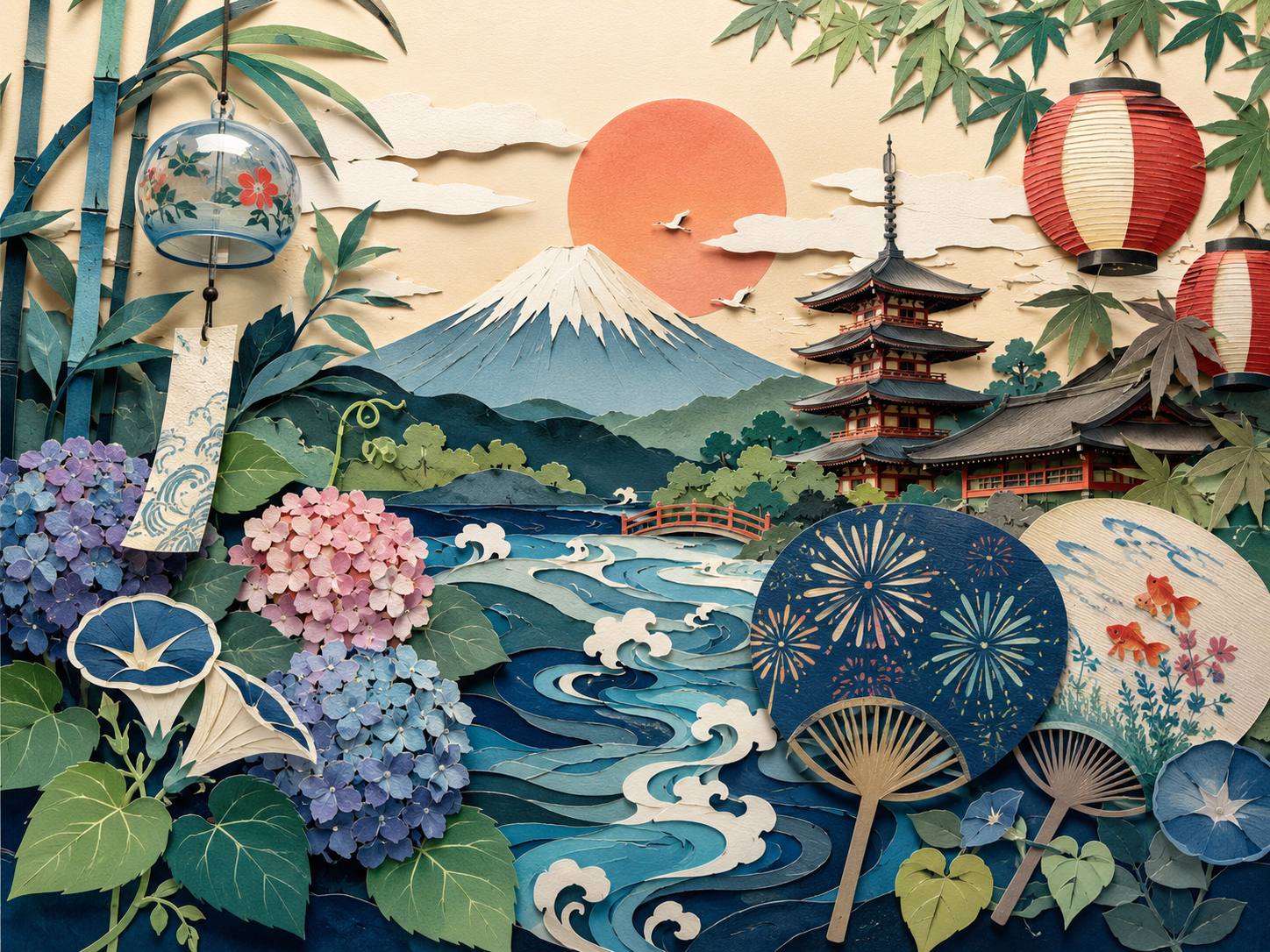
Today’s Art Choice builds summer out of paper. Mount Fuji sits in the distance. Water moves through the foreground. Hydrangea, morning glory, bamboo, a wind chime, paper fans, lanterns and the roofline of traditional architecture gather around the scene. The motifs are old, almost familiar before we name them. But the image is not nostalgia. By cutting, layering and shadowing paper, it turns the grammar of Japanese summer into a contemporary editorial illustration.
That matters for the July 10, 2026 edition of Japan.co.jp. This is a day of AI agents, municipal digital transformation, university drug discovery, orbital semiconductors, robot education, metaverse disaster training, anime tourism, summer festivals and museum visits. The art has to hold both sides of the paper: the future Japan of systems and laboratories, and the seasonal Japan of water, flowers, bells and light. The paper-cut collage style gives the edition a human surface.
Paper cutting as an old future
Japanese paper-cut art, often discussed under the language of kiri-e or kirie, belongs to a larger East Asian paper tradition. It is usually explained through the arrival of paper and paper-cutting practices from the continent, then through Japan’s own development of washi, Buddhist printing, Shinto ritual objects, folk art, illustration and modern exhibition practice. To cut paper is to make an image by subtraction. The artist does not add a line with ink; the artist removes the field around the line and lets the remaining shape speak.
That is why paper cutting is so close to memory. It does not need every detail. It needs the right silhouette, the right edge, the right opening. A mountain can become Japan. A wind chime can become summer. A river can become coolness. A lantern can become evening. The image works because it trusts fragments.
Today’s artwork is not a strict monochrome kiri-e. It is closer to an editorial paper-cut collage, drawing from paper cutting, pasted-paper composition, chigiri-e, magazine illustration and digital craft. But its spirit is still related to cutting: it distills a season into layers, edges and shadows. It does not photograph summer. It constructs summer.
The strength and tenderness of washi
No discussion of Japanese paper art can avoid washi. UNESCO describes traditional handmade Japanese paper as a craft using plant fibres such as paper mulberry, water and bamboo screens, producing paper used for writing, books, screens, room dividers and sliding doors. Washi can look delicate, but its long fibres make it flexible, resilient and strong. That combination — soft surface, durable structure — is one reason paper became so central to Japanese visual and domestic culture.
This digital illustration is not literally handmade washi. Still, it borrows washi’s emotional language: fibre-like texture, muted colour, irregular warmth, visible layering, the small shadow at a paper edge. These details slow the image down. They suggest touch. In a news edition full of AI and infrastructure, that tactile quality is not accidental. It tells the reader that technology still belongs to a world of materials, seasons and bodies.
Why would a digital newspaper use paper texture in an AI age? Because the faster information becomes, the more readers need signs of human measure. Paper is a measure. It remembers hands. It remembers folding, cutting, tearing, gluing, printing and saving. Even when simulated on a screen, it gives the news a place to rest.
Chigiri-e, collage and the newspaper mind
Paper art is not only about cutting. Chigiri-e uses torn pieces of washi, often taking advantage of the feathered fibres at the edge. Pasted-paper images build pictures through coloured shapes. Collage gathers fragments from different worlds and makes a new one. A newspaper is also a collage. It places markets beside weather, culture beside politics, sports beside science, an image beside a headline, and asks the reader to see a day as a whole.
Today’s image is editorial in precisely that way. Fuji provides distance and stability. Water gives movement. Hydrangea and morning glory carry the transition from rainy season to high summer. The wind chime brings sound into a silent image. The fans bring the body. The lanterns pull daylight toward evening. The roofline brings history. Each piece is small. Together they make a national season.
The result is not a tourism poster shouting landmarks. It is quieter than that. It layers recognitions. Japan’s summer appears not as one place, but as a combination of sensory cues: blue water, humid flowers, cool glass, warm paper, distant mountain, festival light. The collage works because summer itself is a collage.
The signs of Japanese summer
Mount Fuji is one of the most powerful anchors in Japanese visual culture. It appears in ukiyo-e, travel posters, corporate design, New Year cards, schoolbooks and souvenirs. But summer Fuji is different from winter Fuji. It is not only snowy purity; it is distance, haze, green, cloud and relief from heat. In this artwork, Fuji is a calm background rather than a conquering subject.
Hydrangea carries the memory of the rainy season. Morning glory carries the memory of school summer mornings. Wind chimes make the invisible visible: you cannot see the breeze, but you can see the bell that answers it. Fans are instruments of self-made coolness. Lanterns mark the passage from ordinary day to festival night. Water suggests both relief and motion. The image does not need to show heat directly because it shows the old cultural tools for answering heat.
That is one reason the picture feels Japanese without becoming rigid. Its Japan is seasonal, not slogan-like. It is a Japan of gestures: listening for a bell, holding a fan, looking over water, noticing a flower after rain.
From ukiyo-e to magazine illustration
Japanese visual culture has long been skilled at describing season inside a flat image. Ukiyo-e prints used rain, snow, moonlight, rivers, bridges, flowers, fireworks and mountains to make time visible. Modern posters, department-store graphics, children’s magazines and travel brochures carried those seasonal codes into the twentieth century. Today’s paper-cut collage belongs to that lineage.
Like ukiyo-e, it uses flatness and pattern. Like magazine illustration, it is edited. Like digital art, it can combine elements with freedom. What matters is that the choices remain visible. The viewer can feel the act of selection: this flower, this bell, this mountain, this water, this fan, not everything. The image is not a mirror. It is a composition of cultural memory.
For Japan.co.jp, that makes Today’s Art Choice more than decoration. It is a different kind of journalism. News tells us what happened. Art tells us what kind of day it happened inside. On July 10, the day’s technology stories need a seasonal counterweight. The paper-cut summer gives them one.
Modern kiri-e keeps expanding
Contemporary paper cutting in Japan is not limited to black paper on a white background. Artists use colour, washi, acrylic paint, fabric, sand, lighting, installation and three-dimensional forms. Exhibitions have shown how paper-cut artists can turn a single sheet into architectural space, lace-like narrative, sculptural depth and contemporary design. The form keeps moving.
The word kirigami has also entered science and engineering. Researchers use cut patterns to design sheets that stretch, bend, deploy and transform. A craft idea that once belonged to paper and scissors now informs mechanical metamaterials, soft robotics, architecture and medical-device design. In that sense, paper cutting is not merely old. It is structurally modern.
This is why today’s image feels like an old-new object. Its motifs are traditional. Its surface feels handmade. But its compositional density, colour management and digital production belong to the present. It does not reproduce tradition. It uses traditional visual language to speak in 2026.
Why this image belongs to this edition
The July 10 Japan.co.jp edition is unusually forward-facing: advertising AI, local-government AI, drug startups, space semiconductor manufacturing, next-generation talent, student robotics, AI awards, virtual disaster training, anime tourism, summer festivals, museums and regional development. Without an art choice, the day could feel like a catalogue of modernization.
The paper-cut summer returns the edition to ground level. It reminds us that AI policy happens in cities that also have heat waves, festivals, school vacations and emergency shelters. It reminds us that space technology is still imagined from the surface of Earth. It reminds us that anime and museums are not just industries; they are part of how families spend summer. The art gives all the day’s stories a season.
That is why the image is not merely beautiful. It is editorially useful. It says: yes, Japan is building tools for tomorrow, but tomorrow is still made of water, paper, flowers, mountain air and evening light.
How to read the image
| Element | How to read it |
|---|---|
| Paper layers | The layers of news, memory and season. They echo the edition’s many subjects without making the image busy. |
| Mount Fuji | A classic centre of Japanese landscape imagery, used here as calm distance rather than tourist spectacle. |
| Flowing water | Coolness, motion, continuity and the movement of a summer day. |
| Hydrangea and morning glory | The bridge from rainy season to summer vacation: humidity, morning, school memory and garden life. |
| Wind chime, fans and lanterns | Sound, touch and evening. These are tools for sensing summer, not just looking at it. |
| Paper-cut collage | A bridge between craft memory and modern editorial design; the day’s high-tech news is given a human surface. |
Japan.co.jp view
Today’s Art Choice is not an escape from the news. It is a way to make the news readable. A hard-edged edition needs cultural breathing room. Paper creates that room. It brings pace, texture and silence into a fast news environment.
Cutting, layering and shadowing paper may look simple, but behind the image is a long journey: washi craft, kiri-e, chigiri-e, ukiyo-e seasonality, magazine illustration, contemporary paper art and digital composition. This artwork gathers that history into a single summer landscape for a 2026 news site.
It fits the July 10 edition because the day is full of future-facing stories. The more Japan.co.jp writes about AI, space, robots and digital government, the more important it becomes to remember the physical and seasonal Japan around those systems. Today’s paper-cut summer does exactly that. It asks the future to keep listening for the wind chime.
Sources and reference notes
This essay draws on materials about washi, Japanese paper cutting, contemporary kiri-e practice, paper collage traditions and the seasonal visual language of Japanese art.
- UNESCO: Washi, craftsmanship of traditional Japanese hand-made paper.
- Ministry of Foreign Affairs of Japan: 2014 statement on UNESCO inscription of Washi.
- Japan Objects: Kirie Japanese paper-cutting artists and history.
- Tokyo Art Beat: “Kirie: The Seven Muses of Japanese Paper-cutting Art.”
- KUBO Shu Papercutting Museum: contemporary paper-cutting and mixed-media practice.
- Frank Museum of Art: paper cosmologies and Japanese kiri-e context.