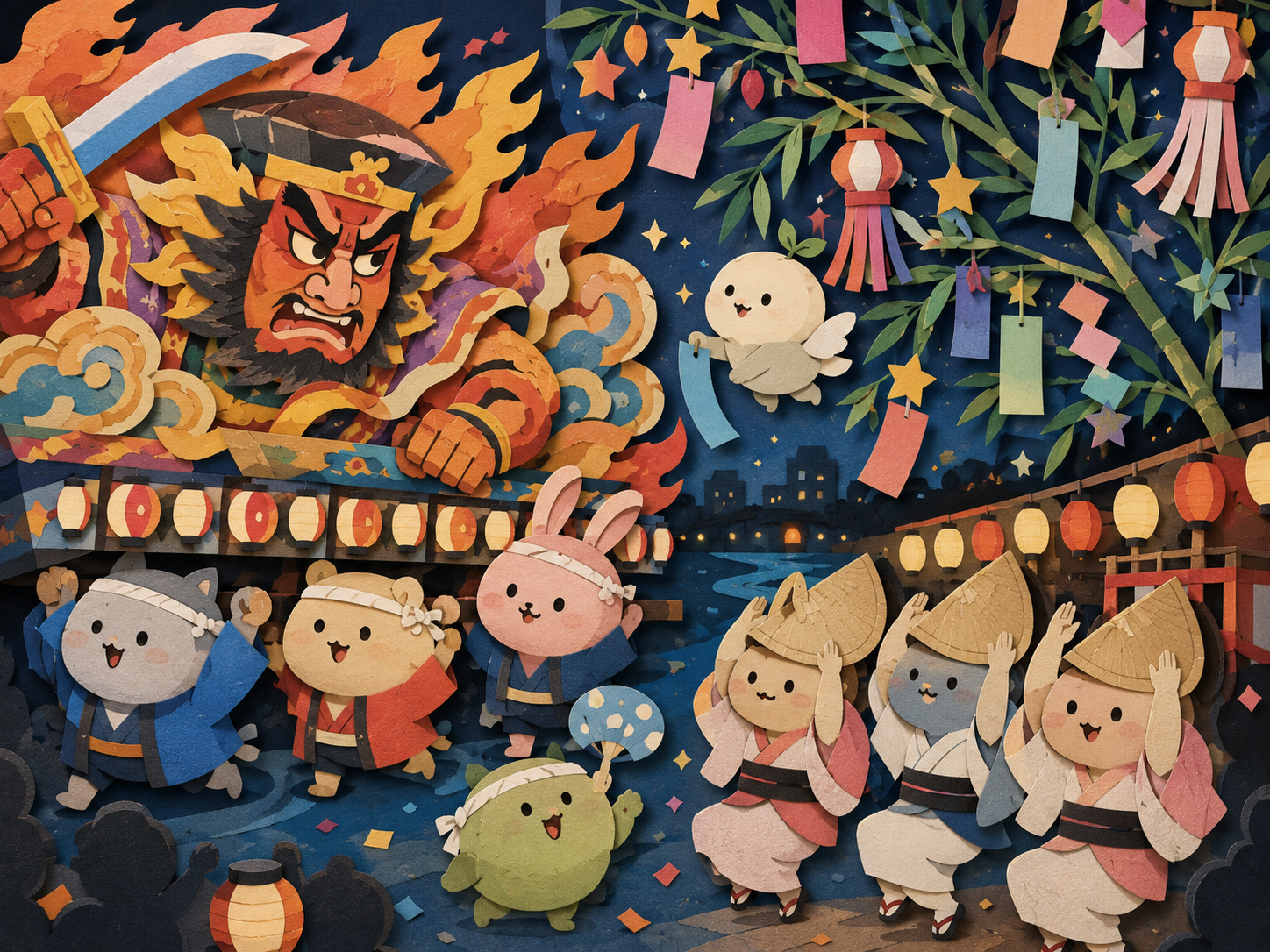
Japanese summer festivals have never been only spectacles. They are walked through, heard in the chest, smelled in the food stalls, and remembered through fans, towels, photographs and the rhythm of drums. In summer 2026, one of Japan’s most powerful contemporary character worlds will step into that older festival space: Chiikawa.
Applibot announced on July 8 that Chiikawa Pocket, the first smartphone app based on Nagano’s Chiikawa, will hold “Chiipoke Summer Festival 2026” across three major festivals: Aomori Nebuta Festival, Sendai Tanabata Festival and Awa Odori in Tokushima. Visitors who show the app screen at designated sites can receive a limited “Chiipoke summer fan,” while festival-only merchandise featuring the characters in yukata will also be sold.
This is more than a cute promotional campaign. It is a meeting of three layers of Japan: regional festival culture, mobile character IP and summer family tourism. For generations, festivals were local media — made by neighborhoods, artisans, dancers, shopping streets, parents’ associations and visitors. Now a character born in the social-media era is entering that civic stage.
A three-city summer route for Chiikawa fans
In Aomori, a “Chiipoke Nebuta” carrying yukata-clad Chiikawa, Hachiware and Usagi is scheduled to appear as a front Nebuta for the Aomori City PTA Federation. It will run on August 2, 3, 5 and 6. Novelty fan distribution is planned from August 1 to 7 near the PTA Nebuta hut.
In Sendai, Tanabata decorations featuring Chiikawa, Hachiware, Usagi, Momonga and Kurimanju in yukata will appear inside the Hapina Nakakecho shopping arcade. At “Haremachi Court” on the second floor of Sendai Station, novelty distribution and limited merchandise sales are scheduled from August 5 to 16.
In Tokushima, the collaboration moves to Mount Bizan. A special “Chiipoke Observatory” photo spot will appear from August 10 to 16, giving families and fans a place to take pictures with yukata Chiikawa imagery above the city. Novelty distribution is planned near Amico Dome from August 12 to 15, while merchandise sales run August 10 to 16.
The numbers behind the summer collaboration
Chiikawa Pocket launched on March 27, 2025 in 43 countries and regions. Its concept is being “together with Chiikawa anytime, anywhere.” The 2026 festival plan takes that promise literally: the app leaves the phone and enters the street, the station, the mountain lookout and the festival route.
Modern character IP rarely stays inside a single medium. Manga, animation, mobile games, pop-up shops, cafes, limited goods, film releases and tourism campaigns now feed one another. Chiikawa is especially effective because its charm is double-layered: small and adorable on the surface, but often anxious, fragile and strangely tough underneath. That emotional range is part of why the series connects with both children and adults.
Aomori Nebuta: a small character before a giant lantern world
Aomori Nebuta is one of Japan’s most visually overwhelming summer festivals. The official festival guide describes its main attraction as large, colorful human-shaped floats, often about nine meters wide, seven meters deep and five meters high, depicting warriors, historical figures, kabuki characters and mythology. They move through the city at night, surrounded by music, dancers and light.
The decision to place Chiikawa as a front Nebuta matters. A front Nebuta does not replace the main spectacle. It opens the way. In this role, Chiikawa becomes a guide — inviting children, young fans and first-time visitors toward the larger festival tradition behind it.
Nebuta is made from craft, logistics and community. Paper, wire, light, painting, music, pulling teams and crowd management all become one moving artwork. If the collaboration works, a child who came for Chiikawa may encounter the true scale of Nebuta for the first time. That is not a loss of tradition; it is one of the ways tradition renews its audience.
Sendai Tanabata: wishes hanging above the city
Sendai Tanabata Festival is held every year from August 6 to 8 and is one of Japan’s largest Tanabata celebrations. Its official English site explains that Sendai holds the festival in August to preserve the seasonal feel of the old calendar, and that central Sendai and neighboring shopping districts fill with colorful decorations. Miyagi tourism materials describe it as Japan’s largest Tanabata event, drawing more than two million visitors.
Tanabata is about wishes made visible. Streamers, paper strips, cranes, nets, purses and other decorations have long carried hopes for learning, craft, harvest, business, cleanliness and thrift. Sendai turns those hopes into an urban ceiling. Visitors walk beneath a city of wishes.
For Chiikawa to appear in Hapina Nakakecho is to move from product to streetscape. The character becomes part of the shopping arcade’s temporary sky. Fans who know Chiikawa from screens and shops encounter it overhead, among local decorations and everyday commerce. The festival becomes a shared route between IP culture and the city.
Awa Odori: between dancing fools and watching fools
Tokushima’s Awa Odori, held each year from August 12 to 15, is Japan’s most famous dance festival and is often described as having more than 400 years of history. Dance troupes known as ren move through the city to gongs, drums, flutes and shamisen. The famous line — the dancing fool and the watching fool are both fools, so why not dance? — captures the festival’s participatory spirit.
The Chiipoke Observatory on Mount Bizan is a different kind of placement. It does not try to occupy the dance route. Instead it creates a memory point above the city, a place where families and fans can pause, photograph and look back over Tokushima during festival season.
Awa Odori is not only a performance. It is a city turned into movement. A photo spot, a fan, a towel or a limited good becomes the object that carries the movement home after the music ends. This is the souvenir as memory technology.
Characters and festivals have always belonged together
It is tempting to treat character collaborations as entirely modern. But Japanese festivals have always used figures, faces and narrative bodies: warrior paintings, kabuki scenes, deities, lucky gods, masks, zodiac animals, maneki-neko, daruma, hyottoko and okame. Festivals have long turned abstract hopes into visible characters.
What changed is speed and distribution. Where woodblock prints and picture books once spread images, social platforms, animation, apps and merchandise now move characters instantly across the country and overseas. Chiikawa began as a manga posted on X, then expanded through television animation, goods, games and, now, festival space.
The PR announcement notes that Chiikawa has won the Japan Character Award Grand Prix in 2022, 2024, 2025 and again in 2026. The series is not a niche mascot. It is a national character platform. That makes its use in regional festivals commercially powerful — but also culturally delicate.
The rule of success: keep the festival as the hero
A popular character alone cannot make a successful festival collaboration. The key is whether the character supports the local tradition rather than covering it. This 2026 plan is interesting because the placement changes by festival: a front Nebuta in Aomori, Tanabata decorations in a Sendai arcade, and an observatory photo spot in Tokushima.
Each site uses Chiikawa differently. Aomori integrates it into the procession structure. Sendai turns it into hanging decoration. Tokushima makes it a viewpoint and memory marker. That flexibility is important. Without it, a collaboration risks becoming only merchandise. With it, the character becomes a doorway into the festival itself.
The operational details matter too. The announcement includes notes about possible entry restrictions, numbered tickets, queue times, changes due to weather or trouble, and etiquette around photography and exhibits. That may seem like fine print, but it is the reality of character-driven crowd management. Joy needs flow. Flow needs planning.
Japan.co.jp view
Chiipoke Summer Festival 2026 is a smartphone game promotion. It is also a small case study in how Japanese culture renews itself. Festivals are not museum pieces. They survive by absorbing new audiences, new media, new logistics and new souvenirs without losing the rhythm that made them local in the first place.
Aomori Nebuta, Sendai Tanabata and Tokushima Awa Odori each have deep regional identities. Chiikawa belongs to the social-media age: tiny, vulnerable, funny, marketable and emotionally strange. Their meeting in summer 2026 is not a story of pop culture swallowing tradition. It is a story of tradition gaining another entrance.
A child receives a fan. A parent takes a picture. A grandparent explains the festival’s origin. A visitor buys a towel and remembers the sound of the drums. In that small chain, character goods become more than goods. They become carriers of place. Japanese summer festivals have always changed this way: one night, one street, one memory at a time.
Reader guide
| Item | Meaning |
|---|---|
| What was announced | Chiikawa Pocket will run Chiipoke Summer Festival 2026 across Aomori Nebuta, Sendai Tanabata and Awa Odori. |
| Aomori | A Chiipoke Nebuta is scheduled as a front Nebuta, with novelty distribution and limited goods. |
| Sendai | Chiikawa Tanabata decorations appear in Hapina Nakakecho, with distribution and sales at Sendai Station. |
| Tokushima | A Chiipoke Observatory photo spot appears on Mount Bizan, with related distribution and sales around Amico. |
| Why it matters | Regional festivals, character IP, mobile apps and family tourism are being connected into one summer route. |
Sources and notes
This article draws on Applibot’s Chiipoke Summer Festival 2026 announcement, official Aomori Nebuta and Sendai Tanabata materials, Tokushima Awa Odori information, Miyagi tourism materials, and Japan Guide festival background.
- PR TIMES / Applibot: Chiipoke Summer Festival 2026 announcement and venue details.
- Aomori Nebuta Festival Official: festival overview, float scale and access information.
- Sendai Tanabata Festival Official: dates, background and visitor scale.
- Visit Miyagi: Sendai Tanabata tourism information.
- Japan Guide: Tokushima Awa Odori dates and background.
- Awa Odori official site: official festival information.