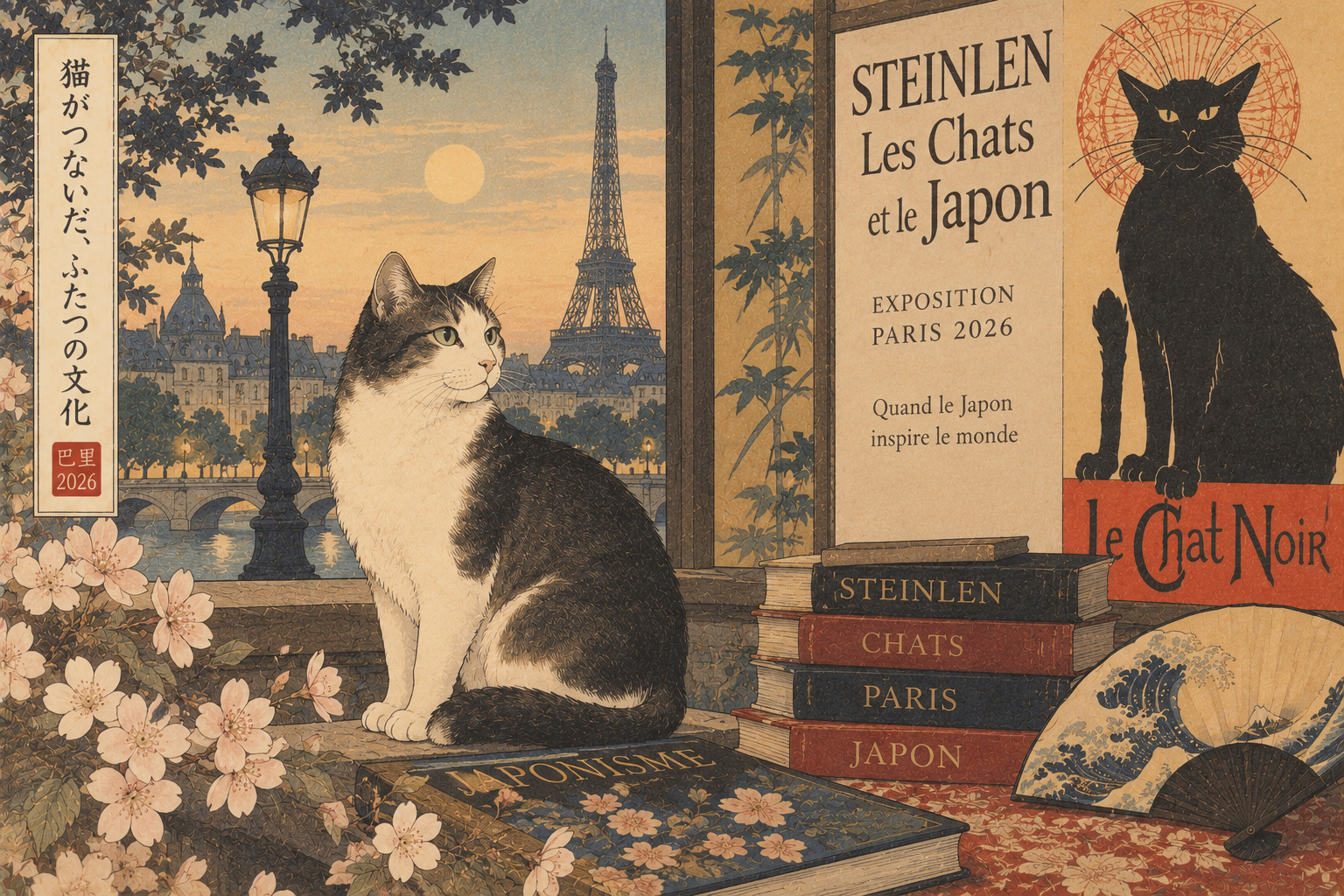
A black cat opens a much larger history of Japanese prints, Parisian streets and visual modernity.
A black cat crosses the art-historical border
A cat needs no passport. In late nineteenth-century Paris, however, the animal could cross remarkably consequential boundaries: between painting and advertising, private affection and public satire, Japanese print culture and Europe’s expanding graphic marketplace. A new exhibition opening on October 17 at Tokyo’s Ebara Hatakeyama Museum of Art makes that journey visible.
“Steinlen and the Japonisme of Cats: From Manet to Le Chat Noir and the Age of Art Nouveau,” presented in the museum’s new building, runs through December 13. The museum expects to display about 100 works, spanning Western prints and posters, Japanese ukiyo-e and previously unseen Japonisme-related materials. It is less a claim that Japan invented the Parisian cat than an invitation to ask how images travel and acquire new meanings.
Who was Théophile-Alexandre Steinlen?
Born in Lausanne in 1859, Théophile-Alexandre Steinlen learned the discipline of commercial design in the textile industry before moving to Paris with his wife, Émilie, in 1881. There he found the radical artistic ecosystem of Montmartre: cabarets, newspapers, printers, street performers and workers who wanted to be seen. His output ranged from caricatures and illustrations to lithographs, sculptures and paintings.
The poster most familiar to a contemporary audience, the 1896 “Tournée du Chat Noir,” distills the era into a watchful dark silhouette with arresting eyes. It advertised a touring entertainment enterprise associated with the famous Le Chat Noir cabaret. The image’s longevity is striking, but reducing Steinlen to that single design obscures much of what he did.
What was Le Chat Noir?
Rodolphe Salis opened Le Chat Noir in Montmartre in 1881. It became a hub for cabaret performance, sharp humor, literature and shadow theatre, in which silhouettes and music allowed stories to unfold in front of an audience. Its name—“The Black Cat”—proved unusually suited to a visual identity.
Steinlen joined a world where an artist’s work did not stay in a salon. It appeared on a wall, in a handbill, in a magazine and in popular conversation. A useful modern analogy is the graphic that circulates far beyond its original audience, although the nineteenth-century economics and technology were very different.
Japan enters the Parisian picture
After Japanese trade expanded in the mid-nineteenth century, prints, ceramics, textiles, fans and other objects entered European markets. The 1867 Paris Exposition helped put Japanese craftsmanship before a broad public. Collectors and artists increasingly encountered ukiyo-e, whose asymmetrical compositions, bold silhouettes and areas of unmodulated color offered alternatives to academic Western pictorial convention.
The term Japonisme covers overlapping processes—collecting, adaptation, fashion, scholarship and sometimes exoticizing fantasy. It should not suggest that all European modern art developed through a single line of influence. French poster designers responded selectively to Japanese artworks while also drawing on lithography, commercial competition and the changing rhythms of city streets.
The 1890 poster that gives this story documentary force
One of the clearest documented connections between Steinlen and Japanese imagery predates the celebrated black cat. His 1890 poster for “Le Rêve,” a ballet set in Japan at the Paris Opéra, uses prominent flattened color and Japanese-inspired graphic devices. The Metropolitan Museum of Art specifically connects the poster’s visual language with ukiyo-e.
The Cantonal Museum of Fine Arts in Lausanne adds an important caution. This entertainment also trafficked in highly stylized European stereotypes of Japan. What looked innovative in typography and composition could coexist with superficial or distorted understandings of Japanese life. Cross-cultural admiration and appropriation are not mutually exclusive; the poster offers evidence of both.
Why the cat mattered even without Japan
Steinlen was an unusually observant cat artist. The Musée d’Orsay describes thousands of appearances of cats in his work and records how he cared for neighborhood animals at a home nicknamed the “Cat’s Cottage.” They could be mischievous, proud, watchful and affectionate, but they were rarely anonymous decoration.
There is insufficient evidence to claim that every Steinlen cat descended from a particular Japanese model. Cats were already present throughout European visual culture, including works by Édouard Manet. The exhibition’s more productive question is how preexisting subjects were transformed by modern modes of composition, distribution and attention.
A satirist behind the whiskers
The Metropolitan Museum has examined Steinlen’s political output, emphasizing his concern for workers and the social conditions of Paris. Posters and widely distributed drawings could reach people who would never enter a gallery. His artistic practice included social observation, criticism and a belief that accessible images could matter politically.
The cat’s independent posture fits that broader sensibility, though interpreting any single animal image as a direct political manifesto would overstate the evidence. Steinlen’s career illustrates how artistic tenderness and social confrontation can coexist: the artist who studied paws and fur also studied poverty and inequality.
The poster becomes a public art form
A poster had to work in a glance. It competed with shops, traffic, other notices and entertainment on the city’s walls. Advances in color lithography made bold designs reproducible and affordable, while the expanding entertainment industry offered a constant stream of commissions. Graphic clarity became both an aesthetic and a commercial necessity.
The comparison with ukiyo-e is rewarding precisely because Japanese woodblock publishing was also a form of popular, reproducible visual culture. Neither market was identical to the other. Yet both challenge the tidy modern division between “fine art” and images made for broad circulation. In that sense the black cat’s afterlife in museums has a productive irony.
Two exhibitions, two directions of desire
The museum has paired the Steinlen exhibition with “Longing for Foreign Lands—Chinese, Island and Early Imported Treasures,” a collection-focused show in its main building examining the long history of imported objects in Japanese tea culture. The paired exhibitions offer an unusually thoughtful curatorial conversation.
In one set of galleries, Europeans look toward Japan; in another, Japanese tastemakers look outward. Desire can generate careful study or caricature. Objects pass through trade, collecting, translation and reclassification. Presenting these histories in adjacent spaces helps resist the idea that influence only travels in one direction.
A practical guide to the Tokyo exhibition
Ebara Hatakeyama Museum of Art is at 2-20-12 Shirokanedai, Minato-ku, Tokyo. The exhibition occupies the second floor and basement level of the new building, October 17–December 13, 2026. General hours are 10 a.m. to 5 p.m., with final admission at 4:30 p.m.; the museum normally closes on Mondays, or the following Tuesday when Monday is a holiday.
Museum director Masayuki Okabe (岡部昌幸) is scheduled to lead an opening-day gallery talk on October 17, from 11 a.m. to noon. The museum revised the arrangements: advance registration is no longer needed, though admission rules still apply. Attendees should confirm the most recent notice; the event may change, and photography or recording during the gallery event is restricted.
What the public record does not establish
The museum says the exhibition includes about 100 items and previously unshown Japonisme materials. It has not furnished, in the public overview consulted for this report, the full exhibition-by-exhibition provenance of those new materials. The description does not by itself confirm that any particular privately held state or impression of the famous 1896 poster will be displayed.
This matters in printmaking. An original lithograph, a later impression and a reproduction may look similar in a small online image yet differ materially in date, context and scholarly value. Readers should consult the actual object labels and catalogue before drawing conclusions about what is on display.
The most interesting thing about the cat
In a museum in Tokyo, a familiar Parisian black cat becomes a path back into Japanese art. That return trip is more revealing than a simple story of one culture “conquering” another. It includes artists and collectors, but also printers, audiences, popular commerce, borrowing and misunderstanding.
The symbol survives because it is compact enough to travel and rich enough to keep being read. A century after Steinlen’s death, it still asks the same question of a new audience: how can one image look so simple and contain so much history?