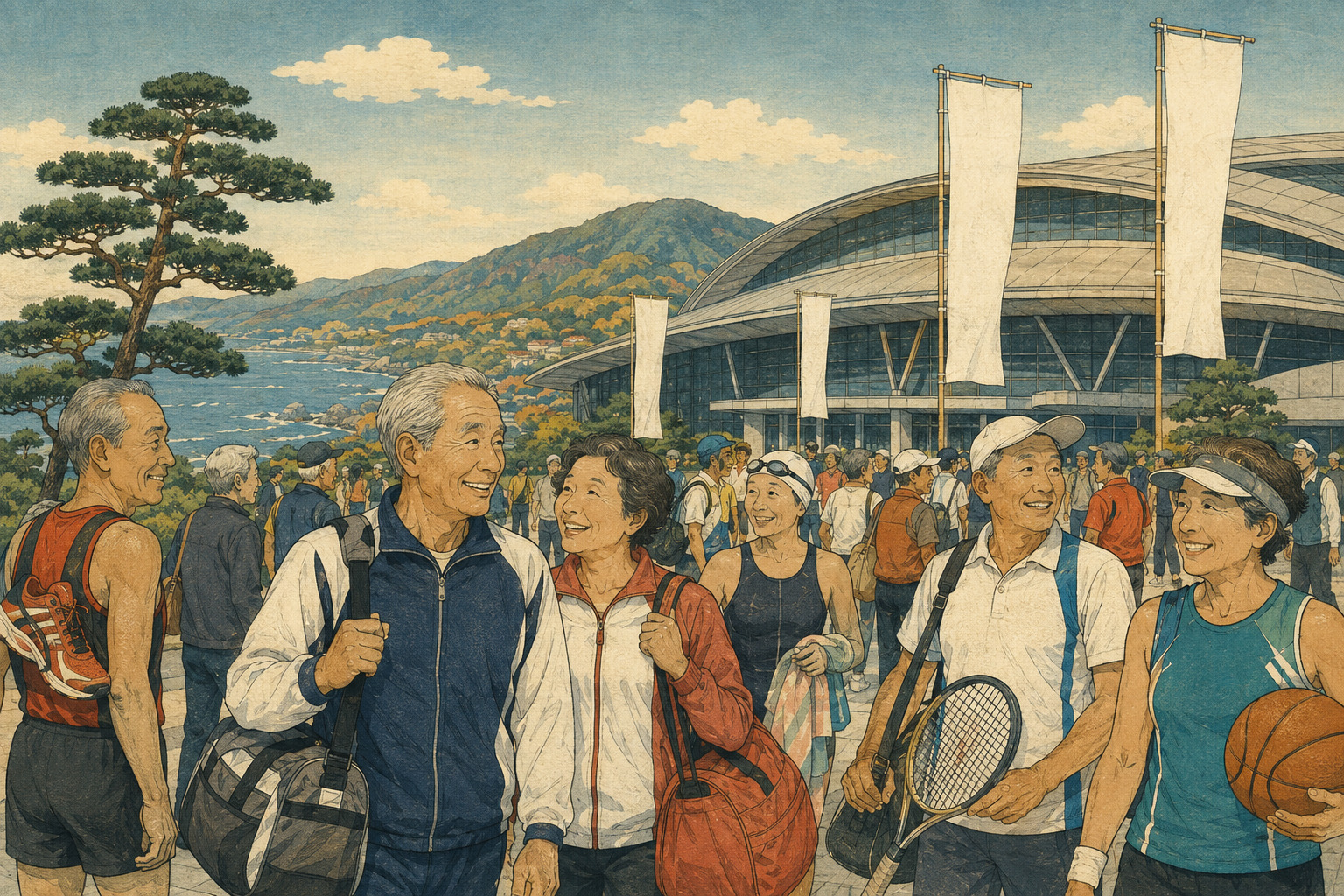
One figure gives the event its headline scale: 7,946 expected participants as of August 25. It is not an athlete count and it is not a crowd expected on one weekend. The Japan Sport Association’s estimate includes athletes, coaches, event and competition officials, operating staff and a 158-member Korean delegation. Organizers say the total may change.
The event is spread across four competition windows. Swimming runs August 29–30, karate September 12–14, ten sports make up the September 19–22 main period, and golf follows September 28–30. The pre-festival opening ceremony is scheduled for September 18 at Hotel Nikko Kanazawa, after swimming has already been completed.
A selected national field, not open-entry recreation
The Japan Sport Association describes the Masters as the country’s only comprehensive multi-sport event for competition-oriented senior athletes. Ages are generally 35 and above, with specific limits and divisions set separately for each sport.
Under the official rules, prefectural sport federations recognize their representatives, and athletes pass prefectural or regional qualifying where required. Each athlete may enter one sport. As a rule, competitors also do not participate in the same year’s Japan Games (Kokumin Sports Taikai). This is lifelong sport with selection and national titles, not a walk-up community meet.
Four competition windows across a month
Swimming opened the schedule at the 50-meter Kanazawa Pool. After weather warnings and transportation disruption in parts of Ishikawa, organizers said at 4 p.m. on August 27 that they had found no condition preventing the meet from proceeding, while advising participants to monitor weather and transit information.
| Dates | Sports | Location pattern | Reporting note |
|---|---|---|---|
| Aug. 29–30 | Swimming | Kanazawa Pool, Kanazawa | Organizer confirmed the schedule after the August 27 weather alerts |
| Sept. 12–14 | Karate | Ishikawa General Sports Center, Kanazawa | Held before the main period |
| Sept. 19–22 | Ten sports | Venues across nine cities and four towns | Soccer, tennis, volleyball, basketball, cycling, soft tennis, rubber-ball baseball, softball, badminton and bowling |
| Sept. 28–30 | Golf | Katayamazu Golf Club, Kaga | Men and women on separate courses |
Competition reaches into Noto
The host map includes Kanazawa, Nanao, Komatsu, Suzu, Kaga, Kahoku, Hakusan, Nomi and Nonoichi, as well as the towns of Uchinada, Shika, Hodatsushimizu and Nakanoto. The official schedule assigns rubber-ball baseball games to Suzu Municipal Baseball Stadium, Nanao Shiroyama Baseball Stadium, Shika Town Baseball Stadium, Nakanoto Town Sports Park Baseball Stadium and Hodatsushimizu Baseball Stadium, among other sites.
That distribution sends teams, federation personnel and accompanying visitors beyond Kanazawa and into communities affected by the 2024 Noto Peninsula earthquake and subsequent heavy rain. It creates an opportunity for national attention and local contact. It does not, by itself, prove that the event raises income, accelerates rebuilding or produces repeat visits.
Recovery communication is a stated policy goal
In a June 2025 address to the prefectural assembly, Ishikawa’s governor said the prefecture would prepare the Masters to raise interest in sport and health and to communicate Noto’s recovery nationwide. The Japan Sport Association’s August 2026 event announcement likewise placed the tournament in the context of Ishikawa’s continuing recovery work.
Those are documented institutional objectives. Outcomes require different evidence: municipal-level attendance, overnight stays, procurement from local businesses, spending in affected communities, media reach and whether participants return. The official materials reviewed at the opening did not publish those targets or a method for evaluating them.
- Athletes, officials, spectators and volunteers by sport and municipality.
- Overnight stays, visitor-days and spending specifically in the Noto area.
- Local procurement and contracts awarded to affected businesses.
- Any event-driven repairs or access improvements at host facilities.
- National media exposure, participant awareness and intention to revisit.
A 158-member Korean delegation
The Korea Sports & Olympic Committee delegation consists of 151 athletes and seven headquarters officials. It will be in Ishikawa from September 17–22 and take part in eight sports: men’s soccer, tennis, women’s volleyball, men’s basketball, soft tennis, men’s rubber-ball baseball, badminton and bowling.
The adult exchange grew from the decision to co-host the 2002 FIFA World Cup. The Japan Sport Association says the exchange has operated annually since fiscal 1997, with Japanese adults joining Korea’s nationwide sport-for-all festival and Korean athletes receiving special entry to the Japan Sports Masters. Host-team exchange matches are also planned.
Third Ishikawa edition, a different test
Ishikawa hosted the Masters in 2011 and 2015, making 2026 its third edition. This time the event arrives during a continuing recovery period and under the local slogan Ishikawa de atsuku naranke!—printed by organizers in Japanese as “いしかわで 熱くならんけ!” Competition viewing is free.
Experience hosting the event can help with operations, but the meaningful test extends beyond medals and schedules. It is whether a dispersed national tournament can be run safely, direct attention and activity into host communities, and leave evidence strong enough to distinguish a recovery contribution from a promotional hope.
Reporting cutoff: This report uses official materials available by 9:50 a.m. JST on August 29. The swimming results page was live, but the full opening-day results were not incorporated. Before publication as an August 30 morning-edition page, the swimming status and results, weather notices and transportation information should be checked again.
- Japan Sport Association — Event announcement, expected participation, schedule and Korean delegation
- Japan Sport Association — Japan Sports Masters 2026 general and sport regulations (Japanese PDF)
- Japan Sport Association — Pre-main-period competition notice
- Japan Sports Masters 2026 Ishikawa official site — Schedule, venues and results
- Organizing committee — August 27 decision to proceed with swimming amid weather alerts
- Ishikawa governor’s assembly address — Policy objective of communicating Noto’s recovery nationally