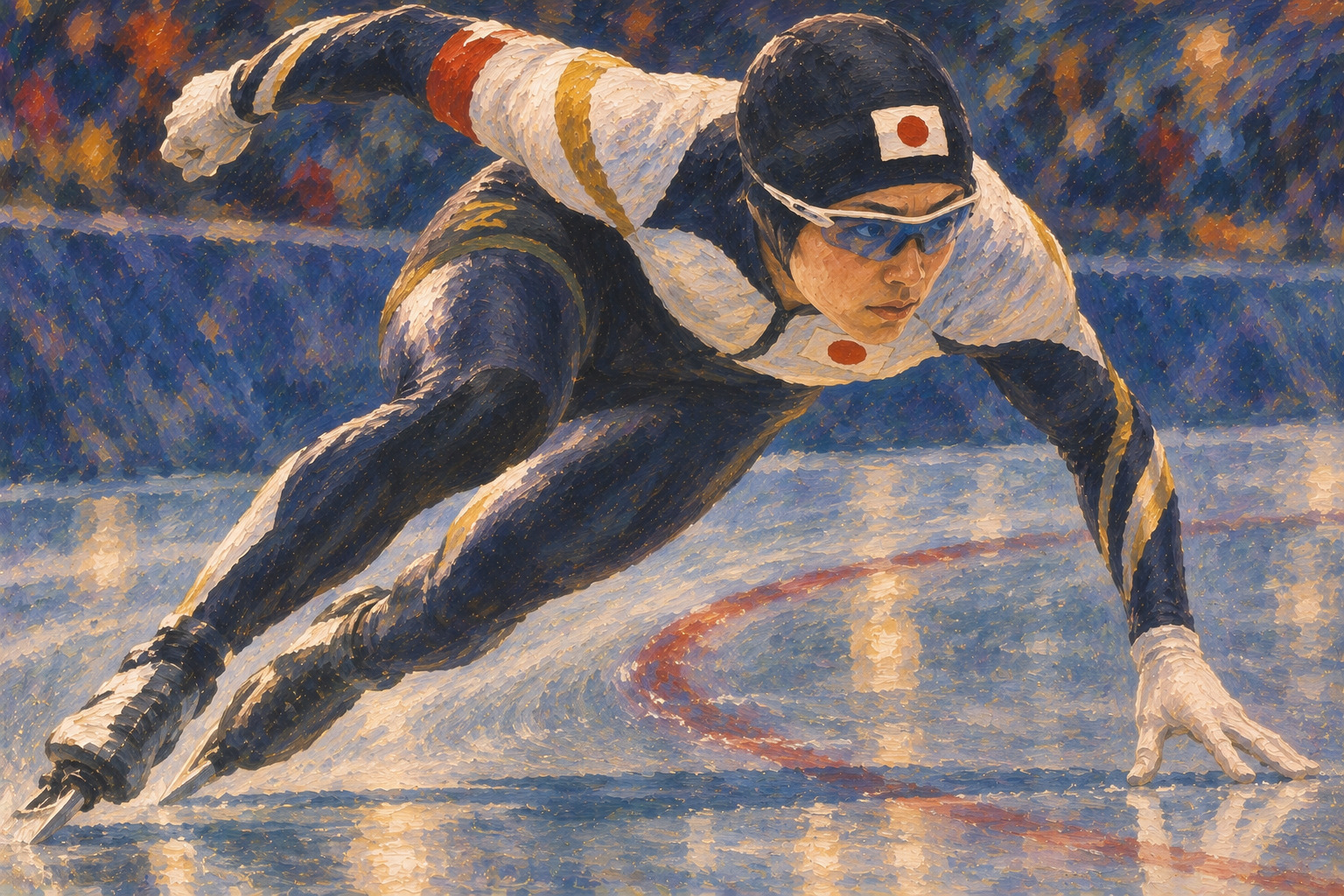
- A Hundredth of a Second From the Podium
- Three Japanese Women, Three Different Benchmarks
- The Men’s 1,000m and the Longer-Distance Test
- The End of the Miho Takagi Era
- How Japan Became a Speed-Skating Nation
- What Happens on a 400-Metre Oval
- Beijing’s Ice Ribbon: An Olympic Venue With a New Role
- The Three-Day Program—and a Tactical Change
- Obihiro: The Next Global Meeting Is in Hokkaido
- An Opening Result, Not Yet a Weekend Verdict
A Hundredth of a Second From the Podium
In the opening race weekend of the 2026–27 ISU Speed Skating World Cup, Japan found a result that was at once encouraging and painfully narrow. Rio Yamada stopped the clock at 1:15.86 in the women’s 1,000 metres in Beijing on November 13. She finished fourth, just one hundredth of a second outside the medals, according to Japanese wire-service reports. That margin is much smaller than the time it takes to blink. In a race decided by repeated technical choices on an oval track, it is nevertheless enough to redraw the podium.
The result has a significance beyond one race. Japan is entering its first full international season since Miho Takagi retired in April, ending a career that set a very high standard for both individual and team skating. Yamada’s performance does not establish a successor, nor does it predict the rest of the season. It shows that Japan has skaters capable of contesting the international front group. This article reports completed races through November 13; November 14–15 results were not yet verified at the reporting cutoff.
Three Japanese Women, Three Different Benchmarks
Yamada, representing Naotomi Shoji, led Japan in the women’s 1,000m at 1:15.86. Yukino Yoshida of Juko was ninth in 1:16.33, while Anna Kubo of JTB finished eleventh. The positions are not interchangeable stories. A fourth-place finish invites questions about what separates a contender from a medalist. Ninth can reveal the performance threshold for the upper half of the elite field. Eleventh marks another measurable point on an athlete’s trajectory.
A 1,000m race asks for both sprint explosiveness and the ability to sustain speed well beyond the first lap. An aggressive start can extract a cost in the final turns; a measured start may leave too much time to recover. Without verified split times and race footage, however, no responsible account can identify the precise moment that cost Yamada 0.01 seconds. We know the finishing time and placing. We do not know which technical decision would have changed them.
The Men’s 1,000m and the Longer-Distance Test
Japan’s Kazuya Yamada, listed with Wellnet, was eleventh in the men’s 1,000m in 1:09.22. Ryota Kojima of M-Wave was twelfth. The winner, China’s Ning Zhongyan, recorded 1:07.43. Those results place Japan’s opening men’s sprint performance at a different competitive distance from Rio Yamada’s near-podium showing in the women’s event. Comparison requires attention to the course, pairs and conditions, but the posted times identify the gap to the leading performance.
In the women’s 3,000m, Momoka Horikawa of Fujikyu finished eleventh in 4:08.47. This race emphasizes an entirely different balance of attributes: pacing, efficient movement and the management of fatigue over repeated laps. Treating the Japanese delegation as one homogeneous squad would obscure the separate technical problems posed by each distance. A useful season review should examine athletes event by event rather than turn one result into a verdict on an entire program.
The End of the Miho Takagi Era
In April 2026, Miho Takagi announced her retirement. The International Skating Union credits her with ten Olympic medals, including gold in the women’s 1,000m in Beijing in 2022 and team pursuit gold in PyeongChang in 2018. Her career was unusually versatile, spanning middle-distance racing and collective events, and it made her a reference point for how Japanese athletes could compete internationally over successive Olympic cycles.
But the retirement of a champion does not create a single vacancy that one younger skater can fill. A national program needs sprinters, endurance specialists, reserves and team-pursuit combinations. It also needs continuity in coaching, access to high-quality ice, sports science and an environment in which athletes can improve without every outing being judged against the medals of a previous generation. The central question for 2026–27 is less “Who replaces Takagi?” than “How widely can Japan distribute competitive strength?”
How Japan Became a Speed-Skating Nation
Speed skating has deep roots in communities where winter ice, school athletics and dedicated local facilities supported repeated competition. Its national visibility grew markedly at the Nagano Winter Olympics in 1998, where Hiroyasu Shimizu won the men’s 500m gold medal. The sport’s development since then has relied on more than headline champions: training infrastructure, regional networks and the slow accumulation of technical expertise have helped keep Japan relevant.
The women’s team pursuit gold in 2018, followed by Takagi’s 1,000m title in 2022, created a modern sequence of achievements that new athletes inherit as inspiration, not as a guaranteed entitlement. The 2026 Milano Cortina Games concluded one Olympic cycle; the Beijing World Cup marks the beginning of another. What sustains excellence across cycles is an institution’s capacity to turn individual knowledge into transferable methods.
What Happens on a 400-Metre Oval
Long-track speed skating takes place on a 400-metre oval. Speed is generated by forces applied to the ice and protected by remarkably precise body positions. On the straights, athletes must produce propulsion without wasting motion. Through corners, they have to counter lateral forces while maintaining a stable and efficient blade angle. Every transition between steps creates an opportunity either to maintain momentum or to lose it.
The 1,000m event comprises two and a half laps, combining quick acceleration with demanding speed maintenance. A hundredth of a second can arise from accumulated differences rather than one spectacular mistake. That is why analytical coverage should ask for official lap splits, lane and pair information, and reproducible comparisons before making strong claims about technique. The fascination of Yamada’s fourth place lies precisely in the smallness of the measurable margin and the complexity behind it.
Beijing’s Ice Ribbon: An Olympic Venue With a New Role
The season opener runs November 13–15 at the National Speed Skating Oval in Beijing, the Ice Ribbon, built for the 2022 Winter Olympics. The International Skating Union says the same arena will host the 2027 World Speed Skating Championships from February 25–28. That makes the first stop an early opportunity to understand the environment in which the season’s major championship will be contested.
There is no automatic guarantee that every Olympic venue produces unusually fast times. Air temperature, humidity, ice preparation, race scheduling and the composition of the field can influence comparisons across meetings. The venue’s historical identity is clear; its direct effect on any particular Japanese performance is a question that would require evidence.
The Three-Day Program—and a Tactical Change
According to the ISU’s November 12 competition schedule, November 13 featured the women’s 3,000m, men’s 5,000m and both 1,000m races. November 14 was scheduled for the first women’s and men’s 500m races and both 1,500m events. The final day, November 15, was set to include team pursuit, second 500m races and men’s and women’s mass starts. Lower-tier Division B sessions precede the Division A races. Start times are provisional and should not be mistaken for results.
The ISU has also highlighted an elimination-based mass-start format for the new season, a change that may reward tactical positioning in addition to raw endurance. The details of how athletes adapt will be clearer only after completed races can be reviewed. It would be premature to write a narrative about Japan’s mass-start performance while those contests remain on the calendar rather than in the official results.
Obihiro: The Next Global Meeting Is in Hokkaido
After Beijing, the second World Cup stop is scheduled for November 20–22 at Meiji Hokkaido Tokachi Oval in Obihiro. Japan Skating Federation lists the event among its official November competitions. The location speaks to the importance of regional sporting infrastructure: elite international competition does not belong only in capital-city arenas, and Hokkaido has a longstanding relationship with winter skating.
Home-ice races can offer young spectators a direct view of the best in the world while giving national-team athletes another chance to measure progress. Those are opportunities, not quantified economic outcomes. The number of spectators, any growth in tourism spending and whether Japanese skaters improve their performances will need post-event evidence. The editorial advantage of following Beijing into Obihiro is the ability to compare real times across a meaningful, short interval.
An Opening Result, Not Yet a Weekend Verdict
As of the reporting cutoff, the confirmed Japanese results include Rio Yamada’s fourth place in the women’s 1,000m, Yoshida’s ninth, Kubo’s eleventh, Kazuya Yamada’s eleventh in the men’s 1,000m, Kojima’s twelfth, and Horikawa’s eleventh in the women’s 3,000m. These are not forecasts or provisional podium allocations. They are results reported on November 13 and should be checked again against the official ISU result records before final publication.
The issue is dated November 16, but editorial production began before Saturday and Sunday racing was complete. That gap must remain visible. A final published weekend recap should add the verified 500m, 1,500m, team pursuit and mass-start performances, then revise the opening and headline if those events change the story. Until that work is done, the most defensible conclusion is also the most interesting: one Japanese skater started a new era just 0.01 seconds from the medals.
Sources and methodology
Reporting cutoff: results announced through November 13, 2026 (Japan time). Competition schedule and international context derive from Japan Skating Federation and ISU materials; individual Japanese placements and times are from dated Kyodo and Jiji reporting. November 14–15 results were not yet verified. No independent rink-side interviews or full split-time analysis was conducted.
- 日本スケート連盟:2026年11月大会日程 / JSF calendar
- ISU:北京大会競技日程(11月12日) / Beijing schedule
- ISU:北京大会公式ページ(リザルト・エントリー) / Official event
- ISU:2026/27シーズン展望 / Season preview
- ISU:高木美帆引退記事(4月29日) / Takagi retirement
- 共同通信(熊本日日新聞):11月13日の日本勢結果 / Japanese results
- 時事通信:山田梨央、3位と0秒01差 / 0.01s podium margin
- ISU:2026/27年間日程 / Full season calendar
- ISU:北京大会の注目選手 / Beijing preview