The most important space in a modern greenhouse may be neither the roof nor the aisle. It is the moving pocket of air among the leaves: the crop canopy, where heat gathers, moisture lingers, carbon dioxide is consumed and yield is made or lost. Japan's latest smart-agriculture certification is aimed directly at that space.
On September 4, the Ministry of Agriculture, Forestry and Fisheries certified a development-and-supply plan submitted by Hort-Plan LLC, a sensor and environmental-control company with its principal development operation in Osaka. The five-year plan calls for a system that measures and locally controls four variables around strawberries and other greenhouse crops: temperature, humidity, CO2 concentration and airflow.
The official diagram shows in-canopy measurement connected to temperature-and-humidity, wind-speed and CO2 sensors. Ducts, a local environmental-control unit, an air-mixing device, a CO2 generator and a water-source heat pump would respond to those readings. Cooling is explicitly included. Rather than treating the greenhouse as one uniform box, the concept is to put measurement and conditioning closer to the plants.
A target, not a certified result
MAFF classifies the technology under cultivation management for greenhouse vegetables and flowers. The stated objective is technology that contributes to a 30% increase in value added by improving the greenhouse environment, including localized CO2 application. That is a demanding economic target, but the wording matters.
Certification does not mean that Hort-Plan has already produced a commercial system, raised value added by 30% on farms, or received an official guarantee that it will do so. The ministry examined a plan under statutory criteria. The one-page public summary does not identify the baseline used for the 30% figure, the number or location of demonstration farms, the expected equipment price, planned unit sales or a commercial launch date.
Value added is also broader than yield. More marketable fruit or higher quality can lift revenue, but electricity, equipment, maintenance, water management and CO2 all cost money. A system can raise output and still fail as an investment. The business case becomes stronger only if more precise control improves saleable production while keeping the added inputs and capital cost below the added value.
What the certification establishes—and what it does not
| Established by the public record | Not established by certification alone |
|---|---|
| MAFF found the five-year plan met the legal requirements for a development-and-supply plan. | That the system is complete, commercially available or profitable for farmers. |
| The plan targets technology that contributes to a 30% increase in value added. | That a 30% increase has been measured or independently reproduced. |
| Certification makes specified financing, tax and research-support measures available to qualifying applicants. | That a loan, guarantee, tax benefit or research-facility request has automatically been approved. |
The crop canopy becomes the control zone
Conventional greenhouse controls often respond to readings taken at one or several fixed points. Yet a crop changes the space around itself. Dense leaves slow air movement. Transpiration raises humidity. Photosynthesis draws down CO2 near leaf surfaces. Sunlight can produce hot spots even when a greenhouse-wide average looks acceptable.
Hort-Plan's public concept places sensors within the canopy and links them to local air delivery. In principle, that creates a feedback loop: measure conditions where plants are active, mix or condition air, send it to that zone and measure again. Targeted CO2 delivery could reduce the amount lost through an open or imperfectly sealed structure. Directed airflow could reduce stagnant pockets. Heating or cooling a smaller effective zone could be more efficient than conditioning every cubic meter equally.
Those are engineering propositions to be tested, not outcomes established in the certification. Crop architecture changes throughout the season. Sensor placement can distort readings. Airflow that helps one row may bypass another. A controller must work across cultivars, greenhouse designs, weather conditions and farmer practices if it is to become a widely supplied product rather than a successful custom installation.
Why a water-source heat pump matters
The plan includes a water-source heat pump, including for cooling. The Zero Energy Greenhouse project, in which Hort-Plan participates, explains the rationale from the developer side. Air-source heat pumps can accumulate frost on an outdoor coil during winter heating and must periodically enter a defrost cycle, temporarily interrupting heat. Water can provide a more stable thermal source where groundwater, wells, irrigation channels or other suitable sources are available.
That does not make water-source systems universal. Available volume, water quality, pumping energy, treatment, discharge arrangements, permits and local hydrology affect feasibility. A system that works beside an abundant suitable water source may not transfer economically to a farm without one. The public plan summary does not state which sources will be used at which sites.
Cooling is increasingly important for greenhouse production as extreme summer heat threatens fruit set, quality and worker safety. But cooling adds an energy bill. The most consequential evidence from the five-year program will therefore combine agronomy and energy: saleable yield and quality, kilowatt-hours, peak demand, CO2 use, maintenance and total operating cost.
From 217 trials to a law about deployment
Japan's current policy was built on years of field trials. Beginning in fiscal 2019, MAFF's Smart Agriculture Demonstration Project introduced robots, AI, internet-connected equipment, drones and data systems at 217 locations covering paddy farming, field crops, outdoor and greenhouse vegetables, flowers, fruit, tea and livestock.
The trials documented real gains. MAFF's fiscal 2024 white paper reports that total labor time in paddy farming fell by an average of 9% while yield per unit area rose by an average of 9%. By technology, average task time fell 61% with pesticide-spraying drones, 80% with automated water-management systems and 18% with straight-line-assist rice transplanters.
They also exposed a persistent deployment gap. Equipment could be too expensive, trained operators scarce and after-sales support uneven. Technologies remained underdeveloped for labor-intensive work such as harvesting fruit and vegetables. Simply inserting a new machine into an old production system did not always unlock its potential.
The response was the Act on the Promotion of Smart Agricultural Technology Utilization to Improve Agricultural Productivity—Act No. 63 of 2024. Enacted on June 14, promulgated on June 21 and effective from October 1, 2024, it created two certification tracks. One covers plans in which farmers and related partners combine technology with a new production method (生産方式革新実施計画). The other covers plans in which developers, equipment makers, service companies, universities and public research bodies join technical development to a route for broad supply (開発供給実施計画).
Fiscal 2019: The national Smart Agriculture Demonstration Project begins.
June 14, 2024: The smart-agriculture promotion act is enacted.
June 21, 2024: The act is promulgated.
October 1, 2024: The act takes effect and the two plan-certification systems open.
September 4, 2026: Hort-Plan is certified, bringing development-and-supply plans to 69.
Certification is meant to bridge the “last mile”
The development-and-supply track asks for more than a promising prototype. Applicants set numerical productivity and dissemination goals. Their schedules and financing must be clear and reasonable. Supply is expected to be broad and continuous, costs and effects must be explained to farmers, and after-sales service must be planned. Safety, intellectual property and environmental burdens are part of the framework.
Certified businesses may seek long-term, low-interest financing from the Japan Finance Corporation for eligible supply investments, use specified research fields and equipment at the National Agriculture and Food Research Organization, and access other measures where applicable. These include reduced registration and license tax, plant-variety fee relief, streamlined aviation procedures for qualifying drone operations and, in some cases, debt guarantees from the Organization for Small & Medium Enterprises and Regional Innovation.
Every verb in that list matters: may seek, may use, where applicable. Certification is a gateway. Separate eligibility rules, applications, facility availability and financial screening remain. MAFF's guidance also says Japan Finance Corporation lending for developers covers investment and long-term working capital used to supply developed products, not the research-and-development work itself.
The labor crisis behind the technology policy
Japan is attempting this transition while its agricultural workforce contracts and ages. MAFF says the number of core persons mainly engaged in farming fell from about 2.4 million in 2000 to about 1.16 million in 2023. Roughly seven in ten were 65 or older. Those under 60—the cohort expected to form the center of the workforce two decades later—numbered only about 240,000.
That makes productivity a food-supply question, not simply a technology-market opportunity. Fewer people are managing larger operations. Automation can remove hours from repetitive work, but data systems can also transfer knowledge, let less-experienced employees perform tasks more consistently and make production more predictable. In greenhouse horticulture, higher and more stable value per square meter may be as important as labor saved.
Technology creates new dependencies as it removes old ones. Sensors drift. Software must be maintained. Networked controllers raise cybersecurity and data-ownership questions. Greenhouse crops cannot wait several days for a technician during a heat wave. Manual fallback, spare parts, local service capacity and interoperability may determine the outcome as much as the control algorithm.
The second plan: augmented reality becomes a service
MAFF's other September 4 action modified a plan from Root Inc. first certified in December 2024. Its Agri-AR application uses augmented reality on smart glasses to guide farm work. The public summary describes parallel-line guidance linked to GNSS-RTK, virtual bed simulation, crop-size measurement and measurements of distance, area and volume.
The amended plan expands functions and applications and adds a rental service for smart glasses carrying the software. Its stated goal is technology that contributes to a 20% reduction in labor time. The shift toward rental is significant because ownership cost is one of smart agriculture's oldest barriers. A service model can spread equipment cost across users and allow software, training and maintenance to travel with the device.
It can also introduce different risks: recurring fees, limited availability at seasonal peaks and dependence on the service provider. The commercial test will be whether farms can obtain the tool when needed and save more labor value than the service costs.
Five measures of success after the certificate
What Japan.co.jp will watch
- Marketable production: Does local control increase saleable yield or improve grade, not merely biological output?
- Total farm economics: After energy, CO2, water, maintenance and depreciation, does value added rise?
- Repeatability: Are gains reproduced across seasons, regions, cultivars and greenhouse types?
- Supply and service: How many farms adopt the system, and how quickly can failures be repaired?
- Environmental performance: How do energy use and greenhouse-gas emissions compare with conventional control?
The number 69 is evidence that Japan has assembled a varied development pipeline: autonomous weeders, harvesters, irrigation controls, sensors, livestock-monitoring systems, drones and now another approach to greenhouse microclimates. It is not evidence that 69 technologies have crossed the difficult line into affordable, durable farm adoption.
That distinction is the heart of the new law. Japan no longer lacks impressive demonstrations. It needs technologies that can be manufactured, financed, serviced and justified on a farm income statement. Hort-Plan's certificate marks the beginning of that test, not its conclusion. Five years from now, the meaningful number will not be how many plans were approved. It will be how much value farmers could keep.
Primary documents and reporting
- MAFF, certification of a development-and-supply implementation plan under the smart-agriculture act — September 4, 2026. Official notice of one new certification and one plan amendment.
- MAFF, summary of Hort-Plan LLC's development-and-supply plan — Five-year period, four-variable local control and 30% value-added objective.
- MAFF, amended summary of Root Inc.'s development-and-supply plan — September 2026 amendment.
- MAFF, status of certified development-and-supply plans — 69 plans as of September 4, 2026.
- MAFF, Smart Agriculture Technology Utilization Promotion Act portal — Legislative dates, certification tracks and support measures.
- e-Gov Law Search, Act No. 63 of 2024 — Authoritative Japanese statutory text.
- Japanese Law Translation, official English title reference — “Act on the Promotion of Smart Agricultural Technology Utilization to Improve Agricultural Productivity.”
- MAFF, detailed guidance for development-and-supply plans — Certification standards, numerical targets, supply and after-sales requirements.
- MAFF, benefits available to certified development-and-supply plans — Financing, tax, research-facility and other measures.
- MAFF, FY2024 Annual Report on Food, Agriculture and Rural Areas, smart-agriculture feature — Demonstration outcomes and implementation challenges.
- MAFF, FY2023 Annual Report on Food, Agriculture and Rural Areas — Agricultural workforce and age structure.
- Hort-Plan LLC, company profile — Company history and Osaka development base.
- Zero Energy Greenhouse project — Developer-side explanation of water-source heat pumps; treated as a project claim.
Reporting note: This report is based on material available through 6:30 a.m. JST on September 5, 2026. Japanese primary sources were used for the plan names, company name, technical terms, statutory framework and figures. The Japanese and English editions were written independently. The 30% figure is identified as a plan objective, not a result already achieved.
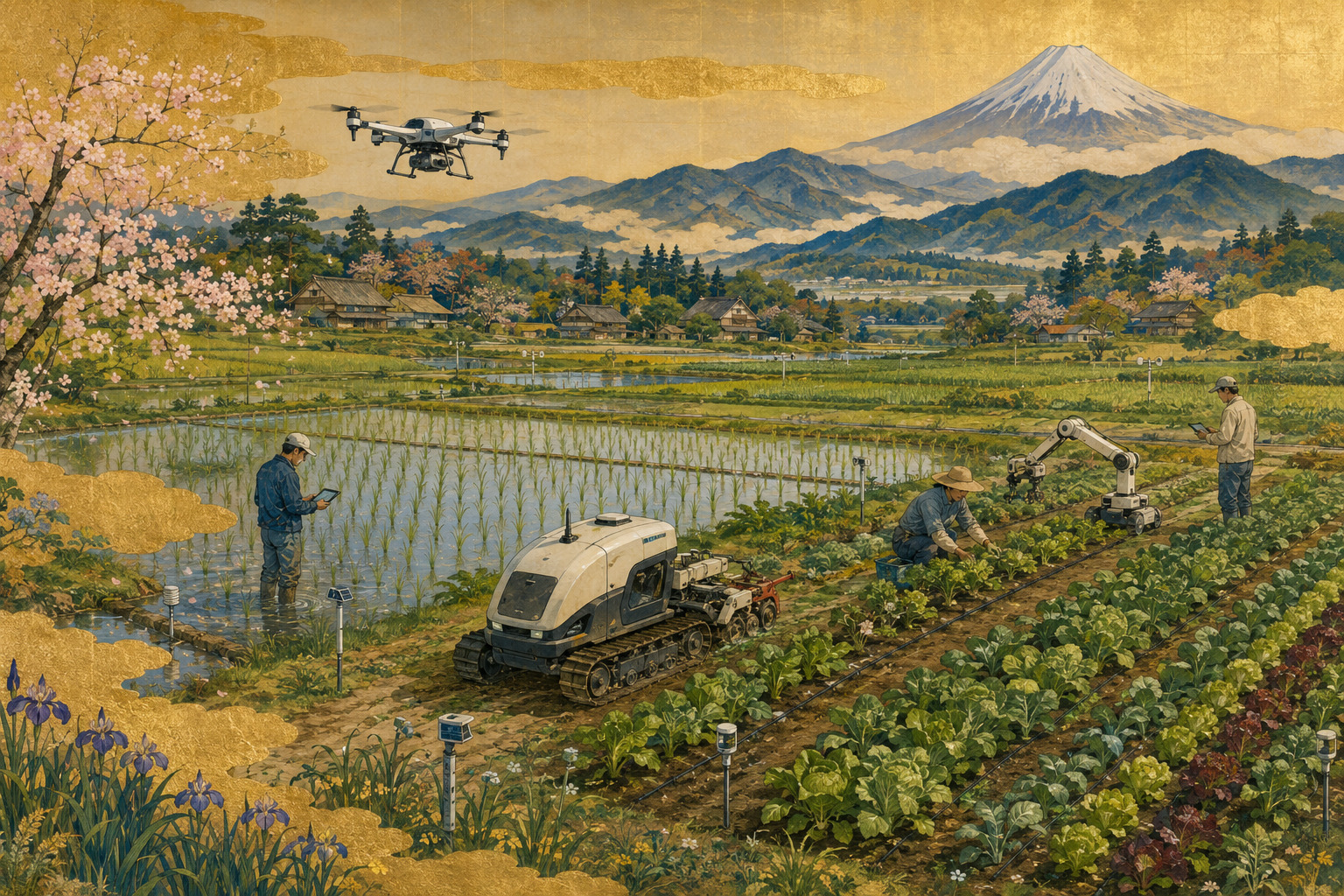
Image rights: © 2026 Japan.co.jp. This AI-assisted editorial illustration may not be reproduced or reused without permission. For licensing, visit the contact page.