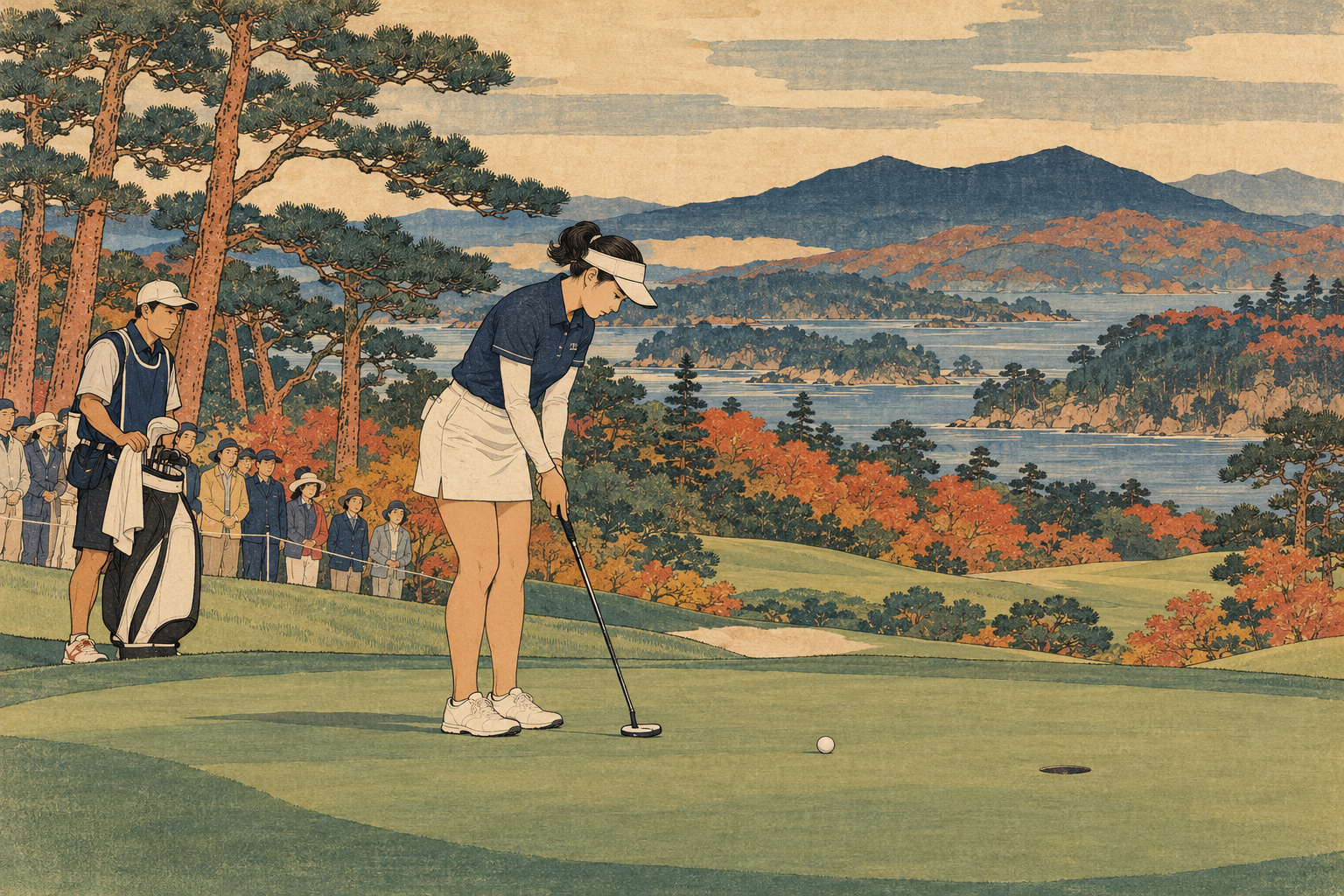
Shiho Kuwaki returned to the winner’s circle in Miyagi with something she had been seeking since becoming a major champion: another victory. Starting the final day one stroke behind, she won the Miyagi TV Cup Dunlop Ladies Open on September 27 at Rifu Golf Club, finishing at 12 under par, two shots ahead of Megumi Kido.[2]
It was her third JLPGA Tour title of 2026 and sixth on that tour overall. Those totals are distinct from her August AIG Women’s Open victory. Her season now connects a domestic revival, an international breakthrough and a successful return to winning in Japan.[1],[10]
A Sunday result with season-long consequences
Kuwaki closed with a 68. Kido finished second at 10 under, while Kana Nagai and Eri Fukuyama shared third at nine under. The championship was settled within the scheduled 54 holes, without a playoff.[1],[3]
JLPGA reported that the win widened Kuwaki’s lead over Akari Sakuma in the Mercedes Ranking. It strengthened her position in the season championship race; it did not clinch the annual title. That distinction matters when assessing a player whose achievements already extend well beyond one tour.[1]
The organizer’s account supplies another reason this result mattered: Kuwaki had recorded second- and third-place finishes in Japan after her British major victory. Contending repeatedly and finishing first are related but different accomplishments. In Miyagi, the final margin settled the question without another near miss.[2]
Before the major, a first win to pursue
Born in Okayama on January 29, 2003, Kuwaki began golf at four and passed the professional test on June 25, 2021. At 23, she has accumulated a substantial record, but her progression becomes more revealing when viewed from its starting point rather than from the latest trophy.[4]
A JLPGA profile published in February 2022 described a young professional adding variety to her approach shots and learning to select different clubs around the green. Her immediate target was a first JLPGA Tour win. She also hoped to become a player followed overseas, like fellow Okayama golfer Hinako Shibuno.[5]
That first tour victory arrived at the Shiseido Ladies Open on June 30, 2024, at Totsuka Country Club in Yokohama. Kuwaki finished at 11 under, two clear of Kotone Hori, winning the event where she had experienced disappointment the previous year.[6]
In JLPGA’s account, she described confronting an old response to mistakes: the urge to recover a bogey immediately, which could turn into impatience. The history is useful because it identifies a practical challenge beneath the broad language of confidence. A player must choose the next shot while carrying the consequences of the previous one.[6]
Three wins, then a season without one
The 2024 breakthrough expanded into a three-win campaign, including the Nitori Ladies and the season-ending JLPGA Tour Championship Ricoh Cup. At the latter, Kuwaki led after every round and finished one stroke ahead of Sakura Koiwai. It was her first title in a JLPGA major championship.[4],[7]
That achievement should be distinguished from her first international major, which came this year. It also makes the intervening season significant: Kuwaki did not win in 2025. Progress in professional golf does not necessarily produce a larger trophy collection every successive year.[8]
Her return came on May 17 at the Sky RKB Ladies Classic, where 15 under secured her fourth JLPGA Tour title after roughly 18 months without a victory. In the association’s report, Kuwaki pointed to better course management and an improved ability to construct a round without forcing attacks at every flag.[8]
This is a more specific account of development than simply saying that she became mentally stronger. Choosing a target involves the likely reward, the cost of a miss and the position left for the following shot. Her explanation placed judgment alongside execution.
The route from Kobe to a British major
Kuwaki’s second domestic victory of 2026 came on June 14 at the Ai Miyazato Suntory Ladies Open in Kobe. She finished at 19 under; both she and runner-up Nagai earned places in the AIG Women’s Open.[9]
JLPGA’s report highlighted a decision on the par-three 16th. With danger to the left, Kuwaki used the green’s right-to-left slope rather than firing directly at the flag, setting up a birdie. The shot illustrates the course-management approach she had discussed a month earlier.[9]
On August 2, at Royal Lytham & St Annes, she converted the opportunity into her first international major. According to the championship’s official account, Kuwaki and Esther Henseleit finished regulation at five under, and Kuwaki won on the second playoff hole. It was only her second appearance in the championship.[10]
The connection is concrete: a domestic tournament supplied an entry route, and a player used it to win abroad. Japan’s tour and the international game are not separate career stories in this case. One helped create the opportunity for the other, before Kuwaki returned to pursue further domestic success.
A tournament rooted in Miyagi
The event she has now won carries its own long history. JLPGA’s retrospective dates its beginning to 1973, when the Matsushima International Ladies Open marked Miyagi Television’s third anniversary. Hisako Higuchi was the inaugural winner.[11]
Rifu became the venue in 2003, the year Ai Miyazato won as an amateur while attending Tohoku High School. The retrospective also recalls the course damage and debate over staging the tournament after the 2011 Great East Japan Earthquake, followed by restoration work and the event going ahead.[11]
Those episodes give the tournament a significance beyond a name on the calendar. Its continuity has depended on local institutions and work at the course, while its competitive stage has helped introduce players to a much larger audience.
The 2026 event was organized by Miyagi Television, with Dunlop, the Sumitomo Rubber Industries brand, as special sponsor. The prize fund was ¥70 million, including ¥12.6 million for the winner. The organizer listed national television coverage of the final round, connecting a regional venue with viewers across Japan.[3]
What Miyagi adds to Kuwaki’s year
There is a striking historical connection in this season: Kuwaki earned her British major place at the tournament bearing Miyazato’s name, then won the Miyagi event where Miyazato had triumphed as an amateur. That is a connection visible in the records, rather than a narrative Kuwaki has claimed for herself.
The immediate task remains competitive. The annual title race continues, and one September victory cannot decide the remaining weeks. What it does establish is that Kuwaki’s year has moved beyond recovery from a winless season: she has won abroad and returned to finish the job at home. Miyagi adds another result to that record—and another test passed after the breakthrough.
