- An extraordinary claim, with an important limit
- How the laboratory crossed an evolutionary divide
- The remarkable 98.76% figure
- What 150 generations really means
- A genome inside a cell is not necessarily a working genome
- The epigenetic gatekeeper
- An experiment that speaks to the history of life
- From a 2018 concept to a multi-institution result
- The technology roadmap is longer than the headline
- What the boundary-crossing discovery actually changes
An extraordinary claim, with an important limit
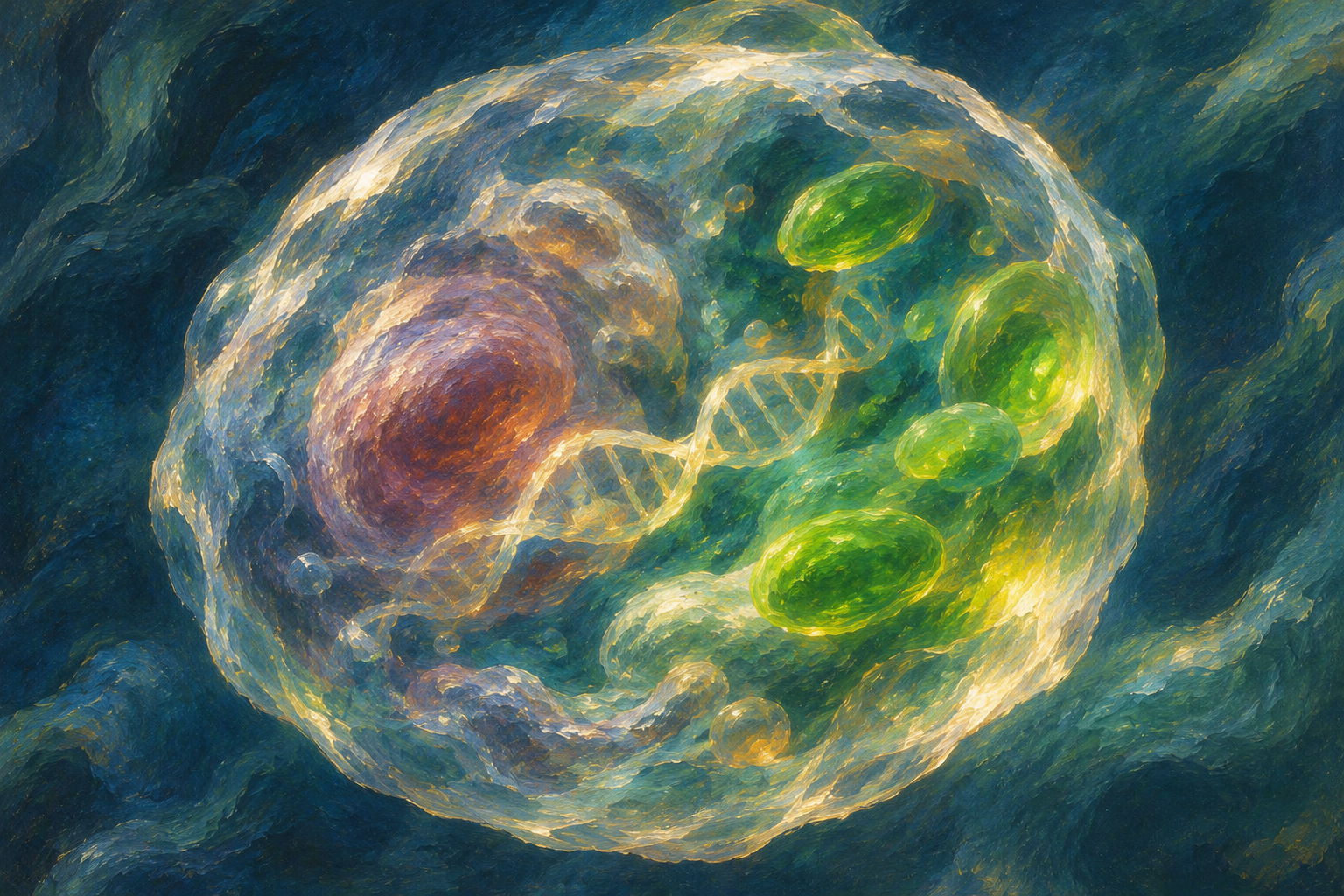
A mammalian cell is not supposed to inherit the chromosomes of a red alga. The organisms are separated by a vast evolutionary distance, and their genetic systems evolved in very different settings. Yet a Japanese-led research collaboration has demonstrated that cultured mammalian cells can retain chromosome-scale algal DNA through repeated cell divisions. The team calls the experimental hybrids “planimal cells.” Its peer-reviewed study appeared in Nature Communications on November 12, 2026.
The discovery is arresting precisely because it is easy to misunderstand. Scientists did not create a green animal, grow a new species or make a mammal photosynthesize. Their achievement lies in the stable physical accommodation of a foreign eukaryotic genome inside mammalian cells—an obstacle that had been difficult to observe experimentally at this scale. The paper also reveals an unexpected paradox: most imported genes stayed silent.
How the laboratory crossed an evolutionary divide
The donor was Cyanidioschyzon merolae, a tiny unicellular red alga commonly called schyzon, whose nuclear genome is only about 16.5 million base pairs. The main recipient model included CHO-K1 cells derived from Chinese hamster ovary tissue. Researchers also examined a human-derived cultured cell line. These were laboratory cell lines, not living animals.
To place algal genetic material in the mammalian cellular environment, the team used experimentally induced cell fusion and also tested uptake of intact algae by host cells. The latter route could initiate DNA transfer, but it did so at a much lower frequency than fusion. Advanced microscopy followed the early events, while genome sequencing and chromosomal analyses asked whether algal genetic material was merely trapped within a cell or incorporated into a structure that descendants could inherit.
The remarkable 98.76% figure
One hamster-derived hybrid line, designated CHO-Cm7, contained assembled algal nuclear sequences totaling about 16.3 million base pairs—98.76% of the reference algal nuclear genome. The researchers also identified 99.48% of the annotated algal genes in those sequences. Some algal chromosomes were preserved as long, continuous regions, and chromosomal evidence indicated physical linkage to mammalian chromosomes, including an attachment near the tip of a hamster X chromosome.
That is a result for a characterized cell line under defined experimental conditions, not a claim that every hybrid cell contains an intact algal genome. It also does not mean an entire living alga, complete with the functional machinery of photosynthesis, continues operating inside the mammalian cell. The distinction between carrying DNA and using the biology encoded by it runs through the entire study.
What 150 generations really means
The collaborating institutions reported that hybrid cultures continued dividing for more than 150 cell generations while retaining algal DNA. A separate experiment removed the antibiotic selection used during cultivation; substantial transferred DNA remained detectable after another 95 generations without that selection, although the relative abundance of some sequences declined.
Neither number describes successive generations of animals. These are passages of cultured cells. Nor should the 95-generation observation be described as perfect preservation: sequences followed different trajectories, and the number of extensively characterized hybrid clones was limited. The strongest conclusion is that chromosome-scale foreign DNA can persist surprisingly long in a mammalian cellular setting.
A genome inside a cell is not necessarily a working genome
Most strikingly, importing the genetic material did not activate an algal way of life. RNA sequencing of the CHO-Cm7 line found no detectable expression for an average of 4,587 of 4,770 algal protein-coding genes—approximately 96%. Certain engineered marker sequences did produce transcripts, but most native algal coding information remained quiet.
This changes the framing of the breakthrough. The immediate discovery is not a new metabolic powerhouse. It is a system that separates two essential stages of biotechnology: delivering and preserving large foreign genetic structures, and then controlling what those structures are allowed to do. For a future engineered cell, the second stage may be at least as demanding as the first.
The epigenetic gatekeeper
DNA does not act alone. Chemical changes to DNA and the proteins packaging it can alter access to genes without changing their underlying letters. Scientists call this layer of regulation epigenetics. In the planimal cells, the imported algal DNA gradually acquired DNA methylation and repressive histone marks associated with inactive chromatin.
The researchers then examined the role of DNMT3A, an enzyme involved in adding new DNA methylation marks. Mammalian cells lacking this function were less able to establish and stably retain transferred algal DNA. The team describes the process as “epigenetic gatekeeping”: the host may protect its genomic order, in part, by accommodating foreign material while restricting much of its activity. That mechanism is strongly supported in the reported experimental system, although it is not necessarily the only process involved.
An experiment that speaks to the history of life
Biology already provides evidence that genetic boundaries are less absolute than traditional categories suggest. In bacteria, horizontal gene transfer can spread useful characteristics between organisms without parent-to-offspring reproduction. In eukaryotes, large transfers between distant lineages are much harder to document and reconstruct. Scientists have often inferred ancient exchanges by comparing genomes long after the original events occurred.
The history of chloroplasts offers a particularly evocative parallel. The dominant evolutionary explanation is that a photosynthetic bacterium entered an ancestral host and developed into a permanent organelle through endosymbiosis. Over evolutionary time, some genetic material associated with the symbiont shifted toward the host nucleus. The new laboratory work does not repeat that ancient history; instead, it gives researchers a way to witness early steps of large-scale genetic accommodation directly.
From a 2018 concept to a multi-institution result
University of Tokyo professor Sachihiro Matsunaga proposed the word “planimal,” combining plant and animal, in 2018 to describe the aspiration of bringing selected plant-like functions into animal cells. The November 2026 result comes from an extensive collaboration with researchers including Hiroshi Kimura of the Institute of Science Tokyo, Hidenori Nishihara of Kindai University, Takuya Sakamoto of Kanagawa University, Yuko Sato of Shizuoka University and Tomokatsu Ikawa of Tokyo University of Science, among others.
The scale of that collaboration matters. Live-cell imaging, chromosomal mapping, long-read sequencing, transcription measurement and molecular analysis of chromatin each address different possible explanations. A microscope image alone could not prove stable chromosomal inheritance; a genome assembly alone would not explain why the imported DNA remains mostly inactive. The result is persuasive because several different kinds of evidence converge.
The technology roadmap is longer than the headline
The team envisages eventually giving engineered animal cells selected capabilities associated with algae and plants, potentially including useful molecule production or photosynthesis-related functions. Those ambitions are scientifically interesting but not demonstrated by the present experiments. Photosynthesis requires more than inserting a list of genes: cellular structures, energy conversion, regulation and metabolic coordination all must function together.
Likewise, claims that such future cells might lower biomanufacturing costs or emissions are aspirations, not measured benefits here. A commercial platform would have to demonstrate reproducibility, stability without special selection, predictable control of gene expression, biosafety and practical economics. The findings open an avenue for exploration rather than delivering an industrial process.
What the boundary-crossing discovery actually changes
The phrase “animal–plant hybrid” seems to promise an exotic creature. The more profound result is hidden from view: a mammalian cell can accommodate an unexpectedly large volume of foreign nuclear DNA, pass it along in cell culture and regulate much of it into silence. Those observations provide a testable model of the early steps of genome-scale horizontal transfer between distant eukaryotic lineages.
The next question is whether scientists can maintain that stability while turning on only chosen genetic functions. In that challenge, the same epigenetic mechanism that may help preserve the genome could become an obstacle to useful expression. The work is not the end of the boundary between plant and animal. It is a new experimental window onto how that boundary is maintained—and how carefully controlled aspects of it might someday be crossed.
Primary sources and methodology
Reporting method: Examined the peer-reviewed Nature Communications paper and original institutional announcements. We did not independently repeat the experiments, interview the researchers or validate any industrial application.