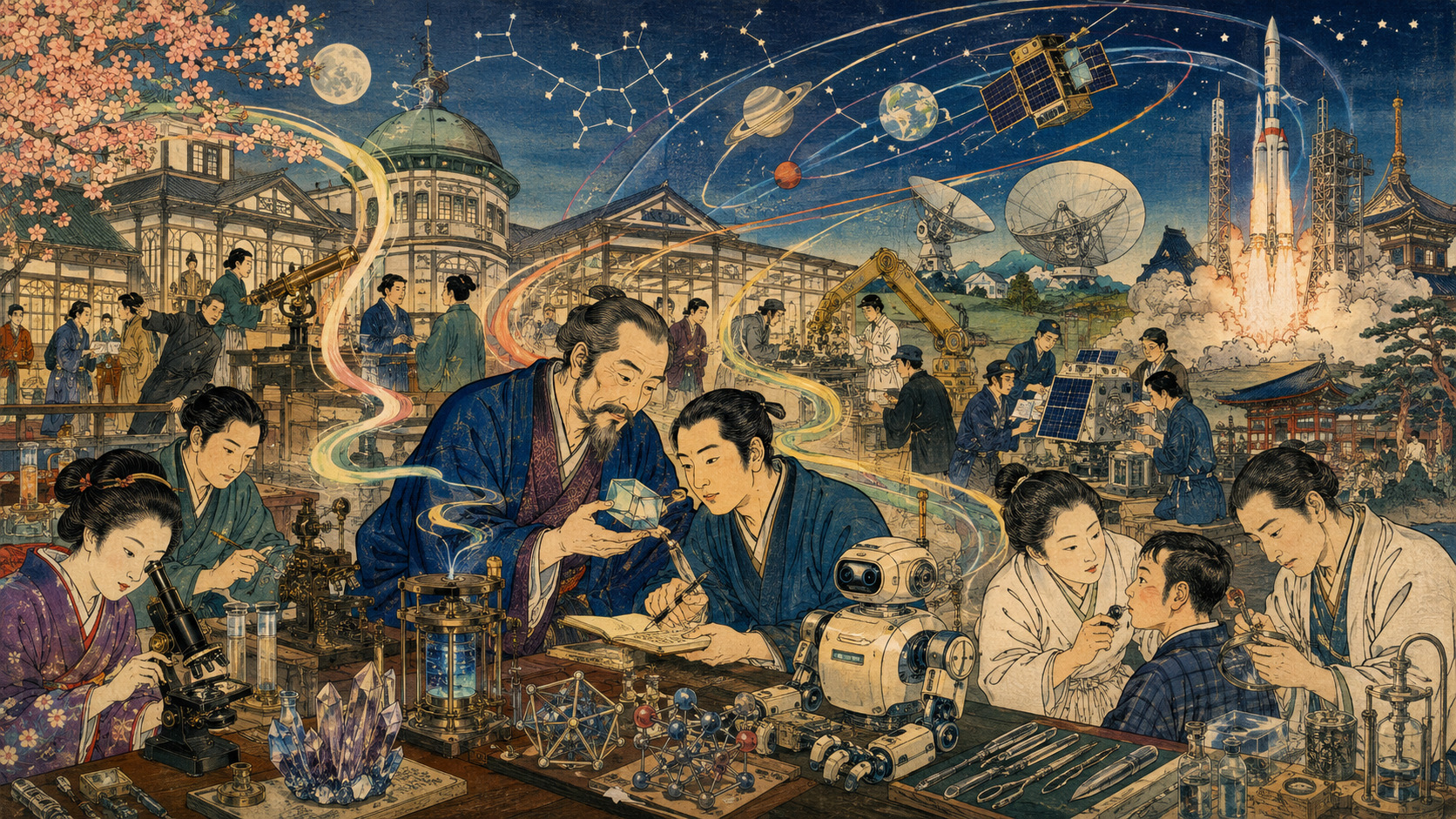
In 1979, Shimon Sakaguchi began pursuing an awkward question: why does the immune system not destroy the body it is built to defend? He searched for cells that did not fit the dominant explanation. Sixteen years passed before his 1995 identification of regulatory T cells. In 2003 he connected them to the FOXP3 gene. In 2025, at 74, he received the Nobel Prize in Physiology or Medicine.
Susumu Kitagawa began treating empty space inside a crystal as something that could itself be engineered around 1990. Porous coordination compounds were widely regarded as too fragile to be useful. He helped turn them into metal–organic frameworks, or MOFs: crystalline structures able to admit, select, store and release molecules. Kitagawa received the 2025 chemistry Nobel.
Japan’s 2026 Science, Technology and Innovation White Paper uses these lives to explain what it calls the “convergence of science and business.” But the deeper lesson is more troublesome than convergence. Valuable knowledge usually spends years looking unpromising. A nation can ask laboratories to move faster; it cannot order nature to reveal itself on a budget calendar.
The white paper’s two clocks
Cabinet approved the 2026 white paper on July 7. Its formal title is the fiscal 2025 Annual Report on the Promotion of Science, Technology and Innovation Creation. Part I, “How Science and Innovation Can Open Japan’s Future,” is a thematic argument. Part II records what the government did during the fiscal year. The paper also serves as an introduction to the Seventh Science, Technology and Innovation Basic Plan, whose five-year term began in April.
One clock belongs to curiosity, failed experiments, replication and scientific generations. The other belongs to appropriations, basic plans, elections and corporate reporting. The first cannot promise a deadline. The second cannot wait indefinitely. The work of policy is not to choose a single clock; it is to finance a portfolio of activities whose legitimate time horizons differ.
Science, technology and innovation are not synonyms
Science creates reliable knowledge through observation, argument and testing. Technology applies knowledge, materials, instruments and skill to a purpose. Innovation occurs when an invention changes practice—through a product, treatment, institution, standard or behavior. A brilliant paper does not automatically become a medicine. Incorporating a startup does not demonstrate that its treatment works.
Confusing the three distorts incentives. Ask basic scientists for near-term revenue and they will choose safer, legible projects. Reward clinical translation by paper count and patient delivery becomes secondary. Count startups without following survival or impact and dormant companies become policy “outputs.” Different stages need different contracts and evidence.
When science and business converge
The white paper argues that the old linear story—basic research, applied research, development, commercialization—is giving way to simultaneous interaction. In AI, quantum science, biotechnology and advanced materials, frontier research can be the business advantage itself. Corporate data, fabrication plants and computing resources can also determine what academic science is possible.
Proximity does not repeal time. Clinical trials, long-term safety, material fatigue, standards and manufacturing yield remain stubbornly physical. Market questions can sharpen research. Short return horizons can also crowd out unfamiliar questions and negative results. Convergence is useful only if it expands the routes through which knowledge travels without turning every laboratory into a poorly designed startup.
Shimon Sakaguchi: 46 years with the immune system’s brake
The immune system attacks invaders, but unchecked immunity attacks the self. Sakaguchi suspected that deletion of dangerous immune cells in the thymus—central tolerance—was not the whole explanation. In 1995 he identified regulatory T cells, a class of cells that suppresses immune responses in the body’s periphery, a finding that ran against prevailing opinion.
The 2025 prize was shared with Mary Brunkow and Fred Ramsdell “for discoveries concerning peripheral immune tolerance.” Researchers are now trying to add, expand or restrain Tregs for autoimmune disease, transplantation and cancer. RegCell, founded in 2016 from University of Osaka research, is one route toward therapy. Incorporation is an intermediate event: reproducible manufacturing, dose, durability, safety, trials, regulatory review and affordable delivery still stand between a concept and patients.
Susumu Kitagawa: 35 years making emptiness useful
MOFs link metal ions with organic molecules to form crystals whose internal cavities can be designed. Kitagawa observed a honeycomb-like complex in 1992 and reported a stable porous coordination compound able to adsorb oxygen, nitrogen and methane in 1997. He later advanced “soft porous crystals” that alter their shape in response to guests or external conditions.
Possible uses include capturing carbon dioxide, storing hydrogen or toxic gases, separating molecules, catalysis and collecting water from dry air. Atomis, a Kyoto University startup founded in 2015, connects such research to industrial needs. But a vast library of attractive candidate structures is not a commercial plant. Materials must be cheap, manufacturable and durable amid humidity, impurities, vibration and maintenance. Translation is where crystalline elegance meets industrial disorder.
iPS cells: a 2006 discovery reaches conditional products in 2026
Shinya Yamanaka and colleagues created induced pluripotent stem cells from mouse cells in 2006 and human cells in 2007. Yamanaka received the Nobel Prize in 2012. The intervening work—making cells consistently, directing differentiation, monitoring tumor risk, matching patients and building quality-controlled production—continued long after the celebrated discovery.
In March 2026 Japan granted conditional and time-limited approval to two products derived from iPS cells. Sumitomo Pharma and RACTHERA’s AMCHEPRY uses dopaminergic neural progenitor cells for Parkinson’s disease. Cuorips’ RiHEART is a cardiomyocyte sheet for severe ischemic heart failure. They are historic thresholds, not final verdicts.
Approval is a bridge, not the end of evidence
Japan’s conditional route gives patients earlier access to regenerative products while requiring post-marketing evidence to reduce uncertainty. It trades some preapproval certainty for surveillance, follow-up and a later decision on full approval. “World first,” a company description of AMCHEPRY, does not mean long-term comparative benefit has already been established.
The same discipline should govern public programs. A patent, company, financing round, trial, approval, reimbursement, adoption and improvement in health are different milestones. A failed trial can produce valuable knowledge. If governments count only successes, bad news travels slowly and patients and taxpayers inherit the uncertainty.
The Seventh Basic Plan: making a “revival of science” strategic
Cabinet approved the Seventh Basic Plan on March 27, covering fiscal 2026 through 2030. Its six pillars are: the revival of science as the foundation of knowledge; strategic prioritization of technology fields; organic integration of science and technology with national security; a more advanced industry-academia-government innovation ecosystem; strategic science and technology diplomacy; and governance reform.
The ordering matters. Security and industrial competitiveness are prominent, but science comes first. The more resources the state directs toward named strategic technologies, the more it needs broad institutional funding and investigator-led grants to preserve unpredictable discoveries outside the list. Concentration and diversity are not alternatives. They insure against different forms of failure.
Seventeen important technologies: a map that moves money
The Integrated Innovation Strategy 2026, approved on July 14, names eleven emerging, foundational and industrial fields: shipbuilding; aviation; digital and cybersecurity, including content; agriculture, forestry, fisheries and foodtech; resources, energy security and green transformation; disaster resilience; advanced medicine; manufacturing, materials and critical minerals; mobility and logistics; ocean technology; and defense industry technology.
It adds six national strategic technology fields: AI and advanced robotics, quantum, semiconductors and communications, biotech and healthcare, fusion energy, and space. Naming is not neutral. Budgets, reviewers, institutions, curricula and procurement follow. A list broad enough to contain everything ceases to prioritize; one too narrow misses the next field. The government should publish selection logic, resource distribution and exit criteria—not allow political access to masquerade as scientific priority.
| Research clock | Purpose | Appropriate support | Evidence that matters |
|---|---|---|---|
| Exploratory/basic | Unknown principles and phenomena | Institutional funds, KAKENHI, durable jobs, shared facilities | Reproducibility, data, people, expert assessment |
| Mission-oriented | Defined national or social problems | Multi-year competitions and stage gates | Technical maturity, alternatives, learning from failure |
| Translation | Move research into use | Prototypes, trials, standards, procurement, regulatory advice | Safety, cost, adoption, real-world effect |
| Infrastructure | Enable every field | Compute, data, facilities and technical staff | Access and quality—not utilization alone |
AI for Science: assistant, instrument or infrastructure?
AI can search literature, predict protein structures and candidate materials, improve weather models and automate experiments. The plan calls for data, compute and application infrastructure. If access remains concentrated in a handful of corporations and elite universities, AI will widen research inequality. Public compute, curated data and technical help must reach small laboratories as well.
Generative systems can produce plausible errors, fabricated citations and inherited bias. Evaluation should record reproducibility, model and data provenance, negative findings and computing cost, not accuracy alone. The more hypotheses machines generate, the more valuable human scientific judgment becomes: deciding what to measure, which proxy is misleading and when not to believe a result.
Science and national security: a postwar boundary moves
For the first time in a basic plan, science and national security form a dedicated pillar. Quantum, space, AI, semiconductors, biotechnology and ocean research resist a clean civilian-military line. The strategy proposes to nurture and protect economically important technologies and support dual-use work from research through implementation.
This is a major postwar turn. Reflecting on wartime mobilization, the Science Council of Japan declared in 1950 and 1967 that it would not pursue science for war, and in 2017 reaffirmed the tension between military-security research and academic freedom. The 2026 system cannot answer that history by pretending it did not happen. It must specify purpose, sponsor, publication rights, export controls, ethical review and a researcher’s ability to refuse participation.
Research security must not become nationality screening
Universities need defenses against covert obligations, theft, conflicts of interest, cyberattack and sanctions violations. But replacing risk assessment with nationality suspicion would produce discrimination, destroy international circulation and weaken Japan’s own science. Institutions should examine relationships, duties, access and conduct—not identity as a shortcut.
Compliance can also consume the research time the plan promises to restore. Government should provide common rules, specialist legal and export-control staff, cybersecurity support and tiered review. Low-risk work should remain simple; genuinely sensitive work needs independent assessment and appeal. Openness and security coexist only through clear, reviewable procedure.
Japan’s top-paper rank is a warning, not a verdict
NISTEP’s Science and Technology Indicators 2025 place Japan fifth in total papers, thirteenth in field-adjusted top-10%-cited papers and twelfth in top-1% papers for the 2021–23 average under fractional counting. Japan had remained fourth in the top-10% measure through 2005 before a long decline. Expanding investment abroad, international collaboration, research time, funding and careers all matter.
Citations vary by field and age and tend to favor fashionable subjects, English-language visibility and large networks. One ranking cannot support a claim that Japanese science has “ended.” Yet the long trend cannot be dismissed. A proper dashboard combines citations with replication, open data and software, standards, patents, clinical or policy outcomes, international networks and the training of new researchers.
The scarcest research resource is time
A new instrument does not create knowledge when its operator spends the week on grant applications, purchasing, audits, reports, recruitment and committees. NISTEP’s recurring survey of researchers and experts reports severe concerns over research time, basic funds, doctoral enrollment, people and facilities throughout the Sixth Plan. Inflation has reduced how much the same nominal budget buys in reagents, electricity and travel.
The new plan promises a large KAKENHI expansion, fund-style financing that can cross fiscal years, more support staff and a 50% research-time target for researchers in groups such as the University for International Research Excellence and J-PEAKS. Those measures are promising. But if measuring research time creates another reporting obligation, the metric defeats itself. Procurement consolidation, skilled professional careers and removal of duplicate evaluation must be part of the result.
Twenty thousand doctorates: design the exit before widening the entrance
The plan targets 20,000 doctoral degrees a year. Prospective students see more than admissions places. They see tuition, living costs, fixed-term employment, delayed family plans and whether companies reward their training. Expanding intake without improving the destination transfers institutional risk to young people.
Doctoral candidates should be treated as early-career researchers, with pay and social protection. Expertise must be valued outside universities—in business, government, schools and medicine—and movement across sectors should be reversible. International researchers need functional administration, family support and fair advancement. Headcount is an input; a durable life in research is the outcome.
Thirty thousand overseas placements: circulation, not export
A target of 30,000 long-term overseas placements over five years aims to connect Japanese researchers to new fields and collaborators. Young researchers hesitate when leaving could interrupt grants, complicate family life or cost them a position on return. An airline ticket is not a circulation policy.
Programs should join departure and return: portable funding, landing positions, equipment access, dual affiliations and joint doctoral programs. Japan must also receive researchers. Internationalization is not a decorative foreigner ratio. It is the ability to participate in seminars, grant review, management and everyday decisions.
¥60 trillion and ¥180 trillion: unpack the large numbers
The plan targets ¥60 trillion in government R&D investment over five years—about ¥45 trillion on the conventional science-and-technology-related budget definition—and ¥180 trillion from public and private sectors combined. The Sixth Plan’s ¥30 trillion government target was exceeded at ¥43.6 trillion, while its ¥120 trillion public-private ambition stood at ¥86.3 trillion through fiscal 2024.
These are nominal figures. Inflation can raise totals while purchasing power falls. Results also depend on how tax credits, fiscal investment and lending, university-fund activity and growth-policy programs are counted. Private R&D matters, but it is concentrated in large companies and later-stage development; it cannot substitute for public basic research. Annual reporting should separate definitions, real values, institutional and competitive funds, personnel and capital.
The ¥10 trillion University Fund: concentration’s promise and risk
Japan began operating its roughly ¥10 trillion University Fund in fiscal 2021 to provide long-term support to selected Universities for International Research Excellence. Tohoku University became the first designated institution in November 2024. Institute of Science Tokyo’s plan was approved in 2026. On July 3 an expert panel concluded that Kyoto University could meet the standard, with formal statutory steps still to follow.
World-class institutions need predictable money, equipment and room for young principal investigators. But investment returns fluctuate, and concentrating support can create a self-reinforcing hierarchy in which strong universities attract still more resources. J-PEAKS, shared facilities and adequate institutional funding should maintain regional and specialist universities. A strong summit is not a substitute for a broad mountain.
1917: RIKEN began where pure science met industry
The 2026 convergence is not new. Chemist Jokichi Takamine argued in 1913 that Japan needed a national institute for the coming age of physics- and chemistry-based industry. Industrialist Eiichi Shibusawa and others assembled support from the Imperial household, government, business and private donors. RIKEN was formally founded in 1917 with an ambition to move Japan from imitation toward original science and industry.
RIKEN researchers developed products and businesses alongside fundamental work. It is an early model of translation. It also belongs to a history in which state, industry and science became entangled with wartime mobilization. Proximity is not automatically virtuous. The questions are who sets the problem, who may use the result, who bears the risk and whether researchers and citizens can say no.
1932: an institution for continuity
The Japan Society for the Promotion of Science was founded as a nonprofit foundation in 1932 with an Imperial endowment. Today it administers KAKENHI grants, supports young researchers and manages international exchange across the natural sciences, social sciences and humanities. Its significance lies less in delivering one technology than in maintaining a durable mechanism for investigator-led scholarship.
Science policy cannot survive on spectacular national projects alone. Distributed peer review lets researchers propose small, unfamiliar questions and preserves unpredictable seeds. The promised KAKENHI expansion should therefore be judged by real purchasing power, success rates, review burden and whether young investigators gain independence—not simply its headline amount.
1945: rebuilding the purpose of science
Defeat dismantled wartime technology organizations. Occupation authorities restricted nuclear, aeronautical and radar research and destroyed cyclotrons. Industrial production in 1946 was roughly one fifth of its prewar level. Food, infectious disease, housing, standards and factory recovery became urgent scientific and technical problems.
The Science Council of Japan and the Science and Technology Administration Council were established in 1949. That year Hideki Yukawa became Japan’s first Nobel laureate. Science had to serve reconstruction, but it also needed a new legitimacy grounded in peace and openness after wartime complicity. That dual beginning makes the 2026 security turn especially consequential.
1956–1970: science for a country catching up
The Science and Technology Agency was created in 1956. Japan issued its first Science and Technology White Paper in 1958 and began annual publication in 1964. A 1960 Science and Technology Council recommendation projected shortages of 170,000 science and engineering personnel and 440,000 industrial high-school graduates, accelerating expansion in universities, technical colleges and schools.
Imported technology, quality control, corporate laboratories and mass education powered high growth. The Tokaido Shinkansen and Tokyo Olympics made technology publicly visible in 1964; by 1968 Japan had the second-largest gross national product in the noncommunist world. The same velocity externalized pollution costs that institutions were slow to recognize.
Pollution and the oil shocks: technology also creates problems
Minamata disease, Itai-itai disease and urban air pollution exposed the danger of measuring progress by output alone. Victims’ observations often warned before official systems acted. Corporate, governmental and academic responsibility came under scrutiny. The 1973 oil shock then made efficiency, alternative energy and materials a national mission.
The lesson is not merely that science can repair damage. Innovation assessment must ask who is exposed, who owns the data, who can challenge the experts and whether a harmful system can be reversed. Health, environment and distribution belong beside patents and revenue.
The 1980s: responding to the “free ride” critique
As trade friction grew, Japan faced criticism that it had prospered by improving technology rooted in foreign basic research without contributing enough fundamental knowledge. Policy turned toward creativity, basic science and international programs: participation in the space station program in 1985, ITER discussions in 1988 and launch of the Human Frontier Science Program in 1990.
The question remains current. Will strategic prioritization make Japan a buyer of global knowledge, or will it contribute knowledge, data, facilities and people that others can use? Science diplomacy is more than national branding. It is the patient construction of reciprocal institutions that can remain functional when politics deteriorates.
1995: from following to exploring
Economic stagnation after the bubble, the Great Hanshin-Awaji Earthquake, the Tokyo subway sarin attack, the Monju accident and the expansion of the internet converged in 1995. A cross-party initiative enacted the Science and Technology Basic Law, arguing that Japan had to stop merely following advanced countries and explore unknown fields as a front-runner.
The First Basic Plan in 1996 expanded competitive funds, evaluation and postdoctoral support. The white paper, first issued in 1958, became a statutory annual report. Competition opened opportunities, but fixed-term jobs and application burdens also grew. Competition strengthens a system only when researchers stand on a stable floor.
2004: the light and shadow of national-university incorporation
National universities became corporations in 2004, gaining greater discretion over personnel, organization and external cooperation. Intellectual property, partnerships, donations and internationalization became management responsibilities. At the same time, operating grants, competitions, performance evaluation and staffing rules interacted in ways that pressured research time and career stability.
It would be simplistic to attribute Japan’s research decline to incorporation alone. Global investment, demography, company research, doctoral education, international collaboration and field mix all changed. Reform should therefore be judged by whether it increases research time, professional technical staff, young-investigator independence and durable resources—not by the number of reorganizations or dashboards.
2011–2021: crisis, Society 5.0 and a renamed law
The Great East Japan Earthquake and Fukushima Daiichi disaster challenged trust among expertise, administration, industry and the public. The Fourth Basic Plan emphasized problem-solving and “science, technology and innovation.” The Fifth Plan introduced Society 5.0 in 2016, proposing a human-centered fusion of cyberspace and the physical world.
In 2021 the law was renamed the Science, Technology and Innovation Basic Act, explicitly broadening its scope to innovation and the humanities and social sciences. COVID-19 showed that vaccines, data, health systems, behavior and communication form one system. Technology cannot compensate by itself for weak institutions or lost trust.
Sending Ghost in the Shell to schools
To promote the 2026 white paper, the education ministry partnered with the television anime Ghost in the Shell and said it would distribute roughly 40,000 posters to schools, science museums and other sites. It is an attempt to move a dense government report beyond policy specialists.
The chosen world evokes more than attractive cyborgs. It raises boundaries between body and information, surveillance, hacking, corporate and state power, identity and inequality. Futures communication becomes public science only when wonder is accompanied by questions: who designs the system, who is excluded, who owns the data and who is accountable when it fails?
Regional science: Tokyo cannot discover for the whole country
Concentrating equipment, money and international networks in a few centers may increase the odds of spectacular success while reducing geographical and intellectual diversity. Agriculture, disaster science, oceans, infectious disease, materials and cultural heritage often depend on universities close to the sites, communities and long-term records involved.
J-PEAKS is intended to strengthen regional and distinctive research universities alongside the elite university program. Shared facilities, joint appointments, national technical-staff networks and links to local governments and companies can make that more than a ranking competition. A powerful peak and a deep base are complements.
Can failure be designed into public funding?
Disruptive research should have a high failure rate. If every project succeeds, the questions may be too easy or the assessment too forgiving. The plan aims to double challenging research projects to about 13,000. More projects will not help if they cannot change direction or if researchers must hide failure.
Programs should define hypotheses and decision rules in advance, then choose at milestones whether to continue, pivot or end. Data and lessons from stopped projects should be available, and an honest failure should not destroy a career. Auditors need to ask not only whether money followed the plan, but whether the work truthfully reduced uncertainty.
Ten tests for the 2026 white paper
| Test | Question for the next report | Evidence to publish |
|---|---|---|
| Research time | Did institutions move toward 50%? | Time by field and rank; work removed |
| Basic funding | Did it grow faster than costs? | Real value, success rates, institutional funds |
| People | Did doctoral lives and careers improve? | Pay, contracts, placement and exit |
| Circulation | Did overseas networks persist? | Return posts, collaborations and inward mobility |
| AI | Can small institutions participate? | Compute access, reproducibility and incidents |
| Priorities | Are selection and exit transparent? | Allocation, reviews and reasons to stop |
| Translation | Did value arrive after incorporation? | Safety, cost, adoption and real-world outcomes |
| Security | Are freedom and safeguards procedural? | Review, refusal, appeal and publication rights |
| Regions | Did concentration hollow out the base? | Funding, shared access and mobility by region |
| Trust | Were failure and conflicts disclosed? | Corrections, negative results and audits |
A research nation at 109
1917 RIKEN is founded to connect original science and industry.
1932 The Japan Society for the Promotion of Science is founded.
1945 Defeat dismantles wartime research structures; reconstruction begins.
1949 Science Council and STAC established; Hideki Yukawa receives Japan’s first Nobel Prize.
1950 Science Council declares it will not pursue science for war.
1956 Science and Technology Agency established.
1958 First Science and Technology White Paper.
1964 Annual publication begins; Tokaido Shinkansen opens.
1970s Pollution and oil crises elevate environment and energy research.
1985–90 Space station, ITER and HFSP expand international cooperation.
1995 Science and Technology Basic Law enacted; Sakaguchi reports regulatory T cells.
1996 First Basic Plan; the white paper becomes a statutory report.
1997 Kitagawa and colleagues report a gas-adsorbing porous coordination compound.
2004 National universities become corporations.
2006–07 Yamanaka’s team creates mouse and human iPS cells.
2011 Great East Japan Earthquake and Fukushima Daiichi disaster.
2016 Fifth Plan introduces Society 5.0; RegCell is founded.
2021 STI Basic Act and Sixth Basic Plan take effect.
2024 Tohoku becomes the first University for International Research Excellence.
2025 Sakaguchi and Kitagawa receive Nobel Prizes.
March 2026 Two iPS-derived products conditionally approved; Seventh Plan adopted.
July 2026 White paper and Integrated Innovation Strategy 2026 approved.
A country that waits for discovery, hurries application and corrects error
Japan’s science-policy history is not a pendulum swinging neatly between basic and applied work. RIKEN began with both in view. Postwar science sought peace and recovery; high-growth science sought to catch up; pollution policy confronted damage; the 1980s sought originality; the post-1995 system elevated competition and innovation. In 2026 national security formally joins the structure.
The lives of Sakaguchi and Kitagawa should not be reduced to a consoling story in which a genius persists and is eventually rewarded. Decades of work were carried by universities, students, colleagues, grants, instruments, journals and international exchange. Hero stories can hide the fact that personal sacrifice has been compensating for institutional weakness.
A capable research nation does not keep every laboratory far from markets. Nor does it drag every laboratory toward them. It preserves a broad safe zone for curiosity, defines missions for public problems, brings manufacturing and regulation into translation early, and places security work inside reviewable rules. It uses a different contract and a different measure for each clock.
The seed of Japan’s next Nobel discovery may sit outside all 17 named fields. It may look useless in 2026, resemble failure or be trusted only by a young scientist. National maturity is not the ability to predict the future perfectly. It is the ability to fund enough room that a future survives when the prediction is wrong.
Reporting notes and principal sources
Public information was checked through August 7, 2026, 9:02 a.m. JST. We reviewed the 2026 white paper summary and Part I; the official Basic Plan and Integrated Innovation Strategy; MEXT’s historical account; NISTEP indicators; Nobel Foundation material; and primary university and company releases. Citation rank is treated as one field-adjusted, time-lagged indicator—not as a complete measure of research quality.
- MEXT: 2026 Science, Technology and Innovation White Paper
- MEXT: Official 2026 white paper summary
- MEXT: Part I, Chapter 1—science and innovation
- Cabinet Office: Seventh STI Basic Plan
- Cabinet Office: Integrated Innovation Strategy 2026
- JST Science Japan: Seventh Plan targets and analysis
- Nobel Prize: 2025 physiology or medicine prize
- Nobel Prize: Shimon Sakaguchi’s work
- Nobel Prize: Susumu Kitagawa’s work
- Sumitomo Pharma: AMCHEPRY conditional approval
- Cuorips: RiHEART conditional approval
- NISTEP: Science and Technology Indicators 2025—outputs
- NISTEP: 2025 expert survey on Japan’s science system
- MEXT: Science policy from 1945 to 1994
- MEXT: Thirty years after the Basic Law
- MEXT: The roughly ¥10 trillion University Fund
- MEXT: Tohoku University designation
- MEXT: Kyoto University’s 2026 expert-panel result
- Science Council of Japan: statements on military-security research
- RIKEN: The institute’s founding story
- JSPS: Mission and founding history
- MEXT: Ghost in the Shell white paper poster