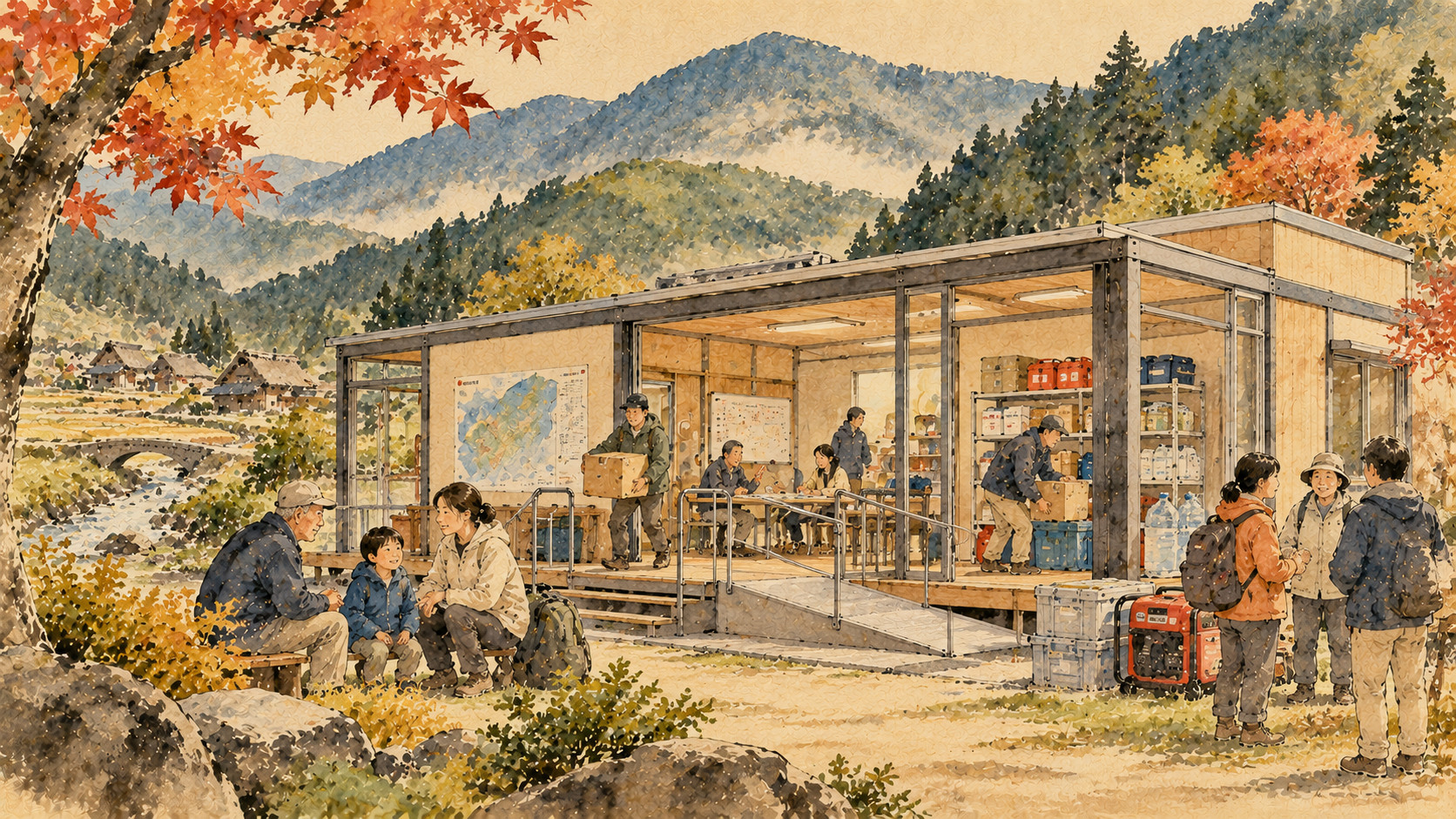
The strongest emergency building may be the one a community already has a reason to use every day.
Imagine a roadside market designed for a second life
On an ordinary Saturday, people might stop at a roadside station in rural Japan to buy vegetables, eat lunch or meet neighbors. After a disaster, could parts of that same complex provide temporary shops, accommodation or a place to organize relief? That question anchored an October 17 session at Bosai Kokutai 2026, Japan's national disaster-prevention gathering in Tottori.
Hokuei, a town in Tottori Prefecture, was the concrete example. Conference organizers described development of food and retail facilities using offsite construction, with possible repurposing into temporary housing or commercial facilities after an emergency. Participants from the mountain village of Tabayama in Yamanashi Prefecture brought a different set of pressures: attracting and retaining families, providing everyday services and preparing for geographically isolated settlements. The Japan Offsite Construction Association published its event report on October 19.
The critical caveat is that the October discussion did not announce a proven network of deployable emergency buildings. Publicly available materials do not establish how many structures could be relocated, who would pay to move them, the relevant legal approvals or whether the concept has been tested during a real disaster. This is a potentially important planning model, not a demonstrated rescue system.
Two places, two kinds of vulnerability
According to the organizers' Japanese program, Hokuei deputy mayor Keiji Okamoto discussed tourism and roadside-station development, while Sumika Yajima of Tabayama's regional development office addressed relocation, child-rearing programs and mountain-village challenges. Tomokazu Oba, chief executive of construction company Create Reibun, contributed the industry perspective, including production systems and skilled labor. Toshinari Nagasaka, president of the Japan Offsite Construction Association and a Rikkyo University professor, moderated.
Those descriptions reflect the published program, not independently transcribed remarks. What matters is the contrast: Hokuei asks whether a busy community asset can be built with future emergencies in mind; Tabayama asks how a small settlement can sustain the social and physical infrastructure necessary to respond when roads are blocked or outside help is delayed.
What 'phase-free' actually means
Japanese planners use the term phase-free for the idea that everyday products, spaces and services should remain useful during disasters. The Japanese phrase heiji no nigiwai ga yuji no sasae ni naru—roughly, the vitality of ordinary life supporting people in emergencies—encapsulated the session.
The logic is attractive. A building occupied and maintained every week is less likely to be neglected than a facility reserved solely for a catastrophe. Its users know where it is, its systems are exercised and it contributes economic or social value when nothing goes wrong. Yet everyday usefulness does not automatically make it safe or legally suitable as emergency accommodation.
A restaurant can have running water and electricity without providing privacy, bathing, secure sleeping space or medical access. Converting a shop into housing can raise questions under building, fire and occupancy requirements. In a disaster, even a movable structure requires accessible roads, a suitable site, foundations, utility connections and capable crews. A module that can theoretically be transported but cannot reach an isolated valley is not resilience.
The long history behind prefabricated emergency shelter
Japan's industrialized housing industry developed during its postwar expansion, when standardization and factory manufacturing offered ways to build at scale. Prefabricated homes and factory-produced components became familiar parts of the country's construction sector. Offsite construction builds on this broader history: producing large components or volumetric units away from the final location and assembling them on site.
Major earthquakes repeatedly exposed the difficult transition from immediate shelter to temporary accommodation and eventually permanent homes. The 2011 Great East Japan Earthquake, the 2016 Kumamoto earthquakes and the 2024 Noto Peninsula earthquake prompted renewed attention to both newly built temporary housing and existing private rentals. Japan's Ministry of Land, Infrastructure, Transport and Tourism maintains guidance on housing options for displaced residents.
Factory fabrication can make some stages more predictable, but cost and speed depend on factory capacity, haulage distances, cranes, roads, foundations, local snow and wind exposure, and how many times a unit is actually reused. A unit that is cheap to manufacture but expensive to transport or adapt may produce disappointing economics.
Buildings as a 'social stockpile'
The organizers introduced a more unusual concept: shakaiteki bichiku, or a social stockpile. Governments conventionally stockpile food, water, blankets and equipment. In this proposal, buildings already performing daily work—lodging, housing, shops or community facilities—could count as assets available for redeployment or different use when disaster strikes.
Such a system depends on more than architecture. Someone must own the buildings, insure them, maintain them and agree in advance when they may be requisitioned or converted. If a retail facility is moved to serve disaster victims elsewhere, the original community might lose its food shop at precisely the wrong time. If it stays in place, is it located outside the hazard zone and large enough to meet local needs?
Contracts, emergency authorities, compensation, staffing and mutual-aid agreements are therefore as important as detachable connections and standardized modules. The proposition becomes credible when those obligations are specified before an earthquake, not negotiated in the aftermath.
Noto's lesson: a roof is only the beginning
The 2024 Noto Peninsula earthquake made the challenges of shelter and reconstruction particularly visible. People need homes, but also familiar communities, schools, employment, medical care and transport. Temporary housing far from existing social ties can generate another set of hardships. No published evidence from the October 17 session establishes that the Hokuei-Tabayama model has solved those problems.
The connection is best understood as a research question. Could routinely occupied, adaptable buildings reduce the delay between emergency shelter and dignified temporary accommodation? Could they be sited where families prefer to stay? And would the arrangements survive simultaneous damage to buildings, roadways and the local government workforce?
Public-health standards cannot be optional
Japan's Cabinet Office revised multiple shelter-related guidelines in December 2024, addressing living conditions, operational checklists and sanitation, including toilets. Disaster sheltering is a public-health and social-care operation, not simply a calculation of covered floor area. Accessible washing and toilets, clean water, food, ventilation, protection from extreme temperatures, privacy and safety for vulnerable residents all matter.
Offsite buildings can be engineered to help meet such needs, but the outcome depends on actual equipment and operations. It is particularly important not to confuse a flexible community room with a welfare shelter designed for people requiring specialized support.
People may be the most valuable reserve
The conference also emphasized kankei jinko—people who maintain ties to a locality without necessarily living there—and established personal relationships between residents, businesses and supporters. Hokuei's visitor economy and Tabayama's efforts to attract families reflect different paths toward stronger community ties.
When a small municipality's employees are themselves disaster victims, access to trusted contractors, neighboring communities and volunteers can determine whether plans work. This is one of the argument's strongest elements. A sophisticated building without people trained to open it, operate it and support residents can be little more than an expensive object.
What would count as proof?
Public officials should ask for the same measurements they would demand from any infrastructure investment: daily utilization, operating income and cost, service life, changeover time, installation and transport cost, number of usable shelter spaces, emergency power and sanitation capability, and annual maintenance requirements. Simulated deployments should include obstructed roads, winter conditions and the loss of grid services, with results available for independent assessment.
Benefits should be compared against alternatives: upgrading ordinary buildings, contracting existing hotels, strengthening roads, improving water systems or keeping strategic supplies near likely hazard areas. A community whose finances are already strained cannot afford a resilience narrative that displaces more basic needs without clear evidence.
From an appealing idea to an accountable plan
The conference supplies a concrete starting point, not a final verdict. Which buildings in Hokuei's roadside-station development are designed for conversion? Has Tabayama committed to a structure of its own? What is the cost per usable square meter in normal and emergency service? Who owns the unit after relocation? What accessibility standards would apply? At the time of this report, public releases do not answer those questions.
For rural Japan, the deeper idea deserves scrutiny: resilience may grow from the activities that keep a place alive between emergencies. If a roadside shop also has a carefully engineered, legally workable second use, an investment in local economic life could do double duty. But only construction records, drills, operating agreements and the experiences of residents can show whether that promise holds.
Sources and Documentation
- 日本オフサイト建築協会:10月19日開催報告 / Offsite Construction Association, October 19
- ぼうさいこくたい2026:SO-20公式プログラム / Official conference program
- 10月10日開催案内・登壇予定 / Original October 10 program
- 内閣府:避難所の生活環境対策 / Cabinet Office: Shelter standards
- 国土交通省:能登半島地震と住まいの確保 / MLIT: Noto housing recovery
- 記録映像 / Recorded conference session